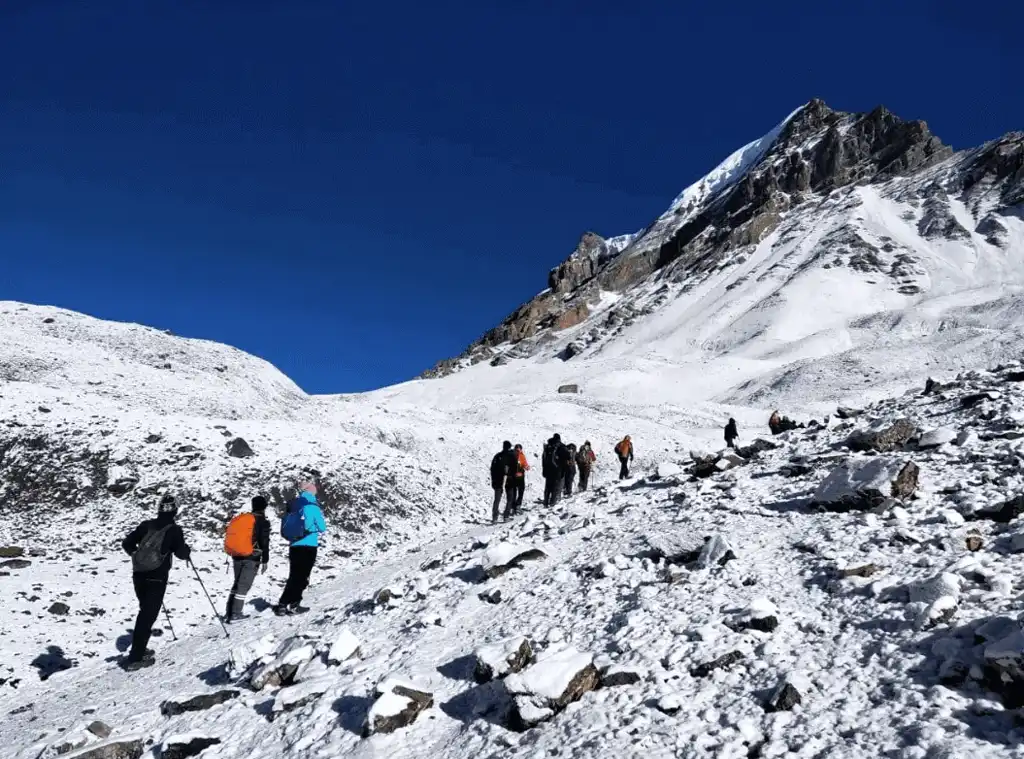
Annapurna Circuit Trek
Annapurna Circuit Trek
Choose your Itinerary
Annapurna Circuit Trek 14 Days
The Annapurna Circuit Trek is a 14-day Himalayan trekking route in Nepal's Annapurna region that crosses Thorong La Pass at 5,416 meters.
A globally famous trekking adventure in Nepal, this route completes the circuit around the imposing Annapurna Massif situated in the very hub of the Annapurna Massif region. Travel 160 to 230km over the duration of 14 days and witness striking changes of altitude and scenery - from cool riverside villages to the high, remote reaches of Manang and Mustang. Complete crossing of the famous Thorong La Pass, perched at a staggering 5,416 meters altitude, followed by descent to fascinating pilgrimage destinations: Muktinath, Jomsom, as well as ending up in Pokhara. Overnight rests are in tea-house rooms and to hike this area, an official ACAP permit and TIMS are necessary.
Ready to experience the ultimate Himalayan adventure? Our trips start from $1150/person - click here to book your trek.
Annapurna Circuit Trek Overview
The Annapurna Circuit Trek is a famous Himalayan trekking route that follows a 14-day horseshoe trail around the Annapurna massif in central Nepal. You will walk from a subtropical valley and rice fields into an alpine desert environment, crossing one of Nepal’s highest mountain passes and observing an incredibly diverse landscape and culture. This full itinerary covers roughly 160- 230 km. It is considerably longer than the shortened versions of the trek, which will bypass many miles on lower reaches by using vehicle transfers, or a remote footpath version of the route by taking on trails such as the remote Ngawal or Tilicho routes.
The Annapurna Circuit suits beginners and experienced trekkers who possess a healthy amount of stamina and who are looking for a very large cultural and landscape variation without requiring any technical mountaineering. A network of motorable roads has been constructed through the valleys of the Marsyangdi and Kali Gandaki rivers, shortening walk distances considerably on the lower sections. However, recent construction of footpaths means you can still avoid vehicle tracks for a good deal of your time. Typically the circuit starts in Besisahar after an overland bus/vehicle from either Kathmandu or Pokhara, and finishes at the airport in Pokhara after a flight following a walk over the 5,416m Thorong La Pass to Jomsom.
The clockwise walk is the faster walk with a steeper climb up and a shorter way to reach its base, but a well established counter-clockwise loop way is the easiest and safest ascent path to gain altitude and easier altitude gain. You can expect a 14-day journey with walking times of 5-7 hours per day of 10-15 km on a trail profile from 820m, rising gradually, to an acclimation base camp of Manang (3,519m), sharply over Thorong La Pass, and dropping swiftly to 2,700m. Key sights along the path are the Marsyangdi gorges, the Tibetan settlements of Manang, Muktinath’s religious temple, and the apple orchards in Marpha. At present, all foreign trekkers are obliged to travel with their assigned tour guides licensed by a registered agency in the Annapurna Conservation Area, while independent tours are carefully controlled. An average budget of between $800 and $1,500 USD is to be allocated for standard teahouse trekking, or up to $1,500 to $2,500+ USD for full private packages including guides.
What You Can Experience on the Annapurna Trekking Trail
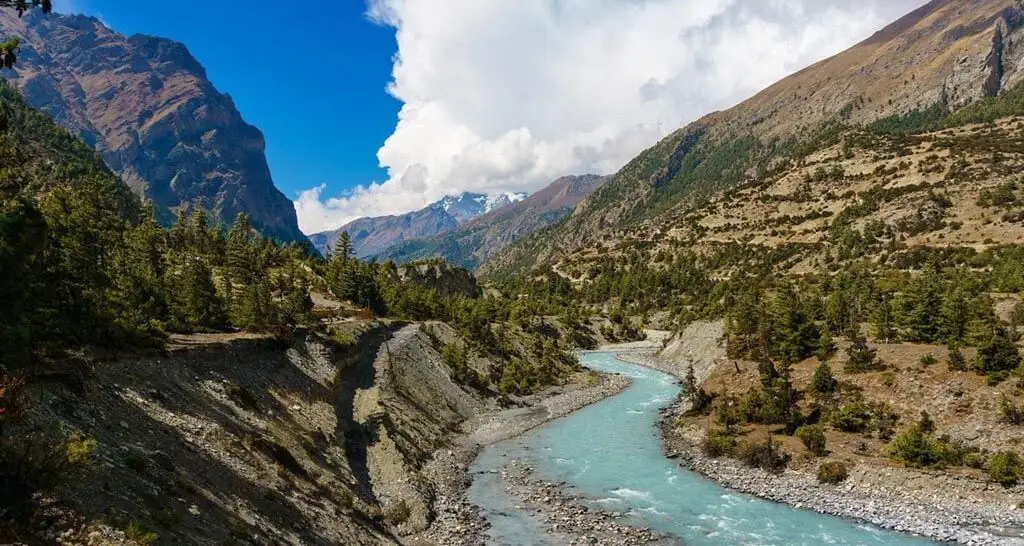
The path moves over sub-alpine jungle valleys above Syange, across the passes into the high alpine desert beyond Manang. Each day's hike is a great experience: either a jump across a boulder-strewn crossing or the golden rays on Annapurna II from Upper Pisang. Underfoot, the landscape moves from muddy, cobblestone forest paths in the early days to stony, wind-blown, dusty scree near the Thorong La Pass. Although new motor-road paths offer walking alternatives, trails for trekking (NATT routes) prove to be a quieter, and in most cases much more scenic way to trek, keeping well away from motor vehicles. The views differ wildly depending on height; in spring rhododendrons explode with colour in lower valleys, whilst spring yields crisp, clear views of high snowy peaks set against clear blue skies.
Mustang the Most Popular Place in Annapurna Region
Having religious significance, the pilgrims often visit this place, Muktinath temple; Hindus have their divine blessings from its one hundred and eight holy water sprouts and from the eternal flame. At the same time, it is the place which Buddhists call Chumig Gyatsa, a consecrated land of Dakinis. The journey to the Upper Mustang is a pricey one with RAP-$50 per day, an ACAP, and a licensed tour guide, who must be hired to get through the journey through Upper Mustang. Because the region is located in a rain shadow at higher elevation, it is a windy, dry, and a desert like region as compared to cold, green lower valleys, which the tourist may enjoy for eating the classic fruits- fresh, organically grown apples and their derivatives, including their cider, and Marpha Brandy. Responsible culture tourism is a concept every tourist should follow with respect to all Tibetan Buddhist culture; do not stray away from the path and keep minimum use of plastic.
Annapurna Circuit with Tilicho Lake Trek
A high altitude expedition through the Himalayas of Nepal, Annapurna Circuit trek is altered with this further route added from Manang as high altitude trekking takes a detour to one of the highest glacial lakes in the world. These steep scree slopes at the beginning gradually change in size into spectacular turquoise water at 4,919m of Tilicho Lake beneath Tilicho Peak. After returning from Tilicho Lake and heading back on the main trek through Yak Kharka, trekkers go for Thorong La Pass of 5,416m and descend to Mustang side and down to Muktinath. This is 14-17 days trek and highly strenuous with high physical challenges requiring a good heart and lungs and being in tune with proper acclimatization process.
Annapurna Circuit Trek Route Map
The Annapurna Circuit runs counter-clockwise from Besisahar or Dharapani through Chame, Manang, Thorong La Pass, Muktinath, Jomsom, and Tatopani to Pokhara.
A trip made in the anti-clockwise direction allows you to get used to and become accustomed to the peaceful and slow-paced ascent through the marvellous Marshyangdi Valley. Starting from here, you can walk all over the big trekking areas of Chame and Manang, then head towards the pass crossing. Once you cross the Thorong La, it will take you down the broad Trans-Himalayan arid landscape heading downhill towards the holy Muktinath and Jomsom area of Nepal. From there, it's going along with the widespread Kali Gandaki Valley till it reaches green forests leading you to trekking hotspots like Tatopani, Ghorepani and finally reaching your destination of Pokhara.
Scenic Highlights and Best Photography Spots on the Annapurna Circuit
The Annapurna Circuit's most photographed sections run from Upper Pisang through Manang to Thorong La, and from Muktinath's temple complex into Mustang's desert valleys.
Scenic value is the most compelling reason why most would embark on this trek, as it comprises striking Himalaya views of towering peaks, high passes, glaciated valleys, ancient towns with monasteries, sites of religious significance and a range of other landscapes. The greatest photography locations available span iconic viewpoints as well as less-occupied viewing posts where stunning views are abundant: Ngawal, Braga, Yak Kharka and Lubra among them.
Upper Pisang, Gyaru and Ngawal viewpoints
- Rank 1 - Must Stop: Great combination of scenery, culture and adventure. There are 3 vantage points (3,300m, 3,670m and 3,660m) overlooking Annapurna II, III, and IV and Pisang peak. This offers a 5–7–hour walk from Chame to Manang. The time frame from Chame to Manang (upper route) is 5-7 hours.
Time for better photography - 6-8 am (morning light on the mountain, low light on the valleys)
Manang Mountain panoramic view
- Rank 2 - Must Stop: The panoramic view from this bustling 3,540 m village takes in a huge area of Annapurna II, III and IV, Gangapurna and Tilicho peak and is the main scene to photograph on this part of your day (likely when you’ve taken your acclimatization day).
- Photography timings: Morning around 7-9am.
Thorong La pass summit and sunrise
- Rank 3 - Must Stop: A major altitude and adventure highlight the circuit, with this highest point (5,416m) reachable in 4-6hrs on foot from Thorong Phedi or the High Camp.
- Photography timings: Sunrise 6am (though this may change depending on the season and your departure time).
Muktinath monasteries and Eternal Flame
- Rank 4 - Must Stop: this important pilgrimage site 3,800 m high offers Himalayan views in a highly revered atmosphere where Hindus and Buddhists have come for centuries. It is a 4-6hr walk from the top of Thorong La.
- Photography timings: Morning 8-10am.
Kali Gandaki Gorge
- Rank 5 - Must Stop: the spectacular, deep gorge carved into Mustang offers impressive rock formations and dry desert-like landscapes to picture on your path towards Jomsom (or cultural photography at Marpha, 2,670 m).
- Photography timings: Morning 7-10am.
Tatopani Hot Springs
- Rank 6 – Optional: About 1,190m, Tatopani is perfect for some culture and natural relaxation after going through a high-altitude section of your journey.
- Best Photography timings By Location, Late in the afternoon (3 pm to 5 pm)
- Ghorepani / Poon Hill Sunrise.
- Ranking 7: A must-stop photographer's point; Poon Hill (3,210m): Awesome sunrise views over the Dhaulagiri range and Annapurna range.
- Allocate your time accordingly if you are going to take photos here because this place will take around 45-60 minutes to reach uphill at Ghorepani. The best photography location is in the morning during sunrise hours between 5:30–6:30 AM.
Other Smaller villages and vantage points
- Rank 8-10 ( Optional) – Braga, Timang, and Tukuche villages give relatively peaceful cultural and mountain views. These villages are all around 2,590- 3,060 m in height. Best Photography time location wise: Soft light for morning or late afternoon photography.
- Top Photography times of location
- Morning ( sunrise or very early morning light): Upper Pisang, Gyaru, Ngawal, Manang, Muktinath and trail-to-Thorong La approach.
- Sunrise photograph. Morning: Poon Hill and a spot on the trail going up to the pass.
- Late afternoon/Golden hour: Ghorepani, Tatopani, Marpha and along Kali Gandaki gorge.
Thorong La Pass
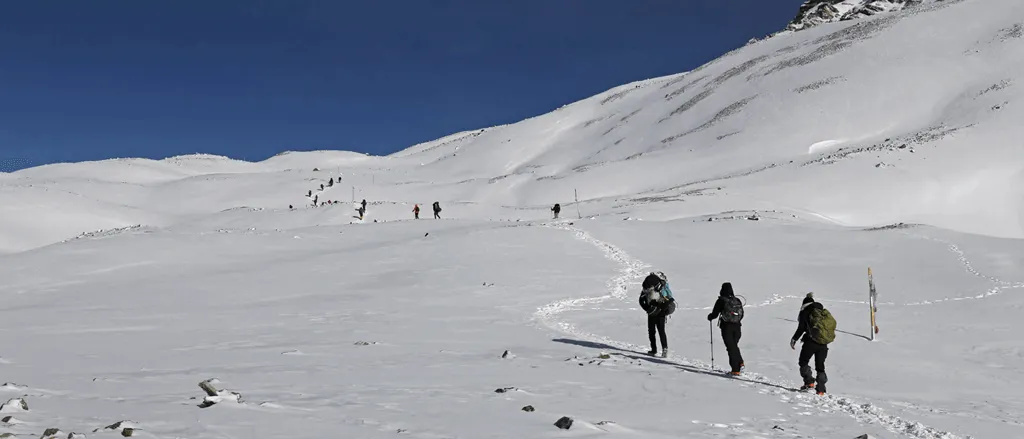
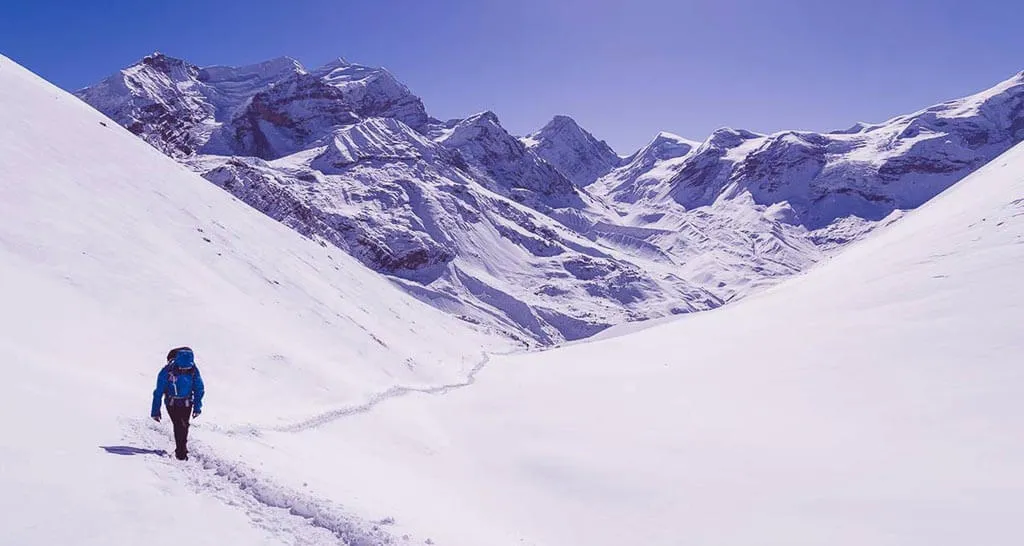
Thorong La is the highest pass and highest point at 5,416m (17,769ft) of the Annapurna Circuit trek, with this part being the most difficult of the whole trek. This requires the fittest, well acclimatised trekkers and an early alpine start followed by weather forecast assessment. From Thorong Phedi (~4,450m) it’s about 966m in elevation gain and about 1,616m elevation loss for a crossing that will lead you to Muktinath (3,800m). From the high camp (4,850m, about 15,900 ft), it’s a ~566m elevation gain and 1,616m loss down into Muktinath. Many trekkers sleep at High Camp in order to have a smaller ascent in the morning, and some stay at Thorong Phedi to sleep at much lower altitudes than at High Camp for the night.
Plan for 7-10 hours of hiking and begin before morning light, around 3:30 AM. If you experience any warning signs of headaches that won’t go away (more than your “normal”), vomiting, disorientation, overwhelming tiredness, and particularly any trouble breathing (anything more than the slight shortness of breath of altitude), then it means you have to turn around. There is no fixing altitude problems (HAPE and/or HACE) on the trail.
If conditions worsen with heavy snow, wind, whiteout, or dropping visibility that makes it impossible to identify a safe line, you will need to turn around too. Crampons are usually not needed on a dry, stable trail but are useful in icy conditions or with some snow - microspikes are a reasonable compromise. Crampons might be required for extreme winter. It is usually advisable to cross East to West (Manang over to Muktinath) from the Manang side as it provides better acclimatization, while a West to East journey is significantly harder as ascending from Muktinath takes one up to altitude from the low western plateau.
Elevation Point | Elevation | Crossing Context |
| Thorong La Pass | 5,416 m / 17,769 ft | Highest point |
| Thorong High Camp | ~4,850 m | Shorter summit ascent |
| Thorong Phedi | ~4,450 m | Lower overnight option |
| Muktinath | ~3,800 m | Major descent destination |
Book Sherpa Expedition Teams For Annapurna Circuit
- Best knowledge and local focus: Built and staffed by qualified professionals from high mountain climbs, our treks will give you unparalleled cultural exposure, deep regional connections, logistical control and access that another provider will never achieve.
- Professional guides: Local guides we employ are licensed and carry extensive Wilderness First Aid, considerable high mountain navigation experience, and expertise on atmospheric and weather phenomena. We are on the ground to ensure smooth transitions at pass heights where communications are often unavailable.
- Guaranteed to depart: 100% of all confirmed itineraries will depart without any surprising last-minute postponements, so you will always feel confident to book your international flights and your vacation time.
- Free sleeping bags: We offer cold-rated down sleeping bags at no extra charge for you to use on your trek, saving you the bother and expense of having to carry your own and paying equipment rental charges.
- 24-hour support in case of an emergency: There is proper communication from our Kathmandu office to the trek leader at all times from daybreak to past dusk continuously tracking changing weather conditions and having an instant emergency evacuation arranged on our behalf if required.
- Easy Booking system: An easy-to-use online booking system lets you instantly tailor the details of your trek and pay deposits through secure e-commerce methods so you can confirm the expedition you always dreamed of.
Annapurna Circuit Trek Itinerary
Annapurna Circuit itineraries commonly run 14 days depending on the starting point, transport used, and side trips. The pace is set based on your transportation mode, day of travel, side trips.
- 14-day itinerary - This balanced plan includes plenty of acclimatisation, trekking and overland transport. You would start the trek either from Besisahar, Dharapani, or Chame if starting this far up.
- Acclimatisation in Manang - Dedicated rest day and a mini acclimatisation trek.
- Across Thorong La: Use the whole day for 5 416 m pass crossing
- Western Route: trek towards Muktinath, Jomsom and Tatopani. After that toward Ghorepani/Poonhill.
- First-time trekkers: Fit beginners will make this 14-day trek at a manageable pace but need to be prepared. Long itineraries like 16- 21 days are for a leisure pace with extra acclimatization with minimal risk.
- Book this itinerary - Contact us to design an itinerary based on your available holiday dates and preferences (including starting and ending point, pace of acclimatization, side trips, etc).
Altitude Chart
Detailed 14-Day Annapurna Circuit Itinerary
You arrive at Tribhuvan International Airport in Kathmandu, and you are greeted with a warm traditional Nepali marigold garland by our airport representative. We transfer you to the hotel on an air-conditioned private vehicle as the day is an exploration through the colourful streets of Nepal’s most populated and bustling municipality filled with aroma and historical beauty. You then check into your hotel.
Lunch would be at your will either on the way to the hotel, or at the hotel, where you also receive a pre trek briefing. The areas which you pass while getting to the hotel are urban neighbourhoods within the municipality of Kathmandu. Expect to encounter the urban dwelling birds and stray animals. Overnight at the hotel in Kathmandu.
Get up this morning and start your day with a full and fresh breakfast from your hotel and start a guided cultural trip and visits through the heritage sites UNESCO sites, namely the Boudhanath stupa and the Pashupatinath temple.
Enjoy your lunch at some nice rooftop cafe overlooking old squares and spend the afternoon with your trekking leader as we take time for a final gear check-up and briefing, before heading to Thamel at night for delicious traditional food like momos and dal bhat.
We pass through major highways of the city Kathmandu and some cultural streets and lanes today as well, and altitude is again not an issue (1,350 m). Expect to spot sacred temples, macaques, pigeons, and stray cattle around the cities. Overnight at the hotel in Kathmandu.
You will start your day early at 6:00 AM for a bumpy ride, getting out of Kathmandu towards the west to take on the Prithvi Highway, then onto dusty tracks along the Marsyangdi River. Have lunch along the roadside restaurant in Mugling or Besisahar; usually fried rice or noodle soup is available. You will cross the rice fields and pass the local waterfall and traditional Gurung village Bhulbhule, etc. You may see many kinds of low-country bird species, barking deer on a far hill, and domestic water buffalo. Overnight stay at a teahouse in Syange.
We begin trekking early at 7:00 am with breakfast. This is followed by crossing the bridge on the fast-flowing and noisy river gorge. Halfway across, we will take a break to enjoy lunch at Jagat. Enjoy crossing stone steps, pine forests with waterfalls along our way. We also experience security checkpoints in Tal village. A very mild form of altitude sickness can occur as we pass 1,500m elevation on our trek. But don’t worry, this will subside soon. Along the trekking we also get to see the grey langur monkeys in the trees and various varieties of butterflies flying around. We’ll then stay overnight at a teahouse in Dharapani.
Your day begins with a delicious morning meal of porridge and honey at 7:30, and you trek further through the thick fir and oak forests with inspiring views of Lamjung Himal over you as you trek through it. Enjoy hot noodle soup at a lunch stop in the village of Timang, with snowy views on one side. While walking, you come across villages such as Bagarchhap and Danque, where large quantities of majestic pine forests and mani-walls can be seen. Mild altitude headaches might begin to emerge as the air pressure increases towards 2,710meters. If you have time, you should look out for: wildlife; more commonly, the Himalayan tahr will be spotted darting across the rocky crags above, and several species of local birds will flutter by. Accommodation will be in a tea house in Chame for the night.
The day will start with pancake breakfast at 7:00h in the morning on a fresh morning. Then walk through steep, forested canyons with pines locally known as Paungda Danda rock face. Lunch will be taken at a local tea house with vegetable fried rice and piping hot ginger tea in Lower Pisang village. Wander past apple orchards through pine woods experiencing spectacular walks up cliff road to a Buddhist area that flutters its prayer flags. Traveling above the treeline, the symptoms of altitude sickness begin at 3,300 meters: visitors often may feel a slight headache and feel a little shortage of breath. And we will see wild animals such as wild sheep that stand on the rock wall and golden eagles flying in the air above head. Overnight at Pisang.
Morning views of the Annapurna massif are awesome in Upper Pisang. Upper scenic high trail traverses high alpine ridgeline of the Annapurna range. After lunch at the old medieval village of Ngawal, surrounded by traditional architecture in the form of stone houses and ancient monasteries, trekking takes a gradual descent through an arid landscape to reach Manang in mid-afternoon. In Manang we will have dinner and an overnight stay in a cosy lodge. The trail goes via: Ghyaru, Ngawal & Braga village. Some mild headaches on evenings are possible.
The day will start with a breakfast in your tea house, in accordance with trekking practices of “Trek High, Sleep Low”. You will not be hiking up today; instead, you will be taking a day of acclimatization hikes to a height of almost 3,800 meters to either Gangapurna Lake or Ice Lake. This will help your body to adjust to the changes in altitude where your body will start producing more red blood cells. You will have lunch in Manang town either at a bakery or a tea house. You are free in the afternoon to explore the Himalayan Rescue Association’s aid post, where they conduct an informative meeting on altitude sickness and its prevention. Your dinner will be had with Tibetan-style bread and dal bhat. You must be extra wary of altitude sickness as you adjust your body to prepare for crossing the high pass.
Today begins with a moderate but continuous upward journey from the valley floor in Manang. Leaving behind the treelines, we now enter barren, windblown alpine scrub. Lunch will be a simple yet satisfying one, provided at a small cluster of teahouses along the arid slopes.
The afternoon portion is short and takes us along the open slopes on which one might witness blue sheep grazing on precarious rock faces high above us.
We will reach Yak Kharka early for our dinner and overnight accommodation. The trail traverses through villages: Gamsang and Tenki Manang. We climb to a height of 4,110m here, and at these altitudes the frequent breathing, dry cold air and exhaustion will begin to feel like the norm.
Leave Yak Kharka in the crisp, cold morning air. We will cross a suspension bridge over the Jorsang Khola before ascending steadily along narrow gravel paths clinging to cliff-sides with potential minor rockfall hazards. By early afternoon, we will arrive at Thorong Phedi or High Camp, where we will enjoy lunch.
The rest of the day is reserved for relaxation, a huge intake of water, and readying your equipment for tomorrow’s crucial high pass.
We will dine and sleep in the busy base lodge at Thorong Phedi. Ledar and Thorong Phedi are the base huts. You’re at 4,420m – the air feels thin, and your breathing will pick up pace with just a few moves. Take it easy and steady.
We get going around 4 am in the frigid darkness of high alpine air.
It is an arduous climb of 4-5 hours, taking us steadily up the barren, ice-covered moraine slopes to the prayer flags of the Thorong La Pass, at 5,416m. A special welcome with hot tea and snacks is ready in between the Thorong La and Thorong Phedi tea-house before we reach the summit for celebration. After spending some time around the pass, the long descent begins and is rapidly made down steep scree slopes into the holy land of pilgrimage and Muktinath, and we have lunch. We then proceed to undertake a drive in an awesome 4-wheel drive jeep, driving down dusty Kali Gandaki valley to the amiable village of Marpha. In this village of Marpha, one enjoys food and rests and stays overnight. Altitude affects you badly throughout the pass crossing. By the time we are all back in Marpha, you will have already recovered.
The day begins with a wholesome breakfast set against the white stone pathways and apple orchards of Marpha, before you board a private/shared jeep and ascend into a thrilling, bumpy daytime journey to the world's deepest river gorge. A roadside lunch is arranged at a restaurant in Tatopani/Beni. The afternoon drive takes on its pleasant pace via paved roads traversing agricultural terraces and reaching Pokhara alongside the tranquil Phewa Lake. The settlements you will pass are Tukuche, Ghasa, Tatopani and Beni. This day you also descend to 850m altitude removing all cold and altitude effects entirely.
Your breakfast this morning is a peaceful one right next to the lake with views of Machhapuchhre from a viewpoint in Pokhara. Then you board the comfortable tourist bus / private vehicle back towards the east. We take the famous Prithvi Highway.
Lunch will be provided halfway during the travel in the restaurant situated on the road (highway). The afternoon drive takes you along the raging river and terraced hills, finally arriving in Kathmandu by the late afternoon.
We pass through various places such as Mugling & Malekhu. Our altitude comes down again to 1,350 meters, where we have normal atmospheric oxygen levels.
Enjoy your last day by having breakfast in your Kathmandu hotel in the early morning. Have fun enjoying shopping for souvenirs for loved ones, and then you are dropped at Tribhuvan Int'l Airport 3 hrs before your international flight.
You are going to travel from the inner ring road of the city of Kathmandu, which has an altitude of 1,350 meters above sea level; hence, there will not be any problem regarding altitude / physical trekking anymore.
What's Included and What's Not Included
Included Services
Transportation & Logistics
- Airport pick-up and drop-off by private car/jeep
- Public bus to Besisahar and tourist bus from Pokhara to Kathmandu
- Local shared jeep/bus to Syange from Besisahar and to Pokhara from Jomsom
- Kathmandu Valley sightseeing tour by private car/jeep
- Government taxes and all official expenditures
Accommodation & Meals
- 3 nights standard twin share hotel in Kathmandu with breakfast (3-star hotel)
- 1 night standard twin share hotel in Pokhara with breakfast (3-star hotel)
- Three meals per day whilst trekking: Breakfast, lunch, dinner
- Fresh fruit daily after dinner
- Trekking lodge (teahouse) accommodation during the trek
- Receive a certificate of expedition completion
Permits, Staff and Safety Gear
- ACAP entry permit & TIMS permits
- Highly professional, skilled, very helpful, friendly, nice, polite, excellent spoken and written English speaker guide. Holding government license of guide with high professionalism (the guide pays himself salary, food, room/lodge, transport, and insurance)
- Strong and helpful Sherpa porters with safety gear and good walking sticks (one porter for two pax: who pays his salary, meals and lodging by himself, and insurance)
- Asst. guide for more than 8 trekkers
All kinds of medical supply first-aid kits
- Oxygen meter to check your pulse, SpO2, and HR (heart rate) twice a day for the purpose of checking altitude mountain sickness (AMS)
- Emergency helicopter rescue arrangement (to be paid by your insurance agent directly)
- Once at the lodge, the sleeping bag, down vest, duffel, and walking stick must be returned
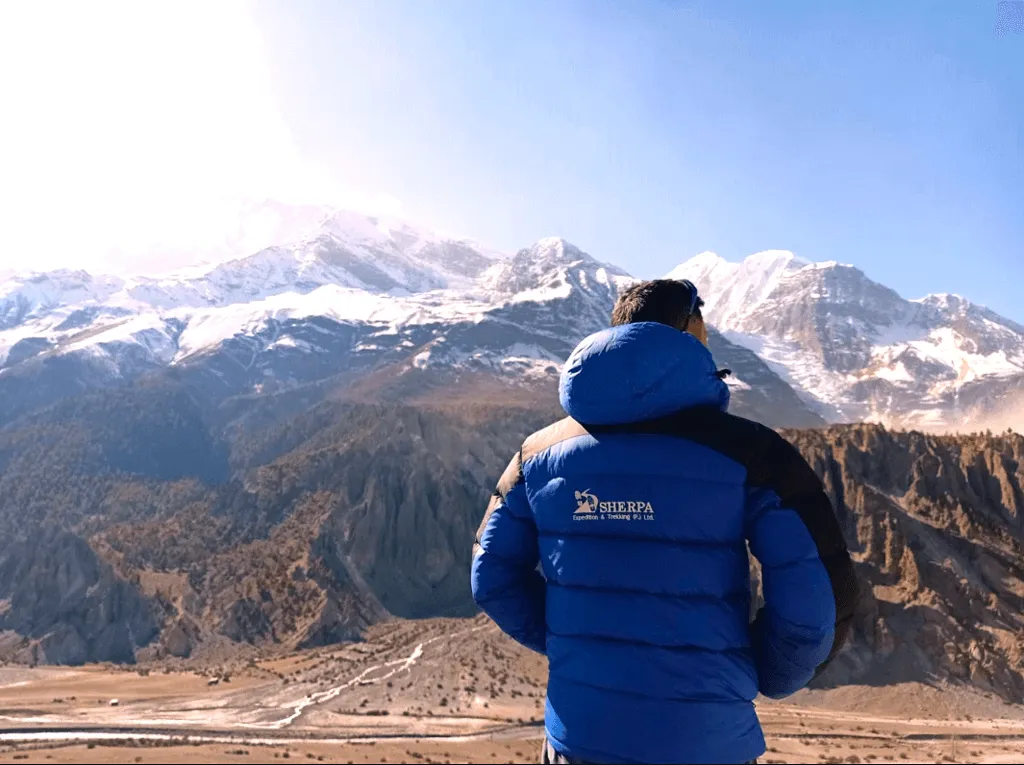
- Sherpa Expedition trekking shirt
- You receive a certificate that verifies that you have completed a trip
Excluded Services
Meals & Personal Expenses in Cities
- Your lunch and dinners in Kathmandu and Pokhara
- Any personal expenses
- International airfare
- International air ticket
- Any kind of personal insurance of yours
- Your Nepal visa entry fee. (Can get on your entry at Tribhuvan International Airport: US $30 - for 15 days, US $50 - for 30 days and US $125 - for 90 days)
- Insurance (travel & health)
Trekking Extras & Add-ons
- Any kind of alcohol, beer, coke, soft drinks, mineral water, soups, tea, coffee, chocolate, coco, hot/cold drinks, and any kind of extra snacks that you eat in the afternoon, in the evenings when you relax, etc.
- Any kind of desserts such as sweets, chocolate, candy, etc., Any kind of desserts during meals
- Hot shower and battery charging along with your stay at tea houses, etc.
- Any kind of tips for your guide, your porter and your driver
If you return earlier from the trip due to sickness and other reasons, the cost incurred will not be refunded; such as airline, hotel booking, mountain room reservation, food, etc., while traveling back to Kathmandu from trekking. All kinds of extra expenses on accommodation & food in Kathmandu will have to bear yourself.
Annapurna Circuit Trek Route Map
Download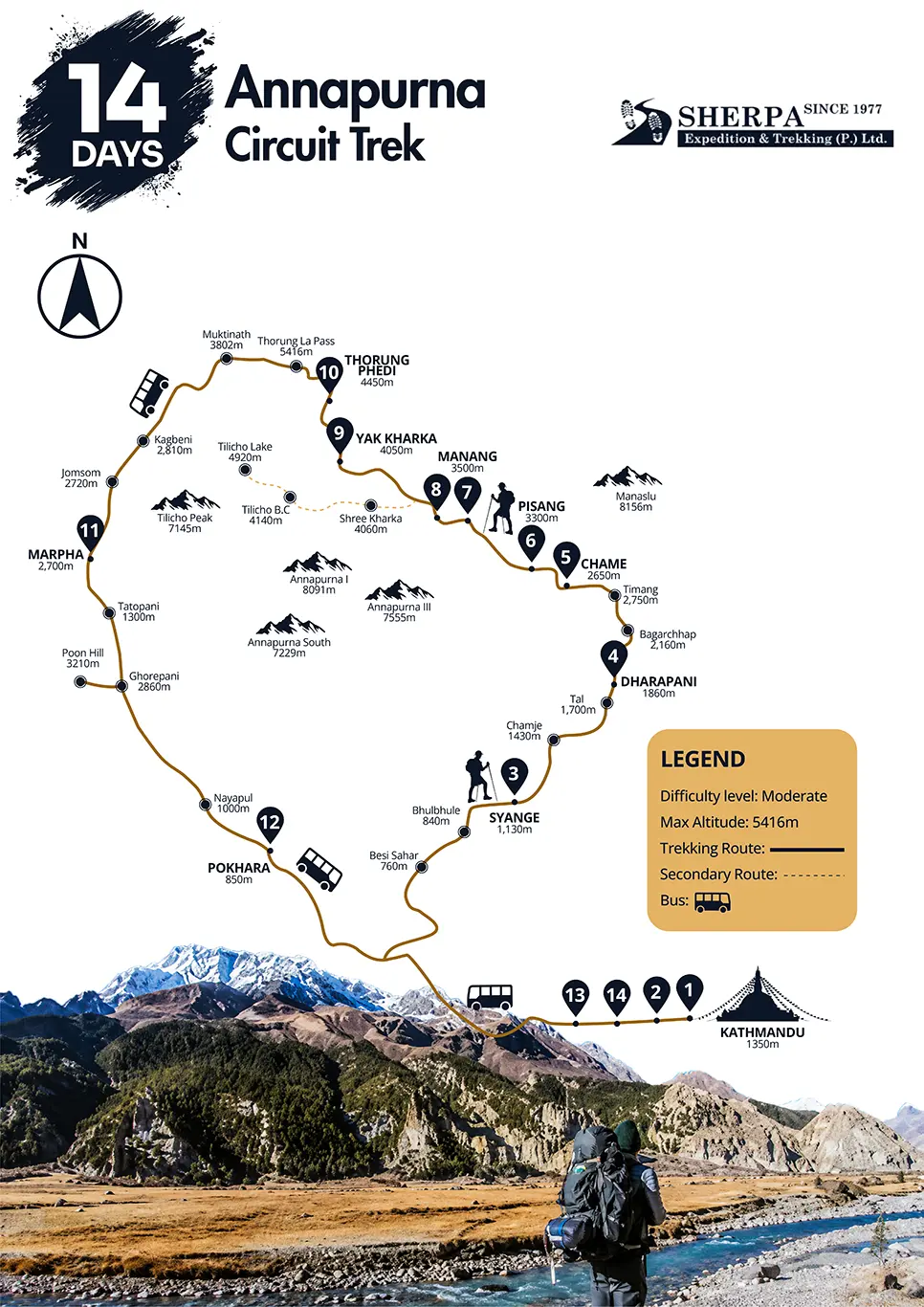
Tour Dates
Every departure listed below is 100% Guaranteed — once you book, your trip will run as scheduled regardless of group size.
Loading departure dates…
Want your own personalized tour?
Annapurna Circuit Packing List
Annapurna Circuit packing lists divide into clothing layers, footwear, sleeping gear, and altitude essentials.
Nearly all Sherpa Trekking Agencies on the Annapurna Circuit will provide you with a large, generous Duffel bag, a warm down Sleeping bag (which you hand back in after your trek), and all personal clothing; well-worn Boots; Daypack and Toiletries must be managed by trekkers. Aim to travel at around 8-10 kg if carrying personal luggage and if you use porters, 5-7 kg in the daypack (and a max 10-12 kg duffel bag):
Layering System:
- Baselayer: 2-3 synthetics or merino quick-dry tops, 1-2 thermal pants.
- Mid-layer:1 medium-weight fleece pullover or softshell jacket.
- Outer insulation: 1 heavy insulated down jacket. It’s comfortable down to -10 degrees C / -15 degrees C with the right layering, even lower.
- Outer shell: 1 waterproof and windproof hoody jacket and 1 pair of waterproof pants worn over other garments.
Footwear:
- Waterproof high walking boots. They must have already been broken in.
- 4-5 pairs of merino wool trekking socks + 1 pair of camp sandals/crocs for evenings
Headwear and Handwear:
- 1 warm beanie + 1 UV sun hat + 1 buff/neck gaiter
- 1 pair of inner liner gloves + 1 pair heavy insulated/waterproof gloves
Sleeping Gear:
- Sleeping bag (will be provided by Sherpa Teams but need to be returned after)
- Duffel bag (will be provided by Sherpa Teams but need to be returned after)
Trekking Gear and Hardware:
- 1 pair trekking poles (adjustable) – very important for the 1,600m descent from Thorong La
- 1 headlamp and spare battery
- 2L of water (either 1L x2 bottles or a hydration reservoir)
- Sunglasses with UV400 category 3 or 4 lenses - it's so they stop you from getting snow blind
Electronics & Security
- 1 power bank of 10,000-20,000mAh
- Water purification: Sawyer Filter OR purification tablets
First Aid Kit
- with any prescribed medications (Diamox)
- blister plasters
- painkillers
- antiseptic
Personal items & Toiletries
- SPF50+ sunscreen
- SPF30 lip balm
- wet wipes
- hand sanitizer
- travel towel (quick dry, ideally)
- basic toothbrush/paste
Highly Recommended Items (Worth the investment!)
- Sleeping bag liner (will give you an extra 5°C of heat and is more hygienic)
- Microspikes & gators (if you intend to walk any of the high passes with a lot of snow like the Thorong La, you need these)
- Dry bags/packing cubes (will stop your pack contents from getting wet inside your duffel bag)
Optional Items
- Camera & spare batteries
- E-Reader or playing cards (entertain yourself between teas)
Annapurna Circuit with Tilicho Lake Extension Management
Sherpa Expedition Teams lead trekkers on the famous Annapurna Circuit along with some of the major side trek trips as well. By including a side trip to the Annapurna Tilicho Lake, one can extend the normal circuit from 3-4 days. This compared to the culturally rich side trips such as Poon hill (with beautiful rhododendron forests and mountain views during sunrise at 3,210 meters in and within a cultural setting with low altitudes) reaches deep into the High alpine trekking to a staggering height of 4,919 meters at the Tilicho Lake.
The side trip offers one a great preliminary acclimatization en route the Thorong La Pass crossing although the path consists of rugged narrow trail, crossing very narrow terrain across brittle scree and risking extremely bitter cold winds along with the risk of afternoon snow squalls. Suitable seasons to make such a high trekking excursion are spring and autumn, between March - May and September- November, due to very reliable climate conditions, where trekkers may add Nar Phu Valley along with this expedition in order to witness the wilderness.
Which Starting Point Is Best: Besisahar, Dharapani or Chame?
Chame is the best starting point for most trekkers today because road transport already covers the Besisahar-to-Chame section.
Although the traditional starting point is at Besisahar, with the recent motorbike expansion, walking from there means several multi-day’s trekking along dusty and often traffic-choked motor tracks. The majority of trekkers prefer to use the jeepable part of the trek, and often take transport from Besisahar to reach either Dharapani or Chame. So, starting from Dharapani or Chame is a big time-saving of 2 or 4 days, so travellers have more time to utilize those travelling days at the alpine higher altitudes above 2,600m. In this section, one has to decide whether one wants to follow some low-altitude authenticity or one would be glad to shorten the walking days and reduce the road traffic exposure, and head immediately to the alpine giants.
Why Annapurna Circuit Distance Varies from 160 to 230 km
The Annapurna Circuit's distance varies because road construction and starting-point choice let trekkers skip or add sections.
Starting at the traditional lower starting point of Besisahar adds an extra 40-50 km of dusty lowland, whereas being dropped directly to the modern trailheads at Dharapani or Chame reduces the actual distance that needs to be walked on foot. Different combinations of using the road and using the trails make all the walking distances vary so much anyway. If trekkers instead are doing the "marked" Natural Annapurna Trekking Trail (NATT) trails, it generally skips the motorable dirt tracks and weaves through villages, increasing the distance trekked on foot for more of a "no road" feeling and often through a more "traditional" route. Additionally, very common side trips such as going up to high-altitude Tilicho Lake, traveling through restricted Nar Phu Valley, or heading south to Poon Hill can add tens of kilometers to a trek. The way the horseshoe-shaped trail is non-repeating in its loop formation around the peak also permits a flexible choice of the walking distance and, importantly, allows one not to retrace their footsteps.
How Much of the Annapurna Circuit Is Now Road? (Jeep-Accessible Sections)
Road construction has made the Besisahar-Chame and Jomsom-Tatopani sections accessible by jeep, shortening the trekked distance for many itineraries.
However, with motorable tracks extending along the Marsyangdi and Kali Gandaki river valleys, the lower section can be traversed by 4WD vehicles, leading many trekkers to miss out on this particular, dusty Besisahar-Chame road section entirely. To the west of Thorong La, the Jomsom-Tatopani section has seen vehicle tracks cut a path through the entire Kali Gandaki valley. However, instead of hiking along the shoulder of heavy truck traffic, many trekkers can now travel part of the way by road vehicle. If you want a classic foot trek, then you need to look for alternative itineraries to this road section, utilizing the Upper Pisang / Ngawal trail bypass alternative to this section, taking the route over the high ridges with great views over the Annapurna Massif; you could utilize the Natural Annapurna Trekking Trail (NATT) system, a network of waymarked trails bypassing roads. The red-and-white (or blue-and-white) signs marking these trails allow foot traffic to travel away from vehicle routes—traveling along old village paths is safer, quieter, and takes the reader out of the dirt and traffic safety issues associated with this shared roadway. Trucks and jeeps create clouds of fine dust as they drive alongside precipitous drops on the sides of thin valleys.
How Difficult Is the Annapurna Circuit Trek?
The Annapurna Circuit is a moderate-to-strenuous trek that does not require technical climbing skills.
Success requires that we have sufficient and continuous endurance for 5-8 hours of walking every day on rough terrain (stone stairs, suspension bridge, dirt path, gravel road, etc). The most strenuous day is probably Thorong La, which requires more than a kilometer to climb up (approx. 900 meters up and 1,600 meters down) over 8-10 hours. It is important to separate fitness and the effect of altitude; being fit can deal with walking for many hours, but only acclimatisation of the body to the atmosphere above 3,000m can help deal with the lack of oxygen.
| Trekking Route | Max Altitude | Daily Walking Hours | Technical Difficulty | Key Challenge Profile |
| Annapurna Circuit | 5,416 m | 5–8 hours | Non-technical | High altitude pass crossing and long distance endurance |
| Kilimanjaro (Machame) | 5,895 m | 6–10 hours | Non-technical | Extreme altitude gain over shorter duration |
| Everest Base Camp | 5,364 m | 5–7 hours | Non-technical | Sustained high elevation sleeping (multi-day above 4,000m) |
Ready to test your limits? Click here to book your Annapurna Expedition
Can Beginners Trek the Annapurna Circuit?
Beginner suitability for the Annapurna Circuit depends on fitness, prior hiking experience, altitude adaptation, and itinerary pace, not a single yes/no label.
A true first-timer with absolutely no experience of high-altitude zones can successfully tackle the circuit but only with a careful and measured itinerary, and with designated rest days in Manang.
They must be cardiovascularly fit; have high weather tolerance (or be prepared for sub-zero conditions); and not possess any health conditions that predispose them to hypoxia. Any beginner who is seeking to complete the full circuit should invest eight to twelve weeks preparing by undertaking an aerobic conditioning programme (long runs, long bike rides); strengthening their legs (Squats, Lunges) and undertaking at least a few practice hikes with a weighted pack to prepare their muscles and joints for the strains of the trail.
Is the Annapurna Circuit Suitable for Families, Older Trekkers, or Solo Female Travelers?
- Families, older trekkers, and solo female travelers can complete the Annapurna Circuit with itinerary adjustments rather than a blanket suitability rule.
- Older trekkers and age: If physically able, seniors cross Thorong La when healthy, but take breaks more frequently as altitude gains.
- Ideal pace for family groups: Teenagers or children old enough will prefer much shorter, daily walks of between 3-5 hours maximum with many rest days in between. Use jeep rides to cover easier, lower elevation roads.
- Solo Female Traveler Safety Notes: Nepal has always remained as one of the most hospitable parts of Asia for a female. While the respect is absolutely astonishing for female travellers in this country, all solo female travellers might consider getting a licensed guide or porter support.
- Guide/porter: A porter is responsible for 15-20 kg. So you can pack a daypack only and leave it very light so that you save your energy for all your passes. This is very important for elderly people, parents trekking, and single people.
Annapurna Circuit Altitude and Acclimatization
The Annapurna Circuit gains roughly 3,556 meters in elevation from Dharapani to Thorong La Pass.
"Climb high, sleep low" is key, and a dedicated rest day at Manang to get used to the high altitude conditions above (3,540 m) and this Manang acclimatization day should not be overlooked. Initial symptoms of AMS (as set by Wilderness Medical Society) are a headache, nausea, dizziness, tiredness and insomnia. Prophylactic treatment with Diamox / acetazolamide is recommended (doctors need to be consulted first; not suitable in case of sulfa allergy); it increases the rate of breathing by natural acclimatization; however, it does not prevent you from having symptoms even with Diamox. Descent is the only definitive treatment if your symptoms move from mild AMS to either HACE or HAPE (delaying descent to can lead to death).
Side Trips from Manang: Ice Lake and Gangapurna Glacier
Manang offers two acclimatization side hikes: Ice Lake at roughly 4,600 meters and views of Gangapurna Glacier.
Taking advantage of these options provides an excellent climb-high, sleep-low acclimatization opportunity, allowing your body to produce extra red blood cells before returning each night to the lower 3,540m elevation of Manang. Gangapurna Glacier and Gangapurna Lake day hike 2-3 hours round trip) is straightforward and passes over the large icefall at the glacier's head, giving phenomenal views. 6-8 hr and much harder trek is to the isolated Kicho Tal (Ice Lake) at 4,600m. The trail is a steep scramble up open ridges without much relief from glaciers, but is well worth it to see the alpine lake, with the added benefit of having Annapurna II, III and IV as dramatic views.
Best Time to Trek the Annapurna Circuit
Autumn (September to November) and spring (March to May) are the most favorable seasons for the Annapurna Circuit.
Autumn weather should be clear and sunny with minimum rainfall after the monsoon, and then during the springtime the rhododendrons flower in the lower hills, which will be pleasant and mild. During the monsoon months, one can expect much rainfall, landslides, muddy and slippery trekking routes, in addition to the risk of leeches lower down the valley. Moreover, monsoon season is not suitable for road travel due to the slippery clay slopes, and for jeeps ride between Besisahar and Chame, because of landslides and muddy paths. As you ascend to higher altitude, the climate becomes more dry; it is a "rain shadow of the Himalayas". Hence, the area of land after Manang, in the direction of Mustang, is rather dry, even in the monsoon season. However, in the winter there are freezing temperatures and Thorong La may be blocked with a massive amount of snowfall.
Month | Season | Trekking Conditions | Pass-Crossing Conditions | Temp Range (<2,000m) | Temp Range (>4,000m) |
| January | Winter | Still and clear, with very cold mornings. Lower trails may be less favorable because of winter conditions. | Snowdrifts are common, with a very high risk of pass closure. | 5°C to 15°C | -10°C to -20°C |
| February | Winter | Conditions remain cold through mid-month, gradually becoming warmer toward the end of the month. | High approaches can hold significant snow depth, making crossings difficult. | 7°C to 17°C | -8°C to -15°C |
| March | Spring | Days become warmer, and snow may begin melting along lower trails. | The pass begins clearing more reliably as the snow-melt rate increases. | 10°C to 20°C | -5°C to 10°C |
| April | Spring | Mid-spring brings mostly clear days, with rhododendrons beginning to bloom at higher elevations. | Snowpack is generally more settled, making pass conditions among the most favorable of the year. | 12°C to 23°C | -2°C to 12°C |
| May | Spring | Warmer conditions develop, although slight afternoon haze becomes more common. | Clear mornings can provide good crossing windows, but trails may become increasingly slippery as cloud cover develops. | 15°C to 25°C | 0°C to 13°C |
| June | Monsoon | Humidity increases at lower elevations, with a greater chance of rain and leeches. | Visibility can deteriorate over the pass, with increasing chances of wind and rain. | 18°C to 26°C | 2°C to 12°C |
| July | Monsoon | Peak monsoon conditions bring frequent heavy rain, muddy trails, and increased landslide risk on lower sections. | Visibility over the pass can be very poor, with strong winds and rain creating difficult crossing conditions. | 19°C to 27°C | 4°C to 13°C |
| August | Monsoon | Heavy rain continues, although conditions generally begin reducing toward the end of the month. | Weather over the pass gradually begins clearing, with better crossing windows developing, but trails remain wet. | 18°C to 25°C | 2°C to 10°C |
| September | Autumn | Weather begins clearing again, leaving a green, fresh environment after the monsoon. | The pass becomes drier and clearer, although it can remain windy and cold at altitude. | 16°C to 23°C | -2°C to 8°C |
| October | Autumn | Peak trekking season, with clear, dry conditions and clean mountain views. | Dry, clear, windy, and cold conditions generally make this an ideal period for pass crossing. | 12°C to 20°C | -5°C to 5°C |
| November | Autumn | Sunny and clear days continue, with cool nights and fewer crowds than the peak October period. | Pass crossing is generally cold, windy, and dry, with clear weather but increasing ice and snow at higher elevations. | 8°C to 17°C | -8°C to -3°C |
| December | Winter | Cool, dry conditions with relatively low tourist numbers; temperatures drop considerably at higher elevations. | Ice and snow begin building rapidly on the pass, increasing the difficulty and risk of crossing. | 6°C to 15°C | -12°C to -18°C |
Annapurna Circuit Trek Cost
A guided Annapurna Circuit package typically costs $870 to $1,999 per person depending on group size, duration, and season.
Essential logistics are included in most agency standard pricing, covering a range of costs such as compulsory trekking permits (ACAP ~NPR 3,000, TIMS ~NPR 2,000), teahouse accommodation and meals during the trekking portion, salary of the local licenced tour guide and porter, and overland transport to and from trekking start points. On the other hand, trekkers will need to account for their personal clothing and gear, travel insurance and any staff tips. Remember to purchase policies including extensive emergency helicopter evacuation and high-altitude medical service in addition to trip cancellation and also important flight delays plus lost or damaged baggage cover. Check thoroughly whether your selected insurance covers vehicles travelling on trekking roads such as off-road jeeps.
Before signing any insurance policy for a mountain trek: apply strict checking with policy validation lists – check authorised altitudes for emergency medical evacuation service, altitude limits so you know that you are covered up to at least the maximum height of the trek, i.e. from 6,000 meters as Thorong La’s highest altitude is 5,416 meters. Be sure to inquire about any hidden trekking-related exclusions; ask the insurance company if traveling over rough terrain in any form of ground transport (such as a mountain jeep) is part of coverage or any exceptional clauses are involved there. The more people within your group, the lower the price per person will be offered, and trekking packages will cost from $1150 /person for middle luxury or small private groups. Get your Himalayan adventure booked, and check the price by group size. Just click here and book right now.
Cash, ATMs and Daily Budget on the Trail
The last reliable ATMs on the Annapurna Circuit are in Besisahar and Pokhara; carry Nepalese Rupees before Manang.
Although there could be occasional ATMs or currency exchange centers in Jomsom or Manang, there are frequent issues due to power outages or network failure, so do not depend on those systems for financial services. Make sure to bring an overall cash estimate from 30,000 to 45,000 NPR (roughly 225-340 USD) to cover expenses on the trail. In general, be prepared for 15-25 USD per day based on expected cash expenses for extras; in higher altitudes, costs will increase as transport costs through porters or mules will be high.
Along the trail, tea houses charge individually for hot showers (2-5), WiFi (2-5), charging laptops/other electronic devices (2-5), and drinking water (2-5). They do not accept any credit cards or digital transactions, and so carry cash in small Nepalese Rupee notes that will be accepted for any payment at the tea houses. Always carry an emergency additional 10,000 NPR (about USD 75) cash for additional nights or unforeseen road closures.
Permits and Guide Requirements for the Annapurna Circuit
The Annapurna Circuit requires two documents: an Annapurna Conservation Area Permit (ACAP) and a Trekkers' Information Management System (TIMS) card.
A foreign national must hire a registered guide to obtain the TIMS card under this rule. None of the trekkers outside of Nepal are permitted to trek solo on any route of National parks and conservation areas in Nepal without a certified guide. It must be issued from the Nepal Tourism Board offices in Kathmandu and Pokhara. You will need a valid passport and two passport size photographs per card and should carry precise Nepalese Rupees in cash.
ACAP (Annapurna Conservation Area Permit) - Card to enter the restricted area costs NPR 3,000 ($23 USD) for foreigners, NPR 1,000 for SAARC countries.
TIMS (Trekkers’ Information Management System) Card - Safety Card required to be obtained by paying NPR 2,000 ($15 USD) through authorized trekking agencies, as this card is provided only in digital form by authorized agencies.
Licensed Guide Requirement: A licensed guide has been made mandatory to issue a TIMS card, and they provide information on the safety of routes, arrangements of meals and rooms during the trek, and the way to handle any emergencies.
Checkpoints: The necessary documents will be inspected at the checkpoints, which are mandatory; some of these checkpoints are Besisahar, Dharapani, Chame, Manang, Kagbeni, and Birethanti, respectively.
| Permit Type | Cost (Foreigners) | Photo Required | Issue Location |
| ACAP | NPR 3,000 | 2 Photos | Kathmandu / Pokhara NTB Offices |
| TIMS Card | NPR 2,000 | 2 Photos | Authorized Trekking Agencies |
Want to streamline your permit form? Click to check out the differences between independent vs. guided trekking and book your permitted guide package.
Guide and Porter Information
By hiring only registered personnel, we ensure ethical porter-weight standards where your porter has to carry between 15-20 kg, as is standard in trekking regions. Also, you are responsible for carrying a lightweight daypack with a weight of up to 5-8 kg.
Our agency trekking provides ideal ratios of 1:8 (guides) and 1:2 (porters), respectively, and travel during trekking becomes safer compared with trekking on your own, where trekking solo can bring poor ratios into operation. Guides have a license approved by the Government of Nepal’s Ministry of Culture, Tourism & Civil Aviation with a high altitude first aid certificate. Normally for guides $10-15/day, and for porter $8-10/day should be paid apart from your total package sum for the trek.
Solo Trekking vs. Guided Trekking on the Annapurna Circuit
Solo trekking on the Annapurna Circuit is restricted for foreign nationals without a licensed guide under current TIMS rules as per Nepal Tourism Board guidelines.
Although at the forefront, independent travel had been initially much cheaper, mandatory guides policies have guaranteed an upgraded level of safety along with consistent directions and available medical treatment when required at higher altitudes and in the event of unforeseen blizzard-like conditions. When you are trekking on an organized tour or use a professional guide arrangement, then porters despite traveling alone, become easily accessible, so you will no longer struggle to pack your luggage uphill across steep mountainside climbs. Although unaccompanied journeys would provide the highest level of time control, guided gives you structural protection using pre-arranged hotel accommodation, interpreters, as well as pass crossing logistics.
Metric | Independent Trekking | Guided Trekking |
| Guide Requirement | Limited to foreign trekkers under current NTB rules; trekkers may travel with or without a porter as they choose, although guide requirements and individual payment rules can apply. | Fully follows the permitted guided-trekking requirements, with a licensed guide arranged through the agency. |
| Cost Difference | Lower daily baseline, approximately USD 20–35 per day when paying their own basic expenses. | Higher baseline, approximately USD 50–120 per day, depending on the service level, excluding or varying with food and other personnel costs. |
| Safety and Navigation | Trekkers assume greater personal risk, with potential navigation mistakes and limited assistance if problems occur. | Greater safety through skilled route finding, altitude-awareness, and assistance with Acute Mountain Sickness (AMS) management. |
| Porter Availability | Individual porters can be harder to arrange directly while already on the trail. | Porters are generally pre-arranged and integrated into the agency's trekking logistics. |
| Flexibility vs. Support | Maximum flexibility to decide daily walking plans, stops, and pace, but with little or no logistical support. | More structured daily schedule with coordinated logistics, agency support, and emergency assistance when required. |
To ensure you complete your trip safely and fully authorized, click here to book your organized Annapurna trek with approved mountain guides on your trip.
Accommodation on the Annapurna Circuit
Trekkers stay in family-run tea houses along the entire Annapurna Circuit route.
You’ll be sleeping in comfy twin beds, hot gas/solar powered showers in your room (and private toilet with en-suite), at lower sites like Besisahar, Chame, Jomsom, etc. The higher you go towards Thorong Phedi from Manang, the simpler the facilities become (thin plywood walls, cold unheated bedrooms, outside toilets). However, these are often squat-type toilets that all share.
As private room opportunities disappear due to high usage, sharing a room and/or a bed with fellow trekkers is the reality, and from Manang towards Thorong Phedi, it may even lead to sharing beds/rooms with people you’ve not previously met. Local food, such as dal bhat, momos and thukpas, along with a selection of western cuisine, can be found in tea-houses.
Once you get above 3,000m it’s a vegetarian trend; many porters have to carry meat around, often for days without refrigeration, and stomach bugs are much more serious at altitude. Expect small fees (often 2-5$) for WIFI and charging gadgets, and bring a 3-season (-10 °C comfort rated) sleeping bag for hygienic purposes as most of these rooms will remain cold at night.
Meals During the Trek
The majority of our teahouses will manage quite well with providing for a vegan/vegetarian with gluten-free food because they have core ingredients in the form of lentils, rice, potatoes and vegetable soup. Nevertheless it is harder not to create some cross-contamination with some other food items so allergy management may be difficult here. Consume cooked and not raw un-washed vegetables salad. Between meals, high value high calories dense food ( nuts, high percent of cocoa dark chocolate or energy bars ) is a perfect snack for the middle of the day to recharge energy. Minimize caffeine and alcohol when acclimatising-they dehydrate you severely, as well as interrupt sleep. Expect meals to cost $4 – $6 per plate below 4,000m, and it's liable to rise to $8–12 per plate at higher altitudes, when not in a package.
Drinking Water and Hydration
Water will never be a problem; we’ll be able to get plenty of water in all the teahouses, common taps, and springs found along the way. In an attempt to limit the amount of plastic waste generated, you won’t be allowed to carry a single-use plastic water bottle in high parts of the trek (Manang, etc.); therefore, carrying a reusable water bottle or bladder to refill it constantly is compulsory. Chlorine/Iodine tabs are inexpensive, light, rapid, and efficient against numerous pathogens, but it affects taste and needs 30 minutes standing before consumption. A far superior alternative would be a water-purifying UV pen (e.g. SteriPEN) or hollow fiber water filter (e.g. Sawyer Squeeze) manual water pump. On average, we need to drink 3-4 liters of water daily, mixed with an electrolyte mix.
Getting to the Annapurna Circuit Trailhead
Most Annapurna Circuit itineraries begin with an overland drive from Kathmandu or Pokhara to Besisahar, Dharapani, or Chame.
Typically the journey begins on the main motorable road from Kathmandu to Besisahar (approx. 175km, 6-7hrs), a road junction from which a trekker must decide upon private jeep vs bus – a 4wd private jeep travels much quicker (than a local bus), has good scope for a multitude of road stops, and is a much safer experience on poor, unpaved tracks, but a local bus is much, much cheaper, though it may be a cramped, time consuming ride. The dirt road expansion down the Marsyangdi river valley means that in theory vehicles can continue even further up the trail beyond Besisahar, and the actual trek can sometimes start from a trailhead higher up in the region, such as Dharapani or even Chame, cutting out miles of walking on traditional treks. Leaving the trek in Mustang, across the Thorong La Pass, trekkers usually terminate the trail either with a 20min flight from Jomsom or again by an 8-10 h rough and very likely dusty road journey by jeep down the Kali Gandaki valley. Despite the road works, it usually pushes the vehicle accessible trail start and end higher, closer to the high mountain scenery.
Communication, Internet and Charging on the Annapurna Circuit
NTC and Ncell mobile coverage reaches most lower villages on the Annapurna Circuit but weakens above Manang and near Thorong La.
Connectivity has certainly expanded around the region, but treat mountain internet more as a convenience for basic chat rather than a remote working option owing to high latency, data caps, and intermittent power cuts.
- NTC, Ncell coverage: State-owned NTC (Nepal Telecom) tends to hold its signal much better at high altitudes (working up to Manang and Tilicho Base Camp), whereas the private network of Ncell tends to provide a relatively high 4G connection to lower villages such as Besisahar, Chame, and Pokhara until an altitude of about 3,500 m. Both of these completely lose their signal between Thorong Phedi, High Camp, and the Thorong La Pass.
- Village wifi: All the lower-lying villages will have wifi in the teahouses, but this is much more expensive at 2-5/day, slower and higher as you climb and is not suitable for heavy uploads, let alone distant video chats.
- Micro-Hydro & solar charging: Most places will be powered by micro-hydro or solar systems and cost the same: 2-5 per charge per device per hour at the higher camps, like Yak Kharka & Thorong Phedi, where the power is often at the most restricted level.
- Power bank recommendation: A 20,000mAh power bank is recommended for keeping your crucial devices charged, thus avoiding daily charging fees.
- SIM/eSIM options: Local SIMs (NTC or Ncell) are readily available in Kathmandu or Pokhara with a valid copy of your passport and photo; the international eSIMs are functional on local roaming networks, but the costs are prohibitively higher.
- Solar-charger advantages and disadvantages: While light portable solar panels will easily charge your battery during a sunny resting day at Manang, they'd most likely just fail under the rainy and foggy conditions.
- Emergency communication: It is advisable for a guide on high mountain passes with no cellular network to possess either a satellite or VHF radio device to contact authorities.
- Dealing with battery drainage in the cold: To protect lithium-ion batteries of both the devices and power bank from excessive discharge during the coldest weather, ensure they are placed inside your sleeping bag during the freezing nighttime.
Annapurna Circuit vs Other Treks
The Annapurna Circuit covers more distance and greater landscape variety than Annapurna Base Camp, and reaches a higher point than standard Everest Base Camp or Kilimanjaro routes.
Trekkers cross from sub-tropical rice terraces, over Thorong La (5,416m) into the barren high-alpine desert environment offering an unsurpassed variety of climatic zones and cultural diversity compared to the concentrated, relatively monotonous localized basin treks, or focused summit trips.
Annapurna Circuit vs. Annapurna Base Camp
| Metric | Annapurna Circuit | Annapurna Base Camp (ABC) |
| Max Altitude | 5,416 m (Thorong La Pass) | 4,130 m (Annapurna Base Camp) |
| Trek Duration | 12–18 days | 7–11 days |
| Total Distance | 160–230 km (varies by road skip/detours) | 67–110 km (out-and-back) |
| Difficulty Level | Strenuous (High pass crossing) | Moderate (Steep stone staircases) |
| Estimated Cost | $870 – $1,999 | $600 – $1,200 |
| Key Scenery Profile | Full circuit, subtropical forest to rain-shadow desert | Enclosed glacial sanctuary surrounded by peaks |
Annapurna Circuit vs. Everest Base Camp
| Metric | Annapurna Circuit | Everest Base Camp (EBC) |
| Max Altitude | 5,416 m (Thorong La Pass) | 5,364 m (EBC) / 5,545 m (Kala Patthar) |
| Trek Duration | 12–18 days | 12–14 days |
| Total Distance | 160–230 km (horseshoe circuit) | 130 km (out-and-back) |
| Difficulty Level | Strenuous (Single intense pass day) | Strenuous (Multi-day sustained high altitude) |
| Estimated Cost | $870 – $1,999 | $1,300 – $2,200 (includes Lukla flights) |
| Key Scenery Profile | Arid Mustang and Marsyangdi River valleys | Khumbu Glacier, Sherpa culture, Everest views |
Annapurna Circuit vs. Manaslu Circuit
| Metric | Annapurna Circuit | Manaslu Circuit |
| Max Altitude | 5,416 m (Thorong La Pass) | 5,106 m (Larke Pass) |
| Trek Duration | 12–18 days | 14–18 days |
| Total Distance | 160–230 km | 177 km |
| Difficulty Level | Strenuous | Strenuous-to-Challenging (Remote terrain) |
| Estimated Cost | $870 – $1,999 | $1,400 – $2,200 (Restricted area permit fees) |
| Key Scenery Profile | Developed teahouses, road choices, high traffic | Wild, off-the-beaten-path, strong Tibetan culture |
Annapurna Circuit vs. Kilimanjaro
| Metric | Annapurna Circuit | Mount Kilimanjaro (Machame Route) |
| Max Altitude | 5,416 m (Thorong La Pass) | 5,895 m (Uhuru Peak) |
| Trek Duration | 12–18 days | 6–9 days |
| Total Distance | 160–230 km | 62–75 km |
| Difficulty Level | Strenuous (Endurance and gradual climbing) | Strenuous-to-Extreme (Rapid altitude gain) |
| Estimated Cost | $870 – $1,999 | $2,000 – $4,000+ (Mandatory park/crew fees) |
| Key Scenery Profile | Himalayan villages, rivers, deep gorges, teahouses | Volcanic peak, multi-climate zones, tent camping |
Is the Annapurna Circuit Trek Worth It?
The Annapurna Circuit is worth trekking for its landscape diversity, cultural immersion, and high-altitude achievement, despite increasing road development on some sections.
This is a trekking tour with a chance to admire the variety of landscape from subtropical pine forests, rice fields and walled villages to the high altitude desert of Mustang region. You can discover local Gurung, Magar and Thakali cultures and visit Buddhist and Bönpo (Tibetan) monasteries and Muktinath holy shrine. Although motorized roads appeared at lower altitudes and spoiled a bit this ancient trail, it is still possible to choose routes which avoid these roads due to the existence of many sidetracks or even ride a vehicle during some particular days of the journey – making it more flexible and less strenuous than it seems, while preserving the feeling of wilderness and solitude above Manang. In the end, the arduous, but completely satisfying climb to Thorong La Pass (5,416m) gives you an unbeatable sense of reward, which makes this epic loop one of the most fulfilling trekking experiences in Nepal.
Health and Safety Tips
Preparation for an Annapurna Circuit trek needs to be strict concerning health and safety in all severe weather extremes. In order to avoid health problems, ensure you apply and re-apply sunscreen to exposed skin to the harsh altitude radiation throughout the day, wearing UV protection sunglasses and using layer clothing to retain body temperature to ward off the effects of hypothermia and frostbite in very cold alpine weather. Re-warm the skin immediately with body heat – not friction or hot water – if it becomes numb, pale, or stiff.
The medically reviewed first aid list that you need for the expedition should have wrap for blisters, O.R.S. Powder, medicines (e.g. Ibuprofen, Disprin or paracetamol), a digital thermometer, and anything personal that you take on a daily basis. A pulse oximeter monitoring is one of the very first steps to altitude sickness management. Headaches are possible, but if vomiting begins, or you become confused, dazed, breathless or are having a chesty cough then seek medical attention urgently as you are potentially developing cerebral and/or pulmonary oedema.
Altitude Sickness Awareness
Perhaps this is the single most important element to acclimatization on the Annapurna Circuit, to know the cures to the various altitude sicknesses. Acute mountain sickness, high altitude pulmonary edema (HAPE) and HACE are some of the altitude related problems that most of the trekkers encounter. The generally effects are mild beating headache, dizziness and sickness from AMS, similarly early symptoms of HAPE include breathlessness, productive dry cough becomes and lip turning blue, and the third one HACE has the same deadly symptoms with delirium, desoriented states and even hallucinations. Acclimatization involves going down on a trail or slope and proceeding at reduced speed and letting your body acclimatize for a day to the specific height naturally. Drugs like acetazolamide will assist breathing adjustment or mask symptoms, but neither will have a significant impact without the body adjusting; therefore, medication always needs professional medical supervision prior to your trip. You must remember never to continue ascending if symptoms increase, and you must descend as soon as symptoms worsen at any stage.
Emergency Rescue and Evacuation
Helicopter evacuation is the primary emergency-rescue option on the Annapurna Circuit, with costs commonly ranging from $3,000 to $5,000.
- The limits of helicopter rescue: Flights will operate only on visual flight rules. Hazy overcast weather, violent head crosswinds with severe turbulence, and the dark of night will cause air rescue postponements, grounding the aircraft until safer conditions or utilizing the emergency ground safety measures.
- Ground Escape Options: Ground transport will be used as an alternative escape strategy when the aircraft cannot be launched. Stretcher carries by hand and/or mule to the designated landing sites; horseback transportation to higher grounds; and/or 4WD transfers from reasonable road heads such as Manang or Muktinath.
- Insurance coordination & direct approval needed prior to launch: Typically, the helicopter companies will require either proof of insurance or the financial clearance directly from the insurer prior to the launch of the aircraft. The insurer will cross check and confirm trail position and medical reports directly with on-the-ground rescuers and authorize the emergency charter to be dispatched to your location.
- Proof of High Elevation Insurance Required (at least 5,000 coverage): All hikers must provide evidence of their travel insurance policies covering them to 5,500 meters and above. This means most standard 3,000 to 4,000 meter insurance policies may void high-altitude medical evacuation claims as they stop coverage below the pass at Thorong La Pass (5,416m).
- Coordination with a guide is crucial: Your authorized guide is responsible for all emergency field coordination. All field communications and medical data are kept by the guide until communication is facilitated to the agency's headquarters in Kathmandu and coordinates are relayed for immediate medical evacuation purposes.
Workflow of Emergency Evacuation
- The guide will assess the condition and move the patient out of danger from the elements.
- The guide will then communicate the medical information to the agency emergency desk and GPS location.
- The agency will then verify the medical information with the 24-hour insurance claims line and authorize dispatch to your GPS coordinates, either to a prepared helipad or an accessible drop zone, so the helicopter is immediately available to evacuate the patient to a hospital in Kathmandu or Pokhara.
Medical Necessity vs. Non-Medical Evacuation:
All evacuations via helicopter will only be authorized as a direct result of the patient being medically threatened, e.g., the presence of HAPE, HACE, and/or a severe injury, verified by medical personnel. Fatigue, simple soreness, bad weather, or a personal preference to descend are all extra out-of-pocket costs and are not an insured medical necessity.
Local Culture and Responsible Trekking
The Annapurna Circuit passes through Gurung, Magar, and Thakali communities and Tibetan Buddhist settlements around Manang and Mustang.
The Hindus farmers of Gurung and Magar dwell in the lower hill region, while traders of Thakali settled in the inner valleys. And then above 3,000m, in the high, dry plateaus, the Manangis and Lobas people can be found with Tibetan influence. Based on when you hike, you could overlap with celebrations like Tibetan New Year – Lhosar and the Racing Horse and Harvest festival Yartung, celebrated around Manang and Muktinath. Knowing basic greetings such as the Nepali term, Namaste (hello) and Tashi Delek (blessings and greetings), is a long way off being adopted as well-loved guests. By engaging in community tourism, you support the local village economies directly through homestays and local teashops. When touring monasteries, maniwalls, and prayer wheels, pass them clockwise (always walking to the left, thus clockwise) – and always obtain permission when taking pictures of villagers, monks or during ceremonies. Please practice Leave No Trace and the regulations of Annapurna Conservation Area, such as refilling water containers instead of using disposable bottles, leaving no trace of your trekking (carrying back non-biodegradable waste, and hiring registered guides and porters at responsible rates).
Responsible Trekking Practices
Reducing the severe environmental damage to the fragile local ecosystem of remote areas which is to extract water, fuel, and discard waste, remains a key aspect of a sustainable Annapurna Circuit trek. Trekkers should carry reusable water bottles along with purification tablets or filters, thereby eliminating the waste from purchasing bottled drinks, and seek out teahouses heated by solar to negate the use of scarce firewood. When trekking, there are ethical standards that must be maintained in the treatment of mountain staff, including respectful behavior towards porters, adherence to the strict load limit of not more than 15- 20 kg, and verifying from tour companies that staff will receive sufficient wages, necessary cold weather equipment, and medical assistance.
Travel by means that conserve the environment, such as sharing multi-passenger 4WD jeeps or taking public buses instead of booking private solo vehicles for trailhead access. When in the mountains while encountering abundant species of fauna which include blue sheep, Himalayan tahr and the scarce snow leopard, keep distance as best you could, don't feed them, and most importantly of all, get villagers' or monks' permission before taking any photographs. All those "leave no trace" core principles have to be followed throughout Annapurna Conservation Area. Visitors should pack out all personal non-biodegradable trash (including wet wipes, batteries, and snack wrappers) to dispose of properly on leaving, stay on the tracks to avoid land erosion, and should not touch or pilfer prayer stones, mani walls or native flora.
Wildlife and Natural Landscapes on the Annapurna Circuit
The Annapurna Conservation Area is home to blue sheep, Himalayan tahr, langur, and the Danphe pheasant, Nepal's national bird.
Despite being rich in diverse flora and fauna distributed in its forest, alpine, and desert biomes, viewing wild animals is neither guaranteed every day nor dependent on time of day alone - sightings instead depend heavily on elevation, season, and trail traffic. Langurs are usually sighted at lower parts where there is dense rhododendron and oak forest (1,500 m-2,800 m) or within tree canopies while brightly colored Danphe pheasants (2,100 m-4,000 m) and golden eagles roam the sub-alpine slopes. High above in the alpine region (3,500 m-5,200 m), Himalayan tahr can be viewed agilely grazing across steep rockfalls, and herds of blue sheep (bharal) graze the ridge above Manang.
Blue sheep are major prey to a very shy animal called the snow leopard, which usually cannot be sighted during a trek, although pugmarks and dung can sometimes be located near high passes like Kang La or Thorong Phedi.
The behavior of visitors must be friendly to animals; a minimum 50 m distance must be maintained along with a quiet walk, and they must not feed, lure, or corner them. Against various man-made threats, ongoing problems caused by rampant poaching, the impacts of road construction that create fragmentation in their habitats, and climate change, the ACAP (Annapurna Conservation Area Project) is involved in effective protection and conservation endeavors through the involvement of the local communities in anti-poaching patrols and insurance for livestock, thereby trying to foster an environment that favors human-wildlife coexistence.
Why Choose the Annapurna Circuit Trek?
Top reasons for this Annapurna Circuit trek include diverse landscapes, customizable itineraries, the presence of numerous teahouses, the wide cultural variety you will encounter, accessible roads, and the exciting pass of the 5,416m Thorong La.
Everest Base Camp has a great profile with iconic prestige and Manasalu has great ruggedness with isolated trails, but Annapurna Circuit gives a bit of both for your first Nepal experience.
This trek offers better acclimatization than Everest, thanks to its gradual elevation gain from lower altitudes; it also benefits from better provisions (there are already many tea houses, which makes food and sleeping arrangements so much easier than over the restricted and remote Manaslu Circuit) and the variety of scenery.
The prime reasons for its selection are the practical ones i.e. trek starting off from lower altitudes which are sure to make for fewer altitude sickness experiences, and that it allows the most spectacular variation of scenery from subtropical forest to rain shadow desert. You don't have to worry about not being in a comfortable proximity to food and sleep since there are tea houses at every reasonable stretch, and you can adjust your journey and customize your starting and ending points of the trek with new road provisions.
Gallery





FAQS
Altitude Sickness (AMS)
Acute Mountain Sickness (AMS) arises when the body is unable to compensate for the decrease in oxygen at high altitudes; symptoms such as headache, nausea, vertigo, lassitude, and loss of appetite may present themselves, usually above 2,500-3,000 m.
Acclimatization may include the following practices: "climb high, sleep low"; avoid alcohol; stay well hydrated and take it at a gentle pace and allow several rest days at high altitudes; walking slowly with regular intake of food should permit acclimatization naturally as well.
A scheduled rest day in Manang (3,540 m) provides opportunities for acclimatization to altitude just before Thorong La; the daily gradient rise is gradual, which strictly follows what is recommended rather than climbing too fast or too high.
In case of minor AMS, one has to stop the ascent and rest, but in case of moderate and severe AMS one has to descend immediately. A guide in any circumstance is supposed to be carrying simple drugs and would assess oxygenation at particular altitudes, especially from Manang onward to the Thorong La Pass.
In case the symptoms do not improve with rest and in case one of the symptoms related to HAPE or HACE comes in, such as breathlessness at rest (acute dyspnea) or confused status and poor coordination (uncoordinated movements), one has to descend.
Internet and Wi-Fi
Most of the teahouses en route have WiFi, though connectivity speed and reliability ranges greatly depending on the location and the weather, particularly at altitudes above Manang.
Connectivity is slower and less reliable above 3,500m due to atmospheric conditions, satellites and a less developed communication network on these parts of the journey. It can be unreliable and may lose reception near the Thorong La and Muktinath.
Most, if not all, of the teahouses offer WiFi, which is commonly a satellite-based connection, but with slow speed, mainly good enough for sending text or mail, not for browsing or video streaming.
Yes, the majority of teahouses charge a fee for the usage of WiFi, ranging from $2 to $4 USD, depending on the equipment that they serve and the usage period-per device or per day. At higher altitudes and remote locations, the rate goes up a little bit.
Showers
Yes, most of them provide hot water for showers. It can be gas or solar heated, although the latter is less reliable before the temperature starts dropping severely in the late autumn.
Yes, but it is not available in a stable manner. Solar heating requires clear weather, and the two areas of Manang are highlands.
Yes, it is typically 2-5 USD per shower. The higher the altitude, the more expensive it is due to the higher transportation costs of the fuel.
The private simple bucket shower with hot water heated by gas is common. They become sparser as one approaches the Thorong La Pass.
Charging and Electricity
Yes, typically available in teahouses via electrical or solar power, but some may be on shared outlets, and charging can take time at higher altitudes.
Yes, available at almost all stops. But be aware of sporadic/limited power available from solar/generators at higher, more remote teahouses.
Yes, usually $1-3 USD / device/charging, with charges a bit more at higher altitude for the limited power.
Yes, a power bank is highly advised for the upper reaches of the trek where charging may not be available/possible during power outages, or may be pricey or unreliable.
SIM Cards and Mobile Network
Yes, you can use a local Nepali SIM throughout the majority of the trip without many problems. The local network works throughout various low- and mid-altitude villages throughout the trek.
Network connectivity is best through Nepal Telecom (NTC), especially at very high mountain altitudes. While Ncell functions great in cities and low towns and villages, NTC provides better signal strength in high-altitude rural areas.
Mobile data service can be found in low- and mid-altitude towns like Chame and Manang. Speeds greatly decrease and vanish as we move to higher alpine regions like Thorong La Pass.
You can purchase a tourist SIM card immediately at the Tribhuvan International Airport on your arrival in Kathmandu or purchase it from authorized mobile shops throughout Thamel and Pokhara by showing your passport and a passport photo of you.
Vegetarian and Vegan Food
Yes, vegetarian food is widely available from every teahouse along the route of the Annapurna Circuit. Options of choice like dal bhat, veg noodles, fried rice, potato momos, etc. are available all the time.
Yes, vegan food options are available; one just needs to specifically instruct to make food free of butter, ghee, or curd. The standard dal bhat would make a good vegan meal, being fully accompanied by rice, lentil soup, and prepared vegetables.
Standard diets for vegetarians and gluten-free are available at teahouses. As for the restriction, the variety of choices gets reduced in teahouses, but a customized meal according to taste could be cooked by keeping the fact that all food items are manually carried upwards.
At high altitudes over Manang, the availability of these kinds of options gets narrowed to minimal. Foods usually consist of limited high-carb foods to provide maximum heat value when prepared at extreme temperatures.
Let your trekking agency know your needs in the food restriction section before you start your trekking, and you do not need to bother about the guide's communication to the teahouse regarding ordering food specifically on time.
Children
This trek is exceptionally demanding, and it should only be attempted by older children who have experience with trekking, possess enough physical and mental capacity for the rigors, and can communicate their health status clearly.
There is no enforced government minimum age for trekking this route. Nevertheless, many doctors and providers recommend against visiting the high altitudes with infant children or toddlers.
Parents will want to determine the ease with which a child might communicate early symptoms of altitude illness and other illnesses. Furthermore, parents probably should be aware of any dangers as the result of cold weather conditions and facilities available.
Fully customizable trekking plans and routes with fewer walking hours and gradual ascent are available and can be put in use when traveling with children.
Yes, extra acclimatization days are typically beneficial for children of all ages on such high-altitude trips, as their developing bodies and systems can easily be distressed by the effects of the thin air.
Older Trekkers
With adequate preparation and attention, the trek can be rewarding for active or senior trekkers in good health, allowing them to witness the natural beauty of the region at a more relaxed pace.
There is no official maximum age limit set by any administering body for completing the Annapurna Circuit; the best approach for an older trekking enthusiast would be a consultation with their doctor before signing up.
While there are no age-specific physical fitness requirements for trekking this route, an individual trekking needs good cardiovascular fitness and enough stamina to trek the distances required to complete the circuit in the specified time.
Yes, older trekkers require and are strongly advised to take a full medical check-up from their physician prior to any trekking activity on this high-altitude route; their fitness will also need the physician's nod.
An adaptable itinerary will undoubtedly make the trekking route much easier for a trekker whose fitness levels are not fully adequate by building in longer intervals of rest and reducing the long walks.
You can consider taking extra days to acclimatize while planning on trekking with a senior. An extra day/two will surely give additional rest time to get used to the altitudes, and hence it's recommendable.
Yes and if a solo woman can directly join one of the already planned departures or prebook a bespoke trip at her own cost, it becomes simpler. Getting the booking through a known local agency leads to a completely hassle-free experience because it provides ground management and logistical support.
Female Solo Travelers
It is considered a very safe trek for solo female travelers owing to the local culture, which is highly welcoming of travelers of all kinds. This is a journey that is undertaken in thousands by solo women or accompanied by a local guide on a seasonal basis without issues of safety.
One may book a licensed female trekking guide on an individual request, though such specific demands need booking in advance because male guides dominate the guiding industry. Booking early guarantees a trained female expert accompanying trekkers.
Agencies provide a 24-hour support backup throughout the trek, a licensed guide, and robust communication facilities. Besides accommodation, which is mostly safe by default within teahouses, additional safety is offered at the trekking sites where trekkers lodge together. Most lower and mid-altitudes on the trail feature a range of teahouses with private single-room accommodations.
At higher altitudes where rooms are shared, the guide or agency can request private lodgings in shared or two-bedded rooms.
Women solo trekkers are expected to dress conservatively, out of respect for the local culture as well as conservative communities in the mountains. It is recommended to stay in touch with family and tell them about trekking plans frequently when network coverage is available.
Weather
During the course of this trekking trip you experience a broad spectrum of temperature ranges, from comfortably warm in valleys at day to subzero during the nights while trekking to the peaks. The mornings here remain fairly clear although you may experience a bit of wind and higher ground may remain cloudy at times during the afternoons.
March to May and September to November would be ideal seasons to explore such treks. The percentage of rainfall during this time is considerably low, weather systems are steady, and views from ranges are always sparkling and clear.
Temperatures while on the mountain ranges will be considerably cold, at below freezing levels beyond 3,000 meters altitude; thus, packing some thicker warm base layer is always a must. A subzero sleeping bag for that night you camp above 3,000 meters will also be required.
Weather will very quickly change, and you may find clear, sunny skies changing to heavy snowfall and rain in a matter of a couple hours; hence, equip yourself with waterproof as well as warm weather gear.
Bad weather conditions have the capability to postpone daily schedule activities and any significant deferrals on high-mountain pass crossings; the schedule can shift for assured safety in case of uncontrollable climate scenarios.
Yes, heavy snow, foggy conditions, and downpour frequently suspend transportation. Flights between various local airports, thus pre-planning requires buffering more days.
Guides have the complete freedom to postpone your trip or turn you back toward lower altitudes once high passages become extremely hazardous for your overall safety. Crossing high passes, particularly Thorong La Pass, either demands shelter at the site or timely evacuation or descent at lower altitudes for your safety and further trekking on the path unless it becomes dangerous.
Road Construction
Due to widespread road expansion projects within some valleys, certain segments of traditionally walking trails have been converted to dirt roads. While vehicular access has deepened into the mountain valleys with vehicle transport for carrying luggage, special alternate footpaths now exist, especially enabling trekkers to circumvent long road sections.
Roads are prevalent along lower reaches in the Annapurnas towards the Manang and Jomsom settlements, respectively. These motorable tracks accommodate both local jeeps and dirt bikes to connect inhabitants between remote settlements.
This itinerary has a strong focus on minimizing exposure to the roads by using an integrated system of former footpaths that have undergone restoration.
The trail system predominantly utilizes paths originally walked on over generations before vehicular transport was facilitated in these remote mountains to avoid motor traffic.
Special and restored 'NATT' trails on the Annapurna circuit, which have preserved the character of trekking paths, have been preferred over driving along routes that are fully motorable, which allow trekkers to enjoy the tranquil nature in a way.
Temporary disruptions in travel on local roads may sometimes occur due to recent road works and landslip during the rainy season. Being flexible about your itinerary helps to eliminate the minor travel issues from becoming a major traveling problem.
Emergency Evacuation
Emergencies, be they due to ill health or injuries sustained during the trek, will be monitored closely by your expert trekking guide. They will take swift emergency action in case of health issues to coordinate an emergency evacuation if needed from the mountain terrain.
Medical issues that will manifest along the trek are typically addressed through medical aid available in lower villages, support from a local trained medical facility if it comes in handy, and emergency evacuations via private rescue operators.
Guides hold direct channels of communication to request private medical evacuation if need be, based on severity and location, but these are to be used with utmost care. This process starts with your guide attempting a first aid response and contacting the trek operator for the prompt implementation of all possible evacuations as needed based on conditions, with guidance and assistance from the trekking organizer.
Serious health issues like HACE and HAPE or major accidents leading to extreme injuries on any part of your body necessitate airlifting your body at a quicker pace to a medical establishment through private choppers.
Chopper evacuations are operational through every nook and corner on this trek, though only if weather favors us greatly. Intense wind patterns or fog will prevent the flight operators, though your safety will take priority throughout the entire process.
If the weather turns bad and prevents helicopters from being flown in to remove the helicopter, teams are trained to move people out on foot or using emergency litter to a suitable ground access point and lower the patient to a point where the ground transport vehicle can get to them.
Yes, arrangements for evacuation can be made with local jeeps, if the road is motorable. Depending on location, a jeep or other vehicle will ferry you from where ground transport or ground evacuations stop.
You should get special travel insurance policies that explicitly provide medical cover for high-altitude trekkers as basic standard travel insurance won't do anything in this case of emergency airlifting costs.
It's to be explicitly mentioned that your travel insurance specifically covers helicopter rescues with a clear mention of all possible and foreseeable conditions, like altitudes, to guarantee you peace of mind on a trekking trail of this magnitude.
Contact our trekking team for a customized Annapurna Circuit itinerary, live availability, and current pricing.
Want to plan your amazing trip in the Himalayas finally? If you want to adjust the number in your group, have the dates you specifically prefer to travel or would like any changes in the itinerary we provide, just let us know:
Plan The Dream Trip.
- WhatsApp and Inquiry form: Speak directly with specialists in case you need instantaneous and immediate trip planning.
- Customized itineraries: inform us of the planned journey pace and included side trips, as well as how you wish to travel luxury and style/ budget traveling, etc.
- Dates and Group Selections: Set a date for departure and choose group size now.
Additional
To carry out this trek, you will need to obtain permits, namely an Annapurna Conservation Area Project (ACAP) entry permit and a registration document for trekkers.
The ACAP entry permit for this trek is available at approximately the cost of 3,000 Nepalese Rupees per trekker. Normally the trekking agency provides a combined price for all trekking permits, and they are usually included in trekking package costs for the Annapurna region trek.
There is no necessity to carry a TIMS card for this trek, as per Government recent decision. There is no TIMS for trekking around the Annapurna region.
For most of the major trekking areas of Nepal, the Government requires the use of licensed professional guides for any foreigner. Independent trekking is prohibited without the guidance or assistance of licensed tour operators and trained Trekking Guides.
The commonly followed trek for the Annapurna Circuit route does not lead to the restricted areas; hence, no special Restricted Area Permits are required for these routes, apart from the regular trekking permits for this route.
Your valid passport, which has a validity of at least six months beyond your return date to your country of origin, is needed to obtain trek permits. You will also require passport-size photographs, as well as a copy of your active Nepal tourist visa.
All international trekkers need to arrange their trekking permits through locally registered trekking agencies and must have a professional guide by their side to make the trek. These trekking rules help in safe travel and better regulation of trekking services in the region.
Your insurance must cover all expenses for emergency medical situations and rescue, as well as evacuation services. You will be required to show valid insurance papers before heading out for any of our treks, trekking trips, and expeditions.
Flying a drone is strictly forbidden in the restricted area unless special permission is obtained prior to the trek from the local government as well as from ACAP prior to the expedition from your home country. If you use a drone, the penalties might be as fine as to confiscate their equipment.
Reviews
12 Days Annapurna Circuit Trek with Poon Hill Trek
12 Days Annapurna Circuit Trek with Poon Hill Trek is an experience-led tour designed for ambitious International trekkers seeking a challenging high altitude Himalayan pass and iconic sights with natural relaxation after crossing Thorong La. Ideal for photographers, pairs and adventurous friends looking for diverse geographical wonders, this extended 12 days teahouse trekking blends an optimum combination of high mountain endurance with low western Annapurna sights. Arriving at Kathmandu, from where you are driven to Chame, you trek further and enter the protected zone of Annapurna Conservation Area, for which you need mandatory ACAP & TIMS entry cards, with excellent hospitality from traditional and local teahouses at different levels.
Continuing steadily upslope through narrow, high mountain passes takes you to Manang, offering time for a much-needed natural acclimatization in preparation to deal with high-altitude/AMS and a high ascent during the high-altitude trekking. Further beyond Yak Kharka on to Thorong Phedi, you are ready to triumph against the challenging 5,416 m Thorong La pass, with a safe landing down to the sanctity of the Mustang region, which encompasses the sacred and windswept village of Kagbeni as well as the holy Muktinath Temple. Your trip now onward to Jomsom along the steep and wide Mustang region through the deep Kali Gandaki Valley.
What distinguishes our package is that we have based our offerings around a more experiential approach, encompassing a significant and truly unique add-on: after Muktinath, you transfer directly to Tatopani and spend the remainder of your day enjoying a warm, therapeutic soak in Tatopani Hot Springs. After relaxing your muscles, your trek heads up into thick rhododendron forests towards Ghorepani; a spectacular day for which you have your own pre-arranged and early rise: a morning hike to the well-known Poon Hill. Here you are faced with a dazzling morning sun bursting on Annapurna Range, Dhaulagiri Range & towering Himalayas-a truly scenic photographic wonderland. After our departure, you will be descending to Ulleri, where you'll be escorted to the holy Lakeside Resort in Pokhara, and from there fly back to Kathmandu to your onward departure point.
By combining high- pass trekking via Thorong la Pass with the opportunity to relax in hot springs and witness world-famous sunrise panoramas, in one smooth package, trekking with Annapurna Circuit and Poon Hill Trek offers a wealth of experience. Annapurna Circuit with Poon Hill Trekkers who choose this package to Annapurna Circuit are guaranteed the most inclusive Himalayan trek.
Annapurna Circuit with Poon Hill Highlights
- Poon Hill: A steep early ascent of just one day to the 3,210m "Golden Roof of Nepal" to see the sunrise glisten and gleam gold across the face of the Annapurnas and Dhaulagiris.
- Tatopani: Descent into the warm sub-tropical Kali Gandaki Valley for some restful rejuvenation and to enjoy the warm subtropical hospitality.
- Hot Spring: Bathe in the mineral-rich thermal waters that are good for your health to relax tired muscles and a way of celebrating your success in crossing the high Thorong La Pass.
- Kagbeni: Visiting ancient village Kagbeni at the entrance of the mustang valley. Streets are well maintained with stone paths and houses are traditional mud brick houses having chortens - Tibetan Buddhist figures. Here one can have the true taste of the rich cultural and traditional heritage.
- Jomsom: Traversing along the wind-blasted and barren Kali Gandaki Valley. It is world-acclaimed not merely for its breathtaking mountain desert, apple orchards and the local Thakali heritage but as a pass which is no less than a miracle of nature.
- Culture/Scenery: Experience an unusual dialogue between snow-crowned high alpine glaciers and ancient monasteries; amidst lush rhododendron forests in contrast to vibrant live culture.
12 Days Annapurna Circuit Trek Itinerary
Upon your arrival at the Tribhuvan International Airport, you will be received by our office representative, who will then transfer you to the hotel. You have a free afternoon to relax in the hotel after the long journey and take in the chaotic feel of the city. You may choose to go for a walk in Thamel and last-minute buying of trekking gear, getting cash converted, having a local lunch, etc. In the evening, meet up with the trek leader to confirm the details, check trekking gear, and sort out details for the next few days trekking into the wilderness.
Your trek starts with an early drive from the Kathmandu valley on the scenic Prithvi Highway alongside the Trishuli and Marsyangdi Rivers through colorful terraced fields and villages to Besisahar (760m). Here, you’ll catch up with your four wheel jeep ride to navigate the challenging, rough trail leading to Chame (2,700m). As you get acquainted with the gradually steeper slopes and the increasing remoteness in Manang District, the road will guide you through the pine forests & deep gorges till the end of the road head at Chame, which is the administrative head of the Manang District. From here, your eyes behold a magnificent immediate view of Annapurna II & Mt Lamjung.
The trail starts with a crossing to the northern banks of the Marsyangdi River before entering the dense woods of rhododendron and pine trees where there are some iconic rock formations such as the sheer curved cliff-face of Paungda Danda rising above 1,500 meters up out of the valley.
You’ll hike past impressive suspension bridges built across the river valleys and Buddhist mani walls created by local communities as their spiritual devotion. When entering the drier upper parts of the valley, you’ll notice how cool it becomes at night compared with your early morning departure.
Arriving in the town of Pisang you have time to explore the unique traditional stoneworking methods used for creating architecture here combined with the ancient monasteries located amidst dramatic alpine landscapes that make this an unforgettable day.
You have two options on which route to take today: either by taking the lower one, passing through Humde, or the higher route, going through Upper Pisang, Ghyaru & Ngawal.
If you are looking for some great panoramic vistas of Annapurna II, IV & Gangapurna, then definitely go with the second option, as this gives much better acclimatization benefits than the lower routes.
The trails also include amazing scenic views of the alpine landscape dotted with ancient chortens and the famous fluttering prayer flags against the backdrop of mountains. As we trek towards the upper side, you’ll observe how the climate changes rapidly turning it into a rain shadowed area similar to the Tibetan plateau.
You will finally arrive at the big village called Manang where you can relax and enjoy your important rest day after having soaked yourself up in the breathtaking scenery all around the valley. Check out our list of best places to visit here if you want to get an overview of the highlights you can see.
The high mountain pass can only be made when the body has acclimatized. Manang has a number of great day hikes which will help the body adjust to thinner air. Two favorite side trips were the day hike to the Gangapurna Lake viewpoint, or the very steep trek up to Chongkor viewpoint where you get commanding views of the Gangapurna Glacier and peaks surrounding, or hike to Praken Gompa and receive a blessing from a monk. The HRA (Himalayan Rescue Association) clinic runs an amazing lecture on acclimatization every afternoon which you can also attend. Spend the afternoon resting and enjoying good food.
Once you depart from Manang, you will slowly climb out of the valley. Tenki village will come up before reaching the grazing pastures in the high mountain region. All trees will be replaced with scrub juniper, sparse grass and rocks. It’s a very easy and very short day in effort, all done to avoid straining at 4,000 metres, crossing streams and passing the yak and blue sheep grazed pastures, whilst appreciating some phenomenal views of the Annapurna range and Chulu West all the way. Upon reaching Yak Kharka you’ll settle into the tranquil teahouse to have some rest and allow your body some time to adjust further to the new 4k height.
The goal today is a short but steep climb to the base of Thorong Phedi (4,510m / 14,800 ft). From Yak Kharka to Thorong Phedi (the base of the pass) today’s walk is up the river canyon through the twists of the path. Soon you’ll cross a suspension bridge, then a rather screwy section of trail which is steep.
Keep your pace slow and try not to step on the loose rock to ensure a stable step. On arrival at Thorong Phedi we’ll check into our teahouse for an early meal. Some trekkers do push ahead for a further one-hour climb to the High Camp at 4,800 metres. However, it does little for the quality of your sleep. Keep drinking, organize tomorrow’s packs, then try to go to bed early for a midnight wake-up.
Beginning at dawn just before 3 am, the grueling climb to the Thorong La Pass will take place under a blanket of stars. The trail is incredibly steep, slippery and rocky. You will struggle as you hike under the weight of yourself and equipment in that thin air, and climbing to the summit of Thorong La (5,416 m), which will be adorned with prayer flags, is an unbelievable reward offering panoramic views of the entire Himalayan Range up to Tibet. After getting some souvenir snapshots, it is time for the 1,600m-plus descent, which will be steep, into the Mustang area; finally arriving in the holy temple town of Muktinath.
From Muktinath, after seeing and visiting this famous place (where locals like Hindu and Buddhists pray), known also for 108 spouts and eternal natural gas flame, you’ll make your way by local jeep/bus down into the Kali Gandaki gorge (the world’s deepest gorge) down to Tatopani via Mustang villages of Kagbeni and Jomsom. In the dry, windswept Kali Gandaki valley, the temperature will start to be not cold. Tatopani is famous for hot springs and it would relax you more from weeks’ days on altitude trekking.
Beyond the steaming hot springs of Tatopani, today's trekking route will be one of the challenging days of the whole hike – where you need to do long and sustained climbing to Ghorepani. It will take you over a suspension bridge over the Kali Gandaki, across farmland, and through the farming lands & village areas of Sikha and Chhitre. You will be ascending the long, never-ending stone staircase, where it goes on changing into thick jungle (rhododendron & oak). The long slog up to Ghorepani, an active ridge village which is the start-point of the walk to Poon Hill. The walk is well rewarded on clear days by excellent views of both the Dhaulagiri range and the mighty Annapurna South.
At first light we wake-up, we grab our gear and start climbing towards Poon Hill at 3,210m on foot before dawn. Once there, the views are worth every minute’s effort as the sun rises behind mighty Dhaulagiri, Annapurna I and Machhapuchhre while illuminating other peaks including Nilgiri.
After taking in this beautiful golden vista, it's time for some much needed breakfast at Ghorepani followed by a descent through Ulleri along stone steps back to the trailhead from which our vehicle will take us all the way back to Pokhara.
From here we catch a scenic 25 minutes’ short domestic flight from Pokhara Airport back to Kathmandu. On arriving back, we'll be transferred to our hotel where you can treat yourself to a nice hot shower, soft bed and a celebratory fare-well dinner in the city.
Your incredibly rewarding 12 day Annapurna Circuit trekking experience officially comes to its conclusion today. Depending on your flight schedule, the day is yours to shop for gifts and souvenirs in the bustling and colorful capital of Nepal (Thamel), take a stroll to one of Kathmandu’s many sacred and impressive temples or simply unwind with a delicious Nepali latte at your hotel or one of the city’s numerous charming cafes before a representative arrives to escort you to the international airport three hours prior to your flight home.
Package Inclusions and Exclusions
Inclusions
Transportation and Kathmandu Accommodation
- All international and domestic airport pick-up and drop-off in a private vehicle.
- 2 nights of your stay will be at 3-Star category in Kathmandu with complimentary breakfast each morning.
- Overland transport from Kathmandu to Besisahar by local bus, Besisahar to Chame by Jeep.
- All local bus transport from Muktinath to Tatopani, and then Jeep transfer from Ulleri to Pokhara.
- All flights between Pokhara and Kathmandu.
Trekking Meals
- Three Meals a day (Breakfast, Lunch & Dinner) for the entire trekking period.
Trek Accommodation
Lodge in carefully selected and best-quality teahouses at different places in the mountains.
Trek Permit
- Annapurna Conservation Area Project (ACAP) permits, TIMS cards.
Guides and Team
- Licensed trekking guide by government of Nepal and trained by the Ministry, government licensed with his insurance, lodging, meals and salary.
- Porters for carrying luggage for each traveler, with their full salary, insurance, lodging and meals.
- An assistant guide is included for each group of 8+ trekkers.
Extras Provided By Company
- Duffel bag, sleeping bag, down jacket & trekking poles.
- Well-equipped first aid kit, medical box & oximeter for each trekker for altitude check (daily check for AMS 2 times a day).
- Helicopter rescue service support in case of emergency and direct contact with insurance and support.
- Personalized Sherpa Expedition and Trekking company t-shirt and a trip achievement certificate to honor.
Exclusions
- Travel Visa and flight: Nepal’s entry and departure international airfare. Nepal visa fee for immigration (USD $30 for 15 days / USD $50 for 30 days / USD $125 for 90 days). The visa is obtainable on your arrival at Tribhuvan International Airport (TIA) of Kathmandu.
- Worldwide travel insurance policy and high altitude insurance (including high altitude emergency evacuation by helicopter).
- Extra porter requested apart from standard package.
- Personal expenses on trekking. Personal items include all clothing, sleeping bag, footwear, and any personal trekking gear which is not included in the itinerary.
- Soft drinks, mineral/bottled/boiled water, alcoholic and non-alcoholic beverages, beer, hot chocolate, coffee, and tea and bar expenses. Private expenses such as laundry and phone calls.
- Snacks on the trek, such as energy bars.
- The teahouses charge for all other hot drinks, amenities and hot water supply: hot shower, Wi-fi connection, battery charging facilities.
- Additional night hotel stay on early arrival, late departure and returning early from trek for reasons beyond reasonable control.
- Tip for the trekking staff.
Any additional expenses due to natural disasters, events and unforeseen conditions beyond control, such as landslides, extreme weather conditions and health related issues, change in itinerary for your safety and security, changes in political condition/strike, government rules and regulations if changes any during your trekking.
Altitude Chart
Tour Dates
Every departure listed below is 100% Guaranteed — once you book, your trip will run as scheduled regardless of group size.
Loading departure dates…
Want your own personalized tour?
15 Days Annapurna Circuit Trek
The 15 Day Annapurna Circuit Trek is an epic itinerary created for slow travelers, thrill seekers, and photography travelers wanting to enjoy all the bliss the Himalayas have to offer without rushing through the journey. Through added rest days and culturally enlightening extensions through the lower valleys, this journey deviates from the established Annapurna Circuit and adds a more comprehensive and enriching journey for you. The journey begins with your arrival in Kathmandu after a scenic flight and then driving on the scenic route towards Syange via Besisahar, with a walk along the verdant trail towards Dharapani, Chame, and Pisang. You will trek into the high alpine region to visit Manang, where you will have a separate acclimation day which is important for your health. From there, proceeding above Yak Kharka and Thorong Phedi, you will finally conquer the highest point of this journey at an altitude of 5,416 m via the spectacular Thorong La Pass.
From the pass, we descend into the holy site for both Hindus and Buddhists, the place of Muktinath. Then further down the valley to the windy valley of Jomsom, the apple village of Marpha, and finally to Tatopani, where those tired may relax in a natural heated Tatopani hot spring to soak tired muscles. From there we begin to ascend towards Ghorepani and our immediate destination of Poon Hill. Trekkers or amateur photographers who want the classic Poon Hill sunrise view will be truly rewarded with spectacular light over the Annapurna and Dhaulagiri mountain ranges at the break of dawn. From here we will walk through Nayapul to board a jeep and continue into Pokhara to stay for the evening before transferring back up to Kathmandu on another drive before being dropped at the airport. The blend of crossing high mountains and experiencing deep cultural connections, hot springs, natural hot springs, sunrises, and the people along the path make this lengthy sojourn an ultimate choice to see more of Nepalese culture.
Trekking Highlights
- Annapurna Circuit—trek through the most renowned trails of the world's finest trekking destination to experience a multitude of terrains from verdant jungle to the alpine heights of Annapurna.
- Poon Hill Sunrise -enjoy an amazing mountain sunrise of Annapurna I, Mt Dhaulagiri, Mt Machhapuchhre, and other eastern peaks from Poon Hill.
- Tatopani Hot Spring -bathe in the natural, relaxing hot spring located beside the Kali Gandaki River just along the Annapurna Himal trek, and feel more refreshed from all the body stress.
- Besisahar: The main gateway town of the Annapurna region, starting point of your overland expedition into trekking trails which later transform into terraced trails accompanied by the flora of verdant valleys.
- Manang – Traditional Tibetan-style high-altitude village with peculiar Buddhist culture and antique monasteries. Acclimatization in the vicinity of the massive Himalayan mountains for the subsequent climb.
- Thorong La Pass- High trekking pass at 5,416 m, is the place that offers amazing 360 degree panoramic views of the entire Himalayan range.
- Muktinath - It is the only sacred temple that holds eternal flame and 108 spouts of sacred waters and is holy for both Hindus and Buddhists.
- Jomsom: Windy valley on the Kali Gandaki River and hub with an interesting airport which is rather unique to the region, famous for its stark landscape and Thakali ways of life.
- Marpha: Wander through the narrow, whitewashed alleys of the “apple-capital” of Nepal whilst sampling your first taste of local cider, brandy and the cool mountain air.
- Himalayan Culture and Landscapes: Experience timeless ways of life, meet Gurung, Magar and Thakali people and enjoy the dramatic, constantly shifting Himalayan landscapes.
Annapurna Circuit Trek 15 Days Itinerary
Our team’s company representative will be there to meet you on arrival and help arrange a smooth private transfer to your hotel. After you check into your hotel, relax for a while as you adjust from flying. Once ready, meet your trekking guide who will take you through the details of the Annapurna Circuit adventure before the trek starts officially. This includes an overview of the route, safety considerations, equipment arrangements and anything else that may come up in relation to your trek. Then spend the rest of your evening free exploring the alleys of Thamel or trying out delicious Nepalese cuisine at some local restaurants.
Today marks the real start of the adventure! We’re going to embark upon a picture postcard journey, beginning with a scenic morning drive towards the starting point of our Annapurna circuit adventure – Syange. This route runs along the famous Prithvi highway where we get incredible views of rushing rivers, terraced paddy fields, rustic villages, and the amazing views of snow-capped mountains. Along the way, you’ll also have opportunities to refresh yourself and enjoy a lovely lunch and tea. Our journey quickly makes the sharp turn off the main road and leaves the town of Besisahar for a rocky track following the Marshyandi River for the most part and then on to another charming little village called Syange to check in for your village tea house before lacing up for the trek tomorrow.
You will begin trekking from Syange following the dramatic Marshyangdi River. You’ll pass over several suspension bridges high above the river as you go up into the narrowing valley. The walk involves traversing through some nice Gurung and Tamang communities such as Jagat and Chamje as you continue into the pine forests of the Manang district. Arrive in Dharapani, check into the tea house and warm up in front of the wood burner with delicious food.
We will start the ascent from here through the pine and oak forests with lots of rhododendrons around the Marshyangdi River. Today’s walk will take us to the serene village of Bagarchhap with an array of Tibetan style stone houses and fluttering prayer flags. And after that, when the view opens up, we can look back at the mesmerizing sight of Annapurna II and the Lamjung Himal mountains.
We climb up through the apple orchards and cross some roaring streams and hot springs close to Latamarang. Today's journey brings us into the municipality of Chame, which is the district headquarters of Manang. This is a vibrant small settlement where we have local markets and enjoy our guest house stay.
Today's trek takes us deeper into the high altitude pine forests where temperatures get significantly cooler and crisper. We shall cross the river numerous times on some rather rickety-looking suspension bridges before passing through the imposing Paungda Danda, an almost vertical, smooth face of rock formed by glaciers some 1,500m above our river. The valley opens up considerably from the entry into Upper or Lower Pisang, and amazing, inspiring views of both Annapurna II and Pisang are available here. Retire to your tea house in the evening, or during the afternoon you can visit the monastery at the top of the hill.
Travel to Manang today is possible through the classic route going via the village of Ghyaru and Nawal, offering wide views over the valley, or via Hongde with its landing field. Either way, there are beautiful views over the peaks of Annapurna. You’ll find the trail changing and the landscape drying to become a more desolate Tibetan plateau with plenty of mani walls, chortens and prayer wheels and a couple of stone settlements. Upon arriving in Manang, traditional culture will be all you see – the main village of the upper valley, at that altitude. Take rest and have a good night's sleep.
For a safe summit of the high pass tomorrow, the whole day is an excellent and well-deserved day of acclimatisation and relaxation in and around Manang village. Enjoy a leisurely breakfast and then consider a day trek up to the Chongkor viewing point, or to the spectacular clear turquoise coloured glacial Gangapurna lake. Another choice is to climb to the ancient Praken Gompa or hundred-rupee lama’s monastery for a ritual blessing and fantastic views of Annapurna IV and Tilicho Peak. Also present in Manang is the Himalayan Rescue Association, giving day-long high-altitude medical lectures, all with the goal of prevention of altitude sickness before you prepare for tomorrow’s arduous climb.
Leaving behind the village of Manang, we begin the ascent from the Marshyangdi valley and trek up to Yak Kharka. The flora and topography around us begin to change – green grasses and fields turn into alpine meadows and grazing grounds with few of the trees. We continue up the trail; we cross over to Tenki Manang by ascending gradually up to the Jharsang Khola.
Here in this untamed and barren landscape, you can expect to find herds of local blue sheep or yak grazing in the shadow of these enormous mountains. As we crossed the 4000m sign-posted this morning, we now travel at a steady, careful, low pace to arrive by midday at Yak Kharka and allow you to relax and acclimatise throughout the afternoon.
Today the day’s journey is short but significant as you approach the gateway to the Thorong La Pass. From Yak Kharka, we walk along the contour of the mountain and descend to cross a wooden bridge over the river and continue ascending on a steeper path of scree leading us to the base camp of the Thorong La Pass in Thorong Phedi. Even though today’s day is shorter, because of the thin air quality, we feel every single step. Here we have to take rest, drink enough water, prepare our gear for the next early morning crossing, and hit the bed early to sleep more.
Starting earlier in the morning around 4 am, we trek toward one of the most challenging but memorable days for you. Today we will trek all the way up to Thorong La Pass (5,416m) through a steeper and icy route, with prayer flags, and you will witness the platform where you celebrated your successful trip by congratulating each other with camera and photos along with the magnificent Mountain view. Then you will commence the very long and steep downhill trip, approximately 2,000 meters vertically down. You will reach and rest your legs at Muktinath, a holy land, by the afternoon at the teahouse.
Following the holy pilgrimage destination to the holiest Muktinath Temple where one can observe the hundred eight stone spouts and burning fire flame always burning 24 hours, we ride back to our vehicles from the Kali Gandaki Valley driving across windy Tibetan influenced hub i.e. Jomsom and historically acclaimed apple gardens of Marpha village with its branded local cider. Then we cross the world’s deepest gorge that exists between Annapurna I and Dhaulagiri and enter into the green and lush landscape from the dry and barren Trans-Himalayan region of Himalayas. In the late afternoon you will reach the very serene village called Tatopani, which provides you with relaxation for weary legs at the hot natural riverside springs.
Today’s itinerary is one that involves a lengthy but mostly flat trail as it branches off from the Kali Gandaki and begins its climb into Ghorepani. The trail crosses the traditional farming villages named Ghara and Sikha. You have a view of the terraced land of millet and mustard on the hills through the beautiful thick forest of rhododendron and oak that blooms pink/red in the spring season. The 3,000 stone steps give your thighs a good workout, although they are softened by plenty of tea breaks, and you finally arrive at the mountaintop Ghorepani Village by late afternoon to enjoy sunset views over the Dhaulagiri range.
Early in the morning (4:30 AM), trek to Poon Hill and witness the glorious sunrise over the top of the snow-capped Annapurna South, Machhapuchhre, and Dhaulagiri range, where you will get marvelous photo shots. Witnessing the sunrise, trek back down to Ghorepani where you will have your breakfast, and enjoy long downward hike via stunning rhododendron forest by the side of Magar village of Ulleri, and Birethanti where you can rest and later have small, final walk up to Nayapul. Here your private vehicle will take you a 2 hrs ride to well-renowned lakeside town Pokhara where you will check in to the hotel, have a hot shower, comfort bed, food and dinner.
Wake to a relaxed breakfast, taking in the views of the serene Phewa Lake, Pokhara. Board a tourist bus or private jeep to travel back to Kathmandu Valley by the same highway, taking in the Marshyangdi and Trishuli rivers and views of the rural villages and terraced fields of Nepal, and street vendors by the side of the highway. Alternatively, there is an option of traveling back by domestic flight, taking 25 minutes, and checking in to your hotel in Kathmandu, followed by a full day for any final souvenir shopping at Thamel.
The Annapurna Circuit journey lasting 15 days officially concludes today. Take a chance to relax at a cozy cafe, explore historical Kathmandu for the last time or browse through local handicraft souvenirs based on your flight schedule. You will be driven by a private vehicle from your hotel by one of our representatives to Tribhuvan International Airport 3 hours prior to your scheduled flight out. With loads of memories from Thorong La, Poon Hill, hot springs, and mountain hospitality – you take off for home.
15 Days Annapurna Circuit Trek Package and Inclusions
Package Inclusions
Accommodation and Stays
- Two nights staying in Kathmandu with 3-star facilities and free breakfast
- One night in Pokhara with 3-star facilities and free breakfast, and the whole accommodation during trekking in a tea house.
Transportation and Transfers
- Airport drop-off by private vehicle
- Travelleing from KTM-Besisahar is by local bus, from Jomsom to Tatopani is by local bus, and Besisahar-Syange is provided with a private vehicle with a shared trip; afterwards, traveling in a tourist bus from KTM-Pokhara.
Trek Meals
- The trekking with full board: breakfast, lunch, and dinner is provided
Permits
- All the necessary fees like TIMS card, ACAP entrance fee, etc.
Guide and Porters
- Skilled, professionally certified, and fully insured English-speaking Nepalese trip guide and highly efficient and friendly Sherpa porters.
Group Size and Guide Ratio and Full Board
- A complimentary assistant expedition leader will be allocated to the group if it has more than eight members.
Trekking Equipment for Personal Use
- One down jacket, sleeping bag and trekking poles (will be available free of cost for the trip and must be returned on completion) are provided.
Trekking and Rescue
- High-altitude trekking and one pulse oximeter and pulse monitoring equipment for prevention and precaution of the AMS.
- In case of emergency, helicopter airlift services from high altitude on the request of the trip leader will only be covered by your travel insurance policy.
- First aid facilities will be present in case of injury/sickness.
Souvenirs
- Official company’s T-shirt.
Farewell
- Sherpa Expedition Company's Trek Achievements certificate
Package Exclusions
- Daily Lunch and Dinner in your stay Kathmandu and Pokhara.
- Nepal Visa on arrival (Tribhuvan Int. Airport)
- US $ 30.00 for 15 Days Visa.
- US $ 50.00 for 30 Days Visa.
- US $ 125.00 for 90 Days Visa.
- Flights and Insurance: International airfares and the necessary personal insurance needed.
- Drinks and bites: All cold and hot drinks (mineral water, special teas, coffee, hot chocolate, soups, alcohol) are not included.
- Desserts/Sweets (chocolates, cakes, pie, puddings. etc.) will not be included either.
- Amenities charges in teahouse like hot shower; electronic charge for appliances
- Gratuity and Personal Expenses: Tips for guides, porters, and drivers and personal expenses.
- Early Departure: Flights, room and meals paid for the treks are not refundable in case of early departure due to sickness or due to other personal reasons.
- Additional hotel and food expenses in Kathmandu must be settled by you.
Altitude Chart
Tour Dates
Every departure listed below is 100% Guaranteed — once you book, your trip will run as scheduled regardless of group size.
Loading departure dates…
Want your own personalized tour?
Overview
The 7 Day Annapurna Circuit Trek is a high-speed and short duration Annapurna Circuit trek targeting upbeat and fit travelers with an average-length or limited vacation trip. This is one rapid-fire version of a relatively long but fast Annapurna Circuit, but does manage to maintain a proper route via Marsyangdi Valley at a decent speed and comes with mandatory and proper acclimatization measures. The 7 - day trekking itinerary is designed with at least an accommodation stop at Manang for reasonably safer altitude preparation and gradual altitude adjustment, as opposed to skipping nights of rest on the shortest possible treks. It's ideal for energetic trekkers without much vacation time, travelers seeking the fastest Annapurna Circuit, people looking for accommodation at Manang for acclimatisation, travelers who wish to trek back to Kathmandu, and folks seeking a fast Annapurna Circuit but not the wildest one available.
Who is this trip for? This fast trekking schedule will suit fit trekkers looking for an awesome experience of Annapurna Massif. Also, this trek schedule caters to people who have very little vacation time but still need to keep their ascent profiles safe during their short Annapurna Circuit.
Who is this trip not for? If you are planning for a relaxing/casual Annapurna Circuit itinerary then this trek plan will not be suitable for you. Likewise, if you're a beginner and do not have enough fitness, or if you need multiple days for acclimatization then this route might also not suit your needs.
Your trek begins with a drive from Kathmandu overland into the remarkable lower circuit. You trace the familiar Annapurna Circuit route, enduring long trekking days along the changing alpine terrain on the route up to the high altitude trekker's mecca of Manang. Your Manang acclimatization day including proper rest and acclimatization here allows your body to adapt below the shadow of the awesome Annapurna Massif, before heading up into the thinner air.
After you’re in Manang you will now continue higher up toward the rain-shadow of Mustang at what is to be the culmination of the trek, trekking over and ascending 5,416-meter Thorong La Pass. Then descend again to the holy and renowned pilgrimage site of Muktinath in Mustang and start your return to Kathmandu and end your 7-Day Annapurna Circuit Trek. Finishing in Kathmandu, this high altitude adventure is a fantastic achievement in a much shorter time than is typically achieved.
Annapurna Circuit Trek in Nepal Highlights
- A super-speed 7-Day Annapurna Circuit Trip planned around experienced, active trekkers seeking an efficient but comprehensive and rewarding introduction to Annapurna.
- A vital Manang acclimatization to get your body used to a more relaxed pace at an altitude of 3,540 metres, safe before passing any further.
- Culminating in the epic and challenging ascent to the pass – the Annapurna Circuit in the Mustang & Upper Annapurna region that passes the infamous Thorong La at 5,416 metres, passing icefall panoramas, peaks & even glimpses of ice waterfalls in Mustang.
- Descending into the tranquil spiritual world of Muktinath, as well as Mustang's vast and unusual desert-like region.
- Treks along stunning scenery of the Marsyangdi valley with glacial melt streams, gorges and chasms created by the rivers and gorge like terrain, rich alpine forests and steep sheer mountain cliff walls.
- You are presented with superb views of many huge snowy mountain giants of the Annapurna and Himalayan ranges: Annapurna I, III, IV, Dhaulagiri and Nilgiri.
- Along with experiencing diverse terrain, you explore off-the-beaten villages and gain valuable experience regarding Gurung and Manangi culture, stupas, prayer walls and primitive stone villages.
- Hike along the magnificent Marsyangdi Valley landscapes along white raging glaciers' rivers and gorges, dense forest slopes and rocky mountain cliffs.
- Watch stunning Annapurna and Himalayan mountain views from the trekking trail and admire imposing Annapurna I, II, III, IV, Dhaulagiri and Nilgiri mountains among a chain of snowy high mountains.
- Trekkers visit remote Nepalese Gurung and Manangi cultures through varied environments and mountain hamlets where they will be surprised by old monasteries, the "mani" walls (prayer stone walls), the "Chorten" (stupas) and stone houses.
- Our goal is to provide thrill & satisfaction through this high altitude trek in the remote wilderness of the Himalayas. The trip ensures that every individual receives proper and safe exposure to high altitudes.
- Get the ultimate Annapurna Circuit experience in a limited amount of free time by making sure that our clients spend minimum time during travel and maximum at destination.
- Enjoy a hassle-free end-to-end trip starting and ending with an easy return back to Kathmandu by road connecting the Himalayas to the capital.
Itinerary
After a long and winding mountain journey that takes you away from the capital city, the morning ride out to the Annapurnas comes to an abrupt end on your arrival in Chame, 2,760 meters, after a steep ascent to the higher terrain; most of the altitude sickness should be felt by now. You'll pass a rugged dirt road alongside deep river gorges, waterfalls, rice paddies of flat hillside farming plots and tiny villages carved into the hillsides for lunch in a rural roadside restaurant just before Besisahar before settling down in a comfortable Chame lodge in the evening. You would see domesticated goats grazing on village land, mules packed up with freight passing you by and if very lucky, you may even see monkeys playfully leaping between trees in the sparse woodland, close to this altitude, along the winding mountain route.
We will encounter the sweet aroma of pine and flower-dotted rhododendron trees, with our trail following along the rushing Marsyangdi River, and feel refreshing pure mountain air for the first time on our treks. The altitude effect hits you at 3,300 metres as you reach upper Pisang. You will see great curved walls of rock, old carved mani walls, prayer wheels, and simple stone domes.
Your lunch will be served at a trail-side tea house in Dhukur Pokhari with beautiful views. You will have your dinner at a guest house in Pisang. Many heavy pack mules come down from Manang, farm goats grazing on the grassy banks, shy musk-deer peeping from behind green branches and brilliant colorful birds perched on the tree branches along your pathway of fragrant pine branches.
Following a slow-paced ascent and the natural settlement with the altitude, you will take one easy walk all through this amazing arid rain-shadow lands of the Upper Manang Valley. At 3,500m we reached the historic high-altitude settlement town of Manang. We walk past historic Buddhist monasteries, traditional flat-roofed mud houses, historic chortens and view the wide valley floor.
We will have lunch in a warm lodge at the village of Humde and spend tonight at an altitude of around 3,500m eating dinner in a warm wood-fired dining room in Manang.
You will no doubt see yaks contained in stone enclosures in pastures along the open valley floor, and be on the look out for pikas darting among the boulders and you may spot horses or bearded vultures drifting high above.
Rise and enjoy your breakfast a relaxing start before a leisurely hike up to one of our popular acclimatisation viewpoints (Chongkor or Gangapurna Lake at 3,800m) to take in Annapurna and Gangapurna vistas from above. Return back from the acclimatization hike and explore a collection of traditional stone villages with fluttering prayer flags, bakers producing delicious local bread from high-altitude bakers, and high alpine ridges. Here you may discover hardy blue sheep in the cliff faces, grazing with yaks and mountain horses, local inhabitants and golden eagles drifting through in thermal winds on the ridge crest. After a tasty lunch in a local cafe in Manang you descend back to your comfy lodge for the evening.
After having a fairly standard uphill trek from the treeline and out of the forests into the crisp, cold alpine tundra, the most pronounced effects of the altitude are at Thorong Phedi, the staging post at 4,600 meters, the air is notably thin and cold. Pastures where yaks graze (Yak Kharkas), small, airy suspension bridges, loose and volatile scree-trails, dry glacial riverbeds will all be encountered. You’ll have lunch in the remote high-rise teahouse in the hamlet of Ledar; then take the biggest meal of the day back in the restaurant at the teahouse inn where you stay the night in Thorong Phedi. You’ll view hordes of yaks eating thinly scattered sparse grassy spots over the frosty slopes and high rises and also Himalayan marmots coming out of the burrows and also a high-fly and also chough fluttering over in the currents high overhead.
Start your day early for one of our most challenging climbs to Thorong La Pass - an altitude that can reach an extreme of 5,416m (the summit). As we climb, enjoy icy moraine trails, fluttering prayer flags, high rock cairns, and snow-capped mountains. Enjoy lunch on packed snacks either at the pass itself, or at a lower tea house in Charabu. We will turn around and make our way down to dinner to stay in the more developed village of Muktinath (3,800m). Look out again along our trek as we pass expedition yaks, Himalayan golden eagle and elusive Himalayan blue sheep clinging to sheer mountainsides up towards the snow.
Your final day ends with an early wake in Muktinath and an incredibly long road journey from there. You may feel high altitude from the first thing up in Muktinath (3,800 meters) and descend to the bottom of Kali Gandaki Gorge as you travel from, seeing dust deserts, windy mountain roads, green hillsides, lively country road towns along the Prithvi Highway. Lunch will take place at the river-side (in Malekhu), and evening at a hotel/local diner in Kathmandu after your trip. You'll spot many pack horses, rural farm cows, village street dogs and close to roadside temples, some monkeys.
Services
Package Inclusion
Transportation
- Overland bus from Kathmandu to Bhulbhule
- Sharing local jeep from Bhulbhule to Chame
- Local bus from Jomsom to Tatopani to Pokhara
- Tourist bus from Muktinath/Pokhara to Kathmandu
Accommodation
- 1 night's stay in a good standard hotel of Pokhara with breakfast included
- Teahouse and lodge accommodation throughout of the trek as per the trek itinerary
Meals
- Full board 3 meals (breakfast, lunch and dinner) from the trek days.
The Papers
- ACAP permit for entering the Annapurna Conservation Area.
- TIMS card for entry pass to the region
- Local / government entry fees
- Paper work and office service charge: 13% local government taxes and service charges.
Professional Mountain Crews
- Our highly experienced English-speaking Government-certified and licensed expedition trek guide / team Leader (with full paid on salary, food, stay, insurance).
- Government authorized Expedition Sherpa Assist Guide for the group of 8 and above.
- Strong Sherpa porters 1 per 2 client (Luggage carry, but up to 10 kgs per person max with salary, food, lodging, insurance)
Equipment & Safety Gear:
- The company is pleased to provide you on rent basis: 4-Season Down sleeping bag, down jacket, Duffel bag and 2 trekking poles (Equipment has to be submitted after the trek).
- We would be using an AMA-certified Pulse Oximeter two times in a day, we would be counting the clients' heartbeat, oxygen-level in our body and will check to monitor the signs for Acute Mountain Syndrome or AMS
- Included in the trek on rental: 4-season sleeping bag, down Jacket, duffel bag and trekking poles (to be returned after trip).
- Appreciation Certificate from the trekking team of Sherpa Expedition & Trekking for successful trek completion.
- Arranged emergency rescue transport if required (your travel insurance must cover this).
Package Exclusion
Flights & Visas
- International flights to & from Nepal.
- Additional luggage in international or national sectors.
- Entry Nepal visa fee at entry point “Tribhuvan International Airport” as follows: $30 USD – 15 days Visa. $50 USD - 30 days visa. $125 USD - 90-day visa
Hotels & Meals
- Hotels & meals (breakfast, lunch & dinner) in Kathmandu.
- Lunch & dinner in Pokhara
- Additional nights' hotel stay in Kathmandu or Pokhara, early departure or arrival to Nepal early coming from trail due to reasons like weather, health problem, or change of itinerary.
Personal expenses & teahouse expenses
- Personal expenses like clothes and shopping.
- All of the beverages along the trail (water, both boiled, bottled, all teas and coffees, also soup, hot chocolate and even booze and juice).
- Personal teahouse services which you are having along the way in trek including; hot shower, internet use, phone call, laundry and battery changing/using.
- Charges for an extra person porter besides package included personal porter.
Insurance & Gratuity
- Personal travel insurance (including high-altitude medical emergencies and helicopter evacuations).
- All the tips for guide, assistant guide, porter, drivers, etc.
- Note: Additional costs and delays: For example, landslides, diversion roads (due to weather), changing route (because of security reasons), sickness, strikes, natural calamities, altering governments, rules and regulation etc.
Tour Dates
Every departure listed below is 100% Guaranteed — once you book, your trip will run as scheduled regardless of group size.
Loading departure dates…
Want your own personalized tour?
17 Days Annapurna Circuit Trek
17-Day Annapurna Circuit Trek offers you a full Extended Annapurna Circuit Trek along with a slow-motion trek for slow trekkers, and photographers seeking culture with nature combined with all the majestic Annapurna’s beauty. Our tailor-made 17-day Annapurna Circuit trek itinerary takes you slow all the way via mesmerizing geography with a beautiful drive from Kathmandu to Bulbule; it follows the gradual trek through valley villages such as Chamje, Bagarchhap, and Chame and then the legendary Annapurna Circuit route you trace through forest & gorge towards Pisang & the barren Himalayan region in a unique way for the vibrant Himalayan villages and culture of the Himalayas. Dedicated Manang acclimatization period is there for better acclimatization to altitudes for longer village sojourns & exploring ancient monasteries, alpine lakes, and local settlements.
As you journey forward, the path ahead will take you further up to Yak Kharka and then to Thorong Phedi and to one of the most iconic and breathtaking sights this trek provides: a steep ascent to the awe-inspiring Thorong La Pass – stretching as high as 5,416 metres and standing in front of an endless array of stunning views. The onward descent to Muktinath from the pass would mark the beginning of this long and otherworldly trek in Manang and Mustang. Drifting through medieval and isolated Tibetan-like villages like Kagbeni and Jomsom, one can enjoy the best possible Himalayan village life before having a vehicle ride to Tatopani to comfort yourself at natural hot springs.
Your route ahead to Ghorepani will be accompanied by an early morning visit to Poon Hill (3,210 m) to be mesmerized by the enchanting golden rays across the Annapurna and Dhaulagiri mountains before your scenic journey to Pokhara and, consequently, to Kathmandu.
In a nutshell, this comprehensive and amazing itinerary will definitely provide you with an indelible Annapurna trekking experience.
Trekking Highlights
- Long Annapurna Circuit- Enjoy a really exciting 17 days of high altitude trek and easy trekking at the same time, taking in all the Annapurna region.
- Besisahar: Transition from the capital to the isolated low foothills where the great mountain journey really begins.
- Manang: Use essential rest days and take advantage of this high alpine settlement with its ancient gompas, high lakes and very unique Tibetan-influenced settlements at the foot of towering mountains.
- Thorong La Pass: Our highest point will be Thorong La Pass at 5,416 meters. You will be on this stunning pass covered in colorful prayer flags waving in the air and be rewarded with an incredible 360- degree view of the astonishing Annapurnas & Dhaulagiri Ranges.
- Muktinath: revered by both Hindus & Buddhists this sacred shrine is the abode of Vishnu and houses 108 holy water-spouts including a natural eternal flame.
- Kagbeni: we pass via the mud & narrow shaded alleys of this ancient fortress-town which acts as entry point for Upper Mustang Forbidden Land.
- Cultural Experiences: Take part in typical village life and traditions, admire historical monasteries, try domestic food and rest a while in hot springs.
- Variety of Mountains and Terrains: Drive through a variety of terrains from tropical river valleys to coniferous forests, from stony high desert valleys to snow capped summits.
- Jomsom- Wander around the Kali Gandaki river valley weathered by constant wind and discover the dominion of the Thakali tribe known for exceptional cultural characteristics and cordiality towards visitors.
- Himalayan Villages- Travel round the ethnic mountain villages with the trek path such as Chamje, Chame, Pisang etc and learn the tranquil lifestyle in the Himalayas.
Altitude Chart
17 Days Annapurna Circuit Itinerary
Welcome to Nepal! Your representative will meet and greet you at Tribhuvan International airport of Kathmandu and drive you to your hotel for Check-in where you relax a bit after your tired journey or roam around the busiest part of the trekking journey that is Thamel street. Later you meet our expedition team for a detailed trek briefing where the guide will check up your gear, explain to you about the trail and will sort out every last-minute worries and doubts that you have so you will have a very good rest tonight. Your trek for an extensive Himalayan journey through popular Annapurna will begin tomorrow morning.
Day one would be spent on travel as we start our journey towards Bulbule through scenic drives taking 7-9 hours starting from Kathmandu.
Leaving Kathmandu Valley we drive along the banks of Trishuli and Marsyangdi Rivers enjoying views of picturesque terraced farmlands, traditional rural hamlets and lush green hillsides leading up to Besisahar.
The snowcapped Himalayas come into view as soon as we head further into Bulbule, after which we can relax by checking into our lovely Bulbule teahouse and exploring the village for sometime before beginning our exciting trekking day tomorrow.
The journey starts today, with your very first official day walking along the banks of the roaring Marsyangdi River.
As you walk the trail, you’ll cross some beautiful suspension bridges and see many breathtaking sights, including lovely terraced fields and sub-tropical forests. You’ll also get to experience some wonderful Gurung & Tamang villages like ‘Bahundanda’ & ‘Ghermu’, famous for their colorful prayer flags fluttering in the air.
Along this 5-6 hour long trek, there are lots of opportunities for amazing photos, especially at those dramatic-looking waterfalls that cascade down from the cliff sides. Finally, after climbing up the last little bit, you’ll arrive at this quaint little town called Chamje. There you can take a nice break at your comfortable teahouse and appreciate the views of the evening.
Today’s path takes us out of Chamje and ascends significantly through tough pine & rhododendron forests. We come upon the Manang region when we cross the river over yet another suspension bridge. A steep set of stone steps leads us toward the town of Tal, whose flat expanse contrasts against its imposing waterfall. From here we traverse groves of bamboo until we find ourselves hiking through stretches of forest where we can admire views of the surrounding mountains and stop to visit nearby rural mountain villages like Dharapani. Eventually we start encountering more arid scenery similar to alpine landscapes and arrive at our destination, Bagarchhap - a very culturally rich Tibetan-influenced village with an amazing number of prayer wheels and stone chortens (shrines).
Your trek carries on as you hike through the oak, maple, and blue pine forest. The path begins to close beside the river; the rocks grow high with the dramatic view of the high mountains. After you pass by the settlements of Danakyu and Timang, you might even spot clear-ups through the clouds and grand views of Mount Manaslu and Peak 29. As the air grows thinner, you rise over 5-6 hours to reach Chame – the administrative center of the Manang district. For the rest of the day, relax in the town, visit the stores seeking out local handmade crafts and unwind.
A trip today with a duration between 5 and 6 hours will reveal astonishing mountain views during a trek upwards in the valley. You'll walk through dense pine forests leading to Paungda Danda, an enormous, curving rock formation rising precariously above the river. As we advance towards Pisang, the vegetation changes to arid mountain ranges and terrain.
Your path will cross the river again and lead to Lower Pisang, where views of Annapurna II and the Pisang Peak can be seen.
You have the entire afternoon to enjoy yourself and visit Pisang’s old monastery in Upper Pisang and its wide vistas over the valley.
It takes around 5 to 6 hours to hike from Pisang to Manang. This trail involves two possible routes off the main route further into the rain shadow of the Himalayas. There are amazing cliff formations, ancient caves, and mani walls along this hike to the dry, open valley of Manang. We’ll pass some really awesome traditional villages on our journey today, like Bryaga – which features a 500-year-old monastery with many valuable Buddhist statues and murals inside. You can expect gorgeous vistas as well when you arrive at Manang, including those of Annapurna III, Gangapurna & Tilicho Peak. Finally, check into your teahouse and get ready for tomorrow’s big acclimatization day.
Ensure that you spend an acclimatization day here because passing Thorong La without adequate preparation can be risky. A popular option is to spend the day hiking either to Gangapurna Lake or the viewpoint above Chongkor, where we have an amazing view of glaciers and turquoise waters. You may also opt to do some hikes in this village – like going all the way up to Praken Gompa, which will give you a chance to meet with one of the resident monks who can grant you a blessing while taking in the panoramic vistas of the Annapurna range. As always when planning on being exposed to higher altitudes, it’s better if you spend more time there (if possible) than coming down into lower elevation. Try visiting the local bakeries after the lunch hour. This gives you the opportunity to rest and take part in a short lecture on what they call ‘high altitude’ provided by the local medical post.
From Manang, the trek continues towards higher altitude and leads you through beautiful alpine pastures covered with juniper bushes and other types of scrub vegetation. With this short 4-5 hour walk, we allow our bodies to acclimatise to the higher altitude while gaining altitude.
You will pass by a small wooden bridge crossing over the Thorung Khola and get some great up close views of Annapurna II, Annapurna III, and Chulu West. There are also chances for you to see herds of lovely-looking Blue Sheep feeding on rocky slopes. You will reach the village of Yak Kharka here today and will want to check into your room, try to stay as warm as possible, and take a peaceful afternoon rest.
Today you have a short but important 4-5 hours trek on your hands that takes you to the base of Thorong La Pass. You’ll walk across the suspension bridge and travel through high-altitude alpine terrain and scree slopes. So keep your pace slow & steady throughout this hike in order to preserve your energies and tackle the decreasing level of oxygen. Once you reach the place called “Thorung Phedi”, which is actually a small settlement right at the foot of the pass, it’s time for some rest here along with drinking lots of fluids and preparing yourself for tomorrow’s challenging trek. Also, make sure you go to bed pretty early tonight because the entire journey up the high pass starts way before the sun rises!
From 3:00 AM, we start our journey on a difficult path to reach the highest point, “Thorong La Pass,” which stands at 5,416-meter height from sea level. Our trek through cold wind and thin air will be rewarded by the magnificent view of all sides (360 degrees) of the two great mountain ranges "Annapurna" & "Dhaulagiri" covered with colorful prayer flags when we reach up here. After some beautiful photo shooting, we go down towards “Mustang Valley” for quite a long time, passing through the desert area after 7-9 hours trekking, and finally reaching “Muktinath”, a sacred temple complex of the Hindu and Buddhist religions.
After some time exploring all 108 waterspouts and eternal flame of Muktinath, we will return, descending down to Kagbeni, which is an old-style medieval village of cobbled lanes among the mud-brick chortens that denote the entrance into Upper Mustang. We will spend ample time exploring Kagbeni and then descend by walking down through the Kali Gandaki's dry river bed to windy Jomsom. We stay at a teahouse here and glance at the Thakali people culture and traditions that live there.
Today you wave goodbye to the remote high-altitude trek, board the transport and settle in for an invigorating and visually stunning drive of 5 – 6 hours along the Kali Gandaki River Gorge down to Tatopani. En route, you navigate what is considered the world’s deepest gorge between the giant peaks of Annapurna and Dhaulagiri. See impressive transformation, from barren hillsides into subtropical luxuriant lower mountain villages to rain forest for Marpha and Dana etc. At Tatopani, submerge yourself in natural hot water flowing beside the river and enjoy the peak of your achievement while crossing the high pass.
Freshen up after your soak in our hot springs and start another 7 to 9 hour climb out of this beautiful river valley and up towards the village of Ghorepani.
Along this route we will travel through some very scenic terrain that includes terraced farmlands and charming Magar and Gurung villages including Sikha & Chitre. We’ll walk through some very unique areas including dense and ancient rhododendron & oak forests full of all kinds of fascinating flora and fauna. At last, reach the hilltop village of Ghorepani, with spectacular views of these very mountains, the magnificent Mt Dhaulagiri & Annapurna South & Nilgiri.
Go for an early hike to one of our trek's main highlight points - Poon Hill viewpoint. As we reach, we shall be able to see a dramatic sunrise on the Annapurna & Dhaulagiri mountain range. Then descend to Ghorepani for some breakfast and then head further down along the beautiful rhododendron forest towards Ulleri village and then onwards to Tikhedhunga.
We have a short break for lunch at Birethanti, close to the river checkpoint. Finally, we complete our trek from there to Nayapul, which would take us around 45 mins on foot only. Our private transport will be waiting for you here in this location and will drive us all the way to Pokhara City. As you arrive, check in to your hotel and relax while having dinner right on the banks of tranquil Phewa Lake.
Start your day with a refreshing early morning hike around calm Phewa Lake or go about relaxed breakfast before taking a simple ride (approx. 6-7 hrs) back to the capital, Kathmandu, via Prithvi Highway with peaceful river views, paddy terraces, tiny villages, as well as various appealing cities along the way. Upon arriving in Kathmandu, you will be transferred to the hotel to enjoy some refreshments. For lunch, indulge in the classic locally made momo and other tantalizing varieties like Thakali Dal Bhat & Newari Specialities from local famous restaurants like Thamel House Restaurants, The Best Kathmandu Kitchen.
Today marks the end of your wonderful 17-day Annapurna Circuit tour. Have your breakfast in your hotel in accordance with your flight schedule. A member of staff will take you to the Tribhuvan International Airport (which is around 3 hours drive). Say goodbye and jump into your return flight with a bag full of thoughts and a heart full of memories back to your homeland of the majestic Himalayan passes and monasteries, meeting humble people, experiencing their cultures and enjoying the beautiful environment.
17 Days Annapurna Circuit Trek Package and Inclusions
Package Inclusions
Transport and Transfers
- Airport pickup/ drop-off at hotel & at the airport in a private car.
- Local Bus & Shared local jeep for Kath-Besisahar-Syange journey.
- Tourist bus for Pokhara-Kathmandu journey.
- Private Car transfer for Nayapul-Pokhara.
Accommodation
- 2 nights hotel stay at 3-star accommodation in Kathmandu with breakfast.
- 1 night hotel stay at 3-star accommodation in Pokhara with breakfast.
- Tea House Accommodation in teahouses while trekking as per the itinerary.
Foods
- Three meals a day food during the trek, including all three meals.
Permits and Paperwork
- Entry permits of Annapurna Conservation Area Project (ACAP).
- Trekkers' Information Management System (TIMS) cards.
- All required documentation paperwork, government taxes, local taxes, and company service charges.
Trekking Crew and Support
- A Government licensed & experienced English-speaking trekking guide with salary, all his meals, lodging and insurance.
- An Assistant trekking guide with salary, all his meals, lodging and insurance for group size above 8 People
- Reliable Sherpa porters (inclusive of salary, all his meals, lodging and insurance). (1 porter for 2 trekkers), provided with good and safe hiking and walking accessories.
Safety and Medical
- The guide will have first-aid medical kit in his access for the trek.
- Pulse Oximeter (USA Medical approved) monitoring pulse, oxygen saturation, and heart rate 2 times a day for any sign of AMS.
Certificates and Awards
- Certificate of trip achievement awarded after the completion of the trek.
Package Exclusions
- All Lunch and Dinners in Kathmandu and Pokhara.
- Nepalese Visa fee: Every traveler can get it at US $30 (for 15 days), US $50 (for 30 days), and US $125 (for 90 days). This can be obtained at the airport on arrival at Tribhuvan International Airport.
- Travel and medical rescue insurance (recommended).
- International Flights.
- Beverages including the soups, tea, coffee, hot chocolate, cocoa and any mineral water, hot and cold drinks bought at the teahouses.
- All sweets and desserts (chocolates, cake, pie, pudding and any extra items off the set meal).
- Cost of electronic charging and warm showers during trekking.
- Gratitude money for porter, guide and driver (Tipping is expected and customary).
Tour Dates
Every departure listed below is 100% Guaranteed — once you book, your trip will run as scheduled regardless of group size.
Loading departure dates…
Want your own personalized tour?
10 Days Annapurna Circuit Trek
10 days Annapurna Circuit Trek is a short classic Annapurna Circuit trek designed for travelers seeking to embrace the classic circuit experience but cannot spare two full weeks for the entire loop. Annapurna Circuit from Besisahar is constructed around a lower starting point and classic route progression as compared with Ultra short circuit that begins at higher elevations in the valley. The main differentiator on the route is a lower starting + classic route progression, which enables travelers to experience changing landscapes from the foothills to the Himalayas and limits the duration to 10 days.
Annapurna Circuit with Tatopani is tailored for limited-time travelers seeking a shortened Annapurna classic, trekkers who are primarily interested in Tatopani Hot Spring in Tatopani, and those seeking a relatively standard altitude profile in the Annapurna region, starting from Besisahar, a relatively lower-elevation region. Tatopani’s unique natural hot spring feature comes naturally to this shortened Annapurna trek route without any dramatic shortcuts while maintaining the practical paced trekking itinerary. This short itinerary might entirely bypass the lower-route experiences found on standard full circuit routes or even ultra-short compressed itinerary.
The best fitted traveler to the 10-days Annapurna Circuit Trek would be those looking to do time-efficient trekking, shorter classic trek routes, and those who would want a blend of lower-route scenery with some high-altitude trekking. This trek is not recommended for those who are specifically looking for a special day for Manang acclimatization, those who specifically want Poon Hill, or those who want a slow complete circuit. Since there is no separate day for Manang acclimatization, the trekking route has focused more on a quicker plan rather than slow acclimatization. Trekking throughout while enjoying the changing scenes, villages and mountains like the Annapurna, while still keeping the flavor of its namesake Annapurna Circuit, will be an intrinsic part of this trip. Overall short itinerary with the limited trek duration, lower scenic views along the original lower route, Tatopani stop and starting point from a lower altitude are all features of a 10-day Annapurna Circuit trek.
One crucial factor to think about before making any reservations is verifying if this particular format of the route corresponds with the expectations regarding the trek and the timing of yours or not. This itinerary is not meant for those who seek certain acclimatization days in Manang along the route, and it's also not for those looking for an extensive version of the trek with 11 days in total. Furthermore, this route is not made for travelers interested in visiting Poon Hill or for those looking for additional cultural or scenic explorations.
10 Days Annapurna Circuit Trek Highlights
- Annapurna Circuit: The trek that goes through the most incredible trekking trail of Nepal, with changes from the tropical pine forests and terraces rich in green to totally barren alpine glacial deserts.
- Besisahar: The place from where the trek commences is a historically preserved valley at river side on the Marsyangdi River featuring lower route trekking path, crossing the rivers, local and colorful people and the culture of Nepali countryside people.
- Thorong La Pass (5,416m): To achieve the highest geographic achievement of our trek, the 7th day of trekking is this challenging pass crossing and we enjoy the 360-degree view in the snow capped Himalayan.
- Tatopani: Arrival in Tatopani; a subtropical valley on the Kali Gandaki river. An environment high in oxygen with facilities of the cozy teahouse to rest while the trekkers recover after high altitude pass crossing.
- Tatopani Hot Spring: Dip into the natural thermal (hot springs), mineral-rich, hot water body beside the river bank in order to soothe tired leg muscles, revitalise energy and recover after a rugged mountain crossing.
Annapurna Circuit 10 Day Itinerary
The adventure to the Annapurna begins in morning after breakfast at the hotel in Kathmandu. Board a Loal bus and drive west on the winding road along the Prithvi Highway. You will take the driving, in the path of Trishuli and Marsyangdi River side while enjoying views of colourful countryside farms on steep hillside, small towns and green hills, you take a simple country Nepal lunch on roadside restaurant nearer to the Besisahar, continue to the dirt road along the side of the river through hill and valley then reach a small entrance village named Bhulbhule by the afternoon. Here spend overnight at the teahouse and have dinner and sleep under in between the subtropical climate.
From Bhulbhule, after a warm breakfast at the teahouse, you’ll take a 4WD jeep into the exciting Annapurna Conservation Area. This bumpy mountain road curves up, around rivers and waterfalls, and past pretty mountain villages such as Jagat, Dharapani, and Koto, passing through the dense and ever-changing vegetation zones. Stop for a delicious lunch at one of the lodges located on the trekking route in Dharapani, where, if you’re lucky, you’ll spot a herd of Himalayan Tahr. Soon, you’ll leave the dense forests behind as we ascend further to reach a very busy trading and district headquarters village. It’s a real melting pot of cultures up here. Stay overnight in traditional teahouse accommodation.
Wake up with mountain views and have your hot breakfast. After which, we set off on foot for today's trek through thick pine and apple orchards, passing suspension bridges over the Marsyangdi River.
Pass the impressive curved rock-face (Paungda Danda), then stop at the cosy lodge in Dhukur Pokhari for a hot lunch. There are also lots of high-altitude bird-life here, including some very big birds – the Red-Billed Choughs & Himalayan Griffons which can be seen gliding effortlessly on the thermals as they pass above our trail. This evening, we will arrive at either Upper or Lower Pisang. There are many fascinating things to do like exploring the local Prayer wheels, having dinner made with local ingredients, and spending the night in one of their finest teahouses.
After a yummy breakfast in Pisang, you could take an early morning either a short lower direct way to reach Manang directly, or take a very scenic upper way via Pisang, Gyaru, and Upper Pisang. This upper road would take you across wonderful views of Annapurna II, Annapurna III and Pisang Peak. At one point in the upper valley, we would have a lunch break in a peaceful, beautiful teahouse in Ngawal and overlook the whole valley. Along the dry area, you might see Pika, a local fluffy-like mouse with a burrow in stone under or groups of Bharal. The route goes gently back down to the valley floor towards Manang, and in the evening, have dinner and stay in the village.
After breakfast in Manang, we are now getting into a serious altitude zone as you trek out of the main settlement of the valley and upwards into an increasingly high altitude landscape. You’re gaining altitude quickly, leaving the Marsyangdi River valley as the trail climbs above it with juniper scrub. You walk past the traditional settlement of Tenki Manang, leaving the valley out into vast and open mountain pastures. We stop for a good, energy-giving lunch at a tea lodge somewhere in the high grounds, perhaps Gunsang, and hopefully spot some marmots and herds of grazing yaks. A relatively shorter day today that helps us acclimatise well to the altitude. Arrive at the isolated settlement of Ledar this early afternoon for evening meal and overnight.
It's day six now. After a steaming, high-energy breakfast, we take the rocky path up to the point where the pass begins. As we skirt the side of screes we cross the Jarsang Khola on a wooden bridge. Watch out for the steep side of the valley for a possible glimpse of Blue Sheep as well as eagles gliding from above with majestic looks.
Reach Thorong Phedi for lunch, then ascend a steep climb through switchbacks to the ‘High Camp’ 4900m in an effort to reduce the distance to travel across the pass tomorrow. Conserve your strength; drink plenty of water and take an early dinner for the big day. Overnight at a mountain guest house.
An early wake up for summit day. An early start means a high-energy, early-morning breakfast followed by an uphill traverse along some gnarly glacial moraines as dawn breaks, under starry skies. The goal is to cross the famous prayer-flagged, 5,416m high Thorong La pass and reach the summit crest. Take in the celebrations and grab some pics from this ultimate high point, before a very long, steep drop down into Mustang; the trek will pause for a late hot-lunch and much-needed rest at a high teahouse in Charabu ( you might even spot some hardy Snowcocks on frozen high ledges, way above the treeline), then down to holy Muktinath for dinner and an overnight at the town’s inn.
Wake up to beautiful temple views from your Muktinath accommodation. Then catch a shared jeep/bus and ride all the way down the desert and windy landscape that is the Kali Gandaki Valley. You drive past Jomsom, the wind-powered apple hub, and traditional Thakali settlements like Marpha. Have lunch at Marpha, a local town renowned for its apples and delicious local fruit pies. Your trek further south passes the Mustang desert and continues to the green and lush area of Ghasa, characterized by waterfalls. Finally, in the late afternoon, you descend into the humid valley city of Tatopani, and immediately make yourself comfortable in the natural hot springs after dinner.
Have a relaxed breakfast in this mild climate. Then you’ll board your transfer vehicle for a ride to take along the banks of the Kali Gandaki river road towards Beni, where there are some beautiful sights of subtropical forests, terraced farmlands and rural hill settlements.
Have a wonderful lunch at the most scenic roadside restaurant either in Beni or Nayapul. Along the way spot the Annapurna Massif and the fishtail, and then you reach the Pokhara valley, also called city of lakes, around the afternoon hour.
After checking in to our hotel, spend the rest of the evening free, wandering Phewa Lake as one enjoys their free time in town. Enjoy a delicious meal at a restaurant overlooking the lake waters with dinner followed by an overnight stay.
Enjoy the final breakfast at the hotel and drive overland to Kathmandu via the Prithvi Highway. This highway traverses the basin of the Trishuli River with a unique and fascinating view of different remote Nepalese ways of life, cable car nearby Kurintar as well as green hills. During this trip, you have Lunch at the riverside restaurant on the way back. Reach Kathmandu in the late afternoon then. Your driver will take you straight to your hotel or the place where you need to go for further arrangements. And this concludes our tour safely.
10 Days Annapurna Circuit Trek Package Inclusions
Package Inclusions
Transportation & Transfers
- Overland public vehicle/local bus trip from Kathmandu to Bhulbhule.
- Shared Jeep/Bus/local bus trip from Jomsom to Tatopani and further trip to Pokhara.
- Tourist bus on trip from Pokhara to Kathmandu.
Accommodation & Meals
- One-night hotel accommodation in Pokhara with breakfast.
- Teahouse/Lodge during trek with 3 times daily meals - breakfast, lunch, and dinner.
Guiding & Support Staff
- Expert trek leader (guide) registered by the Government of Nepal in association with Sherpa Expedition and Trekking.
- For over 8 persons in a group, an assistance guide will be provided
- Strong and friendly local porter Sherpas for every 2 persons (carrying bags and gear up to the lodge and helping).
- Trekking staff (guide, porter, and Sherpa guide), along with their salary, daily food, daily lodging, trekking gear, traveling costs, and trekking permits & visa.
Permits & Paperwork:
- All government & local taxes fee
- ACAP permit fee
- TIMS card fee
- All necessary government and local tax permits.
Gear & Health Monitoring
- Free sleeping bag, duffel bag, down jacket & trekking poles for using and to be returned after trek
- Twice daily check of BP, heart rate and oxygen saturation level of trekking group by trekking guide via pulse oximeter in order to detect Altitude Mountain Sickness (AMS) at initial phase.
- Emergency rescue arrangements for severe health issues (as and when required; the charges are covered by your insurance).
- The official Certificate of Appreciation given by Sherpa Expedition and Trekking upon your successful trek completion.
Package Exclusions
Travel & Visa
- International Flight Cost (Home country - Nepal - Home country).
- Visa cost for Nepal (USD $30 for 15 days / USD $50 for 30 days / USD $125 for 90 days). Visa can be provided at entry into Nepal at TIA airport. Travel insurance.
Travel Insurance
- Travel insurance policy/ high-altitude insurance, including high-altitude emergency evacuation via helicopter.
Personal Expenses on Trekking
- Extra porter requested apart from the standard package.
- Personal items include all clothing, footwear, and any personal trekking gear which is not included in the itinerary.
- Soft drinks, mineral/bottled/boiled water, alcoholic and non-alcoholic beverages, beer, hot chocolate, coffee, tea and bar expenses.
- Private expenses such as laundry and phone calls.
- Snacks on trek such as energy bars.
- The teahouses charge for all other hot drinks and hot water supply.
- Hot shower, Wi-Fi connection and battery charging facilities.
Additional Accommodation and Unforeseen Expenses
- Additional night hotel stay on early arrival, late departure and returning early from trek due to any reason.
- Tips for the trekking staff (to be given on the last day of trekking)
- Any additional expenses due to natural disasters, events and unforeseen conditions beyond control, such as landslides, extreme weather conditions and health-related issues for early returning and others.
- Changes in itinerary for your safety and security.
- Changes in political conditions, strikes, government rules and regulations if changed during your trekking.
Want to know more about this trek?
Chat with us — real trekking experts, not bots.
Altitude Chart
Tour Dates
Every departure listed below is 100% Guaranteed — once you book, your trip will run as scheduled regardless of group size.
Loading departure dates…
Want your own personalized tour?
WHY BOOK WITH US
Local team. Real experience. Hassle-free trekking.
Excited Team
You travel to explore and find. We are your confided in allies to each area of Nepal. Above all, what has any kind of effect while going with us are the human elements. Our entire group is energetic and enthusiastic about their work. Our aides are very much prepared experts with adequate learning about better places, culture and history and are outstanding for their neighborly, mindful and bright conduct. They realize travel is for the sake of entertainment and are energetic to can make the majority of each experience.
24 Hours Service and Informed Advice
We are here to serve you 24 hours per day. You will be dazzled by our client administration as your request will be tended to instantly. We don't send mass-created agenda; we tune in to your solicitations and send you a novel schedule molded according to your solicitations and wants. We are glad to give you any sort of administrations whenever according to your benefit.
Knowledge and Experience
The field of movement can be a requesting business. With more than 40 years of experience, we have driven the route in making the absolute best travel encounters all through the goals that we present. With regards to arranging and executing trips, we accept that there is not a viable alternative for first-degree field learning and specialized expertise. You are spending your well-deserved cash to visit a new nation and it is unreasonable to go for broke by picking an organization with no learning and experience.
Authentic Nepali Business
Our organization is completely worked by Nepalese who have huge learning of the Himalayas and different administrations present in the organization. The committed group will furnish you with a legitimate and genuine administration, exhibiting key Nepali traits, for example, our rich culture and all-encompassing perspectives on the pinnacles. You will encounter Nepal in its crude wonderful self without the additional ornamentations that occasionally contort what Nepali living is truly similar to.
Proficient Workforce
Our organization albeit arranged in Nepal works in hours whenever it might suit you, consequently you get brief solutions to your questions, beneficial approaches to diminish your inconvenience assuming any and productive administration all through your voyage. We comprehend that your time is profitable, henceforth we give any data you need in a snappy way, helping you settle on choices about your movement quicker.
Safe Travels
Counting our aides who are guaranteed and experienced, we put resources into quality hardware to guarantee that your security isn't undermined. The trails you have gone on have been strolled by our aides for quite a long time, they know each corner and are set up for any unexpected conditions, prepared with an alternate course of action. When voyaging you ought to make the most of your opportunity and let us stress over your wellbeing.
Financially savvy Travel with Great Service
Going on occasion be a distressing difficulty, consequently we charge you a focused cost where you don't feel tricked. Besides, in spite of our evaluating, we ensure that administration is completed with no contain; abnormal state of polished methodology and accommodation.
Family Friendly Packages
Experience isn't only for thrill seekers, it's for everybody who needs to encounter life in an unexpected way. At Sherpa Teams we have painstakingly chosen agendas uniquely intended for families who can appreciate a voyage loaded up with experience and holding.
A Purposeful Travel
Our motivation for this organization is to portray Nepal however you may have your very own motivation for the movement, our responsibility is to comprehend and convey. No two design is the equivalent, henceforth we ensure that we comprehend you exclusively and create our controlling in a way that takes into account you to encounter what you wanted.
Care for Nepal
Every one of our movements are completed with alert with an end goal to not disturb the biological system of the regions we adventure into, which implies, most extreme regard is practiced towards the neighborhood networks, legacy destinations and verdure fauna of the Nation. Our movements additionally begin a chain of development in these remote territories where local people focus on the travel industry begin their administration and advantage from it. With our practices, we need to build up a flourishing biological system in numerous remote zones of the nation.
High Success Rate
We are pleased to have a triumph pace of 90% in spite of the battles here and there the difficult climate and troublesome landscape lay before us. We credit this accomplishment to our patient working practices where we are sharp-witted to settle on choices during testing times however not forceful which may need lead to mistakes in the scramble. Our regard for Mother Nature, customers' needs, and our abilities have brought about a careful and safe voyaging background.
Our Kathmandu-based team personally handles your permits and plans every detail for a smooth trekking experience.
Trip Highlights
Experience the best of this region - from high mountain passes to remote valleys, rich culture, and breathtaking landscapes.

8 Days Annapurna Circuit Trek
Short Annapurna Circuit is a refined high-altitude trek for the fit traveler with little holiday and big ambition and for those who want an excellent, efficient, and safe Thorong La crossing with the short but balanced itinerary. This short version has been deliberately configured for limited vacation time, providing you with the optimum and efficient trail ratio with proper acclimatization for maximum safety. This trail is tailored for the "experienced trekkers" and "safety-conscious trekkers" who know what trekking at high-altitude trekking entails and are prepared for high altitude treks, but don't want the severe, excessive risks of extremely physically demanding trips, and would appreciate a Chame start and Pokhara ending with all the advantages a world-class tour can offer.
Who is this for? Experienced trekkers and fit people who seek a truncated but equitable Annapurna Circuit, trekkers who have very limited vacation, trekkers who need the best acclimatization, trekkers and climbers who aim at crossing the renowned and iconic Thorong La Pass and finally those who, after the trek, want their end destination in Pokhara. This short but balanced itinerary is distinct from any other in as much as it starts at the foothills at Chame and involves proper rest and Manang acclimatization.
Go in the stunning Marsyangdi Valley, up to Chame (to avoid the dirty and low altitude road going through the mountain landscapes), then hike through classic solid stone Buddhist villages while also enjoying Himalayan mountain views, mainly dominated by Annapurna Massif. We go higher into the beautiful valley called Manang Valley, where we have to stay for acclimatization at Manang. Then we continue our ascent to the high alpine pastures named Yak Kharka and ascend high up toward Thorong Phedi. The next morning we reach the real Thorong La Pass and begin crossing it, at the high altitude of over 5,416 meters, the amazing high pass, and proceed towards the Mustang landscapes. Upon visiting the revered temple of Muktinath at Mustang and passing through Jomsom, you complete your journey with a hassle-free transfer to Pokhara which is a satisfying conclusion to some unforgettable Himalayan adventure.
It would be wrong to book the trek without first of all contemplating the trekking that suits your desired style of trip and personal level of fitness. Please note: This itinerary is absolutely not for trekkers aiming for the 'classic long circuit', nor does this option fit for the 'extreme 6-day trekking challenge' that involves zero essential rest stops. It is also not the trek for anyone who explicitly wishes to do a 'Kathmandu to Kathmandu trip', since it has a different logistical ending. This is not recommended for a novice who has no experience of trekking and with no acclimatization, or for someone who desires to have an easy trip.
8 Day Annapurna Circuit Trek Highlights
- Fast-track Chame starting point - skips low elevation dirt roads and drops you off directly at the starting point in beautiful high mountain valleys, starting the high altitude trekking and riding portion of your trip high in the Himalayas.
- Separate Manang Acclimatization Day (3,540m) - gives you ample time to get your body used to the thinner air without altitude sickness before you head into the upper alpine regions.
- Epic Thorong La Pass Crossing (5,416m) - the highest point of the loop where trekkers enjoy the best viewpoint of the impressive glaciers and enormous peaks of the high Himalayas.
- Witness sacred Muktinath and Mustang areas where trekkers can experience temples significant in pilgrimage coming from the dry desert land of high Mustang (of the Himalayas’ rainy shadow).
- High altitude treks of Annapurna region – trekking via the dramatic valleys of Marsyangdi full of gorges and rivers, with pine trees on steep hilltops.
- A Panoramic Vista – Fantastic views of giant peaks from a height that leaves one breathless. The most spectacular and sweeping panoramas, including Gangapurna, Dhaulagiri I, II, III, IV, Tilicho and the magnificent Annapurna I range itself.
- High Altitude Landscape Adventure - Trekking into the high Himalayas, crossing bare alpine deserts, windy plateaus, sweeping glaciers and a vast expanse of glacier debris and bleak high mountain passes, to high altitude Himalayan alpine zones.
- Mountain and Cultural Discovery – Walk past ancient, ever-living Gurung and Manangi Buddhist cultures, ancient stone villages with colourful Buddhist prayer wheels and centuries-old living, breathing traditions, and immerse yourself in them through your trek to the high mountain zones of Nepal.
- Relaxing Pokhara Trek Ending - The trek smoothly culminates at the lakeside, in the relaxation zone, after a hard push through the Himalayan high altitude terrain.
8 Days Annapurna Circuit Trek Itinerary
At your hotel in Kathmandu after an early morning breakfast, we start our long overland scenic drive westward in Prithvi Highway following the Trishuli and Marsyangdi rivers and we experience the amazing life of rural roadside towns (Malekhu, Dumre, Besisahar). Lunch is enjoyed on the way in a highway restaurant near Besisahar. After that, we change for a tough 4 Wheel Drive mountain jeep, heading up towards the high altitude through a terraced field, waterfall and cliff side remote village such as Syange, and Dharapani in between and we reach the remote village called Chame. Later you will be served with a delicious dinner at your teahouse and overnight stay in Chame.
Rise to a hot breakfast at your teahouse at approximately 7:00 A.M. And set out along the Marsyangdi River valley. Wander through dense pine and rhododendron forests, coming across traditional stoned villages of Bhratang as well as daring suspension bridges. Look up at the magnificent curve of the Paungda Danda rock cliff hovering above the valley. You stop for lunch in the teahouse close to Dhukur Pokhari, which is simple and minimalistic, but quite charming. The valley floor becomes broader and enters alpine area as you proceed towards your destination, where you may be able to watch herds of Himalayan Tahr feeding along high ledges.
You’ll spend the night at your teahouse in Upper or Lower Pisang, enjoying an evening of spectacular views of Pisang Peak and beyond.
After an early morning breakfast overlooking Annapurna II, you set off and trek through the drier, windy conditions of the upper Marsyangdi Valley. You pass traditional stone-built villages such as Humde and Geru, you see stone Mani walls, prayer wheels which are spun by the local population and various Chortens scattered along the trail. A local lunch is taken en route at one of the trail lodges in Humde or Mugje.
Soaring Eagles and Himalayan griffons can often be seen in the thermal air currents above. As evening approaches you reach the lively village of Manang perched high in the valley. You are allocated to a teahouse lodge, the lodge is warm and cosy and the evening meal is eaten. Following dinner you spend the night as the following day will be an acclimatization day.
Today will not be a rush of miles but will be a more active morning to reach high elevation. Breakfast can be at your leisure at your teahouse in Manang. Following "climb high and sleep low" rules, you will take an afternoon trek to view Gangapurna Lake and/or hike to the Chongkor viewpoint, or a trek toward Praken Gompa in the early afternoon, where views open out over the Annapurna Massif and Gangapurna Glacier.
Lunch in Manang at a bakery/teahouse. Spend your afternoon wandering through the town of Manang past traditional stonewalls, enjoy a visit to the old heritage museum, or participate in the day’s evening medical lecture on altitude sickness in altitude training facilities. Dinner and overnight in your teahouse in Manang.
After a hearty breakfast at Manang, your day hike begins: It gradually ascends from the main valley and passes the tree line to alpine scrubland. You will cross the stream and pass the stone huts of Tenki Manang and ascend to open pastures. Lunch will be at the isolated trailside teahouse at Ghunsang. You climb further up in the thin air and reach the major grazing pastures where you will often see loads of domesticated yak and blue sheep (Bharal) clinging to the steep mountain faces. You will reach Yak Kharka early enough to relax your legs and have your dinner with an overnight stay at your teahouse.
Morning breakfast at around 7.30 AM, then we embark on a short day hike with a strenuous walk toward the base of the pass, traversing through an alpine landscape, a suspension bridge over Thorong Khola, and a rockfall terrain. We stop for lunch on the way at Ledar or at the arrival time at Thorong Phedi in this high, remote landscape where we look for mountain pikas and snow pigeons around the rocks. We arrive in early afternoon at Thorong Phedi (or High camp) to rest, remain hydrated and get our day pack ready for the day's great climb. We have an early dinner and an early sleep tonight.
You start early at dawn, at 4 am after your lodge breakfast, to hike up for about 5 hours under stars; a tough zigzag climbing route takes you to the famous 5,416m Thorong La Pass adorned by colourful flags; you can feast on panoramas of Annapurna and Dhaulagiri ranges from a top before clicking copious photos and beginning an intense downhill trail towards Mustang. You will have a late lunch in charabu/first couple of tea-shops of Ranipauwa. Afterwards, hike down to the sacred pilgrimage site called Muktinath, which includes a visit to the very holy Muktinath temple, enjoy your congratulatory dinner and have the soundest sleep you will experience in Muktinath.
You start your last day with a quiet morning breakfast at Mustang Mountain views with the backdrop of dry lands. You take a scenic road down through the Kali Gandaki Valley-which holds title of the world’s deepest gorge-including the apple-growing villages, i.e. Jomsom, Marpha, Lete and Tatopani, including a lunch stop. As we descend, the dry, barren land changes to lush sub-tropical hills till you get on the highway to Pokhara. By late afternoon, you will be in Pokhara. Your trekking formally concludes at Phewa Lakeside for some evening rest and overnight in Pokhara.
Short Annapurna Circuit Trek Package and Inclusion
Package Inclusion
Comprehensive Transportation:
- Private bus from Kathmandu to Besisahar.
- Local shared Jeep from Besisahar to Chame.
- A public bus/jeep will be provided from Muktinath to Pokhara.
- There is also service provision for return from Pokhara to Kathmandu in local bus.
Accommodation and Meals:
- You will stay at a hotel in Pokhara with breakfast provided.
- Teahouse / Lodges accommodation while we trek and there will be 3 meals per day throughout the trek.
Permits and Official Paperwork:
- ACAP permit (Annapurna Conservation Area Project).
- TIMS Card (Trekkers Information Management System card).
- The required paperwork include Government taxes, Local taxes, and Company service charges.
Professional Support Staff:
- Highly experience, fluent in English, government registered/approved and trained on the Ministry of Tourism courses trekking guide (food, lodging, salary and insurance included)
- Experienced strong and capable Sherpa porters help to assist you for your bags (food, lodging, salary and insurance included)
- Trekking coordinator assistant, when group more than 8 (food, lodging, salary and insurance included)
Equipment and Gear Support:
- Assistance Equipment (must be returned after trek): Down jacket, duffel bag (this you can keep), sleeping bag and a real map.
Health, Safety and Recognition:
- Comprehensive first aid medical kit, carried by the trekking guide.
- American Medical Association-approved pulse oximeter device, used twice daily to examine the pulse, heartbeat, and oxygen saturation level of the trekker to monitor for AMS (Acute Mountain Sickness).
- Certificate of trek success.
Package Exclusion
- Nepal Entry Visa fees - as per your time upon arrival at Tribhuvan International Airport (you need around US$30 for 15 days, US$50 for 30 days and US$125 for 90 days).
- Travel and Emergency insurance- trip insurance including travel, medical and emergency high altitude rescue insurance (highly recommended to have a policy).
- International flights to Nepal and back.
- All alcoholic and non-alcoholic beverages, including hot soup, tea, coffee, hot chocolate, coca-cola and bottled and purified mineral water to your taste; all kinds of cold drinks and other extra foods that you can buy from the local shop/teahouses.
- All types of desserts including chocolate, cake, pastry and pudding, etc.
- Teahouse extras expenses like hot shower in room and Battery recharging and electricity usage.
- Tips to guide, porter and driver (it is expected to tip)
Tour Dates
Every departure listed below is 100% Guaranteed — once you book, your trip will run as scheduled regardless of group size.
Loading departure dates…
Want your own personalized tour?
6 Days Annapurna Circuit Trek
Short Annapurna Circuit Trek is a mountain trek package with a hard expedition, designed for serious high altitude trekkers, physically fit expedition trekkers, or repeat Himalayan trekkers with very little trekking vacation time. This very extreme short itinerary is made only for trekkers who have already done hard treks (experienced trekkers only) in the Himalayas, because the trek itinerary reaches high altitude in Annapurna Conservation Area fast bypassing the comfort of easier days. This will definitely save you a lot of time on holiday and will take you to the highest point within the limited holiday time you have. It is for trekkers looking for a compact Annapurna Circuit Trek, those ready for the fastest altitude gain and who wish to reach Thorong La Pass within their time and budget on this Short Annapurna Circuit trek, and those who are already aware of the high altitude risk.
Who is it for? This short trip has been designed to provide a brief experience for hikers with 4,500/5,000+ meters of experience, mountain endurance runners who can maintain the best shape possible, and professional hikers with a schedule constraint.
Who is this trip not for? The physical difficulty of this route is not suitable for beginners, inexperienced Himalaya travellers or travellers who have below par fitness levels. It is absolutely not recommended for travellers who want a gentle journey of the Annapurna Circuit, people who want to do gradual acclimatisation or those travellers who have less experience of high altitudes.
A rugged direct Kathmandu to Chame drive whisks you away, with low-level walking for days before heading straight into the higher mountain valley above Chame. You then continue on a trek through, past Manang, encountering Gurung villages and experiencing local Manang culture interwoven with rich Tibetan Buddhist culture. Since it has a direct approach to the high mountain, there is no Manang acclimatisation stay, and participants can feel much more rapid altitude gain en route to the higher alpine. Amongst the Annapurna massif, including Annapurna I, Annapurna II, Annapurna III and finally Annapurna IV besides beautiful views of Dhaulagiri and Nilgiri, you will prepare for the most significant moment in your high mountain endeavour – safe Thorong La Pass crossing at an elevation of 5,416 metres. Later you descend to Muktinath to visit the sacred shrine Muktinath Temple, proceeding through Jomsom, and concluding with a fast Muktinath to Pokhara drive to Pokhara, before finally driving to Kathmandu.
Before Booking: 6-Day Annapurna Circuit Trek The 6-Day Annapurna Circuit Trek is a maximum altitude endurance challenge as this sped-up version excludes any required days and gradual acclimation days. And you need to meet basic requirements, both physical and high-altitude specific, before applying. Who Is This for? Who Is This Not for?
Annapurna Circuit Trek 6 Days Highlights
- Classic high mountain trekking route to Annapurna Circuit for experienced adventure hikers in reduced time, with an extreme rapid Annapurna Circuit Trek experience.
- Direct travel overland from Kathmandu to Chame, direct driving bypasses low elevation trails to accelerate your Annapurna region rapid journey, which starts at the next immediate step.
- Trekking to traditional Gurung villages along the mountain river valley, with old-time architecture, local village life and sincere mountain hospitality.
- Experiencing traditional Manang culture throughout these alpine villages by living within the alpine high settlements.
- Learn about genuine Tibetan Buddhist history and culture with stunning colorful prayer flags, turning prayer wheels, stupas and sacred monasteries along the high road.
- Cross Manang Valley and Himalayan landscapes, with glaciers and pines, and a high altitude desert landscape.
- Enjoy Annapurna and Dhaulagiri mountain views from all angles, a great wide panoramic circle of 360 views covering all of I, II, III and IV, as well as Nilgiri and the towering, great white Dhaulagiri Himalayas.
- A high alpine adventure - an ultimate thrill, a real thin-air trekking experience in the legendary Annapurna Mountain Circuit network.
- A spectacular triumph that marks the successful Thorong La Pass crossing at 5,416m - the highest point of the entire Annapurna Circuit.
- A holy pilgrimage, reverence, and experience with the holy Muktinath Temple, where Hindu & Buddhist communities revere this holy pilgrimage shrine, with 108 holy water spouts and the everlasting holy burning fire.
- Enthralling experiences and the culture of the Gurung & Tibetan peoples, ancient lifestyles, and ways of life in the high ridges of Nepal.
- A cool relaxation with scenic views to Pokhara from Muktinath via the world's deepest gorge, going down from the high mountains to the tranquil lakeside.
Altitude Chart
6 Days Annapurna Circuit Trek Itinerary
Your Annapurna Circuit trek in Nepal starts with the first days in the Annapurna region. After an exciting scenic and rough drive, the trail leaves Kathmandu towards the mountain passes of the Annapurna, prior to ascending sharply from below near Besisahar. After the road journey to Chame, the air turns cold and most of the high land will be felt.
Pass through the deep gorges of rivers, the cascading waterfalls as you continue along the narrow dirt roads, and pass through rice paddy terraces and the rural mountain settlements in hillsides.
Lunch will take place at a highway restaurant after Besisahar, dinner in a cozy guesthouse in Chame. You'll see various farm animals and local creatures that can be seen along the way, such as stray dogs, local farm animals and pack mules carrying cargo along the dirt track, and monkeys in the trees of the lower altitude jungle areas, as you enjoy this incredible scenic mountain journey.
The cool mountain air will refresh you and as the first section of this trek takes you down towards the wild Marsyangdi River you'll trek through pine and rhododendron forests. Altitude will first be really noticeable when the path starts climbing to Pisang Village (3300m) where the climb isn't long, and the following short descent from 3350m takes you down to 3300m. You'll travel over immense curved walls of stone, old carved mani walls, prayer wheels and many traditional stone homes as you ascend up to where a trailside teahouse within Dhukur Pokhari affords you lunch, before you stay for dinner at your teahouse in Pisang. The forest has a sharp scent of pine to it, and along the route it becomes a usual thing for travellers to observe large, heavily loaded pack mules to their fore and rear, browsing farm goats, nervous-looking, hidden musk deer lurking deep in their thorn-covered homes; you'll also see a multitude of colourful mountain birds fluttering among the trees.
Today begins with a pleasant hike through the unique dry rainshadow country of Upper Manang Valley. At approximately 3,500 meters your acclimatisation will finally catch up as you walk to the remote, high altitude, ancient village of Manang.
You’ll visit several ancient Buddhist monasteries as well as walk among the characteristic flat roofed mud houses. You’ll see some very old chortens (Buddhist shrines) too with great views over this vast valley.
Enjoy a lovely lunch in a friendly teahouse in the village of Humde then share your final meal together at a wood fired dining room in Manang. Along the wide expanse of this valley’s floor there are often yaks and pikas around while there are often horses inside their stone walls and high up flying the big lammergeier vultures.
As you gradually climb up from the tree lines, you will start walking with the views of the highest mountains and reach the beautiful high mountain Tundras. The altitude here will be the most significant one when we arrive at the 4,600 meter point which is known as “Thorong Phedi”. Here we have to pass through some natural attractions such as Yak Kharka grazing fields, suspension bridges swaying in the wind, loose scree fields, and Dry glacial River beds. You will eat lunch at a basic alpine teahouse at Ledar village and dinner at your teahouse lodging in Thorong Phedi. Grazing yaks, Himalayan marmots scampering out from their burrows, and alpine choughs circling in wind currents can all be observed on these barren, cold slopes.
Start your morning with a freezing climb up to the formidable Thorong La Pass. Altitude bites hardest here, peaking on the pass’ summit of 5,416m above sea level.
Pass through icy moraine trails, fluttering prayer flag monuments, high rock cairns, and sweeping snowcapped mountain ranges. Have a packed lunch from either the pass or down at the bottom teahouse in Charabu and a rewarding dinner down at 3,800 m Muktinath. Along snow covered walks and rocky descents look for yaks. Watch Golden eagles on the wing and be sure to watch out for the rarely spotted Himalayan Blue sheep as they clatter down ravines on rocky descents.
After a morning tour to visit the holy Muktinath Temple Complex, journey back down from high altitude gains (our highest altitude gain will be achieved today when we go down from the temple complex at Muktinath starting at an elevation of 3800m). Today’s trek takes us on a very long journey down from our high altitude towards our destination city of Pokhara, descending into tropical/sub-tropical lower altitudes.
As you go down the dusty Kali Gandaki Valley, experience huge deep gorges along with the apple orchards of Marpha, terraced steep hills, and lunch at Tatopani at a wayside restaurant. After a long way down to Pokhara, you reach this beautiful city and take dinner at some cosy little restaurant on the lakeside. You can come across loaded ponies on the pathways, local stray bulls along the way, stray dogs, and town ducks.
Annapurna Circuit Trek 6 Days: Cost Includes and Excludes
Cost Included In Your Package
- Kathmandu - Besisahar transfers on a local bus, Besisahar to Chame by Sharing Jeep Pokhara - Kathmandu transportation on a Local bus
- One night hotel accommodation in Pokhara with breakfast
- Muktinath To Pokhara transportation by Bus or sharing jeep.
- Three Meals a day [Breakfast, Lunch, and Dinner] during the trek
- Accommodation on beautiful cozy tea houses as per the itinerary
- Annapurna Conservation Area Project (ACAP) entry permits and Trekkers Information Management System (TIMS) cards
- Experienced English-speaking, government licensed and ministry of tourism trained trekking guide with meals, accommodation, salary and insurance
- Strong experienced Sherpa helpers [porters] with meals, accommodation, salary, and insurance
- Assistant trekking guide for groups over 8 people with meals, accommodation, salary, and insurance
- Down jacket, four seasonal sleeping bag, duffel bag and trekking map (down jacket and sleeping bag are to be returned after trip completion)
- Comprehensive first aid medical kit carried by the guide / American medical association approved Oximeter
- Necessary paper works, all government, and local taxes, company service charges
- Oxygen meter to check your pulse and oxygen saturation and heart rate twice daily (Very useful to check Altitude Mountain Sickness(AMS) symptoms) which will ensure your health during the trek.
Cost Excludes
- Meals whilst you are in Kathmandu Lunch and Dinner.
- Meals in Pokhara.
- Nepal entry visa fee (easy to obtain the visa on arrival at Tribhuvan International Airport – Kathmandu). $30 USD for 15-day, $50 USD for 30 Days, and $125 USD for 90 Days visa.
- Your Travel and medical rescue insurance(recommended).
- International airfare.
- All the alcoholic and nonalcoholic, soup, tea, coffee, hot chocolate, cocoa, mineral water, extra food, cold and hot drinks on trek ( i.e. those you choose to purchase along the way and during evenings in the tea houses)
- All desserts & sweet things like chocolate, cake, pie, pudding.
- Hot shower and battery charging at the tea houses.
- Tips for the guide, porter, and driver (tipping is expected)
Tour Dates
Every departure listed below is 100% Guaranteed — once you book, your trip will run as scheduled regardless of group size.
Loading departure dates…
Want your own personalized tour?
9 Days Annapurna Circuit Trek
Annapurna Circuit Trek full package is an all-inclusive, fully organized complete Nepal trekking package for global travelers, especially those who are planning a trip to Nepal, focusing on the Annapurna Circuit expedition. Structured as a smoothly organized trekking itinerary, this guided Annapurna Circuit makes trekking hassle-free by offering complete management of your travel, including Kathmandu arrival and departure, and all Kathmandu logistics. Particularly suited for first-time Nepal visitors, Annapurna Circuit couples, and private groups to Annapurna with a specific vacation timetable, for those who desire to let others manage all the travel arrangements. So, this trek is a full-service trekking package with trek guide and porter services included.
Who is it for? This comprehensive package is suitable for internationals traveling to Nepal with the sole purpose of completing the Annapurna Circuit, those who need an arrival/departure package into/from Kathmandu, and travelers in need of a fully serviced trek package. This trip is also for those individuals who want a trekking itinerary instead of making individual logistic arrangements independently, and those who prefer Kagbeni/Jomsom and Mustang travel experience. Other itineraries lack the integration that this route features, complete logistic package into/out of the country arranged for internationals, overnight at both Kagbeni village and Jomsom village, full guide and porter support, full Annapurna expedition with arrival and departure support.
Begin the trip with a smooth Kathmandu Airport reception and assistance, then begin your overland adventure to Chame. Journey trekking through the rustic mountain villages of the rich Buddhist cultures from Chame, through the breathtaking Manang Valley with Annapurna Massif views, to prepare for a pre-dawn hike via sub-alpine valleys to Thorong Phedi. Walk along the striking and renowned Thorong La Pass (5,416m), enjoying lovely views all along the Himalayan landscapes. Afterwards, descend to the sacred region of Mustang until you arrive in the holy region of Muktinath and journey through the ancient Kagbeni to Jomsom and the final destination, Pokhara, concluding the best Himalayan trekking experience harmoniously.
As a first step, you should check if this inclusive package meets your travel needs and arrangements. Please note that this package is not for trekkers who are on a tight schedule and do not need transport to airport/city transfers/hotel stays. Trekkers who make their own transport arrangements should also not book this package, and equally, this package is not suited for hardcore hikers/trekkers on a super brisk 6-7 day trekking challenge that eliminates standard rest day arrangements in the trek. This trek will also not serve trekkers wishing for the very shortest Annapurna Circuit trek, or just a Chame-Pokhara trekking package, while still missing the airport/urban arrival/departure/transfer support in the capital.
9 Days Annapurna Circuit Trek Nepal Highlights
- Trekking into Manang and the great high alpine landscapes of the Himalayas characterized by great glacial valleys, ancient stupas and steep high altitude slopes offering valuable time gaining crucial altitude.
- Completing the peak high altitude mission reaching the Thorong La Pass 5,416m; with expansive all-round mountain views and bright prayer flags in the wind.
- Passing by the Holy Muktinath and the Mustang region – home of divine places of prayer, ancient monasteries and unique high alpine Mustang's arid, rain-shadow region.
- Kagbeni/Jomsom real-life experience with a night out, walking through old cobblestone paths and ancient medieval monasteries along the Kali Gandaki River.
- Good continuous 24hr, day and night, views from all around the Annapurna massif (I, II, III, and IV) while seeing Gangapurna, Dhaulagiri, and Nilgiri.
- Witness the terrain shift; start out in pine scented river valley and end up in the semi-arid, desert- like terrain of the high alpine, through culturally unique Gurung and Manangi Tibetan Buddhist villages.
- Tremendous peace of mind trekking under the complete and safe management of a professional guide and porter, who can safely manage and navigate you over the trails, watch for any health issues, and arrange and take care of your bags and other essentials for a trouble-free experience in remote areas.
- Providing you with the whole circuit experience - we manage the trail pace effectively and ensure you don't miss out on the best of the cultural, scenic and natural highlights, nor the summit success of the high passes.
Annapurna Circuit Trek Itinerary for 9 Days
Upon leaving customs, you will be met by our airport representatives, who will transport you to the hotel. Our representative will have you check us into your hotel rooms, and you will be able to enjoy a late lunch or a snack at your hotel. Then you would be free till the evening. You can also explore the local shops around or just relax after this long flight. In the evenings, you can join up for a short briefing about treks with our trekking guides before enjoying a nice meal of traditional Nepali cuisine along with some cultural performances in the evening. We shall be spending our nights here in Kathmandu town so that we get enough rest before the journey starts. Lunch and Dinner is not part of the package so that you can explore on your own.
You get the day off to an early start with a hot breakfast at your hotel before embarking on a long drive west overland on the Prithvi Highway. This highway runs alongside the Trishuli and Marsyangdi Rivers, before you reach exciting highway stopovers such as Malekhu and Dumre, to arrive in Besisahar for a trailside lunch. In Besisahar you board a private 4WD vehicle, as you will need this for the difficult mountain road ahead. You will see waterfalls and villages on your way to higher ground to reach Chame, travelling past several more villages and waterfalls. Soon you start to notice the effects of higher altitude, with slight headaches or breathlessness. You check into a lodge house in Chame. As you are at 2,760m, some mild symptoms of altitude may be felt.
After a hearty breakfast at your Chame lodge, you set out for the first full day of your trek following the powerful Marsyangdi River along pine covered trails passing the apple orchards of Bhratang. You cross a formidable suspension bridge and look back at the concave stone of Paungda Danda above. Lunch is served by the trail at Dhukur Pokhari, a lodge situated next to our trail passing where you can observe a good number of Himalayan Tahr high on cliffs. Afterwards, the valley broadens considerably as we approach Lower or Upper Pisang. Following on from this, your evening is spent and dinner taken in your Pisang lodge beneath the shadow of Pisang Peak.
Enjoying your cooked breakfast with a clear mountain view of Annapurna II, you move up into the arid Manang Valley. You pass some truly traditional stone-built villages like Humde and Geru. You hike past etched mani walls, as well as chortens and prayer wheels, all en route, with lunch at a teahouse in Humde. In the rocky and arid areas you may observe griffon and Himalayan eagles flying overhead as well. By early afternoon you reach the remote, high-altitude gateway of Manang (3,500m), which crosses the 3,000m mark as you begin to get familiar with a light-headed feeling, reduced appetite, and mild sleeplessness, etc. You stay, eat dinner, and spend the night at a lodge in Manang.
Today commences early after a final morning meal in Manang, before embarking on a prolonged and gradual incline into high alpine landscapes. You leave the timberline behind as you pass through alpine meadows beyond the charming villages of Tenki Manang and Ghunsang. You can take lunch during the journey, and you may have the opportunity to watch for grazing blue sheep on sheer mountainsides. Crossing a suspension bridge over the Thorong Khola, you reach your day's destination. Thorong Phedi (4,600m) is an altitude where you can experience physiological altitude effects: oxygen deprivation to your bloodstream causes severe throbbing head pain and often nausea and an obvious loss of energy. It will be a good time to receive a close assessment of your oxygen levels from your guide. You will have your dinner early this day, and you will spend an overnight stay in Thorong Phedi ahead of the big pass to come.
Today is the highlight day. At 4:00 AM, you rise from bed to a special morning wake-up call, followed by an early breakfast. You start your ascent over steep and icy trails under moonlight to cross the mighty Thorong La Pass, 5,416 meters, beautifully decked with prayer flags.
At this height, you should expect the physiological stress to peak, with extreme breathlessness or difficulty breathing heavily on this arduous day. After taking a snapshot at the top of this long and high pass, we traverse the route downward through the steep terrain toward Mustang. A late lunch, along with a visit to the sacred Temple of Muktinath, is on the way. After reaching there, you will hop into a local jeep and drive to the famous town of Jomsom, concluding the evening with a delicious and hearty dinner and overnight stay.
A peaceful morning meal in the company of Jomsom's dry, rocky scenery, and then you hop into an overland jeep which drives all the way through the Kali Gandaki Gorge, the deepest gorge in the world, passing historical Mustang villages such as Marpha, Lete, etc. You will stop for lunch at a local hotel in Tatopani. As we descend in elevation, any altitude symptoms gradually fade away. The lofty desert gradually turns greener towards the semi-tropical zone, and then the paved road starts at the highway to Pokhara. Then, upon reaching Pokhara, hotel check-in, have lakeside dinner, then overnight and rest.
Breakfast with views by Lake Fewa. We'll take a scenic vehicle trip back to Kathmandu in Tourist bus or Private Jeep on the Prithvi Highway – passing lush, terraced farmland, rushing rivers and Nepali hamlets before we complete the journey to arrive in your Kathmandu hotel late this afternoon. You'll have a late supper then be at your own disposal for souvenir shopping at your pace or for a final coffee in a cozy cafe while perusing any recent purchases you have made to take home with you. We'll then embark for your farewell dinner. Overnight in Kathmandu.
Your last morning can be spent at your Kathmandu hotel enjoying your final breakfast, with some downtime or packing up if your departure is due sometime in the morning. The drive to Kathmandu International Airport is provided 3 hours prior to departure. All our staff will see you off to the airport, with a pleasant goodbye to be carried in your memory, and a heart full of remembrance for Nepal and the Himalayas, as your 9-Day Annapurna Circuit Trek comes to an end.
Annapurna Circuit Trek Package for 9 Days
Package Include
Transfer
- By private car/jeep for airport pick-up & Drop in Kathmandu.
- By Tourist / Local Bus for Kathmandu to Besisahar.
- By Sharing a Jeep from Besisahar to Chame.
- By Bus/Sharing Jeep from Muktinath to Pokhara.
- By Tourist Bus (option for local bus available) from Pokhara to Kathmandu.
Hotel Accommodation and Meals
- Standard two-sharing bedroom hotels stay in Kathmandu and Pokhara along with breakfast.
- On other days, lodge accommodation with good teahouses and during the trek, 3 meals per day along with the teahouse.
- Government papers & Permits.
- Entry permit in the Annapurna Conservation Area Project (ACAP).
- Other entry permits for trekking like TIMS card. All other required papers, government tax, local tax, and company service charge.
Professional Support Staff:
- English-speaking, trained, government licensed and Ministry of Tourism-accredited guide with complete provision of meals, accommodation, salary, and insurance.
- Strong and expert Sherpa (porter) support with complete provision of meals, accommodation, salary and insurance.
- Assistant Guide for more than 8 participants (Meals, accommodation, salary and insurance covered).
Equipment & Gear Support
- Four-season sleeping bag
- Down jacket
- Duffel bag
- Trekking map (sleeping bag & down jacket will be returned once the trek is over)
Health, Safety & Medical
- Complete first aid kit in the possession of the guide
- American Medical Association-recommended oxygen meter (pulse oximeter), to be used twice a day to monitor and evaluate AMS, as well as your pulse and heartbeat.
Package Exclude
- Kathmandu and Pokhara meals: You will be provided Lunch & Dinner on tour for both cities.
- Nepal Entry Visa - to be paid on arrival at Tribhuvan International Airport, Kathmandu ($30 for 15-day visa, $50 for 30-day visa, $125 for 90-day visa).
- International Air-fare and travel insurance: Travel Insurance, Medical Rescue Insurance (highly recommended to have this, not included in this package), International Flight tickets to and from your home too.
- Personal Expenses: Laundry, battery charging, telephone, shopping, extra porters and your personal equipment.
- Additional Provisions and drinks: Other additional snacks purchased during trek and in any place. Also, soft drinks (tea, coffee, hot chocolate, cocoa, water, cold drinks etc).
- Tips: for your guide, porters and driver (it is custom).
Tour Dates
Every departure listed below is 100% Guaranteed — once you book, your trip will run as scheduled regardless of group size.
Loading departure dates…
Want your own personalized tour?
11 Days Annapurna Circuit Trek Overview
11 Days Annapurna Circuit Trek is an ideal choice 11-day trip package curated for internationals, debut Nepal trekkers, and travellers seeking convenience at the cost of minimal compromises during Annapurna Region trekking. This well-rounded complete Annapurna Circuit Package, curated and oriented towards a complete travel plan and a quintessential trek, entails salient Annapurna Circuit features while incorporating crucial Kagbeni visits and scenic exploration of both Kagbeni and Jomsom along with Manang acclimatization, the gateway to the Annapurna region. Best suited for trekkers looking forward to an exciting high-altitude trekking expedition across the grandeur of the Himalayas with considerable ease and not an extensive long period, this standard itinerary is customized to ensure optimum time and maximum cultural immersion.
Your trip really starts once you get to Kathmandu; that is where the airport transfers are, and you will stay in a hotel. There are these briefings before the trip too, all of which get things ready for you to go into the Annapurna region. We actually skip some of the lower walking paths because there is a vehicle drive that takes you right to Chame. This just makes the trek more efficient, putting you right into the middle of the mountains quickly. From Chame, the trekking route goes up through alpine forests. You get to Lower Pisang, and then Manang. A rest day in Manang is quite significant as you need acclimatization to the height gradually and effectively so that you do not suffer from acute mountain sickness, which is an illness related to height. It is a crucial part of high-altitude itinerary preparation just before aiming for higher heights of Yak Kharka and then Thorong Phedi.
The highlights for people to remember on the classic route, i.e., the major tasks to accomplish, are crossing Thorong La Pass at 5,416 meters (a real uphill climb), followed by descending into a Hindu pilgrim's holy destination, Muktinath and subsequently traversing through the windy streets of Kagbeni, which narrow down considerably with the narrow houses lining it. From Jomsom, you take motor transport, and this takes you right down through the Kali Gandaki gorge, which is really dramatic scenery, heading towards Pokhara. After that, it is just a comfortable drive on the highway back to Kathmandu, ready for your flight home, when your international departure is scheduled.
This well-designed trekking plan is tailor-made for those adventure lovers looking forward to deciding between different complete circuit packages, taking into consideration proper coordination, safety standards, and good support.
Combining the smooth city transit in Kathmandu and fascinating mountain scenery in the entire Annapurna Region, the whole package comes out as a wonderful experience for you.
11 Days Annapurna Circuit Trek Highlights
- Classic Annapurna Circuit trekking: The renowned Himalayan “horseshoe” Annapurna Circuit trekking route, which takes you through every type of ecological zone – from the warm river valleys to the harsh high-alpine desert.
- More complete circuit: More of a proper Annapurna circuit, with the necessary mountain passes and culture, without feeling like we’re cutting corners geographically – 11 days of full-on travel.
- Manang rest and acclimatization: We include a much-needed rest and acclimatisation day in Manang, the region’s cultural hub. Your body will be acclimatized to the altitude to venture towards the pass.
- The Kagbeni Experience; Located on the threshold of the Forbidden Kingdom of Upper Mustang we trek to the fort town of Kagbeni (a stripped & windswept town that will see you travel hundreds of years back in time and retrospectively on traditional Tibetan life)
- Jomsom Experience: Hike all the way in the Kali Gandaki River Gorge. Admire the district headquarters town of Jomsom and its mountain strip with apple scent (Seasonal) and pristine, clear air.
- Kathmandu Arrival/Departure Package Structure: Benefit from effortless, locally managed end-to-end travel management, covering welcome briefings, hotel transfers, airport drop-offs at international airports, and back.
- More Defined Standard Circuit Placement: Adhere to a tried and tested itinerary design with a proven pace and staging of tea houses in the high mountains to maximise safety and minimise the chance of weather impacts.
- Traditional Annapurna Circuit Experience: No Poon Hill Loop. Focus exclusively on the established high trail and Thorong La pass crossing by leaving out the low-elevation foothills that form loops in other plans.
11 Days Annapurna Circuit Trek Itinerary
The day starts right away with an airport pickup at Tribhuvan International Airport; one of our representatives will be there to meet you, holding a traditional garland. Thereafter, you will find a comfortable vehicle that takes you through the hustle and bustle of the city to your pre – arranged hotel in Thamel. After checking in, you will have an easygoing afternoon. Relax for a while or buy that last-minute trekking gear.Lunch is arranged at a nice local cafe; it offers either traditional Newari dishes or some continental options too. Later in the afternoon, there is a pre-trip briefing you need to attend; this will be with your lead guide, and the purpose is to go over safety procedures and talk about permits. For dinner, we will go to a traditional Nepali restaurant where they also have live cultural music playing. At 1,400 meters, there are no altitude worries at all, so you should be able to sleep well and be ready for the mountain journey that begins the next day.
Your day will start rather early, with breakfast at the hotel, and then you begin an 8- to 9-hour private jeep ride in a 4WD vehicle, heading north from Kathmandu. The way you go follows along the Trishuli and then the Marsyangdi rivers, and you will see terraced hillsides and waterfalls cascading down, as well as many rural villages. You are going to stop somewhere in the middle for a hot lunch, some dal bhat, at one of the roadside lodges in either Besishahar or Dumre. After that, you continue, passing over suspension bridges and along some rocky canyon roads, until you get into the Manang district. It will be late afternoon by the time you reach Chame, which is the main administrative center there. Dinner is usually served at one of the friendly, warm teahouses, and typically will be prepared as an accompaniment to your meal with roasted rice and garlic soup. The altitude in Chame is 2,760 meters and probably won’t cause you any of the nasty symptoms, although making sure you drink plenty can help your body get used to the different air.
The day normally begins rather early in Chame; you would have breakfast with the sunlight hitting those pine forests, close by. Then, one heads out walking, and the path takes you over a fairly big suspension bridge. After that, it kind of winds through a very steep, narrow gorge; that is what they call the Paungda Danda rock face. You go past Bhratang, this old apple farm; it has a rest stop where you can get fresh pastries. Continuing along, you are in thick pine woods then, and you stop for lunch at a lodge right on the trail. It has good views of Annapurna II. Later in the afternoon, the trail crosses some fields, usually buckwheat, before it goes into Lower Pisang. For dinner, it is always nice, filling noodles and a steaming cup of hot tea, usually at the lodge. Just remember as you hike up from here - once you've hit over 3,200 m, the air starts to feel decidedly thin, and you really need to be walking at a consistent, measured pace and drinking water constantly.
Your day starts right with a hearty breakfast looking across the striking Pisang valley wall and towards peaks looming over. Continue up to this old village in an elevated stronghold of stone constructed above the River Marsyangdi, commanding views out across the full range of the Annapurnas. Continue to Ngawal for lunch in this picturesque Tibetan-esque village, which has an ancient monastery. Later part of the afternoon sees us descend slowly through windswept arid lands past Braga village with its cliffside gompa and reaching the town of Manang just before sunset. At 3,500m the body feels pressure, and it’s imperative that we drink a lot of water, rest, and have early sleep to avoid AMS.
We begin today gently with a relaxed breakfast at our lodge, taking full cognizance of the 4 Ws of high elevation trekking- “water, wind, weight and acclimation. Instead of going higher, we would set off on an acclimatizing day hike to either Gangapurna Lake or to Bhojo Gompa ridge. This will have you pushing elevations up to around 3,800 meters, encouraging your body to create some new natural, healthy red blood cells. Lunch will be taken back down in the Manang valley at a local bakery or a café. Spend the rest of the afternoon visiting the Himalayan Rescue Association aid post and be treated to a talk on preventing mountain sickness. Dinner would be served – it would likely be some dal bhat and Tibetan bread.
Breakfast will be taken in the opening out treeless valley of Manang. Leaving the main Marsyangdi valley, the trek goes steadily upwards through alpine shrub and juniper, past ancient Mani walls and groups of small shepherd’s settlements; blue sheep may be seen on the sheer cliffs above. Your walk is deliberately paced to manage the increase in altitude, and you will reach Yak Kharka early in the afternoon for a welcome bowl of noodle soup and potato cakes for lunch. After lunch, relax, re-hydrate and make yourself comfortable before getting a reasonably early night as the night temperature is below freezing at 4,000m – a mild shortness of breath when physically exerted is normal here.
After breakfast in the high desolate windy plateau, you will have a very short and quick descent to the river before crossing a wooden suspension bridge over the Jarsang Khola, the trek leads steeply along the base of giant rock walls, passing through Ledar, the landscape becomes increasingly austere, an arctic–alpine landscape and desolate terrain all the way to Thorong Phedi, an early finish has been organized to spare your energy for tomorrow. A hot lunch awaits at the lodge; later, take an opportunity to get an early night and to double-check your gear for your pass traverse tomorrow. Altitude headaches and insomnia are relatively common here, as you are at 4,450m, so maintain fluid intake.
It’s a very early morning wake-up around 4 am, followed by a light breakfast and warm tea at sub-zero temperatures in the alpine dark. You will then trek towards Thorong La Pass (5,416m) with your guide, which means tackling a steep, rough climb with many loose rocks, and the thin air. Upon reaching the top of Thorong La, festooned with prayer flags, you will enjoy the view as it’s one of your best unforgettable experiences.
After a moment, the downward slope begins. The trek now goes down to the Mustang region via rough stony paths. You will reach for your late lunch at Ranipauwa close to the sacred Muktinath temple, and then you’ll take the 4WD local jeep ride to traverse the Kali Gandaki valley and go down to Jomsom. Relax with dinner in the evening while the altitude drops to approximately 2,700 - 3,800 meters. If you have been affected negatively by altitude, it will be gone the moment you arrive.
Have breakfast, amidst the windy valley of Jomsom, with views of faraway mountains. Then you embark on a jeep/bus trip with a local 4WD for a rough ride along the world's deepest river gorges, past Tatopani and through subtropical rolling hills. You'll stop midway to enjoy lunch of local fish-curry/dal bhat by the riverside. We will arrive at Pokhara, the colorful Lakeside City, by afternoon by jeep track as it turns into an asphalt road to Pokhara.
You will check into the hotel and have a ceremonial dinner by the lakeside, Phewa Lake. No more altitude problems with 850 meters; the rest, after an early dinner, will be just heavenly.
Your day starts with breakfast with views of Lakeside in Pokhara with reflected snow on the distant mountains. Today you will catch a Tourist Coach/Private vehicle and drive back along the river corridor for the remaining 6-7 hours to Kathmandu.
You'll stop for a hot lunch by the roadside restaurants midday.
By late afternoon, you'll reach your hotel in Thamel, Kathmandu, unpacked and enjoy your spare time shopping or get a wonderful massage.
Enjoy your final full breakfast at the hotel on your last day in Nepal, and if time permits, then depending on the time of your flight, perhaps one last visit to the maze of Thamel, where you can hunt for those smaller souvenir items and packets of tea you may have missed during your initial discovery. Our airport representative will receive you at the lobby and will assist you with your luggage and then escort you in a private vehicle to the international airport on the Annapurna Circuit for your homeward international flight from the Tribhuvan Airport with fond memories of high mountain passes and a colorful Nepal.
Annapurna Circuit Trek 11 Days Package and Inclusions
Package Inclusions
Accommodation and Logistics
- Two nights' hotel in Kathmandu, inclusive of breakfasts
- One night hotel stay in Pokhara, including breakfast
- Teahouse lodging throughout the trek
- The trek follows the specified itinerary with a comfortable and snug teahouse stay.
- Airport pick-ups and drop-offs by a private jeep and/or a vehicle for airport transfers
Ground Transport
- Kathmandu to Besisahar road trip on a jeep and ride back to Kathmandu from Pokhara on a local bus
- Kathmandu to Besisahar road transfer by a local bus
- Jomsom to Pokhara by jeep (sharing)
- Pokhara to Kathmandu highway back by a local bus
- Meals and Nutrition
- All three meals a day (Breakfast, Lunch, and Dinner) for your entire trip
Permits, Docs & Safety Gear
- Annapurna Conservation Area Project (ACAP) permits
- Trekking Information Management System (TIMS) cards
- Down jacket, 4-season sleeping bag, duffel bag & trekking map (return down jacket & sleeping bag after trip)
- Fully-equipped medical first-aid kit with American Medical Association-approved oximeter for guide
- Oxygen monitor to regulate heart pulse and rate, and oxygen saturation regularly for early symptoms, and check twice a day to be cautious against altitude.
- Required government paperwork, local and government taxes
- Company service charges
Trekking Support Staff
- English-speaking, licensed government and Ministry of Tourism certified trekking guide
- Strong & experienced Sherpa/porters
- Additional asst. guide for groups of 8 people
Package Exclusions
Travel and Food with Locals
- Dinners & lunches in Kathmandu.
- All food at Pokhara.
- All international tickets.
- Nepali visa on arrival (15 days visa: US $30, 30 days visa: US $50, 90 days visa: US $125).
Locally Funded Traveling and Individual Costs During Trek
- Drinking facilities like juice, soft drinks, water, hot chocolate, tea, and coffee.
- All additional food and extra meals and food, etc.
- All the desserts. Chocolate, candy, cake, puddings, etc.
- Hot shower facilities, battery charging (phone/camera) facility.
- Private land transport, jeep/cars inside and outside of the city.
Insurance, Tips, Etc
- Travel & Medical insurance with helicopter evacuation at high altitude (compulsory and extremely recommended).
- Tips for guide, porter and driver (Standard & custom as part of your travel on the trail).
Tour Dates
Every departure listed below is 100% Guaranteed — once you book, your trip will run as scheduled regardless of group size.
Loading departure dates…
Want your own personalized tour?
Slow-Paced Annapurna Circuit Overview
This Annapurna Circuit trek is a 13-day trek designed for trekkers who are happy to take more time over the normal Annapurna Circuit and not jump up the path to knock days off the route. Starting from the Besisahar side gives this trip its own pace to follow compared to our shorter, Chame-start expeditions whilst keeping Thorong La as your objective for the expedition as a whole.
If you are looking to do a slower-paced Annapurna Circuit and take it easy with time to acclimatize gradually, it can't get much better than this. It would suit first-time Annapurna Circuit trekkers, trekkers worried about safety, trekkers of average fitness, trekkers seeking to take things slow, older or less-fit trekkers and travelers less concerned with time, more with comfort.
In more specific terms suitable for new Annapurna Circuit trekkers, those seeking a gradual itinerary, trekkers concerned about altitude and anyone with time to play around with for a slower expedition.
This itinerary will seamlessly lead you along the fabled Annapurna Circuit while crossing key landmarks like Besisahar, Manang, the awesome Thorong La Pass, Muktinath and Jomsom. Unique differentiating factors that this trip can boast of are slow-progressing altitude gain, a relatively unhurried pace with more rest days, appropriate acclimatization, and a less-pressured journey with less physical exertion.
By avoiding the rushed and fast paced schedule, you allow your body to become accustomed to the adjustments to the elevations you pass by. You don’t push the body to high altitudes quickly and when compared to other trips, you don’t need to consider risks associated with rapid ascents. The hike is also planned to suit either a novice or a seasoned hiker.
Thus, the daily schedule is designed in such a way as to include both physical activities and plenty of rest, allowing high-altitude accomplishments to be an enjoyable experience rather than a very tiring test of endurance. The essence of such a journey is thus to allow you to enjoy amazing views of the Himalayan mountains, the local culture, and the serene atmosphere without being in a hurry.
Who Is It NOT For?
- Ultra-fast trekkers who take the trekking experience lightly, as they are addicted to rushing through their journey full of excitement.
- Travelers who have only a little time off work or are in need of an itinerary packed with too many activities in their schedule.
- Travelers for whom the Poon Hill trek extension is clearly more important than completing the whole trek.
- Highly fit and experienced trekkers looking for the ultimate pace. They enjoy a physical challenge, with quick ascents and no optional recovery days.
Trekking Highlights
- Besisahar – Your gateway to the Annapurna region allowing trekkers to leave the lowlands behind and start the overland section of your journey into the hills.
- Marsyangdi Valley – A spectacular, river-fed valley that you will traverse during the first days, a dramatic landscape carved with rushing white-water and waterfalls, dense jungly gorges and ancient rice terraces.
- Manang – An age-old centre in a wide, arid mountain valley, offering much-needed acclimatisation or rest days where you can explore, with a mixture of ancient monasteries, stone houses and impressive, imposing peaks.
- Gentle Ascent profile – The altitude is gained in careful increments, giving the body time to more gradually adapt to the altitude increases and minimising altitude problems.
- Thorong La Pass – The climax of your journey; experience the achievement of standing on top of your trek, 5,416m and gazing over Himalayan peaks.
- Muktinath – Your holy stopping point, revered by both Hindus and Buddhists, a holy temple that consists of 108 water spouts and a forever burning fire, located at the base of the Thorong La descent.
- Jomsom - Windy administrative center of Mustang that also brags the broad Kali Gandaki valley, apple trees, and local cultures that are preserved well. In addition ancient religious monuments are there, and this is the point where you are in the Trans Himalayan region.
- Himalaya Villages: Ethnical, hospitable Gurung, Thakali & Tibetan-influenced teahouse villages on the route offering you their warm hospitality and mountain life glimpse.
- Annapurna Ranges Views: Gigantic, spectacular snow-capped mountains, with the backdrop all mountains like Annapurna II, III, IV, Gangapurna, Tilicho Peaks, etc. along the route.
- Local Culture and Traditions: Intricate cultural aspects where visitors can experience and observe the ancient Buddhist and Hindu traditions and heritage, prayer wheels, mani walls and old traditions still followed today during treks.
Annapurna Circuit Trek 13 Days Itinerary
Your life’s incredible journey will begin early in the morning as you take a private jeep or local bus from Kathmandu to the west of the country along the Prithvi Highway and make your journey towards this stunning town – the official gateway to Annapurna. The route is truly mesmerizing, travelling along the banks of roaring rivers and terraced hills before making a detour to turn northwards to this amazing gateway. Trekkers will go as far as a rough dirt track road if the road condition permits and will then proceed towards Syange. It is also a fun trip to see a dramatic change in the scenery as it moves forward from the periphery of the city to the village with awesome waterfalls and green hills.
The very first trekking day on the trail will lead you walking along with the most wonderful roar of the Marsyangdi River. You will walk across suspension bridges, with many of those hanging with fluttering prayer flags, and hike through various steep cliffside routes and dense subtropical forests. You will soon make it to the Manang district by entering a beautiful river valley known for its vastness of plains and surrounded by waterfalls at Tal. From this point on, you will have to walk until you make it to this village and will experience the typical mountain house stay overnight.
Proceeding along this path higher towards the mountain region, the trail from Tal snakes through deep pine and rhododendron forests and the trail also leads you through tiny settlements and farming villages, such as Dharapani. At this stage, the trail seems to start constricting a bit, and you’ll feel the difference as the thick lowland air is replaced with cooler mountain air. You’ll start noticing some sort of cultural change as they use much more Tibetan-inspired architecture, prayer flags, and mani walls. Danakyu is the final stop for today, where you can catch glimpses of the snow-covered giants and get acclimatized for your trek.
We start out by hiking along the trails, passing through lovely pine forests and remote villages such as Timang, where one is surprised to get some amazing close-up views of both the ‘Peak 29’ and the other mountains known as Mt. Manaslu. Our route takes us along some beautiful paths ascending into alpine flora & pines amidst babbling streams, etc., while our next stop is made at around lunchtime when we finally arrive at the District Headquarters (Manang), also popularly known as “Chame”. Here, there are contemporary facilities available alongside all the local markets and hot springs, which are perfect to soothe out any muscles & joints pain, thus leaving them relaxed & refreshed for future endeavors.
After a steep and spectacular forested ascent through thick pine trees from Chame, you’ll venture to a narrow river valley crossing a deep, dramatic gorge which opens to a precipitous, vertical rock face of sheer 1,000m plus height called the Paungda Danda, a curved, natural rock face and the dramatic summit of Annapurna II looms in front of you. After this formidable passage, we’ll make our way to the base village of Pisang, framed in dense forests and with classic stone houses. You'll find yourself suddenly noticeably short of breath as you enter the upper Himalayas; the weather and landscape are incredibly different at this altitude.
You can take one of two routes up to Manang today, of which the higher path via Ghyaru and Ngawal is arguably one of the most stunning panoramas on the entire trekking circuit, including viewpoints of Annapurna II, III, IV, Gangapurna and Tilicho Peak.
A tough and wind-swept section of land past ancient monastic communities and stone villages gives way to the awesome, wide and stark, desert-like high valley of Manang, which is encircled by vast peaks. Having reached this destination, you will get comfortable and enjoy your multiple-night stay here, which allows you to become accustomed to the thin air.
Acclimatization to make your way across Thorong La safely and more comfortably requires some kind of break at the lovely town of Manang; rather than a day totally at rest, it actually is an active one. Hike up towards Gangapurna Glacier, to the ‘Ice Lake’ or onto the nearest ridgelines to take in the 360-degree surrounding mountain views. Today a short trek is advisable to aid your adjustment to the high altitude. A day spent wandering through the pretty alleys of Manang village is a pleasure – perhaps visiting one of the many bakeries for cake. You can relax, chat with the friendly locals, and attend the Himalayan Rescue Association's high altitude sickness educational programme here.
With improved fitness due to rest day and better acclimatization, you leave Manang and start out on an increasing incline, out of the Marsyangdi valley and along the alpine scrub, juniper bushes and open meadows populated by the grunting yak. This climb towards the 4,000m threshold is deliberately kept slow and even to help alleviate any altitude-related problems; you arrive at Yak Kharka by early afternoon, ready to relax with a refreshing drink.
This day involves quite a steep hike to get to the base of the pass through thin air and over the uneven rock-scattered floor. Crossing a couple of suspension bridges over a fast running stream on your way, you may also encounter evidence of occasional rockfalls due to unstable slopes of scree. If feeling well and depending on the weather conditions, you could continue a short way further to high camp. This would shorten the extremely steep climb you will undertake the following day, but the higher you camp, the higher the risk you pose yourself and care must be taken over hydration, etc and staying warm when sleeping at high elevation.
Physically, the hardest day will probably be summiting the infamous Thorong La – usually setting off to get an early start to avoid the ferocious winds that come up in the afternoon (usually leaving around 4-5 am in the darkness). Climb a steep and iced over trail in darkness until reaching a narrow, windy saddle at 5,416m, adorned with colourful prayer flags just as the sun rises over the edge of the mountain to shed light over the remote Himalayan peaks. After plenty of photos and celebrations, begin the equally long and steep descent along the scree-filled trail, into the lower Mustang valley towards the holy site of Muktinath.
You’ll start your scenic journey by switching from the dusty, rocky, winding valley paths to a rough and winding vehicular road where you can switch on a local jeep and experience the scenery while driving down the Kali Gandaki River Gorge (one of the deepest river gorges in the world). The jeep takes you down from the barren and windswept high altitude Trans Himalayan deserts into lush green subtropical valleys with blooming apple orchards and impressively cascading falls of white water. Finally, the jeep drops you off at the village of Tatopani by the river in the afternoon. Soak in the curative and natural mineral-rich hot springs by the river in the evenings after your treks.
You’ll travel by Jeep/Bus all the way to the beautiful lake city of Pokhara. After a long walk, we are heading back to one of the beautiful cities of Nepal for another day’s journey. We drive through various villages, rice terraces and foothills of the Himalayan Range, which will offer views of Machhapuchhre/Fishtail Mountain & Annapurna South mountain ranges. On arrival at Pokhara, you can relax in the lakeside town, having beautiful landscapes around, as well as enjoy the comfort of city life in the evening, followed by a farewell dinner by the shore of Phewa Lake at night.
On our last day, we are going to enjoy our time relaxing in our tourist bus / private jeep as we are driven back to Kathmandu city from Pokhara [our official starting point via the famous Prithvi Highway.
We will see all the rivers, fields & villages that surround us throughout our amazing experience along with the far-off views of majestic Himalayas. We will reminisce about all the cultural exchange and challenges we had throughout this wonderful 13-day adventure tour.
As we approach Kathmandu in the late afternoon, you’ll be dropped off at your hotel, signaling the last day/triumphant end of your ‘slow-paced Annapurna Circuit Trek.
Annapurna Circuit Trek 13 Days Itinerary Cost Includes and Excludes
Includes
Accommodation & Meals
- Teahouse Accommodation: Your stay will be in local teahouses throughout your trekking part.
- Pokhara Hotel: One night of hotel accommodation will be provided with breakfast in Pokhara.
- Full Board (3 meals a day) Food: Breakfast, lunch, and dinner meals will be provided during the trek on a full board system. Food will be freshly prepared and clean.
- Fresh fruits will be served after dinner in the evenings as a treat.
Transportation & Logistics
- Your bus journey from Kathmandu to Bhulbule/Syange - This is where your trek commences.
- Return travel - Shared jeep or bus to Pokhara, from where it’s back to Kathmandu by tourist bus.
Staff & Crew Support
- Experienced English-speaking Licensed guide, with his salary, accommodation, food and drink, insurance, and all expenses incurred in trips.
- The porter service would be of 1 strong and reliable porter who is shared between two trekking people (one porter/two trekkers).
- In addition to one main guide, an assistant guide would be provided for groups of more than 8 people.
Permits & Documentation
- Conservation Permits (Annapurna Conservation Area Permit (ACAP) and Trek registration documents)
- Trip Completion - Trip Completion Certificate provided after the trek.
Safety & Equipment
- Health Monitoring (2 times a day) using an oxygen meter for pulse, oxygen saturation & heart rate to detect AMS at early stages.
- Medical supplies with a complete first aid kit carried by the crew.
- Emergency support including Helicopter Evacuation (which is billed directly to the customer's travel insurance provider) can be arranged.
- Clothing and gear including: Sleeping bag, down jacket, walking sticks, Duffel bag (to be handed back to guide at the end of trek).
- Official Sherpa Expedition & Trekking T-Shirt.
Excludes
- Visa & Airfare
- Nepal International Flights
- Kathmandu-Nepal-Kathmandu international airfare.
Nepal Entry Visa
- For those entering Nepal via Tribhuvan International Airport, Nepal entry visa fee. ($30 USD for a 15-day tourist visa, $50 USD for a 30-day visa or $125 USD for a 90-day visa) All of these visa fees are paid on arrival.
Personal Insurance
- Travel and medical rescue insurance including high altitude emergency helicopter evacuation. (Highly Recommended.)
City Meals
- Kathmandu: Any of your lunches or dinners that you are eating in the capital.
Pokhara: Both your lunches and dinner to be eaten at a teahouse at Pokhara (breakfast will be available in the house).
Other Teahouse Expenses
- Beverages: any alcoholic and non-alcoholic drinks (bottled water, any kind of tea, coffee, hot drinks of any kind), including cocoa, hot drinks, and any other packed or bottled cold or hot beverages.
- Other food products or meals: other meals not mentioned above, including various desserts (ice cream, cakes, pies, etc.), or other desired foods, confectionery products, etc.
Tipping
- Gratuities, tips, and tricks given to your trekking guide, porter, and their driver. (Customary).
Tour Dates
Every departure listed below is 100% Guaranteed — once you book, your trip will run as scheduled regardless of group size.
Loading departure dates…
Want your own personalized tour?
18 Days Annapurna Circuit Trek
18 Days Annapurna Circuit Trek is a comfortable but rather unhurried trip up to a classic mountain journey, aimed solely at travelers and slow travelers, lovers of luxury/adventure, and those who prioritize rich experience more than length of trip. This is an extended trekking itinerary trip paced with the addition of rest and recovery days offering gradual altitude progression to deal with the mountain sickness caused by reduced oxygen greatly while also maximizing the physical comfort. Heading out of Kathmandu, start your trip through Besisahar and climb into the wondrous scenery that defines the original Annapurna Circuit route. There is lots of space for extended culture experience while offering longer stays at the main trekking villages and deeper village life immersion.
Up in the shadow of the valley, spending more time in Manang will prove vital for that essential acclimatization and to enrich yourselves in the ways of the people and for a pleasant diversion before you hit those heights. This adaptation makes it easier for you to overcome the highest feature of this trek - the Thorong La Pass - that presents these stunning Himalayan vistas to you in full splendor. Crossing the pass plunges you down into the revered Muktinath. From here unfolds your truly spectacular Mustang expedition into the ancient villages, marveling at architecture and traditions, weaving through narrow lanes in ancient Kagbeni and navigating through the renown windswept valley roads that lead into Jomsom.
On the journey further down, we visit the picturesque apple gardens and whitewashed home villages of Marpha, the renowned village for its cultural heritage & local items. The longer journey option has an additional relaxing day at the famous natural hot springs at Tatopani on the riverside - a lavish, relaxing session to ease tired muscles. The trek takes you higher up to Ghorepani and Poon Hill viewpoint, and then comes down to Pokhara. The specially planned trek has been well designed in a way that it blends a true high-elevation trek, proper leisure days, genuine social exchange and excellent panorama, along with easy strolls.
Trekking Highlights
- The Slow-Paced Annapurna Circuit – If you are interested in spending some extra time discovering the local culture of this beautiful area, then our slow-paced version of this route will include more rest days and allow you to discover everything on a relaxed and enjoyable basis.
- Starting from Besisahar: Vibrant gateway to the Annapurna region that allows an easy start to your mountain trekking adventures in Nepal, then why not consider starting your adventure here.
- Manang: High-altitude mountain village offering fantastic and various chances to acclimatize; hike to side destinations, explore ancient monasteries, hike to wonderful glacier views.
- Thorong La Pass: (5,416m/17,769ft) – This high Himalayan mountain pass, located in the highest part of the Manang region, sits between high, imposing snow-covered mountains. It's the summit of this trekking expedition.
- Muktinath: (3,790m/12,435ft) – Known as a place of salvation for both Buddhists and Hindus; this temple and its 108 springs are perched on top of the Annapurnas at one of the highest altitudes in Mustang.
- Kagbeni: (2,804m/9,199ft) – This traditional, old medieval village is built from mud, serving as the former door to Upper Mustang across a narrow valley with wind in the famous Kali Gandaki.
- Jomsom: (2,761m/9,060ft) – The central market, hub, and main tourist center for Lower Mustang, is renowned for its apple farms, cool breezy valley and fascinating Thakali culture.
- Tatopani: Soothe your muscles at the beautiful riverside thermal hot springs of Tatopani - the perfect way to unwind after treks on the passes.
- Himalayan villages: You will feel a true mountain life experience in cobbled hamlets, terraced cultivations and highland villages.
- Longer cultural exploration: Stay for several days in villages and discover their lifestyles; walk with them around to discover age-old gompas and savour their dishes.
18 Days Annapurna Circuit Trek Itinerary
Your great adventure starts as your flight lands down to the Kathmandu airport. You will then proceed through customs, and at Tribhuvan International Airport, your representative will meet you at the terminal and transfer you to your hotel by private transfer through bustling city roads. You can have a light, fast lunch somewhere nearby according to your landing time. In the afternoon, you can visit shopping centers and colored street alleys of Thamel. In the evening, you will have a short briefing of the trip before you finally retire for the night.
You will spend today driving eastwards towards the Annapurna region taking approx 7-8 hours of travel. This trip will start with a 7 – 8 hour drive from Kathmandu to either Syange or Jagat.
The beautiful road trip along the banks of the Trishuli and Marsyangdi Rivers will take us deep into the heart of some of the most vibrantly picturesque countryside landscapes in Nepal as we travel beyond Besisahar.
The terrain gets more rugged from here on out with a number of amazing cascading falls and breathtaking river gorges that carve their way through rolling hills studded with little farming communities and towns. We'll be spending our last night together in Syange or Jagat and checking in to a local teahouse for the night to relax after driving all day long.
After a hearty and refreshing mountain breakfast, head onto the trail, following the fierce and wonderful Marsyangdi River. Suspension bridges, tea houses and terraces are just some features of today’s trail as you ascend higher to Chamje, where after a taxing ascent, you’ll reach Tal, a high valley-opening village with a cascade of waterfalls around the local stone houses. You’ll have lunch before following Karte and crossing yet another suspension bridge into Dharapani, where you’ll get settled in for a warm dinner in the communal hall and overnight rest.
Soothed by the crisp morning air and alpine shadows, you embark on your trek to Bagarchhap & Timang, gaining phenomenal early views of Manaslu. Traverse steep forest terrain of pine, oak & fir to be recompensed with a hot lunch & some delicious breads and soup in Thanchok. Following the river, you'll see prayer flags, a mini gumba, ancient inscribed stones and cascading waterfalls to your destination – Chame, the capital of the Manang District. As you reach your final destination, check in and unwind around the central fire for a tasty dinner this evening.
Leave Lamjung Himal’s mighty views and trek up the steep, narrow river valley through thick pine forests. Follow an increasingly narrow trail crossing a swinging suspension bridge, then look out for the extraordinary Paungda Danda, a sheer, smooth rock face of sheer height rising above several thousand feet from the trail. Then reach Dhukur Pokhari, where you’ll stop for a well-earned lunch while staring up at your surroundings. The route further leads you into the high alpine, dry landscape as you approach either Upper or Lower Pisang. Settle into your room and have a delicious meal made by the local teahouse owner.
Begin with the excellent high route from Upper Pisang, undoubtedly the most scenic route with magnificent views of Annapurna II and III. Traverse up and down the ridge, into villages such as Ghyaru and Ngawal, with a more Tibetan characteristics (chortens, prayer flags, stone built houses) and have lunch in Ngawal, basking in the sun, peace and in the company of the monumental peaks that dwarf others. Gently slope downwards towards the valley floor, again reaching a small valley which leads you past Braga, housing an old monastery on top of a cliff. Eventually, come into the dry, windy valley of Manang, which leads you to your booked hotel.
Enjoy a leisurely morning with breakfast accompanied by the views of Gangapurna Glacier on your rest day. Then you set off on your morning hike up to Chongkor viewpoint, or up to glacier lake to further help acclimatisation, before heading back to Manang for a relaxing lunch in a local bakery or teahouse with warm pastry and tea. After this, go for an exploration of Manang village, take a look at the heritage museum, or attend a high-altitude medical lecture. End the day with a mellow group dinner and conversation.
Set out from Manang after your morning breakfast. This is one of the days when you will be setting out from the main valley. This is a walk with easy ascending over sparse open meadows. You will pass the tiny hamlet of Tenki and leave the forest, climbing high above the treeline, and the way via juniper bushes. Have afternoon tea or late lunch in charming Ghunsang while you can enjoy awesome views of the Annapurnas in the background. You may walk through rickety wooded bridges to cross streams, and while crossing the streams, watch for the yak pastures along the route. Reach early at Yak Kharka and have a warm dinner in the dining room.
Get up early in the cold altitude and enjoy a relaxed early ascent alongside the river. Take your own time, hike at your pace and cross the settlement of Ledar. Passing this village we see that the hills become steeper and more barren. We cross a wooden suspended bridge and carefully step through a landslide-prone area; here you reach the base camp, Thorong Phedi.
Take early lunch so that there is enough rest at the base camp lodge. In the afternoon, you rest, drink lots of fluid and organize your daypack. Have an early dinner before turning in for a rest and good sleep.
At 4:00 am the alarm starts ringing! Switch on headlamps and head straight to the top of this steep hill to reach high camp and notorious pass. After many hours of exhausting ascending, in extremely cold weather we are at Thorong La Pass (5,416 m) , a beautiful place decorated with many prayer flags and with stunning panoramic views of all the Himalayan Range. After enjoying our moment at the pass we will steeply descend to the Mustang region of Nepal and will stop for a tea and snacks near Charabu. Finally, we make it to the religious village of Muktinath and visit the sacred temples. We’ll enjoy a long, well-deserved dinner to celebrate the achievement of crossing the pass here.
We'll go down today towards the stark Tibetan landscapes of the region of Mustang. We will cross on foot through the old village of the fortresses and monasteries and reach the wind tunnel of the Kali Gandaki Valley, and we will take lunch at the edge of the riverbed near the border of Kagbeni in Upper Mustang. Afterward, we will keep going on the dusty ground in the windy town of Jomsom, and finally we will reach the old and beautiful village of Marpha with its stone houses and its apples.
We’ll spend the morning walking through Marpha’s delightful pebble streets before hitting the south trail along the river, passing Chhairo, a small Tibetan refugee village, and along a forested trail to Tukuche. We’ll take a break for a delicious lunch with views of the Dhaulagiri icefall at Larjung before continuing our descent through Kobang and Kalopani, where we rejoin the lush green vegetation. After crossing a series of small rivers, and suspension bridges over the Kali Gandaki River we arrive in Ghasa for overnight stay and a warm local dinner.
We begin with a morning descent into the deepest valley with views of awesome cliff walls and through a small settlement, Rupse Chhada, which has a stunning waterfall. We descend further to Dana for an excellent lunch among the lush subtropical greenery and an orange grove. We continue downhill alongside the river to Tatopani, check in to the teahouse, have a very yummy dinner, and get a good sleep.
Have an opportunity to sleep in and have breakfast in this lovely, warm, humid environment. It is a great day to simply rest from the excellent trekking days - wash any clothing, read or wander around the quaint small town. In the afternoon we regroup for a laid-back lunch and have some fantastic fresh fruit and cool drinks from a little local shop. Later on during the afternoon we will soak in the hot and healing waters of their mineral-rich natural thermal hot pools situated beside the river before dinner.
We’ll start with a long day of gradual uphill trekking, passing through the villages of Ghara and Sikha, where local life unfolds along the terraced hillside. At Chitre we’ll stop for lunch with views across to Dhaulagiri and then set off through beautifully lush rhododendron and oak forests, climbing numerous stone staircases until we reach the vibrant, colorful mountain village of Ghorepani, perched precariously on the ridge line. We’ll then have a warm, cozy dinner in front of the fireplace.
Morning Hike: Get up very early before dawn to witness the stunning sunrise over the majestic Himalayas, Dhaulagiri and Annapurna range from the summit of Poon Hill on our short (45 min) hike up. After the wonderful views, we’ll descend to Ghorepani for our breakfast. We will then commence our hiking downwards to Ulleri and Tikhedhunga with stops for lunch at Birethanti, near the river checkpoint and then continue to our final destination of Nayapul, where our private vehicle waits. We’ll then drive alongside the lakes and the hills of Pokhara and wrap up with a delicious celebratory dinner near Phewa Lake.
Take an easy morning breakfast overlooking Lake Phewa, then board your tourist bus or private jeep. Travel to the east towards the Prithvi Highway, retracing your route through villages, stepped valleys, and river banks. Take another roadside lunch near Mugling on the river bed.
Upon your arrival in Kathmandu late afternoon you will drop your bags and check in to your hotel for a relaxation session. You will spend the remaining time visiting the Thamel area – a local souvenir-shopping district.
Have a relaxing morning; enjoy a final, enjoyable breakfast as you gaze out over the Annapurnas on Phewa Lake and board a vehicle for Kathmandu. We take the same ride back down to Kathmandu by the Prithvi Highway - we'll pass again through the same valleys, villages, and riversides as we did from Kathmandu. We’ll be taking an allocated place at a restaurant for our lunchtime stop. Upon arriving back in Kathmandu, you will have some final time to take a last walk through Thamel, doing some final souvenir shopping.
Annapurna Circuit Trek: Cost Inclusions and Exclusions
Package Inclusions
Transport and Transfers
- Pickup and drop by private vehicle from Airport.
- Kathmandu to Syange by local Bus.
- Nayapul to Pokhara by Private vehicle.
- Pokhara to Kathmandu by tourist bus.
Accommodation
- 2 nights stay at a hotel in Kathmandu including breakfast.
- 1 night stay at a hotel in Pokhara including breakfast.
- Accommodation at a tea house along the trekking itinerary.
Food
- Full board meals facility, which includes 3 meals each day (Breakfast, Lunch, Dinner) during trekking days.
Permits and Documentation
- Annapurna Conservation Area Project (ACAP) entry fee.
- Trekkers’ Information Management System (TIMS) Card.
- All government and local taxes, and company service charges.
- All permits, documents and official paperwork.
Trekking Team & Support
- We offer the services of a full-time licensed English-speaking trekking guide who will have significant experience (all costs related to food, shelter, wages, and insurance).
- We offer the services of an assistant trekking guide for groups of 8 plus.
- We offer the services of proficient and healthy Sherpa porters (including food, shelter, wages and insurance) in the ratio of one porter for two trekkers.
Trekking Equipment & Health Facilities
- Provided: Down Jacket, high-quality sleeping bag, Duffle Bag, and Trekking Map (The jacket and sleeping bags to be returned on the day of trek completion.)
- First aid kit fully equipped with supplies provided by the tour company along with trekking guide.
- Pulse oximeter check will be given twice daily for monitoring pulse rate and oxygen status as per AMA criteria while at trekking altitude.
Certifications & Awards
- Achievement Certificate
Package Exclusions
- While in Kathmandu, lunch and dinner are not included.
- In Pokhara, all meals and accommodation are not included.
- You must procure a visa (15-day visa costing USD 30, 30-day visa at USD 50 and 90-day visa at USD 125) in order to enter Nepal (the visa can be obtained easily upon arrival at the airport in Kathmandu).
- Travel and medical insurance, including any rescue by helicopter.
- The international flight tickets to and from Nepal
- All drinks while on the trek, including both alcoholic and non-alcoholic drinks along with juices, teas, coffees, hot chocolates, mineral waters, and other items taken by you.
- All desserts, including chocolates, pies, cakes, and so on, will not be included.
- The charges for hot water showering experience, wifi charges, device charging cost etcs are not included in this package.
- Tipping guides, porters, and drivers (is not compulsory but it is appreciated widely).
Tour Dates
Every departure listed below is 100% Guaranteed — once you book, your trip will run as scheduled regardless of group size.
Loading departure dates…
Want your own personalized tour?