Langtang Valley Trek
Langtang Valley Trek
Choose your Itinerary
Langtang Valley Trek - 10 Days Overview
The Langtang Valley Trek is a 10-day trek (also offered in 5-, 7-, 8-, and 9-day variants) through Langtang National Park in Nepal, reaching Kyanjin Ri at roughly 4,773 m or Tserko Ri at 5,033 m.
Being a classic himalayan trek that starts and ends with a road only from Kathmandu via Syabrubesi without needing any domestic flight. This langtang valley trek is a good option for a more relaxed, shorter and flightless alternative to Everest Base Camp and Annapurna Base Camp hike. And also this hiking trail is categorized as moderate trek level that is suitable for first time Himalayan trekkers, family hike or solo hiker with time duration between 5 – 10 days.
Its diverse landscapes stretch from subtropical forests through to alpine regions, demonstrating its immense glaciers, Langtang Lirung and time-honored tamang culture villages within Langtang National Park. Stressing ecological tourism and reconstruction after the 2015 earthquake, this Langtang trek tour in Langtang Nepal promises you wildness inside and out. If you are keen to look at the whole daily schedule, then see the Langtang Valley Trek 10 days section, or the date and prices section below.
Langtang Valley Trek: Quick Facts
Feature | Specification |
| langtang valley trek duration | 10 Days (5, 7, 8, 9-day variants available) |
| langtang valley trek altitude | 5,033 m (Tserko Ri) / 3,870 m (Kyanjin Gompa) |
| langtang valley trek difficulty | Moderate |
| Start / End Point | Kathmandu / Kathmandu |
| Trek Region | Langtang National Park, Rasuwa District, Nepal |
| Accommodation | Mountain Teahouse / Lodge |
| Transport | Road-only (No domestic flights required) |
| Best Season | September–November / March–May |
| Group Size | 2–14 Trekkers |
| Meals Included | Full Board (Breakfast, Lunch, Dinner) |
| trek quick facts | Technical specifications summary |
Langtang Valley Trek Highlights
The Langtang Valley Trek's highlights include road access from Kathmandu without a domestic flight, glacier and Tamang-village scenery, and two optional high-altitude viewpoint hikes.
- Road access from Kathmandu is available without a domestic flight, which can easily beat Everest Base Camp for accessibility to tourists.
- The protected area of the Langtang National Park provides different kinds of rhododendron forest habitats for red pandas and Himalayan pheasants.
- Authentic Tibetan Buddhist Culture of the Tamang people, evident through the existence of traditional gompas and stoned chortens, as well as Langtang village along the trail.
- Excellent views of such magnificent snow-capped mountains as Langtang Lirung, Langtang Ri, Dorje Lakpa, Ganchenpo and Yala peak at certain points of the trek, with nice views of Ganesh Himal and Porong Ri peaks afar.
- Visit a place celebrated globally and home to a world-famous Yak Cheese factory, based at Kyanjin Gompa, the center of culture and food in the overnight halt.
- Fascinating and challenging climbs of Kyanjin Ri and Tserko Ri-two spectacular high altitude view point which provides a magnificent vista of neighboring glaciers.
- Exploration of the higher valley to destinations such as Langeshisa Kharkka and alternative locations for enthusiastic trekkers wishing to ascend higher peaks and find the shrines.
Latest Update on the Langtang Valley Trek (2026 Road Access)
A flash flood caused by the glacial melt in the Rasuwa district, dated August 26, 2026, has damaged Syabrubesi as well as the northern road to the border with Tibet, cutting off the normal starting point of the Langtang Valley trek. This destructive Rasuwa flash flood flowed through the Bhote Kosi and Trishuli corridor, causing total road closure and causing great devastation for its neighbors. Nonetheless, according to the Langtang trek update, this specific Langtang trek upper valley section, starting from Lama Hotel until Kyanjin Gompa, is in good shape physically. Due to the Syabrubesi flood, the trekkers are currently being re-routed to Thulo Syabru alternate trailhead which is now accessible with the 4WD Jeep, for future visitors, please seek confirmation directly with the Nepal Tourism Board or the licensed operators, due to unpredictable quick changes occurring after langtang flood 2026 before starting your trip to Nepal. We are updating information in the real time as far as possible, and we are capable of responding to questions related to what would be the best possible adjustment for your langtang trekking itinerary if you plan, either inquiry and/or book from us.
How Long Is the Langtang Valley Trek?
The Langtang Valley Trek runs 5 to 14 days depending on the itinerary, and this page's primary package is the 10-day route.
Though the headline duration is about the full journey, it is vital to make a distinction between trekking days and total journey days, since the total day count is based on the sum, including the day of your arrival in the country to langtang valley trek itinerary, including travel back day from Langtang. This Langtang Valley trek 10 days has been the best-selling because of two hotel days in Kathmandu, an essential rest day/acclimatization day in Kyanjin Gompa, plus Tserko Ri ascension day-a strenuous climb. Below is the table representing the range and variety of routes mentioned:
Duration | Package Type | Profile | Trade-offs |
| 10 Days | Flagship Package | High safety/Success focus | Full acclimatisation and the 5,033m Tserko Ri summit are included. |
| 9 or 8 Days | 8 days langtang valley trek | Time-limited but fit | Typically eliminates either one Kathmandu night or one day for return. |
| 7 Days | langtang valley trek 7 days | Fast-paced travelers | The Tserko Ri side-hike will not take place, and arrival will be at Kyanjin Gompa. |
| 5 Days | short langtang valley trek 5 days | "Express" adventure | Will only reach Kyanjin Ri; Tserko Ri and day rests omitted. |
Shorter trips, like the 5 days langtang valley trek, require a very high level of fitness due to compressed stages of ascent and a lack of side trails; for safety and an enriched experience of Kathmandu 10 days trek is the perfect option.
Please click here to view prices based on different dates for each tour duration
Langtang Valley Trek Itinerary
The primary 10-day Langtang Valley Trek itinerary runs Kathmandu, Syabrubesi, Lama Hotel, Mundu, Kyanjin Gompa, Tserko Ri, Lama Hotel, Syabrubesi, Kathmandu, with an arrival and departure day in Kathmandu.
The suggested route is a Langtang Valley Trek 10 Days that will begin in the lower hills of Dhunche and, reaching glacier highs in the glacier valley, and high altitudes.
Day | Route | Elevation | Details |
| 1 | Arrival | 1,400 m | Airport to Kathmandu hotel transfer. |
| 2 | Kathmandu to Syabrubesi | 1,460 m | Drive (7-8 hrs, ~122 km) through and over the foothills of Dhunche. |
| 3 | Syabrubesi to Lama Hotel | 2,470 m | 5-6 hrs trek (11- 12 km); +1,000m ascent via forest. |
| 4 | Lama Hotel to Mundu | 3,550 m | 5-6 hrs; pass Ghodatabela (3,000 m) and the sites of the 2015 landslide in Langtang Village. |
| 5 | Mundu to Kyanjin Gompa | 3,870 m | 5-6 hrs; ascent all the way into the open alpine valley. |
| 6 | Acclimatization Day | 4,850 m | Relax at Kyanjin Gompa, and a climb to Kyanjin Ri is optional. |
| 7 | Tserko Ri Summit | 5,033 m | 7-8 hrs to summit the top and return to the Lama Hotel. |
| 8 | Lama Hotel to Syabrubesi | 1,460 m | 5-6 hrs; long descents through bamboo/rhododendron forest. |
| 9 | Syabrubesi to Kathmandu | 1,400 m | 7-8 hrs drive to the capital. |
| 10 | Departure | - | International departure transfer. |
Note that our licensed guides might tailor any of these days according to your fitness, the weather conditions, and the pace of the group. The shorter versions (5/7/8/9-day) imply a shortened return journey or the skipping of some optional side excursions. We provide full customization of the private or group tour’s itinerary to suit your personal preferences.
Contact us to personalize your private Langtang tour.
Altitude Chart
Itinerary
You will be welcomed at the Tribhuvan International Airport by our representative, who will escort you to the hotel by private vehicle. Today will be a day to dive into the mesmerizing and messy alleys of Kathmandu as you get familiar with Thamel.
You can either have your breakfast or lunch, depending on your arrival, at a local restaurant in the city, where you will have the opportunity to taste delicious local food such as momo. As you travel around, you are surrounded by the hustle and bustle of markets and the ancient temples, which make it clear Nepal is a rich place of culture. In the afternoon, you will have your briefing session on your trek and sort out equipment.
Wake up early at 6 am, to avoid the traffic of the city. Enjoy a proper breakfast at the hotel before taking a Jeep or Bus to the destination for 122 km, which is a lovely drive through the middle hills of Nepal, guiding you through the turning, twisting hills of the middle hills through the commercial town of Trishuli Bazaar. Have a taste of local dal bhat while having a short halt for lunch along the road. This road would lead toward the Ganesh Himal when it goes uphill for Dhache. Reach Syabrubesi in the late evening, enjoy dinner in the tea house, and take a rest. A long drive through a turning & twisting road may possibly give you motion sickness, so take enough fluid in the entire duration.
After waking up to the roar of the Langtang Khola River, we’ll enjoy breakfast on Tibetan bread and eggs in Syabrubesi.
After a quick introduction to our trek, the beginning is made across the suspension bridge to go farther into this wild nature. While walking along, watch for langurs and red pandas in its natural habitat around those woods areas of oaks and rhododendrons. Our mid-morning stop provides us with lunch at the small settlement of Bamboo, surrounded by high walls that give us a beautiful backdrop view from where we rest after our long hike along these winding trails.
The afternoon brings a continuous ascent towards Rimche until we finally arrive back home. After dinner, we can expect some hearty portions consisting mostly of hot soup & pasta at our beloved Lama Hotel to fill us up again (extra cost applies here).
Start the trek by going through the "Land of the Trees", where the forests start thinning. You can leave your overnight stay at the Lama Hotel after having a decent breakfast and walk into the serene meadow of Ghoda Tabela, where there used to be a Tibetan resettlement village. You might even get the slight feeling that the attitude is changing and that the air is slightly thinner than the last few days.
Lunch will be in Thangshyap with spectacular views of Langtang Lirung, then reaching and leaving the memorial of old Langtang village and observing how much everything has changed since the earthquake of 2015.
You can make it to Mundu village and sit down for an early evening Sherpa stew meal; then you might feel that it's significantly colder. There are mani stones on every side of the trail.
Today involves a shorter, gently sloping walk for your body to take notice and adjust to the changing altitudes. In Mundu, have breakfast in the lodge, then after that walk through a field of yaks and large rocks/chortens, leading you into the glacial valley with yet another walk through yak pastures again. Lunch will be at the early standard location of Kyanjin Gompa, which will also be the last occupied village on this trail. Spend the afternoon touring the well-liked village of Kyanjin Gompa with the tourist favorite yak's cheese factory before touring an ancient monastery and receiving a huge serving of hot soup as you check the saturation levels of oxygen during dinner.
A critical point on our journey is whether we want to rest in our village or attempt the Kyanjin Ri viewpoint. Following a slow breakfast at your lodge, the majority of trekkers decide that they need to take on this challenging ascent.
You’ll make the gradual ascent past these rugged ridges decorated with prayer flags flying in the high-altitude wind. At the summit, you’re rewarded with unparalleled sights, taking in a 360-degree view of Ganchenpo and Langshisa Ri.
Returning to our village, you can enjoy a delicious lunch consisting of noodles or soup before the afternoon is free time. Here, we can either use the chance to get some great photographs taken or just sit around relaxing up for the big summit challenge tomorrow.
Dinner is served quite early today, which gives us an opportunity for a health check by our guide. This is such an important part of the trek because it really does help push forward with acclimatization.
Today will be our longest, most satisfying day of trekking, which starts well before sunrise (around 4 a.m) in order for us to make it for the sunrise. Eat a short, very energizing breakfast and embark on the long, steep climb to Tserko Ri (5,033m, the highest point) of our trek, passing steep, icy slopes and thin, cold air. The summit affords great views of Tibet's Mr. Shishapangma. We eat lunch in Kyanjin Gompa (late lunch, as the day has been so rewarding for us), then head down the valley- a very tough one on our knees, but it gets easier as our air gets thicker- arriving at the Lama Hotel at dusk to find a well-cooked meal waiting and, finally, a night of truly restful slumber.
The morning starts nice and easy; the hardest stages are well behind you, and after breakfast at Lama Hotel, you get to wander down through the familiar trees again slowly. You’ll have all the waterfalls and suspension bridges to walk past once again, as seen on day 3, but from a different point of view. You’ll stop for lunch at Bamboo or Rimche, which should also be much more enjoyable to eat at a restaurant due to the higher temperatures.
Energy levels tend to rocket when the deeper valley is reached, which has so much more oxygen at this level, and this walk downhill is so comfortable.
The afternoon hike would be a casual trek back to the trailhead. Dinner in Syabrubesi would be the time to celebrate with and thank your porters and guide, and recount tales of the trek during a final mountain meal.
This day is your last mountain breakfast in Syabrubesi, followed by boarding your vehicle for the return. You will drive back through the same mountainous highway via Dhunche and Trishuli; on your way, you get an opportunity to see the rural side of the highway of Nepal. After the driving, you have lunch on a side of the riverside; you get to relish the last dal bhat in this beautiful mountain country.
As you are nearing the capital, you will feel the silence and peace of the Himalayas turn into the busiest capital. At the hotel, you will enjoy a hot shower.
You can have dinner at your new hotel to celebrate your accomplishment of trekking in the Himalayas with all of your new friends, and your last dinner in Kathmandu could be opportunities to exchange your successful photos with friends and contact no's.
Your last morning of the trip ends peacefully, over breakfast at the hotel, reflecting on your adventure through the Langtang Valley. Depending on your flight time, there may be time for some final sightseeing at Swayambhunath or even some last-minute bargain hunting for trinkets at Thamel's bright colored stalls. You would pass by the tourist market one more time, trying to acquire a warm blanket of yak wool or local tea.
Transfer via a private vehicle back to the airport by a member of staff 3 hours prior to your flight time. You fly out carrying a memory of 5000m landscapes, ancient monasteries and some incredibly hospitable Tamang people. The tour ends as you fly internationally.
Services
Costs Included In Your Package
- Airport picks up and transports by private Car/Jeep.
- Two Night's hotel accommodation In Kathmandu with breakfast (3 star Hotel)
- Transportation from Kathmandu to Syafrubesi and back to Kathmandu via public bus.
- All standard meals (lunch, dinners & breakfast) during the trek.
- Best possible teahouses, lodge accommodation (generally twin share rooms)- during the trek
- Government licensed holder English speaking trek leader (10 or more trekkers an assistant guide) and porter to help carry your luggage.
- Strong, helpful Sherpa porters with proper safety equipment and walking equipment, his salary, food, accommodation, and insurance (one porter for two people).
- Guides and porters provided by Sherpa Trekking & Expeditions, including their meals, insurance, salary, lodging, transportation, and other necessary equipment
- All the required permits and paper works( Langtang National park permit, TIMS etc)
- All government, local taxes, and official expenses
- Assistance in arranging rescue operations in case of complicated health conditions such as altitude sickness (funded by travel insurance)
- Souvenir - Sherpa Trekking & Expeditions t-shirt
- Use of sleeping bag, down jacket, duffel bag, and walking poles (if you don’t have your own, to be returned after the trip is completed).
- Sherpa Expedition and Trekking’s certificate of appreciation & completion after the successful trek
- Oxygen meter to check your pulse and oxygen saturation and heart rate twice daily (Very useful to check Altitude Mountain Sickness(AMS) symptoms) which will ensure your health during the trek.
Costs Exclude
- International airfares
- Nepal entry visa fee (easy to obtain the visa on arrival at Tribhuvan International Airport – Kathmandu). $30 USD for 15-day, $50 USD for 30 Days, and $125 USD for 90 Days visa.
- Extra night’s accommodation in Kathmandu due to early arrival or late departure or early return from the trek.
- All the alcoholic and nonalcoholic, soup, tea, coffee, hot chocolate, cocoa, mineral water, extra food, cold and hot drinks on trek ( i.e. those you choose to purchase along the way and during evenings in the tea houses)
- All desserts & sweet things like chocolate, cake, pie, pudding.
- Hot shower and battery charging at the tea houses.
- Lunch and dinner in Kathmandu
- Personal clothing and gear
- Travel insurance which has to cover emergency high-altitude rescue and evacuation (compulsory)
- Tips for guide and porters (recommended in our culture – and well deserved too!)
- Additional costs or delays caused by events beyond our control, for example, landslides, severe weather conditions, itinerary modification due to safety concerns, illness, change of government policies & strikes.
- All the costs and expenses which are not listed in "costs include" will be counted as exclusions.
Langtang Valley Trek Route Map
Download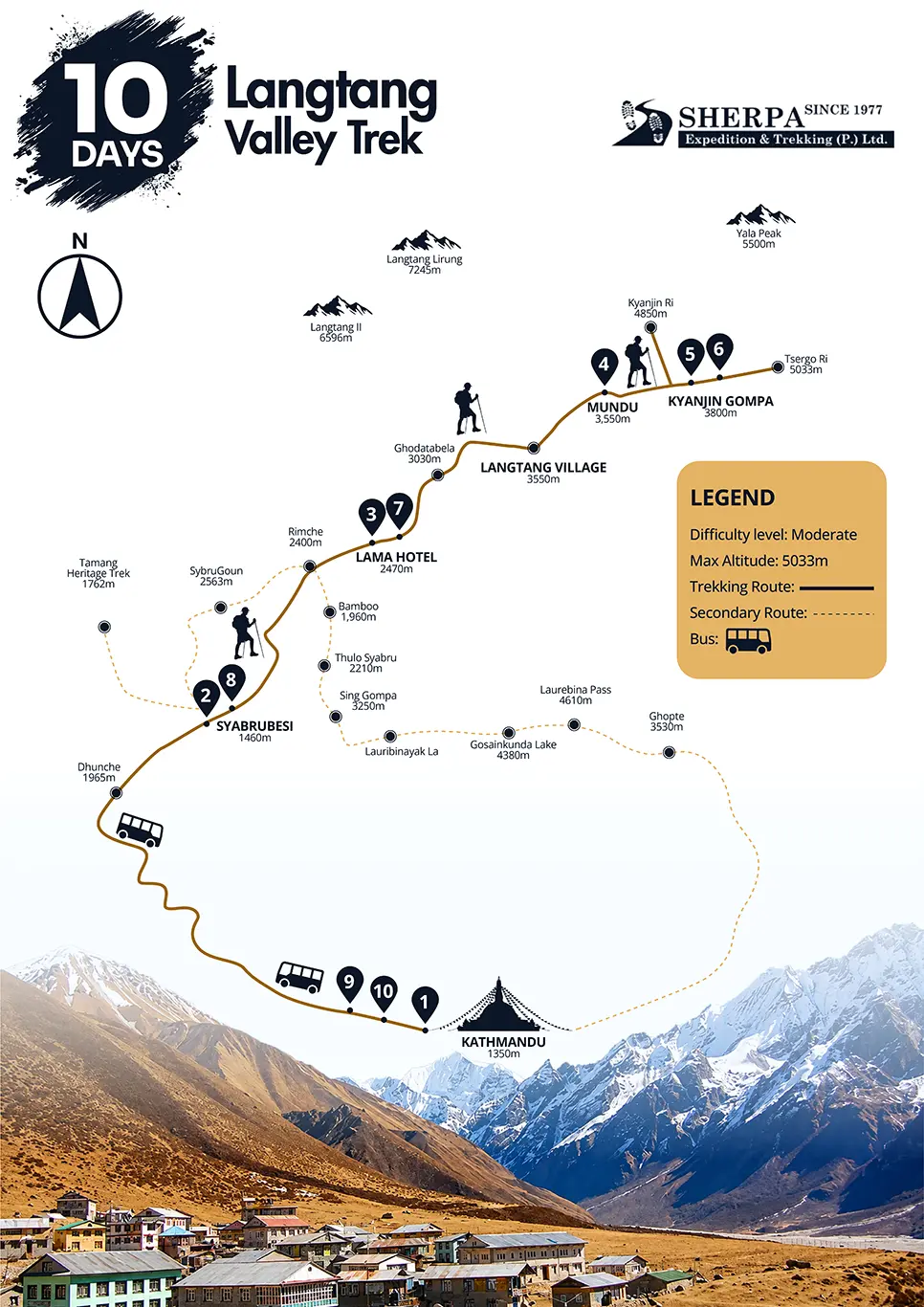
Equipments
Packing List
A Langtang Valley Trek packing list should cover layered clothing, a warm sleeping bag, broken-in hiking boots, and basic first-aid and water-purification supplies.
- Your comprehensive packing list will consist of a three-part layering system: moisture-wicking base layers to keep you dry, a warming insulating jacket (fleece or down) for cold nights, and a good waterproof outer shell.
- Shoes will be crucial; you need your hiking boots in which to hike, as well as a few warm trekking socks and thin teahouse shoes to wear indoors.
- You will need an outer-rated to zero below, -15°C, down sleeping bag; (Gear shops around Thamel gear rental rents them out for about $1/day).
- Extreme protection for extremities: ensure you pack a woolen hat, gloves, and also a large-brimmed hat that shades from the sun, and UV-protective eyewear plus glasses which eliminate snow blindness.
- You will also want collapsible trekking poles to reduce wear on your knees, a good bright headlamp for pre-dawn awakenings, a good long-life power bank, and a small (25-35 litre) daypack to put all the items that you will carry during each day's walk.
- Personal medical kit for water tablets, general first aid items, good factor 30+ sun cream, and all personal medications.
- Don't forget basic personal hygiene requirements like feminine products and cleansing wipes, as these things are unavailable outside of the capital.
- Remember to bring along any personal documents, such as photocopies of your passport and permits – and a stash of smaller denomination NPR – cash only. While Thamel is a great place to browse and pick up any last-minute items, be wary of fake brands – many items can appear to be genuine but will fail you when you need them most.
Kyanjin Ri vs Tserko Ri: Which Viewpoint Hike Should You Choose?
The two optional vantage point hikes from Kyanjin Gompa are Kyanjin Ri and Tserko Ri, and of course vary greatly in altitude and therefore distance and steepness. Choosing between Kyanjin Ri and Tserko Ri (Tserko Ri is often used) will largely depend on current fitness levels, time available, and condition after acclimatisation.
Feature | kyanjin ri | Tserko Ri |
| Elevation | 4,300 to 4,773 m | 4,984 to 5,033 m |
| Duration | 5 hour round trip | 8 - 9 hour round trip |
| Elevation Gain | Approximately 620 m | 1,100 - 1,200 m |
| Difficulty | Moderate | Steep but non-technical |
| Key Views | Langtang Lirung, Ganchenpo, Yansa Tsenji, Langshisa Ri, Naya Peak | Same peaks, plus Tibet and Mt. Shishapangma (8,027 m) |
| Best For | Lower-risk alternative | Pre-dawn sunrise hike |
In case of altitude sickness, skip the higher peak and choose the safest, Kyanjin Ri. Yet another less-visited Menchhyamsa Ri (~4,650 m) hike is there as well. Always make choices with consideration given to weather and body condition.
How Difficult Is the Langtang Valley Trek?
The Langtang Valley Trek is rated moderate, involving 5 to 8 hours of walking a day on non-technical trails with a maximum sleeping altitude near 3,870 m.
The trek can be quite challenging, taking 5–6 trekking days of mostly steep, rocky and high-altitude paths without any specific mountaineering techniques used, such as using crampons. Talking about trekking difficulty is a moderate graded trek, although you will experience quite an impact on your knees returning to the valley. It is slightly shorter in duration and less altitude reaching than both Everest base camp trek and Annapurna Circuit. Still, the hours of walking per day and the exertion are similar. To fully enjoy and complete the trek, it is necessary to have an average fitness level allowing you to walk 10-15 km + 500-800 m as in a day. We recommend preparing 4-8 weeks before departure, training plan with uphill and downhill endurance and doing some sport sessions carrying a trekking bag with you. It is vital to note that despite a moderate grade, there is a possibility of altitude sickness anyway, especially if you plan to hike to Tserko Ri (~ 5000 m). This trek is perfect for novice highland trekkers, as well as older people who like to keep in good shape – the routes are well defined, and tea houses are frequent.
How Much Does the Langtang Valley Trek Cost?
A guided 10-day Langtang Valley Trek package typically costs $500 to $1,000+ per person, while independently arranged trekking runs roughly $300 to $700.
The Langtang Valley Trek Cost largely varies depending on how and where you would like to travel and the type of service you would prefer.
Expense Category | Estimated Cost (USD/NPR) | Details |
| Permit Cost | ~$25–$50 (NPR 3,000–6,000) | Consists of a national park entrance and a TIMS permit. |
| Transport | $8–$150 | $8 to $15 per person on a local bus, $20 to $30 per person by a local share jeep, $150 per private jeep. |
| Daily Budget | $25–$40+ per day | Roughly NPR 3,000 plus. Food, lodging, and other costs would go higher as you gain altitude. |
| Trek Package Price | $565–$3,190 | $565 to $1,235 by local guide (trekking service only); a trekking tour package with an international operator, including flights, is $2,790 to $3,190. |
| Optional Extras | $1–$5 per item | A hot shower, charging of battery & Wi-Fi would be charged. |
| Tipping & Fees | Variable | A tipping for the guide and porters is expected; a visa to Nepal and travel insurance are not included in the cost. |
The total cost of our services depends on Inclusion exclusions you choose when booking a plan. Budget teahouse-only options offer a minimal level of support, whereas premium packages include Kathmandu hotels and free equipment hire. Independent travelers need to keep in mind that they will have to pay additional amounts for tips and gear. Use our calculator to obtain a fair estimate based on specific dates of your arrival.
What's Included and Excluded in a Langtang Valley Trek Package?
A standard Langtang Valley Trek package includes airport transfers, teahouse accommodation, a licensed guide, permits, and most trekking meals.
By assessing the benefits of package inclusions, you'll be able to determine which is best for your money, and remember that we offer a free down jacket and sleeping bag rental along with 3-star Kathmandu accommodation with our package.
Included | Excluded |
| Kathmandu – Syabrubesi transport, guide, porter fee | Flights from and to Nepal, Nepalese visa |
| The park entrance fee, TIMS Card and teahouse accommodation | Upgrade to private jeep and travel insurance. |
| All the meals (B/L/D) for 10 days trekking | Tip to guide & porter, alcoholic and soft drinks, other desserts. |
| Medical kit and oxygen saturation monitoring device | Personal expenses (shower, electricity charge, Wi-Fi, and many more) |
It is important to realize that higher-end packages may include Kathmandu nights and equipment rental, whereas local budget-operator deals generally do not. The porter cost is incorporated into our services, whereas with other operators it may be an addition, and we encourage the client to compare identical inclusions with different operators and not the price.
What Permits Do You Need for the Langtang Valley Trek?
The Langtang Valley Trek requires a Langtang National Park Entry Permit, and guide/TIMS requirements should be verified against official sources before departure.
Check requirements concerning a guide and TIMS before you depart from the park service in Nepal, as these can change.
Permit / Requirement | Cost & Details | Verification & Locations |
| Langtang National Park Permit | 3,000 NRs (around $23 USD) + 13% VAT for foreigners; 1,500 NRs for SAARC; those younger than 10 are free | Verified at Dhunche checkpoint & Syabrubesi checkpoint. |
| TIMS Card | The present status is unclear: while some sources said it has been replaced by local fees, Nepal tourism board, TAAN, may still consider the fee ($20) applicable. | Verify before traveling. |
| Guide Requirement | At present, in late 2024/2025, regulations appear to have been tightened, banning independent trekking and solo trekking for foreigners on most routes. | Present it as a regulation that needs to be verified from authority. |
| Required Documents | Proof of a copied passport and a minimum of two passport photographs are needed to proceed. | All foreigners have to produce this trekking permit document. |
All trekkers must have these documents on them at all times - officials check these documents at all possible points from the entry of the park right up to the trail.
Do You Need a Guide for the Langtang Valley Trek?
Current reporting is mixed on whether independent trekking is still permitted in Langtang, so confirm guide requirements against an official source before planning a self-guided trip.
In the past, this area has been a favored option for many independent trekking hikers due to the well-marked trails and relatively simple terrain. Yet, the recent announcements of 2025 regulatory tightening may change the solo trekking possibilities for the time being, though they have yet to receive official confirmation from local authorities. Either way of the guide requirement, hiring a licensed guide offers a list of advantages, including local language and culture expertise, assistance in booking and reaching accommodations, and help during an emergency in general. The most crucial part, however, is the ability to acclimatize. Porter cost ranges from roughly $18-25 per day. The porter luggage weight is limited to 15-20kg (combined for two trekkers), and the guides have one too at around $25-35 per day, which may be well worth the cost for any single, experienced, female solo trekkers or anyone visiting in winter or rainy seasons, who has no trekking experience. Also check TIMS card status carefully prior to setting off since the independent trekkers' permit will be subject to be canceled anytime.
What Is Accommodation Like on the Langtang Valley Trek?
Accommodation on the Langtang Valley Trek is in teahouses family-run lodges with twin-share rooms, shared bathrooms, and a communal dining and heating area.
- Teahouse accommodations are normally standard twin rooms with wooden beds, sleeping pads, and pillows, but it is very rare for there to be single rooms.
- Blankets are supplied everywhere, though you may want to take a warm sleeping bag to supplement them at the very top.
- Toilets are normally squatter, but more modern or larger villages may well have western toilets. Hot showers have an additional fee, while up in the highlands they are cold and not very consistent.
- The bedroom is not heated whatsoever; therefore, the only access to heat, particularly in the evenings, is from the large central wood-burning stove, found in the central dining hall.
- Electricity and internet access rely upon wifi charging services; charging your devices and connecting to the Wi-Fi costs a small extra fee and gets spotty the higher up the valley you are.
- Peak season (October-November and March-May) is busy, so it’s a good idea to book ahead or arrive early in the afternoon to find a room.
- There are two options other than standard teahouse accommodation: upgraded hotel-style Kyanjin Gompa lodging and improved rooms in Syabrubesi for those seeking extra comfort, and camping (a rare option only available for specific group requests).
- Some premium trekking packages also include an upgraded Kathmandu hotel stay before and after your trek.
What Food and Water Are Available on the Langtang Valley Trek?
- Teahouses along the Langtang Valley Trek serve dal bhat, noodles, momos, and other trekker staples for breakfast, lunch, and dinner.
- Typical teahouse food menus provide an adequate supply of energy via Dal Bhat (included with free refills) and an ample variety of chowmein, momos, porridge, Tibetan bread, pancakes, and Sherpa stew.
- Vegetarian, vegan, gluten-free diets are quite manageable on the part of the lodge owners. However, bread options for the gluten-free eaters could be limited, and it will be useful to warn your guesthouse about severe allergies well in advance.
- Costs go up in proportion with altitude: there's extra cost involved in carrying all this on either porters or yaks for so long.
- At altitude, it's extremely important not to dehydrate and maintain hydration: we suggest drinking at least 3 to 4 liters of water per day, in order to let your body adapt to the conditions.
- Bring water purification tablets or an extra filter to avoid contributing to the proliferation of single-use plastic bottles, for both environmental and financial reasons.
- Bring enough cash budget to buy meals, snacks, and drinks, since cash is king, and there's no way to exchange cash once you leave Syabrubesi: budget accordingly for each day in advance.
When Is the Best Time to Trek the Langtang Valley?
Spring (March to May) and autumn (September to November) are the best times to trek the Langtang Valley, offering the clearest mountain views and most stable weather. The autumn winter monsoon means very varied traveling experiences depending on what your priorities are:
Season | Trail Conditions & Weather | Best For |
| Autumn (Sept–Nov) | The trail offers maximum post-monsoon views and clear skies. Temperatures are relatively pleasant during the first few days but plummet by December. October is the busiest month. | Photography, first timers, and best mountain views. |
| Spring (March–May) | The trail is famous for its rhododendron bloom season, which occurs in large numbers and brings warm days. The visibility is good, although it decreases to some extent due to dust, haze, and afternoon clouds by late May. | Nature lovers and those trying to avoid popular trekking seasons; not very crowded. |
| Winter (Dec–Feb) | The routes are less crowded but very cold, as there are excellent chances of snow/ice on the trekking routes, Kyanjin Gompa, and Tserko Ri. Hence, take an excellent stock of woolen clothes. | Experienced trekkers in harsh cold and absolute solitude. |
| Monsoon (June–Aug) | Heavy rains and very gloomy, cloudy weather with leeches define these trails. Landslides risk are the biggest hazard for both the road and the trail, which must be handled extremely well. | The treks are not advisable in very low visibility and high risk, though very courageous might opt for it. |
The best time to trek hinges on how much you don't mind being cold vs how much you like clear skies. For most people who are interested in the successful expedition, Oct or April are the months when they get the best weather. Make sure to check out the local weather forecast before your arrival because of the chances of landslides or blocking due to heavy snowfall.
How Do You Prevent Altitude Sickness on the Langtang Valley Trek?
Altitude-sickness risk on the Langtang Valley Trek rises mainly above 3,000 m, particularly during the Tserko Ri or Kyanjin Ri side-hikes near 4,300-5,000 m.
- Dealing with altitude sickness starts with knowing the common initial AMS symptoms such as chronic headaches, nausea, lightheadedness, loss of appetite, weariness, difficulty sleeping, and becoming out of breath with activity.
- It is important not to confuse mild AMS symptoms with more serious and potentially deadly HACE and HAPE conditions. Symptoms like confusion, loss of coordination and resting breathing difficulty are not to be ignored or put off – the priority in this case is an immediate, steep descent.
- Effective acclimatisation relies upon: the slow ascent through the elevations, utilizing the rest day at Kyanjin Gompa (day two), drinking lots of fluids (water, tea), and the avoidance of alcohol, while travelling slowly all day long.
- The most important rule for climbing mountains is to not ascend at all if your condition is deteriorating; if you have any doubts, your guide will assess your condition and decide whether you should descend.
- Although you should try to drink plenty of fluids, this will not be sufficient to prevent AMS. Any decisions on preventative drugs such as diamox should be made by your doctor before your expedition, and not by self-medication
- Make sure that you have the appropriate travel insurance evacuation with an elevation of 5,500 m heli evacuation clause, and a helicopter rescue policy in case of an emergency.
- In order to ensure your wellbeing, our company offers the use of a pulse oximeter, which measures the oxygen saturation and heart rate; this twice-daily procedure is crucial for the early detection of AMS symptoms.
How Do You Get to the Langtang Valley Trek Starting Point From Kathmandu?
Syabrubesi, the Langtang Valley Trek's starting point, is reached by a 7 to 9 hour road journey from Kathmandu covering roughly 120-123 km.
Category | Transport and Route Details |
| Local bus | It's generally the cheapest and most uncomfortable option, usually setting off in the early morning (between 5 AM & 7 AM) from the Macha Pokhari bus stand in Kathmandu; usually expect the trip to last for approximately 8–11 hours. |
| Shared jeep | A shared jeep is a way for you to get to your destination somewhat more quickly and less uncomfortably for a modest increment in cost. |
| Private jeep | A private jeep, by far the easiest and most comfortable, will likely cost you around $150 one-way per jeep; it will often pick you up from your hotel, and it will be most cost-effective when sharing among your group members. |
| Travel Route | Kathmandu to Syabrubesi road eventually passes Trisuli Bazaar, Nuwakot, and you will be checked for your mandatory park pass upon arrival at high-altitude Dhunche. |
| Road Conditions | After Dhunche you can expect the road to be winding and potentially bumpy for the remainder of the way to Syabrubesi; travelers are often prone to motion sickness, delays due to weather or roadwork, and potentially due to seasonal landslide risk possibilities. |
| Recommendation | Highly recommend an international Kathmandu buffer day before flights to try to balance possible fluctuations in road conditions traveling back to Kathmandu. |
Langtang Valley Trek vs Everest Base Camp and Annapurna Base Camp: Which Should You Choose?
The Langtang Valley Trek is shorter, road-accessible, and less crowded than Everest Base Camp or Annapurna Base Camp, though its main viewpoints reach a lower maximum altitude. The choice between Langtang vs Everest Base Camp and Langtang vs Annapurna Base Camp depends on how much time one has versus the need for "high-altitude views".
Feature | Langtang Valley Trek | EBC trek (Everest Base Camp) | ABC trek (Annapurna Base Camp) |
| Itinerary Duration | Choose from 5- and 11-day lengths - perfect for limited holiday time. | Needs a considerable amount of time, as a gradual ascent with acclimatization must be planned. Generally, this needs to be 12-14 days. | Can be anywhere from a short 7-day trek to a 12-day trek depending on start and end point, and can also be integrated into other shorter holidays. |
| Logistical Access | Fully ground accessible (removes reliance on weather dependent/unreliable air travel). | Usually includes a 45 minutes to 1-hour flight into Lukla, which provides one of the most impressive introductions to Nepal's highlands but is highly prone to weather delays. | Fully road-accessible from Pokhara, this can easily be arranged for group trips or the lone traveler. |
| Altitude Comparison | Climb to about 4,773m/5,033m at one or more optional viewpoints for good altitude comparison with various trek altitudes. | The highest destination is Kala Patter at approx. 5,545 m, which is the highest possible physiologically for most and provides impressive views with the altitude. | Relatively low altitude, with the highest reaching 4,130 m, with an optional viewpoint offering accommodation at the viewpoint. |
| Scenery & Culture | A unique pristine glaciated valley offering a detailed, immersion-based experience of the Tamang / Tibetan Buddhism and cultures along the way. | Features iconic Sherpa culture and stunning close-up views of the world's tallest peaks—with the highlight of the 8000 m peaks dominating the terrain. | Annapurna Amphitheater, an entire ring of mountains with 360-degree views (excluding 3 out of 14 highest peaks on the planet); Gurung culture is prevalent. |
| Crowd Levels | It is not typically overcrowded and offers that solitary view of the Himalayas even during other busy trek months. | Most popular trek and, as a result, has the highest level of crowd levels with tourist foot traffic both on the trail and in the lodges. | Balanced numbers, still busy, but typically nothing like how busy Everest Base Camp treks get. |
| Recommended For | Recommended for first-time Himalaya hikers, short vacations and solo/group trekkers wanting an uncrowded expedition. | For those with a sense of adventure, wanting to "tick off the bucket list" of seeing Mount Everest and wanting to experience the famed Sherpa heartlands. | For those who want an impressive amphitheater but can't afford/do a long-duration trek and have little/short time allocated in Nepal. |
| Total Cost | Lower price as no domestic flights are involved and park entrance fees are minimal. Lodges here are less of a high-rise "luxury hotel". | More expensive option due to the need for flying in/out of Lukla and the higher daily rate of charges. | Mid-priced trek, still avoids flight costs, and can often get just as good lodges at a comparable price range as other regions. |
Comparing Langtang vs Everest base camp and Langtang vs. Annapurna Base Camp shows that Langtang is the preferred option for those looking to avoid the crowd levels of the more popular base camp routes while still being able to enjoy a spectacular mountain experience.
Can You Combine the Langtang Valley Trek With Gosaikunda or Tamang Heritage?
The Langtang Valley Trek can be combined with the Gosaikunda lakes or the Tamang Heritage Trail for a longer, more varied Himalayan itinerary.
- Alternatively, you can take a Gosaikund extension, which will take you to explore the alpine lakes found here, situated at an altitude of 4,380m. Hindu and Buddhists considered these to be a pilgrimage site, with its major festival being Janai Purnima. This means an additional 3-5 days to the trekking with a combined itinerary. You are expected to take due precautions regarding the numerous ice formations in the area over the course of the winter.
- These are considered important rather than an area to skate upon, as many as 108 lakes and ponds of these areas include Gosainkunda, Bhairab Kunda, Saraswati Kunda, Surya Kunda and Naga Kunda, among others.
- A combination with the Tamang Heritage Trail provides insight into village life. It includes some interesting hot springs, often taking place as a cultural prelude or epilogue to the main valley trek.
- For more serious trekkers, the combination can include either the challenging ganja la pass hike or the Yala Peak climbing trek, which offer a greater sense of achievement but require additional expertise and considerations with regards to permits.
- Typical combined itineraries will see between 12 and 14+ days being allocated to the overall trekking adventure.
- Aim to choose your preferred extension based on your interest: the scenery and religious importance of the lakes make a Gosaikunda trek ideal, a greater cultural immersion is found on the Tamang Heritage Trail combination, and a serious challenge is reserved for those undertaking the Yala Peak climbing trek.
What Is Tamang Culture Like on the Langtang Valley Trek?
Tamang communities with strong Tibetan Buddhist influence make up most of the villages along the Langtang Valley Trek route.
If you take yourself along for an immersion among the Tamang culture, you will discover an enduring ethnic group consisting of more than 120 acknowledged sub-clan grouping approximately 80% of the trail population. The Tamang language is of a Tibeto-Burman ethnic group and are said to be about 75% related to the Gurung. Their robust Tibetan Buddhism is visible throughout the trekking season at all of their many temples, stupas, and mani stones. Above all, remember the monastery etiquette to never walk around the religious building counter-clockwise, and do ask permission before using a camera.
Life in Kyanjin Gompa, at such high altitudes, is supported by high-mountain yak herding and yak cheese production, as well as the agricultural practice of terracing. During Sonam Losar, the Tamang New Year is held around Magh (approx. February), traditional Damphu music and Tamang Cello might be encountered. For the trekking community, responsible tourism practices, including discretion around occupied homes, occupied monasteries, and sacred stupa-like memorial sites, are of vital importance to protect cultural integrity.
How Did Langtang Recover From the 2015 Earthquake?
The April 2015 earthquake triggered an avalanche that destroyed old Langtang Village and killed many residents and trekkers, and the community has since rebuilt its lodges and trails.
This disaster has been the bleakest point in Langtang village history; originally, the village was wiped out entirely when a giant Langtang avalanche of snow, rocks and ice collapsed onto it. Community recovery began quickly by the sheer force of those surviving who worked in unison, clearing the paths once again and building their new, modern guesthouses. A memorial wall to those who lost their lives in the disaster has been put up at the site of the old village, which bears the names of the lost citizens.
Travellers can help give back and support the community through responsible tourism by sleeping in the lodges, buying yak cheese made by local farmers. This directly gives support to the area when you buy local produce and crafts.
When visiting the memorial wall, show respect to the site; do not use this place for photos. Although much of the valley now stands rebuilt, guides still will be ever wary of geological issues and trekkers should abide strictly by their guide's orders when crossing unsafe points in the valley. In spite of the 2015 earthquake, the Langtang Valley is still considered a primary trekking location in the world, and its inhabitants are remarkably strong people.
Is the Langtang Valley Trek Suitable for Beginners and Families?
The Langtang Valley Trek suits many first-time Himalayan trekkers and families with older children, though it still involves several consecutive days of high-altitude walking.
As an easy beginner trek, it gently eases you out of the road and into the trails, with a good number of teahouses to offer safety and comfort. However, even as a first Himalayan trek, it involves walking for 5–6 consecutive days, with 5–8 hours on foot every day, and a significant altitude gain if one wishes to attempt any of the popular viewpoints such as Tserko Ri. When traveling with children or considering family trekking, note that their children's altitude may react differently to altitude than yours – it is advisable to consult with a pediatrician regarding high-altitude travel before setting off on your adventure. The same applies for senior trekkers, who may want to get a full medical check-up and realistically assess their abilities before embarking on this journey, as the ‘moderate’ rating might be a slight overstatement for older or inexperienced hikers. If you are unsure about your group’s abilities and have young children along, consider a shortened version (5-7 days) that would allow you to skip some of the higher viewpoints for safety and peace of mind. Overall, this trek is a great way to introduce your family to the Himalayas due to its malleability and gentleness relative to other treks in the region.
Do You Need a Porter on the Langtang Valley Trek, and How Much Should You Tip?
A porter is optional on the Langtang Valley Trek and typically carries 15-20 kg, often shared between two trekkers.
- Hiring a porter guarantees you're maintaining a responsible porter weight limit of 15-20 kg, making the experience more enjoyable for all without exploiting their abilities, and simultaneously supplying income to local communities.
- Some major benefits are minimized physical exertion, more strength to enjoy the environment, potentially increasing your rate of acclimatization.
- While a porter cost is roughly an $18 to $25 per day service (depending on the operator), the money supports the local economy and guarantees the well-being of your equipment too.
- The final thank-you or tipping guide porter after a wonderful journey has always been encouraged. Typically, for a 7- to 8-day trek, a communal sum of $60 to $100 among a team of two trekkers will be fine.
- Such a tipping sum is to be given in Nepali rupees or good-condition US dollars when bidding farewell to the guides and porter during your final evening over dinner.
- In addition, tip expectation varies depending on a group trek and private trek; on a group trek, your entire tip might be pooled among the members, which is then given among the entire assisting staff.
- Overall, the porter is an essential support for your expedition, and his efforts and local knowledge make the daily amount worth paying.
How Do You Book the Langtang Valley Trek, and What Is the Cancellation Policy?
Booking the Langtang Valley Trek typically involves a deposit to secure your dates, a licensed operator handling permits and logistics, and a cancellation policy that varies by how far in advance you cancel.
- To book langtang valley trek, the applicant will just need to submit a clear photocopy of a valid passport with the online application form. Since last minute bookings are subject to a permit's availability, the booking could also be made a month or a couple of weeks in advance.
- The 30 percent of the trekking deposit, which is non-refundable, should be paid in order to secure the booking. The payments can be made via our online portal using credit cards (subject to a 4% charge) or by SWIFT/Wire transfer. The remaining 70% of the total payment should be cleared upon the arrival of the travelers in Kathmandu.
- Both the fixed group departures for social trekkers and the custom private trek booking option for family and solo travelers, along with a personal guide, are available.
- Our cancellation policy includes a 30% deduction if cancelled 12 months prior to the day of departure, 50% of the amount if cancelled 6 months in advance and no refund in case of cancellation within 7 days of the scheduled pickup. However, in case of any cancellation by Sherpa Expedition and Trekking, a full refund of the amount paid will be processed as per refund policy.
- A postponement fee of $150 will be levied if the client wants to reschedule and informs Sherpa Expedition and Trekking at least 30 days before the day of departure. There will be no refund in case of early return or unused portion of the trip.
- We are an authorized and insured operator providing quality guided tours and certified guides. We have exceptional traveler reviews about our services in the field of Himalayan trekking and expeditions.
- View our latest availability calendar right now and click ‘Book Now’ or ‘Enquire’ to get started on your Himalayan adventure.
Gallery



Tour Dates
Every departure listed below is 100% Guaranteed — once you book, your trip will run as scheduled regardless of group size.
Loading departure dates…
Want your own personalized tour?
FAQS
Difficulty & Fitness
It is a moderately difficult hike. Although it does not require any technical skills in climbing, you have to walk continuously for 5-8 hours a day up the most demanding trails. A good fitness level is required to cope with several-hour climbs at high altitudes.
Ghorepani Poon Hill is the easiest one since it has the shortest days of hiking and the highest point is not so high. Moreover, it is less dangerous than Langtang trekking because of the accommodation and food supply.
Without doubt, it is for the first Himalayan trekker because it includes road transport and a well-developed teahouse system. It is also more comfortable since it takes you through a genuine glacial valley, whereas long mountain flights are associated with considerable risks.
There is no officially stipulated upper or lower age limit, but the individual's capacity to withstand altitude plays a critical role in determining whether it is safe. The elderly, individuals who suffer from any health-related concerns, or younger children should ideally consult their doctor before starting the trip.
There are no issues while trekking with children when there are enough energetic young children who don't suffer from any diseases. When hiking, it is recommended to take all care and caution when you start hiking and children. High points like Tserko Ri should not be accessed to eliminate the chances of sickness due to altitude.
Your safety comes first. Guides will change the route or stay until the conditions improve. Should the operator decide to cancel a trip citing the danger of a landslide, a complete refund will be given.
Best Season & Weather
October is the best time for clear post-monsoon mountain vistas as well as fine weather. April is another good time, enjoying the warmer weather plus the full spectacle of the rhododendron flowering season in the forests.
The recommended periods are Spring and autumn. During Autumn (Sept-Nov), the visibility is also the best, and during Spring (March – May) the wildflowers are in bloom, and the weather is agreeable.
In winter you find peace and clear blue skies - not to mention the bitter cold. Layers are essential during winter as daytime temperatures can drop to well below freezing and summit views may be obscured by snow.
Trek Duration & Itinerary
A normal itinerary for walking up the valley and back again is usually about 7-11 days at minimum, to factor in the travel time from Kathmandu and time to acclimatize at Kyanjin Gompa and day hikes to viewpoints higher up.
The trail climbs via Lama Hotel and Langtang village to Kyanjin Gompa and retraces the same route down the valley.
The total circuit trekking route of about 60-80 km follows from about 1,500 to just under 3,900 m, following the river, or, as shown on a trail map, it goes uphill all the way.
A combined trip to add the holy high alpine lakes at 4,380 m. To do that, you would need to cross Lauribina Pass, and usually this adds between 4-6 days to the main valley trip.
Altitude & Acclimatization
The altitude during the overnight stays varies from 1,500 m at Syabrubesi to approximately 3,870 m at Kyanjin Gompa. By ascending to progressively higher altitudes, you get accustomed and accustomed.
The peak altitude achieved in this trekking journey could be the summit of Tserko Ri, or at Tserko Ri summit itself which stands at 5,033m, or a viewpoint such as Kyanjin Ri, which reaches an altitude of about 4,773m, from where you will be rewarded with views overlooking the Himalayas.
Avoid going at speed and make sure that you hydrate yourself. Try to use the rest day at Kyanjin Gompa and avoid alcohol as much as you can; adhere to the principle of "climb high, sleep low" so that you do not have problems associated with altitude sickness.
Safety & Emergency
Yes, all has recovered well, with repaired trekking paths and luxurious new lodges being built. There is also a memorial for the people lost in the 2015 earthquake, which is found on the site of the old village.
Yes, the trail is totally open. Nepal government and Nepal Tourism have certified that all bridges and paths have been confirmed safe to trek for the current trekking season by the local administration/local tourism authority, taking seasonal changes into consideration.
Yes, comprehensive travel insurance and an evacuation cover are necessary. The insurance, which includes high-altitude rescue, must be presented to us before commencing the trek for personal security.
It should cover trekking to 5,500m and include an emergency helicopter evacuation. Check that it has all these specific high-altitude travel clauses.
Your assigned licensed guide will make communication to our local office about alternative measures, if needed, to travel safely - changing the route or transport used, etc to bypass a blocked section of the trail.
Yes, helicopter evacuation can be done for medical emergencies. Several tourists take insurance for an additional premium helicopter return to the capital to shorten their journey back from Kyanjin Gompa.
Flights & Transportation
With a 7-9 hours drive. The clients have the choice of opting for a very economical local bus, sharing a jeep, or travelling privately in a 4WD, passing through Trishuli Bazaar and Dhunche.
No internal flight needed. The trek is reliable and very cost effective than the trek to Everest since it is not possible that the mountain flights get cancelled during unpredictable weather conditions.
Yes, the return can be a helicopter return in a luxury format. Clients can return from Kyanjin Gompa by a helicopter ride that takes only 30-40 mins to Kathmandu. This bypasses the walking & driving process.
For road travel/transfer, if the road conditions turn bad or there is a threat of landslide, then we arrange transport by coordinating with transport unions and get appropriate directions for an alternate route or suggest waiting for some time to get the passage clear. The safety of our client is our priority.
Permits & Documentation
Trekking alone at the moment isn't possible. Rules have been increasing for guides, and they will soon be a prerequisite for security and development to support the local community within the high-altitude National Parks.
Yes, a registered/licensed guide will generally be required for trekkers. Upon reaching the Dhunche point, you will have to show all documentation that proves a registered professional accompanies you.
Even though you would get permission, you have to obtain the Langtang Permit & TIMS card. But currently, under the rules, a guide should retain these cards in their personal possession during trekking.
Yes, the majority of non-nationals must have a visa. These are easily attainable at your arriving airport upon your arrival in Kathmandu for 15 days (USD 30), 30 days (USD 50), & 90 days (USD 125).
These can be obtained online before reaching Nepal or obtained from the kiosk facilities right at the arriving airport (where payments are accepted in international currencies like USD, EUR, and GBP). You can also get these from the Nepali Embassy in the capital where you live.
No vaccination is legally compulsory to enter Nepal. From a medical point of view, there are a few inoculations, such as typhoid, hepatitis A and tetanus, that may be advised to those trekkers who are going to sleep in teahouses and hotels at high altitude.
Recommended. When staying in teahouses, you may wish to protect yourself against food/water-borne illness - see a travel health clinic no later than 6 weeks before your trek.
You will need your scanned passport, 2 passport-sized photos (for permit) and your travel insurance details (which must include evacuation at high altitude).
Accommodation
Basic twin accommodation (unheated) plus a dining room with a stove characterizes a normal lodge. Bathrooms are shared, and conditions can be very rudimentary the higher up you go.
Basic twin accommodation (unheated) plus a dining room with a stove characterizes a normal lodge. Bathrooms are shared, and conditions can be very rudimentary the higher up you go.
Very true private rooms with their own bathroom attached are seldom available; twin-share is the norm. If traveling alone, you might be required to share in peak season.
Yes, you will get a hot shower & internet charging for an additional (small) cost ($2-$5). Solar power can be unreliable, so bring a power bank just in case.
Facilities on Trail
No, there are no ATMs between Kathmandu and the trek starting point. You would have to withdraw cash in Kathmandu for the whole of the trek for all personal expenses.
Yes, a cash budget in Nepalese Rupees (NPR) is important. You will need money for snacks, drinks, recharging, showers, tipping, etc because teahouses do not take cards or international currencies.
Paid internet service (Wi-Fi) is commonly provided in guesthouses in Kyanjin Gompa, but it's relatively slow, dependent on weather. It's good for text messaging but not for downloading heavy data at all.
The signal is weak, intermittent, and can be lost in lower valley points. Wi-Fi is available at some teahouses, but coverage is poor at higher elevations, so it's better to assume you will be undergoing a digital detox for the duration of your trek.
No- To prevent yourself from dehydration you will be expected to either carry with you water purification tablets or purchase a filtered water bottle. We would prefer you not purchase water bottles from tea houses to keep plastics out of the National Park.
Dal bhat is lentils served with rice and vegetable curry, Nepal's national dish. In the teahouses, it represents the best bargain because most guesthouses offer complimentary rice and lentils refill on most teahouses for hunger trekkers.
Gear, Packing & Luggage
A porter is limited to a total of 20-25 kg of baggage; shared between two trekkers. You should pack a light day pack for immediate needs such as hydration, snack & water, jacket when needed.
Maximum 12.5 kg per trekker in a duffel bag that the porter carries to ensure porters are in good and healthy condition to carry our loads on the challenging and steep mountain trail.
Approx. 5-7 kgs in your backpack and with water to drink; this pack contains rain coat, sunscreen, a camera and trekking gear needed throughout the day, with more comfortable gear for trekking.
Bring a wicking material shirt, a down jacket and wear hiking boots that are broken in. Sleep bags rated for -15°C, walking poles, a torch (headlamp), and a portable power bank are important things you shouldn't forget at home.
For winter, a heavy thermo set, insulated gloves and micro spikes in case of icy ground and slopes. Also a higher temperature sleeping bag and more fleece will help you withstand the freezing temperatures on the night there.
Guides & Porters
It is generally not advised and often mandatory these days. A licensed guide is really required to ensure safety. He is trained to handle trekking conditions and any kind of emergency and AMS cases.
Yes. Mandatory to hire a licensed guide for foreign trekkers in any National Parks in Nepal. The primary reasons are safety and providing locals with employment. Authorities check permits at the Dhunche entry point and see if the guides/porters are licensed or not.
A guide would manage safety issues such as navigation and arrangements for accommodation. Porters carry trekking gear, which becomes heavy in the Duffel bag during the trek. It is essential that you hire a guide and porters for any trek; otherwise, you will have to rush the journey and focus on carrying your gear.
At that time, we will verify the person’s Govt of Nepal ID card. All our employees have their certificate/permit of being a licensed trek leader or porter, plus high altitude training and first aid training for safety and support services.
Yes. Female guides are available. Please state it during the booking process so we are able to provide our female staff for you at the time of your departure dates.
The maximum weight a porter can carry in a duffel bag is 25 kg, which is often shared between two trekkers' bags. We apply that kind of arrangement for the better condition of our trekking staff.
Food, Drinks & Trekking Budget
Board at teahouses is $30-40 a day. Although you may be tempted to buy your own food at the teahouse, the prices rise steeply with altitude. These prices include all three meals and include teas and coffees and water purification too. Almost all lodges will provide free rice, dal and curry refills on the first helping making it perfect for people on a budget who may need energy.
You will need some amount of personal money to spend throughout your trek. A decent estimation would be anywhere between $300-$400 (USD). This can vary depending on you but it is also wise to carry a decent amount of extra money for personal effects such as to pay your guide porter team, use internet services, pay for hot-water showers, and many other expenses you might accrue.
Yes, it's the best value meal. They can refill rice, dal, and curry freely at lodges. Hence, you should regain energy on long trekking days.
Drinking water is not provided; you will need to buy it or purify it yourself. Water treatment tablets would be the most convenient and cheapest form of water purification. The National Park does not welcome your plastic waste; therefore, the water purification tablets are also very handy.
A realistic estimate for this adventure would be $10-15 per day. This is largely dependent upon which services will actually be available at what altitude. At higher altitudes, costs shoot up steeply due to the fact that services have become almost inaccessible to people.
Trek Cost & Pricing
The expenditure is quite low for local people in view of the low cost of permits and internal transport fares. Nepalis, most of the expense on accommodation and food will remain at NPR 2,000-3,500 a day.
International standard package Langtang Valley treks cost around 500-1,000 US$, which varies according to the number of trekkers and service standard, such as accommodation facility on hotels in Kathmandu, transportation by different types etc.
Standard packages comprise permits, airport drop-off and departure, guide, porter, accommodation at tea house on trekking area and on hotel of Kathmandu and meals during the trek but except visa fees, international airfare, travel insurance and personal equipment.
The visa for Nepal, flights on an international line, travel insurance and trekking gear are not included. You will pay the expenses for alcohol, snacks, Wi-Fi connection, the payment for showers, and tips for the agency's crew and guides.
Family & First-Time Trekkers
Yes, with some preparations. You will want them to be acclimatized and the day's walk to be short. Using an alternative porter to assist children over the steep bits of trail is an option.
There aren't any laws regarding age, but it's recommended this hike be done by children age 7+ and fit, able-bodied adults. Elderly trekkers should be able to handle high altitude and cardiovascular work.
Certainly one of the most popular, as it offers moderate trekking challenges, spectacular glacial scenery and plenty of local color without having to overcome any of the logistical complications that other trek destinations require.
Yes, the road access and length of the trek make this hike more practical to trek for families than those that require mountain flights. In addition, the lodges themselves are very welcoming, providing comfortable common space in which trekking companions of all nationalities can chat.
The trek is accessible for anyone able to walk 5-6 hours; regular cardiovascular and hiking training is beneficial so as to enjoy the mountains rather than just find the trek tiring.
Trek Comparisons
Either of these choices would be fantastic. ABC has an amphitheatre in the mountains, while Langtang has a glacial valley, and then, higher up, profound Tamang Culture. Along with that, Langtang is very accessible from Kathmandu; the trail is rarely crowded.
Stay in Langtang for shorter 7-10 days tours around the valley, or choose the Circuit option for longer tour 14-21 days where you have to cross one over motor-able pass, i.e. Thorong La.
The Short Ridge Trek in Langtang provides a view across to Machapuchare, while Mardi Himal will do the same with a similar amount of trekking involved. Still, Mardi Himal will allow a trek in a longer valley with many more (7,000) mountains around you and allow more of a cultural perspective.
Manaslu is a more difficult trek that leads you through a remote restricted region, while Langtang is very easily accessible and suitable for beginners. Manaslu caters to experienced trekkers, while Langtang serves as an ideal introduction to the Himalayas for newer trekkers.
Langtang vs. Everest Base Camp shows that the higher fame/higher altitude comes with extremely high crowds; Everest has glacier beauty with paying for a flight (which Langtang does too but with no flight cost), lower expense, and much lower crowds.
Yes, it’s less crowded in Langtang. It’s more serene and tranquil to experience the mountains and the local culture without the sense of a trekking highway.
Traveler Reviews & Experience
The reviews indicate that the people of the Tamang tribe are friendly, and the valley is beautiful. The trekker enjoyed the yak cheese factory and the wonderful view from the top.
Yes, for the price and effort, you can have beautiful views of 7000 m peaks. It's a very good place for those who want to enjoy both nature and the people there.
The most positive thing is the beautiful view from the top. Going through the forest to the glacier, and the friendly people at Kyanjin Gompa and the great spirit of the village after the earthquake, are also very nice.
The only bad thing is that you have to drive a long way (8 hours) to get to trail head. Also, because it is just there and back, you can see most of the beautiful landscape only twice.
Drones, Photography & Regulations
Yes but it requires permits. Apply for permission from CAA, the tourism department, and national park authorities. Serious penalties apply to illegal flying of drones.
CAAN permit along with NP authority is required which is quite tedious for tourists to obtain. Professional filmmakers may require hiring a local fixer who is familiar with the process of all this government paper work.
Yes. For all commercial/professional aerial filming, permits from relevant government authorities (if permitted), with fee payment, are required. Handheld still photography is allowed, as long as you respect locals' privacy and monastery etiquette, etc.
Booking & Required Information
Just click 'Book Now' or 'Enquire' on our website, then state the trek, your planned date of travel and booking details. We then request that you upload a scanned copy of your passport and pay a 30% deposit for the trek, which would confirm your departure.
A scanned copy of your current passport and 2 passport-sized photos are required in order to arrange the trekking permits and proof of travel insurance detailing cover up to an altitude of 5,500m for a medical emergency.
Yes, often booked a couple of days prior, provided there is staff availability and guides. However, booking between 2-4 weeks in advance is generally sufficient for ensuring excellent backup teams and experienced guides for treks.
Ideally a book 3 to 6 months in advance so that a trainer can tailor a physical fitness program to suit your needs and to secure an experienced licensed guide.
Deposits & Payment
A non-refundable deposit of 30% is due for trekking in order to book the respective dates and to pay for trekking permits and arrangements in advance. Your booking will be confirmed on receiving the payment.
The payment is accepted by card (at an extra charge of a 4% service fee) and via SWIFT/international wire transfer. Bank charges are to the client, and the receipt of the money transfer must be e-mailed.
The balance amount of 70% must be paid on arrival in Kathmandu, prior to the start of your trek. The payment accepted would be cash payment in either USD or NPR, or card payment.
Yes, there is a 4% fee on card payments. On the bank wire transfer, the clients are requested that the intermediary banks’ charges be borne from their side so that the total deposit amount reaches our account in Nepal.
Cancellation, Refunds & Date Changes
A deposit of 30% of the tour is non-refundable. The later we receive your cancellation and payment of the second half, the higher the price will be. However, if we cancel (e.g. on safety grounds), we provide an option for a full refund or a change of dates.
Yes, with a change of date fee ($150). There has to be a minimum of 30 days' notice. The remaining balance of the tour payment already paid will be converted to a deposit for your change of dates.
We do not give refunds for early withdrawal. Our committed expenses for staff and lodges will be retained. You are responsible for all further hotel or transportation costs, should you leave early.
We prioritize safety, and if such a reason is given, we will change the program accordingly and may offer you changing the dates to a later date. If the departure is canceled, it may allow a full refund for all money paid.
Yes, but not later than 30 days in advance, after payment of $150. We will be happy to confirm new dates, depending on guide and permit availability for you.
Reviews
9 Days Langtang Valley Trek
The 9-day Langtang trek is one of the best Langtang trekking holidays, or, most importantly, the complete Langtang package, specially designed to be fully planned as the Langtang trekking package to ease your journey, from arrival to departure, seamlessly. This Langtang Valley trek package becomes the best full Nepal trekking holiday by combining city facilities with trekking arrangements and permits; the trek structure can also be described as a full-service Nepal trekking vacation for a foreigner who wants a full service Langtang trek.
From a logistic standpoint, with the Langtang holiday package there is absolutely no stress given from arrival and departure points due to arrival to departure support, as well as airport pickup in Kathmandu right from when the guest arrives. The guest doesn't have to endure their own journey to explore Kathmandu using local transportation; instead, they can enjoy their straightforward airport transfer trekking package or have their Kathmandu to Langtang package, which includes both Kathmandu and the Langtang trek, smoothly. The Kathmandu hotel included with arrangements makes this deal irresistible, as it allows for no stress with accommodations before and after the mountain adventure; this must be the best Langtang trek with a Kathmandu hotel for someone who doesn't want any more trouble traveling.
This turnkey Nepal Langtang trekking package is appropriate for those who want a Langtang trek with airport pickup and the Langtang trek logistics organized by a trekking specialist. This fully guided Langtang holiday from Kathmandu is what makes up a comprehensive and powerful Nepal trekking holiday choice for most of the hikers. It provides you with an engaging, amazing trek that starts with a leisurely pace from Kathmandu.
An all-inclusive Langtang package from Kathmandu format of this nature is made for global tourists coming to Nepal for trekking. It is perfect for novice Nepal travelers and convenience-oriented buyers who are looking for the least hassle and want one company to organize accommodation, international arrival and departure support in Kathmandu making it a full-service Langtang trek.
Travelers to Nepal should not consider this Tsergo Ri package if they have already booked their hotels in Kathmandu, do not require an airport transfer and are not interested in traveling to Kathmandu city. It is not a low-cost alternative for budget backpackers, those seeking just basic on-trek facilities and travelers whose sole aim is Tsergo Ri peak without any supplementary city coordination. Our complete Langtang trekking package itinerary is the only choice for your comprehensive, well-organized trip combining the beauty of Kathmandu Heritage City and the glory of the Alps.
IMPORTANT ROUTE UPDATE
As you might know, our standard starting place, Syabrubesi, for our Langtang Tsergo Ri package has been temporarily closed because of floods & landslides. To ensure everyone's safety during the trek, we have made a modified version of our existing Langtang Valley trek plan.
We begin this modified Langtang Tsergo Ri trek hike from Sundarijal. An exciting trek from here takes us next to Chisapani, Kutumsang, Gopte, Lauribina Pass, Gosainkunda, Thulo Syabru, Lama Hotel, Kyanjin Gompa and some great side treks after that, while witnessing some superb mountain scenery from Tsergo Ri or Kyanjin Ri. On our way back, we retrace the journey from Kyanjin Gompa to Thulo Syabru, Gosainkunda and Kutumsang to Kathmandu.
Trekking Highlights
- Kathmandu to trail logistics packaged as one trekking holiday: From arrival at the airport to your transfer to the trailhead, all travel logistics are bundled under a single itinerary.
- Support of picking up or dropping off at the airport as agreed in the package: Your arrival/departure transfer is taken care of by professional tour leaders and experienced drivers.
- Accommodation in Kathmandu: Your lodging is guaranteed for 3 nights in Kathmandu for convenience before and after your trekking – don’t concern yourself with hotel bookings in the city center of Kathmandu.
- Classic Langtang Valley and Kyanjin trekking package included: Your high mountain adventure into rugged wilderness, tracing pathways to isolated Tamang villages and glacial abodes, climaxing at Kyanjin Gompa.
- Tsergo Ri extended to primary treks included: Experience phenomenal panoramic views of the Himalayas from high vantage points of Tsergo Ri (5,033m) – you have the opportunity for unmatched photographs in a serene Himalayan area.
- Ideal for international travellers aiming for a problem-free trip: Take this problem-free holiday designed for international travellers who seek maximum adventure and the least logistical hassle for trekking.
Elevation Profile
Langtang Valley Trek 9 Days Itinerary
Your expedition starts with a thrilling feel as your international flight reaches Tribhuvan International Airport, and you are greeted with a marigold mala by the dedicated representative of our company. Proceed through baggage claim and get through with immigration and customs formalities, you finally come to the arrival hall and be picked up for your journey by private vehicle to reach a city Hotel. Get checked into your hotel and make yourself comfortable with no mountain fatigue to be felt at the 1,350m above sea level in capital Kathmandu. This evening, get lost wandering around Thamel's liveliest neighborhoods, buy your last-minute requirements of trekking gear, and discuss your entire tour itinerary with a professional trekking guide; later, retire to bed early.
After breakfast you will meet your transport, driver, and trekking crew for your drive to the north. After leaving the Kathmandu Valley behind, the drive takes you along country roads, through highways up the mountainside, and rough, bumpy dirt trails with views of green terraced farmlands on the hillsides, waterfalls tumbling down the mountains and through primitive rural farming settlements. The halfway point of the drive takes you to the local busy teahouse with a local lunch stop offering hot, good food.
There are no altitude problems at all in Syabrubesi at 1,400 meters. Along the way, you can expect to see cows along the side of the road, along with the goats, plus a host of native birds. Syabrubesi is the start village for the trek, and when you finally arrive here by late afternoon, the plan will be to check in, get settled in the lodge, unpack your duffel and prepare them for the trip.
Have an early morning breakfast at your Syabrubesi lodge, tie up your boots, and hit the mountain trail. The walking trail involves crossing firm suspension bridges over the thundering Bhote Kosi River. It continues with the ever-uphill, shaded jungle terrain covered with oak, maple, and tall rhododendron trees. Have lunch at an adequate rest stop during midday along a quaint teahouse village, like Pairo or Bamboo, right on the banks of the river. At a height of 2,470 meters, while the respiration rate might increase at few steep segments, actual high-altitude maladies are unheard of. Troops of fun-loving langur monkeys are a common sight as they bound between tree canopies on this river corridor heavy with jungle, where colorful forest birds are sighted before reaching Lama Hotel for dinner and sleep.
Have a filling breakfast at your Lama Hotel lodge in the bracing mountain air this morning and resume walking. The trail keeps gently climbing through prime pine and rhododendron woods, after which the valley slowly opens up in front of you, near Ghora Tabela, from where you can clearly get astonishing views of vast, snow-capped mountains in the distance. Have lunch at the top river portion of the valley at the traditional teahouse of your selection to recharge for the upward climb. At a trekking height of 3,500 meters, you may experience light adaptation to higher altitude with minimal initial breathlessness while climbing uphill parts. Pass by big mani walls, spinning prayer wheels, stone built traditional houses, depicting their distinct, rich culture before reaching the rich & ancient village of Langtang, where you rest and admire the awesome view of the mountains.
After breakfast, we will head out for our short and scenic trek. We’ll pass some sweeping yak pastures, huge glacial moraines, and several sacred Buddhist monuments, and we should arrive in the high settlement of Kyanjin Gompa by midday to enjoy a hot lunch.
Once we have had a good meal, we can embark on our afternoon acclimatization hike – this time heading up towards Kyanjin Ri. We will scale the ridgeline that rises all the way up to 4,773 meters, which brings us very close to the 4,800-meter threshold (and the problems associated with climbing there). Our ascent also brings us into cold and windy conditions, although the panorama from the top of Langtang Lirung and the surrounding icefalls more than compensates! At the end of a hard day’s work, we carefully make our descent back down to the village of Kyanjin Gompa and spend a restful night at a cozy local teahouse.
Before the first rays of sunlight make their appearance, we have our light breakfast at Kyanjin Gompa and head out for an incredibly tough climb towards the high-altitude viewpoint of Tsergo Ri (5,033m). The temperature will be quite cold, with chilly alpine winds blowing from time to time and also the thinning of air.
We will eat lunch while reaching the high-point view of Tsergo Ri or when coming down after that journey. We experience shortness of breath due to the height, which adds more exhaustion as well, but since we descend quickly, this part becomes bearable.
Once we conquer such an amazing view, we take a tour right till the bottom of the hill. Passing through Langtang Village, we reach the Lama Hotel to stay overnight.
After a relaxed morning breakfast at your Lama Hotel lodge, you head out on the last leg of your trek. This section of the trail will bring you down into dense forests and deep river gorges once again.
As you make your way downwards past some of the same bamboo groves and waterfalls that you walked by earlier this week, you’ll encounter several more suspension bridges over various rivers. The lunch stop today (along with the entire descent) puts you right down to an elevation of just 1,470m, which eliminates any effect of walking at high altitude – you should be able to breathe normally! As well as being one of the most beautiful areas in Nepal, the trail features quite an array of different birds and even some monkeys. You should be arriving back in Syabrubesi tonight for a relaxed evening celebrating with your trekking crew.
You start your morning with breakfast at the Syabrubesi lodge. Afterwards, board your private return vehicle, which takes you along some winding mountain highways back towards the Kathmandu Valley where you’ll have a few last moments of breathtaking scenery as well as views of the fast-moving rivers, the steep terraced farmlands, and the rural hilltowns.
The drive takes around 4 hours and includes lunch at a lovely local restaurant by the side of the road midway through the trip. As we arrive in Kathmandu in the late afternoon, we’ve got enough spare time that you can just kick back, chill out, relax, unpack all that trekkers’ gear you brought with you, tidy up your souvenirs for later packing, and just make the most of an enjoyable night alone, enjoying all this freedom to yourself!
It's your last day here! According to the scheduled international flights for departure today, we'll be spending this morning relaxing and having a nice breakfast. You may do some last-minute packing and then proceed to check out from the hotel.
At the designated departure time of the day, our private vehicle, along with a company rep, will come and pick you up at the hotel lobby to take you through all the city traffic to Tribhuvan International Airport in comfort and safety. So that you can board your plane back home safely as well, with lots of beautiful and incredible memories of your amazing Himalayan trekking adventure in Langtang Valley. Have an awesome trip back.
Cost Includes and Excludes
Package Include
- Airport transfers: Our reps will receive you at the airport reception in the departure & arrival halls, then transfer you to the hotel by private car/jeep.
- Hotel in Kathmandu. 02 nights' accommodation at a hotel in Kathmandu with bed and breakfast.
- Surface Transportation. Public bus transportation from Kathmandu to Syabrubesi & return.
- Meals on trek. Breakfast, lunch and dinner for all days of the trek.
- Teahouse lodging: Finest available lodge & teahouse lodging accommodation during the trek, on a sharing basis.
- Guide & porter staff: Government-certified, experienced English-speaking trek leader (guide), assistant guides for groups of 8 and above, one strong porter (for every two travelers for convenience).
- Staff welfare: complete welfare for guides & porters, including wages, food, accommodation, transport, personal equipment, medical insurance & accident insurance, etc.
- Permit & fee document: required trekkers & trekking permits - entry fee to Langtang National Park, TIMS Card, etc.
- Tax and local fee: Government taxes, local levies and charges, official operational duties.
- Safety and medical monitors: Once in the morning and in the evening the checking of pulse rate and blood oxygen saturation using an oximeter and a comprehensive first-aid box for illness on the trek, along with first-rate rescue team backup.
- Free services gear on use: A down sleeping bag, down jacket, duffel bag, as well as durable trekking poles would be loaned free for usage (these shall be returned after the trek).
- Gifts and souvenirs: T-Shirt from the Sherpa Expedition and Trekking for each of the trekkers with certificate after completing the trek.
Package Exclusions
- International Flights: Entry and exit flight fare from Nepal to home country.
- Nepal Tourist Visa; To enter Nepal at Tribhuvan International Airport of Nepal, US $30/visa for 15 days, US $50/visa for 30 days, US $125/visa for 90 days.
- Extra night/hotel during stay in Kathmandu as a result of earlier coming and later going or earlier returning to the city from the trek.
- Alcoholic drinks and refreshments: Alcoholic drinks, bottled mineral water, soft drinks, all kinds of beverages (hot or cold), sweets, chips as snacks, added meals, other than the normal menu.
- Personal extras in teahouse: Extra charges for showers, camera batteries charge or cell phone battery charge and any kind of Wi-Fi usage in the teahouses.
- City food: Lunches and Dinners in Kathmandu are not included.
- Personal trekking gear and apparel: Personal trekking items, trekking boots and trekking equipment.
- Personal insurance coverage: Travelers should buy a good personal travel insurance policy covering emergency helicopter rescue and medical costs for high-altitude sickness at the time of tour confirmation.
- Tips: Tips for guides and porters.
- Force majeure & unforeseen costs: Any extra expenses due to naturally unavoidable factors beyond our control, such as landslides, weather disturbances, roadblocks, changes in government rules/regulations, or strikes; such costs and expenditures will have to be borne by individual trekkers.
Tour Dates
Every departure listed below is 100% Guaranteed — once you book, your trip will run as scheduled regardless of group size.
Loading departure dates…
Want your own personalized tour?
5 Days Langtang Valley Trek
The 5-Day Langtang Valley Trek is an action-packed Fast Langtang Trek purposely designed as a compressed itinerary to meet the demands of today's active outdoor adventurers interested in an exciting fast mountain adventure in an extremely shortened schedule. Designed specifically for experienced hikers or adventure-focused hikers who are used to conquering higher altitudes, this rigorous mountain venture translates into the richest of much possible geographical exploration within an exceptionally limited time Nepal trek.
Such a tough trekking profile demands exceptional physical condition and good levels of stamina for sequential long walking days, in which there is high altitude gain. To utilize the journey time and also to make up for the time lost in Nepal, the logistic schedule includes the transfer of the group by private jeep transfer from Kathmandu to the trekking starting point in Syabrubesi to start the strenuous treks. Every day on this adventure trekking requires concentration of heart & soul, a well-developed cardio system, and determination to traverse across the bamboo jungle and glacial river gorges up to high altitude meditation haven: Kyanjin Gompa.
This expedition has been crafted carefully and designed only for experienced trekkers and travelers with limited Nepal stay who are already well-versed in previous altitude trekking experience and are fit to acclimatize to abrupt, steep upward movement. The layout is, nevertheless, completely unacceptable and is inappropriate for people trekking into the Himalayas for the first time, slow walkers, children travelling with family, rookies who might feel deterred or intimidated by demanding hours of walks each day, people who prefer leisurely acclimatization processes or people who have weak resistance to acute variations in barometric pressure and scarcity of pure mountainous air. This expedition is, however, a highly suitable fast mountain route for individuals who have an excellent fitness level and can manage abrupt vertical increases.
IMPORTANT ROUTE UPDATE: 5-Day Fast Langtang Trek
There is a current closure due to floods and landslides on the normal Langtang Valley trail, and to ensure the safety of our trekkers, we will take a new alternate route to Langtang Valley. The new alternate route takes off from Sundarijal and moves to Chisapani, to Kutumsang and to Ghopte, Lauribina Pass and Gosainkund. After the pass, we descend to a quicker route down to Thulo Syabru, lama hotel to Kyanjin Gompa. You can experience a side trip from Kyanjin Gompa to the Kyanjin Ri, and then we come back down to a speedy pace trail through Thulo Syabru and Gosainkund down to Kutumsang and Kathmandu. Adventure awaits, and in its interest, safety is always taken first.
Trip Highlights
- Syabrubesi: Your necessary first doorway to your hurried Himalayan odyssey, this lively mountain village greets you upon disembarking the bus from your overland ride; it offers humble teahouses, roaring river confluence points, and the immediate jump from blacktop to wild trails.
- Lama Hotel: A serene & quiet forest dwelling outpost next to the roaring Langtang Khola where a cozy scattering of wooden lodges permits exhausted hikers to rest under ancient, towering oak trees and blooming rhododendrons.
- Langtang Village: This heartening Tamang village is revived in resplendent might & culture in the form of charming stone buildings, whirling prayer wheels, fluttering prayer flags, and the hearty people who inhabit it.
- The spiritual heart of the valley is Kyanjin Gompa – The 3,800-metre high monastery with ancient sacred Buddhist temple, a small community cheese factory run by the local folk and jaw dropping views of 360 degree views in between the colossal glacier cover clad Giants of the Himalayas.
- Kyanjin Ri: Scaling over 4,773 m, this high-altitude viewing point of Kyanjin Ri presents a visually rewarding hike, though rather challenging at points; you will be gifted unparalleled panoramic, unforgettable sunrises across snow-capped pinnacles such as Langtang Lirung and adjoining icefalls once you have reached its high summit.
Altitude Profile
Langtang Valley Trek 5 Days Itinerary
As the day unfolds dynamically, you start your ride from Kathmandu on a winding, steep road to the northwest towards Syabrubesi. You will be riding through small steep ridges and streams of waterfalls, accompanied by terraced agriculture fields till where you will have lunch break and without pause ride or trek till bamboo. From here onward, you ascend on a downhill terrain through beautiful, subtropical woodland with the rushing Langtang Khola River to the side.
Worry not at this altitude, 1,400 meters will provide you with no effects of altitude, however along with troops of dancing langurs leaping along the branches and butterflies of wide array flapping on the damp forest floor would be an awesome feast for eyes.
By late afternoon, you arrive in the settlement known as Bamboo on the riverside, where you'd be retiring in the comfortable teahouse lodge overnight.
Start your day in Bamboo with a warm breakfast followed by an uphill, steady and rather vigorous climb. Throughout the whole ascend, you will be walking through fragrant pine and rhododendron forest alongside various traditional village settlements like Lama Hotel, Ghore Tabela, etc. At midday, get together for lunch and enjoy it while passing the gorges by visiting a teahouse lodge.
Ascending all through you will find a few mild symptoms like a bit of breathlessness, headaches or cold fingers, etc. You are at an altitude of 3,500m where you will have a sight of domestic yaks on high mountain slopes along with falcons flying high above; the day ends and you will arrive at Langtang Village with reconstructed homes at late evening and then back at your cozy tea house lodge; unwind and drink lots of water and share your day with phenomenal vertical miles that your body covered up.
This morning you are woken early, but breakfast is served inside the village inn at Langtang. Today's trek will be short as we walk back into the high glacial basin; along the path, you may pass yak pastures, old mani walls and carved religious rocks, with vast ice walls towering over us. After an hour or two walking, you will reach your lodging for tonight at Kyanjin Gompa, and we eat lunch on arrival so you have time to adjust to the increased altitude; at 3,800m you can expect to suffer the standard moderate altitude effects: cold hands, thin breath and shortness of breath when walking quickly. You will see herds of shaggy yaks; you'll spot marmots in and out of the alpine plants, spend the day in Kyanjin Gompa investigating a local cheese factory and exploring an old monastery before retiring to bed early to rest before the summit.
This morning will be a pre-dawn start upon consuming a light meal/ energy bars back at Kyanjin Gompa before you leave and begin a long and challenging steep ascent of Kyanjin Ri (4,773m). This demanding high-altitude climb will be the toughest test for cardiovascular endurance to date, and the thin-air effects will be clearly noticed; fatigue and shortness of breath will be intense. Enjoy a picnic lunch at or about the high ridge of the climb before a long and knee-crunching descent back down through the valley forests back down to Lama Hotel for a sleep.
Your final day begins with breakfast at Lama Hotel then you will be making the rapid final descent through dense woods back down to the trailhead at Syabrubesi. You have lunch locally just before boarding your return vehicle. Sliding back down to 1,470 meters immediately takes away all altitude symptoms leaving you with full energy restored. From Syabrubesi you board your transport for the long overland trip back along mountain winding roads toward Kathmandu. Along the way you may see domestic cattle and wildlife along the way in this rural region. Arriving in the capital valley by late afternoon you will transfer back to your hotel, bringing a successful and exciting high speed trekking expedition in Langtang Valley to a close.
5-Day Langtang Valley Trek Cost and Inclusions
Included
- Accommodation & Food: Simple Teahouse accommodation in lodges and three delicious local Nepalese dishes a day served (breakfast, lunch, dinner).
- Transport: Comfortable private jeep transport between Kathmandu and back from Syabrubesi.
- Porters (1 porter for every 2 trekkers), Assistant guide for group size of more than 8, fully paid including their food, accommodation, insurance, transport and salary.
- Permits & Documentation: Langtang National Park entry permit and TIMS Card.
- Safety & Health Monitoring: Well-equipped first aid kit, Daily check of heartbeat and signs of AMS at 7 and 9 P.M. Using a finger oxygen saturation meter and immediate arrangements for emergency helicopter rescue.
- Free equipment & complimentary items: Free available loans on high quality equipment (sleeping bag, down jacket, duffel bag, walking sticks); Free daily fruit supply after dinner; Exquisite Sherpa Expedition & Trekking T-shirt; certificate of completion.
- Taxes & Fees: All Government Taxes, Service fees of official organizations, permit fees inclusive; No extra charges to pay.
Excluded
- Kathmandu accommodation before and after trek & Meals in Kathmandu - excludes lunch and dinner in Kathmandu before and after the trek with accommodation.
- Your Flight & Travel Fees - international round-trip air-ticket, and Nepal visa fees - obtainable at Tribhuvan Int’l Airport after entry; 15-day - $30; 30-day - $50; and 90-day - $125
- Compulsory Insurance - Personal travel insurance, medical insurance and high-altitude travel insurance policy, including emergency helicopter evacuation insurance.
- Personal Shopping and Snack cost - Souvenir buying, toiletries, clothes washing, snack bar expenses, other personal shopping costs.
- Soft/alcoholic drinks & Dessert cost on the trail - Any non-alcoholic (mineral/ bottled water, tea, coffee, Coke, energy drink, juice, etc.) and alcoholic beverages and any type of dessert (chocolate, cake, pie, etc.) on the trail are extra costs not included.
- Lodge amenities and tipping cost: Chargeable activities such as hot showers and battery recharging of electronic appliances at the teahouses, as well as tipping fees to the guides, porters and drivers, will be additional costs not included.
- Additional Costs if Returning Early - There will be no refund for services such as extra nights' accommodation, food and transportation if you decide to return early; the extra costs involved are to be borne by yourself.
Tour Dates
Every departure listed below is 100% Guaranteed — once you book, your trip will run as scheduled regardless of group size.
Loading departure dates…
Want your own personalized tour?
8 Days Langtang Valley Trek with Tsergo Ri
The 8 Days Langtang Valley Trek with Tsergo Ri is the ultimate high-altitude alpine adventure, crafted especially for avid outdoor people and mountain lovers who desire a high degree of immersion in the wild. The Langtang Tsergo Ri Trekking Journey, being the definitive extended itinerary, has been put together to appeal to those seeking remarkable viewpoint seekers and avid adventure photographers. The Langtang Tsergo Ri is an ambitious high-ridge acclimatisation day, which makes this trek the ultimate Langtang Tsergo Ri viewpoint trek journey to offer dramatic and panoramic Himalayan views from arguably the most popular summit in the region.
The intensity level ramps up while climbing up in order to reach the over 5,000m high alpine viewpoint, as it comprises quite a challenging hike which takes into account one's cardio fitness, but this leads to a wonderful trekking peak experience, which does not require the need for any specialized mountaineering gear.
This journey is simply sensational from the Langtang mountain viewpoint, and even photographers can take home outstanding lighting from this particular prime sunrise viewpoint. The overall journey reveals extensive Himalayan panorama, making every bit of this trip a veritable utopia for any creator on a dedicated Langtang photography trek.
The trek is well balanced logistically, offering a mix of strenuous days of alpine walking with a cultural aspect. Leaving from Syabrubesi, there is a gradual walk up a valley through forests, passing traditional Tamang villages and glacial valleys to Kyanjin Gompa. From Kyanjin, the true high-mountain walking commences with the ascent of Tsergo Ri and Kyanjin Ri, and subsequently walking back down along the same trail in order to catch the transport back to Kathmandu.
This particular program has been designed and formulated only for fit trekkers with proven altitude experience who love enduring intense physical exercise. Conversely, trekkers who are utter amateurs of trekking, not inclined to strenuous ascents, or who wish for a cultural trek with gentle, level walks should certainly try other trekking trails. On the other hand, this 8-day Langtang Valley Trek with Tsergo Ri, if you have the required energy, would truly present itself as one of the most beautiful and remote treks you've ever taken through Himalayan vistas.
IMPORTANT ROUTE UPDATE: 8-Day Langtang Valley Trek with Tsergo Ri
Since our normal trekking trail down into Langtang Valley had recently been destroyed by flash floods & landslides, our trek to Langtang Valley will now be operated on the safest new route of the High Alpine path, leaving Sundarijal and going via Chisapani, Kutumsang, Ghopte, then over Lauribina Pass to Gosainkunda and down to Thulo Syabru, Lama Hotel, Langtang Village, to the final endpoint at Kyanjin Gompa. Our trekkers will be climbing Tsergo Ri, Kyanjin Ri and several other vantage points surrounding the region. They will be descending safely back to Kutumsang, Gosainkunda, Thulo Syabru, and finally back to Kathmandu.
Trip Highlights
- 5,033m viewpoint (Tsergo Ri): Hike to a famous, high-altitude ridge and be rewarded with awesome vertical drops across the valleys, from where the mountains loom before you.
- Langtang Himalayan vista: Endless sweeping expanses of sky will be filled with unhindered panoramas of immense ice-capped mountains, gigantic glacial walls, all dominating the northern borderlands.
- Sunrise locale: Photograph the mystic early light of dawn painting the rugged Himalayan summits from classic vantage points en route.
- Trailhead/base for viewpoint trek (Kyanjin Gompa): This remote and charismatic spiritual sanctuary perched on a mountaintop will be your mountain village base from where you will do the main hikes to the summits.
- Sight of glaciers' icefalls (Langtang Valley): Take in astounding waterfalls of ice, rivers of hundreds of thousands of years-old glaciers carving into the heart of the high Himalayas.
- Mountain scenery: gorgeous and ever-changing panorama of deep gorges and steep mountainsides with alpine pastures and enormous, colossal mountains.
Elevation Profile
Langtang Valley Trek 8 Days Itinerary
You will depart early in the morning via public vehicle or, if preferred, a private jeep, from Kathmandu in a northwest direction toward Syabrubesi, featuring an exciting river gorge. The trip is an adventurous one along the narrow mountain ridges, across waterfalls, up and over terraced farmland, through busy side markets; lunch at a simple side tea house on the highway; there is no altitude risk at 1,400 meters. You will also be able to spot local domesticated livestock as well as fauna native to Nepal along this stretch of your journey.
Late in the afternoon, you’ll arrive at Syabrubesi village by the river and enjoy an evening at the local tea house lodge.
Breakfast will be provided at the Syabrubesi teahouse in the morning, then you will begin to trek. The trail ascends via several suspension bridges across raging rivers through the humid, dense, subtropical forest composed of oak, maple, bamboo, etc. You would halt for your lunch at a lodge perched on a riverside halfway along the trail. As the elevation starts to increase to 2,470m, it becomes a relatively easy climb; however, altitude sickness would be very uncommon this high up. Whilst in this steep valley corridor the langur monkey can easily be seen skipping through the tree canopy, and bright, colourful butterflies swarm all over you due to the fascination with their wet habitat and the humid climate. Arrive at Lama Hotel in the evening.
You wake at Lama Hotel for a large breakfast before embarking on a constant, strenuous upward trek. Pine forests form the majority of the pathway until the valley starts to widen again near Ghore Tabela, where you stop for lunch in a teahouse just along the gorge route. Crossing the 3,500m threshold to Langtang Village is possible this evening, as some people get slight altitude symptoms here, or may feel a little short of breath or coldness in their hands. Wild-looking surrounding landscapes with herds of domestic yaks and large, soaring Himalayan birds of prey surround you as you stay in the afternoon, recuperating within the restored, rich cultural village.
An early breakfast this morning is served at your Langtang Village lodge. The trek today is shorter, however. It leads you further into the high-alpine glacier basin through grazing yaks, old mani walls, and Buddhist prayer stones beneath formidable ice titans. Lunch will be taken upon arrival in Kyanjin Gompa while you acclimatize to the altitude increase. Operating at 3,800 meters, mildly noticeable cold extremities, an obvious quickness of breath upon strenuous activity are not uncommon. Long, shaggy yaks wander the floor of the wide valley, and you are invited to explore the cheese factory and an old monastery that afternoon.
During the morning hours, you may consume a small breakfast or some energy bars in the Kyanjin Gompa before a tremendous high-mountain scramble. The trip up towards the rocky slopes of Tsergo Ri at 5,033 meters is strenuous to the highest degree, and there really are some big climbs up there with major altitude reactions; you simply become completely spent and out of breath at these dizzying levels. Lunch is a packed lunch eaten in relative proximity to the summit ridge or the trip down. The panoramic views from the summit, looking out over the entire range of vast glaciers and sharply etched rock peaks, are completely unparalleled. You begin your descent back to the Kyanjin Gompa, where supper is reheated, and you recover in bed.
Begin the day by having your breakfast at Kyanjin Gompa before hiking for a second time on a subsequent acclimatization hike to the scenic ups and downs of Kyanjin Ri (4,773 m), which gives wonderful alternative views overlooking the sunrise. Lunch boxes are given during the day out, and the day is spent walking through beautiful trails that offer marvelous scenes. As per schedule, you return to your lodge after the acclimatization hike, pack your rucksacks, and start walking all the way down - a journey of pain in your knees through valley forests to reach Lama Hotel in the evening. By descending to the lower level, you will definitely feel comfortable opening your lungs to deep inhales in the surrounding forest area.
After breakfast at Lama Hotel, you take a swift final descent through thick vegetation back to your starting point at Syabrubesi. During the hike down, you will eat lunch at a rudimentary village teahouse on the side of the track. The altitude sickness will cease having any impact once you get all the way down to the initial 1,470m elevation. Your stamina will be rejuvenated when returning to the more populated jungle environment with an abundance of langur monkeys and lowland bird species. And getting back into Syabrubesi in the afternoon, you can spend your remaining hours in the trekking village relaxing or browsing the street shops or having a drink with your guide celebrating the completion of your trek.
A final morning breakfast at your hotel in Syabrubesi sets you off to board your waiting vehicle for the protracted overland journey back to Kathmandu. You will enjoy a highway restaurant lunch midway through the day. Back through lovely valleys with rice terraces, your transport to Kathmandu will travel via these attractive rural views with grazing domestic animals and other small rural animal life along the highway, as you make your way back into the vibrant and exotic capital by late afternoon and transfer back to your hotel. This successful adventure trek to the high valley of Langtang has come to an enjoyable conclusion today.
Langtang Valley Trek 8 Days Cost and Inclusions
Inclusions
- Transportation: Local bus (Return) from Kathmandu to Syabrubesi and vice versa.
- Meals: 3 meals per day: Breakfast, Lunch, Dinner. For lunch and dinner, you will take meals at the teahouse while trekking, and breakfast you will take at the teahouse.
- Lodges: Twin-sharing standard teahouse for accommodation.
- Trek Leader: English-speaking, Government-trained and well equipped trek leader and the required number of assistant guides for over 8 participants.
- Sherpa Porters: Reliable and dependable Sherpa Porters for everybody (two trekkers per porter, each carrying more than 15 kg). Porters' day-to-day expenses are inclusive such as their food, accommodation, wages, and insurance.
- Agency Support: Trekking and guides from "Sherpa Expedition and Trekking" have been provided with all provisions such as meals, full insurance, complete remuneration, required equipment, lodging, and transport, as well as additional amenities from "Sherpa Expedition and Trekking."
- Permits & Documentation: All applicable permits and needed paperwork in reference to your trek (e.g., TIMS, Langtang National Park permit) will be handled.
- Fees and Taxes: All respective government, local, and related taxes will be taken care of.
- Rescue and emergency arrangements: Support arrangements are ready for rescuing you. In case of a severe medical sickness such as altitude sickness, your travel insurance policy will cover any necessary treatments and arrangements; all needed treatments are at your own cost.
- Health Monitoring: An oxygen meter is available on the trip to check your oxygen saturation and pulse regularly twice a day to ensure your health and to minimize sickness such as altitude sickness.
Complementary equipment:
- Sleeping bag, down jacket, duffel bag & one walking stick to be returned at the end of the trek.
- Complimentary Sherpa Expedition and Trekking T-shirt.
- Sherpa Expedition and Trekking certificate at the conclusion.
Exclusions
- International Airfare: All international flight airfares.
- Visa Fee: Visa entry fee for Nepal, which is applicable. ($30 USD for 15 days, $50 USD for 30 days, $125 USD for 90 days) Visa fees will have to be paid upon arriving at Tribhuvan International Airport.
- Extra night charges: An extra accommodation charge per night in Kathmandu before or after the trek.
- City accommodation, meals, and transport: Meals and hotel stay along with transport arrangement within Kathmandu.
- Drinks (all types): tea, coffee, soft and hard drinks, hot chocolate, and soups (on the trek, you choose and get them by yourselves).
- Desserts, Sweets, and Candy: All kinds of sweets such as chocolate, pie, etc., on the trek.
- Lodge extra services: Hot water baths, battery charge facilities, Wi-Fi charges etc. in the lodges.
- Personal Kit: Any personal gear you may want on the trek.
- Travel Insurance: Travel insurance to cover all eventualities is mandatory, including high-altitude trek coverage and an emergency medical evacuation.
- Tips: Tipping the porters and the guide is an expected and well-appreciated aspect in our culture!
- Force Majeure and Unforeseen cost: Extra costs to be borne as a result of factors beyond our reasonable control, such as landslides, heavy storms and other natural phenomena, modification of itinerary due to safety concerns, sickness, change in government policy, or industrial strikes.
- Unforeseen or Unlisted items: All other costs and expenses not specified under "costs include".
Tour Dates
Every departure listed below is 100% Guaranteed — once you book, your trip will run as scheduled regardless of group size.
Loading departure dates…
Want your own personalized tour?
7 Days Langtang Valley Trek Overview
The 7 Days Langtang Valley Trek is an amazing Budget Langtang Trek for budget travelers, backpackers, and travelers already in Kathmandu. This is an excellent Affordable Nepal trek, which concentrates on methods of low cost trekking by using local resources and avoiding expensive luxury hotel packages. It is also an ultimate Independent Langtang Trek where you control your own pace, making it a great value for those traveling independently or backpacking Nepal and wanting a rich Himalayan experience at a low cost.
Logistically, the trek is focused on shared or local transportation, mostly public buses, as most people opt to take a public bus from Kathmandu to the trailhead of the Syabrubesi Langtang Trek. Along the trail, you are fully dependent on local tea house accommodation and the food you can get at the local eateries, meaning your own expenses will remain low. With a self-guided route, flexible itinerary, flexibility of the daily schedule is up to you, allowing extra days and time for lingering in the alpine village or for shortening the length of hikes based on your own energy level. Since the trek is effectively a Langtang Trek without a guide, you should be mindful to have good navigational skills and take it up as a self-guided adventure that is perfect for a budget trekking Nepal experience.
This independent package is designed to suit an independent traveler who likes to have everything under their own control. But this tour is not suitable for those who look for airport pickup, luxury travelers, full holiday package tourists, and those who want to extend Tsergo Ri. This tour does not have any expensive frills. It cuts out the middlemen for convenience and affordability, so that you can have an incredible mountainous adventure on the 7-Day Langtang Valley Trek from Syabrubesi offered here.
IMPORTANT ROUTE UPDATE: 7-Day Budget Langtang Trek
As the catastrophic flood & disaster landslides at Bote Koshi and Trishuli River corridors have been damaging the normal main channel/pathway, which is Pasang Lhamu Highway and the path from Syabrubesi to Langtang Valley, access has been blocked and is impossible. For safety, we will take a local trail through Sundarijal, Chisapani, Kutumsang, Gopte, Lauribina Pass, Gosainkunda down to Thulo Syabru, Lama Hotel, Langtang Village to Kyanjin Gompa. From there you can also freely do excursions by trekking to your side trails and come down to Kathmandu through Gosainkunda and Kutumsang.
Trip Highlights
- Syabrubesi: Main trailhead settlement, where vehicles turn in, making way for a vast network of trekking trails.
- Bamboo: Lush riverside stopping place, in the subtropical vegetation, where travelers usually take a break for their midday meal beside the raging river.
- Lama Hotel: A close set up into thick forests, offering peaceful teahouse lodging within the wild valley corridor.
- Langtang Village: A deeply culturally diverse, re-erected village, offering a deep glimpse into traditional Tamang lifestyle and mountain experience.
- Kyanjin Gompa: Final destination and ultimate spiritual stop, set in a spiritual center amongst the highest mountains, in a high valley with an age-old monastery and the glacial mountains around.
Altitude Chart
7 Days Langtang Valley Trek Itinerary
Today's trek starts with a jeep/local bus journey from Kathmandu, which we have planned (after your arrival) for an early hour, as our route goes northwest through some really nice mountains.
We'll be taking you all the way from Syabrubesi to Kathmandu. As we travel, you'll see the roads cut sharply up some mountain ranges, streams that fall, lush green terraces, bustling marketplaces, and we'll even take a lovely roadside lunch in a tea house while we are traveling along the highways.
At this altitude, since it's only about 1,400 meters above sea level right now, don't worry too much about high altitudes causing problems. But here's what you can look forward to seeing as you drive around - lots of domestic animals and a lot of wildlife. Then, at last, when it gets quite dark in the evening, you get to relax at Riverside Place, where you check into your local lodge in Syabrubesi.
After a good, hot breakfast in a Syabrubesi teahouse, you take the path. The track crosses a number of swing bridges which span the river, which rushes noisily by and cuts into the land as it ascends. These paths pass through humid, subtropical forests full of trees such as oak, maple and bamboo.
A good halfway house lunch is to be had in an eating house along the river.
Climbing gradually towards 2,470m, true altitude sickness has not really been a problem, though there is some steady climbing at this point. Troops of lively langur monkeys leap between the trees while multi coloured butterflies dart through the thick atmosphere around your evening’s sleeping accommodation at the Lama Hotel. This trek goes deep into the conservation valleys corridor.
You start the day with a filling breakfast at Lama Hotel, then it is an ongoing and steep climb throughout the whole day. Pine forests cover the entire track up until the valley opens out at about Ghore Tabela, where you stop off. You will have lunch at a tea house along the gorge crossing.
After arriving in the Langtang village, your altitude will be over 3500m. A slight symptom of altitude problems may be felt by some of you and this is shortness of breath or cold fingertips, etc.
Domestic yaks roam across the surrounding terrain at high-flying levels accompanied by birds of prey, and you relax in the village for the afternoon in what seems like an amazing and historic rebuilt village.
Your accommodation will offer you breakfast at an early hour. Then you start walking to the high-altitude glacier region. On your way, you enjoy beautiful views of huge yak grass fields and ancient mani and Buddhist prayer walls, with a background of enormous ice peaks. Lunch will be served to you upon your arrival in the area, once you reach an altitude of 3,800m, where you can feel the beginning of altitude sickness due to low oxygen levels. You will feel coldness in your legs and also shortness of breath. You may also see yaks walking around in the valley and following the program.
You’ll be having either a light breakfast or some energy bars before getting prepared for another one-day hike tour here with us. That’s going to be really challenging for most people because during that walk, they might experience some effects from the altitude.
We start our hiking journey early in the morning, just before sunrise, towards the breathtaking view of the beautiful slope of Kyanjin Ri (4,773m) with its stunning landscape. But you don’t need to worry about physical exhaustion while trekking, because you will receive your lunch package.
Once we finish covering all those amazing sights during our half-day sightseeing tour together today, we go back down to Kyanjin Gompa again, where everything was packed neatly yesterday night. So now, after quickly checking out your stuff, head straight over to enjoy another nice stroll back through these forested hillsides until finally reaching Lama Hotel tonight.
After breakfast at Lama Hotel, your morning trek begins with the swift descent through the forest to a quick finish at the trailhead at Syabrubesi. Midway through the walk, a humble roadside teahouse provides you with a quick lunch. The complete and rapid drop down to 1,470 m will immediately solve all your residual altitude symptoms, and full energy levels will be regained.
The scenery reverts back to the warm green forests where langurs and different lowland bird species once again put in an appearance.
You will be reaching Syabrubesi in the afternoon, so you have ample time to rest your weary feet, stroll around in the village streets visiting its market stalls and commemorate with your guide the conclusion of your trekking ordeal.
Following a breakfast in your teahouse at Syabrubesi, you will then embark on a day-long bumpy ride through rugged and serpentine mountain roads toward Kathmandu. The same journey of traversing back down the various ridges you had hiked uphill in the earlier days will allow you a first-hand view and understanding of the Nepalese cultures at another roadside restaurant during lunch in the middle of the journey. Terrestrial birds and lots of cattle and domestic animals would still entertain you on the way, confirming that they are drawing nearer to the populated valley now. Your hotel in Kathmandu by the end of the evening would also mark the achievement of an adventurous high-altitude trek in Langtang Valley.
Langtang Valley Trek Itinerary for 7 Days Package Cost and Inclusions
Inclusions
Transportation
- Travel from Kathmandu to Syabrubesi and back to Kathmandu by local bus.
Accommodation and Meals
- All standard meals (3 meals a day, i.e. Lunch, dinner & breakfast) will be provided during the trek.
- Teahouse lodge accommodation of a reasonable type (usually twin sharing room) during the trek.
Guide and Porter Services
- Government-licensed, English-speaking trek leader (assistant guide on trek for more than 8 trekkers).
- Strong and humble Sherpa porters equipped with proper safety gear, walking gear, their own salary, food, accommodation, and their insurance coverage (one porter for 2 trekkers).
- The guide and porters will be provided by Sherpa Expedition and Trekking, including expenses for their food, insurance, wages, lodging, transportation and equipment.
Permits and Official Documentation
- All the required permits & paperwork (Langtang National Park permit, TIMS, etc.).
- All government, local, and official expenditures and taxes.
- Certificate of Appreciation & Completion by Sherpa Expedition and Trekking (after successful trek).
Safety and Health Services
- Assistance will be arranged in case of any complicated illness, like acute mountain sickness, for which travel insurance will be necessary for evacuation (funded by travel insurance).
- Oxygen meter to test your pulse, oxygen saturation, and heartbeat twice a daily basis, which can check symptoms of Acute Mountain Sickness [AMS] clearly so that your healthy trekking is ensured at every step.
Complimentary Gear
- A gift of: Down jacket, sleeping bag, duffel bag, and walking pole (only on demand and to be returned after the end of the trip).
- A souvenir Sherpa Expedition and Trekking T-shirt.
Exclusions
International Flights
- All international airfares.
Visa Fees
- The Nepal entry visa fee, which is convenient to obtain on arrival at Tribhuvan Int'l Airport, Kathmandu: 15-day - $30 USD, 30-day - $50 USD, 90-day - $125 USD visas.
Additional Accommodation & City Meals
- Any extra nights’ accommodation required in Kathmandu due to early arrival, late departure or early return from the trek.
- The hotel stay for lunch, and dinner in Kathmandu.
Trail Drinks & Snacks
- All alcoholic and non-alcoholic drinks, including soups, tea, coffee, hot chocolates, cocoa, boiled water (mineral included), added fare, etc., cold and hot drinks on the trek (i.e. The ones that you choose to buy along and in the evenings at the lodges).
- All items such as chocolate, cake, pie, etc., and desserts and sweet items.
Lodging Facilities & Personal Gear
- Hot showers and battery charging at teahouses.
- Your personal kit and attire.
- All personal gear/clothing.
Insurance & Rescue
- The recommended Insurance, and one which should include Emergency Rescue and Evacuation at higher altitudes (obligatory).
Staff Gratuities
Tips for guides & porters (well-deserved according to our culture).
Unforeseen Circumstances & Others
- Force majeure, unscheduled activities, changes due to any such unavoidable, accidental issues beyond our control such as natural causes, landslides, weather changes, political disturbances, flight delays or cancellations.
- Costs and extras not stated in "Costs Include".
Tour Dates
Every departure listed below is 100% Guaranteed — once you book, your trip will run as scheduled regardless of group size.
Loading departure dates…
Want your own personalized tour?