


MANASLU CIRCUIT TREK
MANASLU CIRCUIT TREK
Choose your Itinerary
Manaslu Circuit Trek Cost, Itinerary, Difficulty & Permits
Manaslu Circuit Trek is a 14-Day restricted area trekking route of 153-200 km around the world’s eighth highest peak, Mt. Manaslu (8163m) and crossing high Larkya La Pass (5,106-5,167 m) in Gorkha district, Gandaki Province. It is a restricted area trek which requires special permit to trek and also payment of Manaslu Conservation Area Permit.
A typical circuit travels from Machha Khola to Dharapani/Besisahar, passing by the remote, Tibetan cultural-influenced Nubri and Tsum communities. The necessity for a regulated trekking permit and government-licensed guides have assured that the trekking permit issue data suggests that this is an appreciably lesser-visited trek than such routes as Everest Base Camp or Annapurna Circuit; a pure and more wild Himalayan adventure.
The statistics for trekking permit issues reveal that this trail, where you have to use an authorized, licensed guide and have extra paperwork done because it is a government regulation, is still beautifully wilder than Everest Base Camp and the Annapurna Circuit.
Manaslu Circuit Trek Overview
Manaslu Circuit Trek can be called the remote, stunning and culturally vibrant trekking route around the world’s 8th-largest mountain massif, Mt Manaslu (8163 m), which also makes it undoubtedly one of the best trekking trails. This breathtaking Manaslu round trek is situated in Gorkha district, Gandaki zone, Nepal. It is because of the restrictions in this trekking route requiring tourists to hire a licensed guide, along with a special restricted trekking permit obtained from the concerned authorities, that this region has remained quite undiscovered. The standard route for this circuit trek starts from Kathmandu to Macha Khola to Samagaun to Larkya La to Dharapani. It consists of traversing through the ravines, forests and valleys covered with glaciers.
Furthermore, this once very important salt route between Nepal and Tibet has been used for many years by ancient traders and yak caravans to traverse over the passes and trade Tibetan salt for grains. This route deeply influenced the ethnic structure and traditions of people inhabiting the nearby valley.
While trekking deeper into the Budhi Gandaki River valley on the quest to reach even higher grounds in the snow-capped Himalayan range, the landscape transforms dramatically offering unpretentious views over various ethnic communities dwelling in the region tucked between the Nubri and Tsum ethnic groups. The locals living at higher altitudes believe deeply in centuries-old Tibetan Buddhism, and hence one can witness an abundance of mani walls, ancient monasteries, and chortens, including carved stone chortens. Because the route strictly controls tourists (by not issuing permits to outsiders and having very strict trekking restricted areas to retain the region's beauty as much as possible), the path leads you through awe-inspiring untouched beauty without any notion of exploiting the hundreds of year-old lifestyles of the tribes of the Himalayas.
Where Is Manaslu Located?
Mt. Manaslu sits right in the center of north-central Nepal. This is a very isolated and also rugged part of the Gorkha district, which is in Gandaki province. The mountain itself is an imposing peak, really dominating the middle of the Mansiri Himal range. It is quite a huge mountain, located near the northern border, close to China.
This area was at one time the borderland between Nepal’s high Himalayan region and the big, high Tibetan Plateau. The mountain is exactly in the central position of Nepal’s northern mountain range, so other tall, formidable mountain chains surround it. On the western side of that, there's the Annapurna massif sitting very close.
It is centrally situated within the country's northern area and lies directly between the mountain kingdoms' primary large mountain ranges and has neighbors the vast Annapurnas in the west and the heavily glaciated Ganesh Himal range in the east, approximately 130-140 kilometers northwest of the capital city of Kathmandu, and is hidden from immediate sight from the distant low-lands.
Mount Manaslu: The 8th Highest Mountain in the World
Mount Manaslu stands at 8,163 meters and is also officially known as the “Eighth highest mountain in the world”. Standing proudly at an altitude of 8,163 meters (26,781 feet), the great mass of Manaslu mountain lies secluded in the heart of Nepal’s untouched Manaslu Conservation Area. Towering above the land it sprawls majestically across is a sweeping vertical facade of gargantuan proportions, dominated from above by a massive glacial cirque from which flow enormous sheets of ice to feed roaring alpine rivers far below.
One of the classic mountains in mountaineering legend, this majestic peak has had a mystique since it was first ascended in 1956 by the brave Japanese expedition led by climbing leader Toshio Imanishi and including Gyalzen Norbu. Called Manasa (meaning spirit or psyche, in Sanskrit) by the local people, this huge mountain continues to draw in all of mountaineering’s very best when they attempt its tricky, avalanche-prone peaks. But this peak can also be a wonderful finale for a fulfilling hike through these stunningly rugged, high-altitude wilderness areas.
Manaslu Circuit Trek Map
The Manaslu Circuit Trek map will show you a full horseshoe of high Himalayan scenery from the drive from Kathmandu to Machha Khola and then going northwards along the Budhi Gandaki river gorge and passing through towns such as Jagat and Deng, climbing up into wide glacial alpine valleys, such as those found around Namrung and Shyala. After that, there come days of acclimatisation up villages such as Samagaon and Samdo to the high lodgings at Dharmasala before summiting the amazing Larkya La Pass and finishing off via Bimthang and Dharapani towards Besisahar.
Trek Leg / Checkpoint | Approx. Elevation | Geographical Character |
| Machha Khola to Jagat | 869m to 1,340m | Subtropical river valleys, suspension bridges and restricted area entry checkpoint |
| Deng to Namrung | 1,860m to 2,630m | Dense forests, opened to view rock staircases and Tibetan Buddhist temples |
| Shyala to Samagaon | 3,500m to 3,520m | Wide glacial valleys with peaks and old monasteries |
| Samdo to Dharmasala | 3,790m to 4,450m | Barren yak pastures, leading to the final high altitude rocky staging shelter |
| Larkya La Pass to Bimthang | 5,106m to 3,700m | High mountain pass crossing with following long descent on glacial moraines |
| Dharapani to Besisahar | 1,860m to 760m | Re-entry to lower forested hills and connection to the Annapurna network |
Manaslu Circuit Trek: Quick Trip Facts
The Manaslu Circuit Trek covers a spectacular Himalayan journey and spans 115 miles, circling the world’s eighth-highest mountain and can be described as logistically complex, challenging, physically demanding, and administratively complicated. By selecting the option of such an all-inclusive Manaslu circuit trek package, the client authorizes us to provide accommodation and transportation according to the current regional regulations, arranging a trekking guide, or even teahouse accommodation at high altitudes.
| Fact Category | Trip Detail |
| Duration | 14 days (10–15 day variants available) |
| Distance | 153–200 km |
| Max Altitude | 5,106–5,167m (Larkya La Pass) |
| Trek Grade | Moderate to Challenging |
| Permit Type | Restricted Area Permit, MCAP, ACAP |
| Best Season | Spring and Autumn |
| Accommodation | Teahouse |
| Region | Manaslu Conservation Area |
| Starts At | Machha Khola |
| Ends At | Besisahar / Dharapani |
| Daily Walking Hours | 5–7 hours |
| Fitness Level | Good cardiovascular endurance & stamina |
| Booking Option | Book a comprehensive Manaslu circuit trek package via a registered agency |
Manaslu Circuit Trek Highlights
Some highlights of the Manaslu Circuit Trek are its awesome natural attractions, cultural heritage, and high-altitude challenges, along with a high-adventure activity in the Himalayas; it truly offers a wow-some experience.
- Manaslu Base Camp trekking: A stunning expedition of hiking on a side trip to have great intimate views of 8th highest mountain on the globe with humongous hanging glaciers and giant icy walls
- Birendra Lake: This is the most outstanding glacial lake in Samagaon, formed by the meltwater from the Manaslu glacier, and is considered sacred by most people who believe.
- Larke la Pass: The highest point, Larkya La Pass (5,106-5,167 m), is the most rewarding part of the Manaslu circuit trekking trail, with spectacular views of the snow-covered mountains, for those able to make the crossing.
- Panoramic mountain views: There are panoramic views of the majestic Mt. Manaslu (8163m), Himlung Himal (7126m) & Annapurna II (7937m) and also some other mountains on different mountain passes and peaks.
- Ice & Glacial cirques: Giant, interesting shapes of ice are found at the upper reaches of rivers that are often seen while trekking on the Manaslu circuit trail.
- Suspension Bridges over the Budhi Gandaki: Adrenaline-pumping windy river crossings hundreds of feet above rumbling river gorges, found high up in the restricted, lower valleys.
- Pungyen Gompa Monastery: An old and spiritual place of worship for Buddhism, situated beneath the shadows of Manaslu. An amazing place of peace with strong roots in valley history.
- Samdo village: a Tibetan refugee settlement barely on the border at high altitude, undisturbed from the 21st century for its stone houses and its culture of yaks-keeping.
- Rare Himalayan wildlife: Possibilities of roaming the uncrowded, well-maintained slopes not far away, the elusive species living in these heights: the Himalayan Tahr or the Snow Leopard.
- Nubri and Tsum Culture: Immersion into the ancient ways of Tibetan life complete with prayer stones on mani walls, spinning prayer wheels and truly warm people.
Manaslu Circuit Trek Photos
The Manaslu Circuit Trek photos are a bright visual record of breathtaking landscapes, the colossal mountains and the culturally varied experiences gained from the trek to this remote part of the Himalayas. The Manaslu trek photos clearly mark this remote destination as a spectacular and remote region with remarkable and breathtaking mountain views and diverse human encounters.
- Larkya La Pass snow-crossing: A series of remarkable photos captured by the trekkers during their arduous traverse over wind-blasted passes over the high elevation of the trekking region at Larkya La, bounded by looming, frost-laden peaks that create a vast backdrop to the sky and glacial features.
- Lake Birendra is an emerald green- blue jewel of meltwater bordered by a steep, sheer mountain face topped by high Mt.
- Manaslu with its many suspended glaciers.
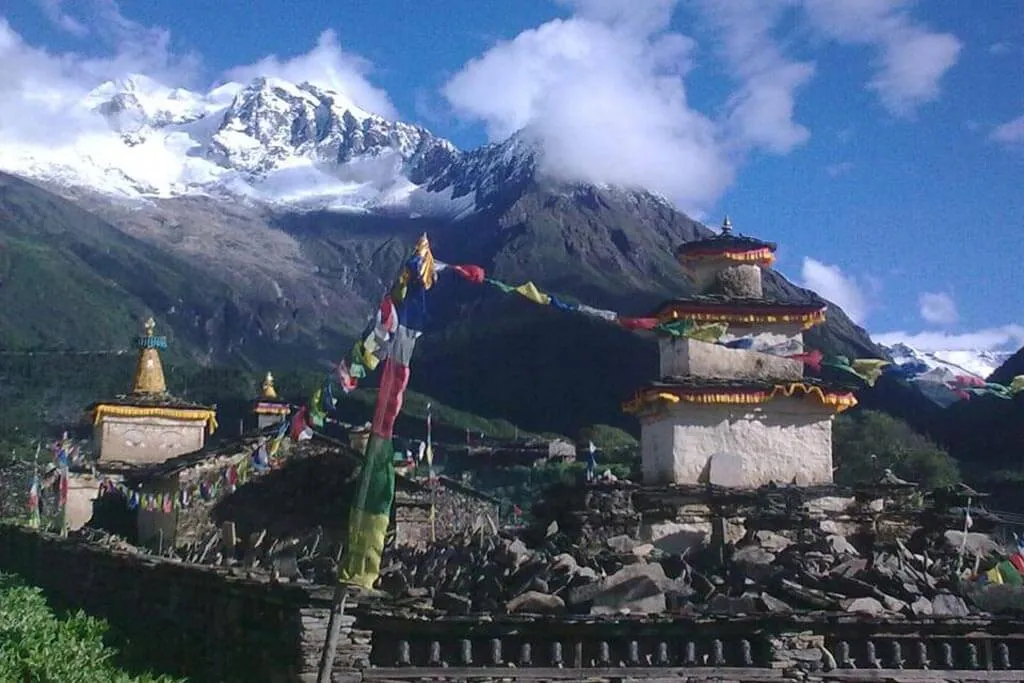
- Samagaon Village Photos: Capturing the charm of traditional houses built from local stone and adorned with fluttering prayer flags and the unique atmosphere of locals living their everyday life among the majestic Himalayan peaks.
- Suspension Bridges Photos: Unique opportunities for taking pictures of thrilling suspension bridges using cables and ropes above the gushing turquoise waters of the hanging river and the thrilling gorge below in the lower river valleys.
- Ancient Monasteries and Mani Walls Photos: Excellent photo opportunities to capture the fascinating carved stone walls and ancient prayer wheels along the trail and take pictures of monasteries as sacred symbols of the Nubri culture.
- Terraced Slopes and Subtropical Valleys Photos: Perfect for taking photos of a transition from a valley of rich greenery to the vastness of the upper part of the village with extensive pastures for yak and glaciers.
Manaslu Base Camp
Manaslu Base Camp is a marvelous high-altitude alpine environment located at around 4,400 to 4,800m above the sea level exactly at the base of the 8th highest mountain on earth on the most rugged Himalayan frontier of Nepal. To experience such an amazing place on the classic trek route, most of the hikers will undertake a pleasant side-trip through the traditional village of Samagaon where the trail diverges off the main route and begins to ascends beyond the formidable moraine walls, and the loose scree slopes and glacier chutes that after a number of indications lead to an elevation of a few meters higher above the mean magnitude of the dark icefalls and giant rock faces. Though, the most optimal viewpoint for photographs and panoramics has to be above the ridge of the upper basin, from where the gigantic hanging glaciers, seracs and shining ice walls provide a great composition for the camera to grasp the nature's grandeur. From here, trek with unparalleled access and views to this spectacular, rugged beauty, revealing the brutal landscape traversed by world-class mountaineers targeting the peak.
Birendra Lake
Birendra Lake is a magnificent aquamarine lake on the main trail, is itself situated by the edge of the Manaslu Glacier in the Gorkha district of Nepal, about 3,691 m (12,129 ft.) in altitude. On the standard trek itinerary, it's usually incorporated as a necessary acclimatization side trip from Samagaon village either 45 minutes or an hour of grueling steep upward hike, flanked on both sides by mani stone walls and rough moraine ridges. For the best, most elevated view and ideal camera shot angle, try to ascend the loose gravel ridge along the east coast of the Lake, a vantage point that casts a view of the lake and surrounding terrain from the make-believe height of the mountains high above. In the background of this glacial basin, the massive ice-covered ridge wall and sprawling hanging glaciers of Mount Manaslu hover and loom amidst a breathtaking scene.
Larkya La Pass Crossing
Larkya La Pass Crossing is the last physical and mental challenge of the entire expedition. It is situated at a very high altitude which is measured between 5,106-5,167 meters in the north-central region of Nepal. To reach the final crossing point of the trek as defined in the normal itinerary it's necessary to begin a strenuous pre-dawn ascend from the isolated mountain refuge of Dharmashala, up a treacherous icy and snow-washed moraine trail battered by ferocious winds at the earliest hour of the morning. So for the best angle of photographs of the final pass, the camera needs to be deployed from the windy sheer summit of the pass itself, on the network of prayer flags, to behold the extensive sweep of all encompassing valleys and summits like Himlung Himal, Cheo Himal, Annapurna II, and the huge glaciers of Manaslu.
Views of Mt. Manaslu, Himlung Himal & Annapurna II
Incredible views of Mt. Manaslu, Himlung Himal range are a feast for the eyes which covers some of the most breathtaking highland peaks in the Himalayas ranging in altitude from 3,700m to the jaw dropping ice capped horizons over 8,100m. On the normal trip itinerary, you get your first sight of these incredible spectacles as you move up to Samagaon, cross the magnificent highland viewing platform of Larkya La Pass and descend into the vast sub alpine valley of Bimthang. But for the ultimate view and picture taking angle, the open glacial moraine peaks at Bimthang and the glaciated final climb over the pass stand out as the most desirable locations to be standing. Here, the cameras will take in the awe-inspiring view of the snow fluted ice walls of Mt. Manaslu, rock and glacier encrusted neighboring peaks of Himlung Himal and the distant, commanding pinnacle of Annapurna II to form one single panoramic image.
Glaciers & the Glacial Cirque
Glaciers are enormous geological features composed of imposing walls of pristine blue ice and expansive amphitheater-shaped valleys at elevations ranging from 4,000 meters to more than 8,000 meters across the higher elevations of the Mansiri Himal range.
As part of the standard itinerary, trekkers will find themselves walking along these glaciers, sometimes just a few meters above them, on their journey from Samagaon toward Samdo and the unforgiving approach to Dharmasala, which follows a massive frozen desert of crusted moraine and raging avalanche gullies. The best photogenic vantage point is from the extremely high terminal moraine knolls that cluster on the outskirts of Samagaon or, for an even more spectacular shot, from across the valley of Bimthang. A telephoto camera lens will then reveal the enormous cirques of Manaslu, rising high on both sides of the mountain and framed by jagged upthrusting rock, ice seracs, and towering crevasses.
Suspension Bridges & the Budhi Gandaki Gorge
Suspension bridges are an exciting network of long steel-cable footbridges suspended hundreds of feet above roiling alpine waterways, all at elevations stretching from approximately 700 meters to 2,500 meters, spread out along the deep lower river gorges of the Gorkha district. These engineering oddities can be seen frequently throughout the early days of the standard trekking route itinerary, on the trek from Machha Khola through Jagat, Philim, and Deng. For the absolute finest vantage point and photographic shot, the best angle is achieved from the cliffside trails just before stepping out onto the bridge deck, with the camera aimed across the gorge to frame the narrow, sheer rock walls. The camera can capture the vertiginous drop to the frothing turquoise Budhi Gandaki River below and showcase the vibrant, wind-whipped prayer flags fluttering through the canyon.
Monasteries: Pungyen Gompa & Sama Gaon
Monasteries are a stunning array of ancient, highly spiritual Buddhist sanctuaries, including Pungyen Gompa and village shrines, which are located at precisely the same elevations, from 3,500 meters to more than 3,800 meters above sea level, across the distant forbidding high-altitude valleys in the Gorkha district. To experience these cultural treasures on the standard trekking program, travelers must undertake a vital day hike from the main settlement of Samagaon over yak meadows and tough moraine tracks that slope directly under the soaring south face of Mount Manaslu. To obtain the absolute best photographic vantage point and shot composition, the perfect perspective can be obtained from the grassy prominence just in front of Pungyen Gompa, as the lens peeks back down into the monastery compounds themselves with enormous hanging glaciers rearing against the sky. From this vantage point, the camera lens easily and terrifically captures variously colored prayer flags contrasting against the time- and space-warping snow-encrusted high mountain wilderness, alongside traditional stone architecture and revered mani stones.
Samdo Village & the Tibetan Border
Samdo Village is a Tibetan refugee village located on a high Himalayan plateau 3,875m in altitude on the Nepal-Tibet border just a few kilometers from the historical Tibetan border. The approach is from Samagaon, up the trail steeply up past the desolate yak grazing fields and the remnants of old Tibetan trade routes, for a 3 to 4 hour walk of scenic views. For the best viewpoint at the optimum photographic angle hikers should climb to the low ridge just behind the village settlement which faces north towards the high passes into Tibet. From this vantage point a panoramic shot frames of broad wind scratched Himalayan peaks, herds of domestic yaks grazing, and rustic stone walls, hemmed in by traditional flat roof stone houses.
Wildlife: Himalayan Tahr, Marmots & Snow Leopard
Wildlife is indeed a delicate collection of such impossibly exotic, rare Himalayan high-altitude species as the mysterious Himalayan Tahr, the known alpine marmots and the famed snow leopard, all surviving across protected zone elevations (3,000 meters to 5,000 meters). On the base trekkers' typical itinerary, they'll often make fortuitous sightings of the protected animals as they cross the decrepit cliffs, the rocky scrubs, the alpine highs between Deng, Samagaon, and the high-altitude Suikimla approach toward Dharmasala. In pursuit of the most sublime sight and optimum photograph posture, it's best to hike the nature trail with telephoto and glass toward the main trail and scan the steep, rocky cliff faces and broken ridgelines where these animals sunbathe and forage from time to time. From this excellent portrait square, astute trekkers will snap unlikely native fauna traversing exposed, vertical rock faces in their natural adaptation to the treacherous, freezing conditions of the upper Manaslu conservation sector.
Nubri and Tsum Communities
Nubri is a unique indigenous cultural group living in secluded high-altitude river valleys at precise settlement altitudes of 2,000 meters above sea level to 4,000 meters. The Nubri people are encountered by tourists during the spiritual and adventure trekking circuit as it passes through traditional villages Deng, Namrung, and Samagaon. The most crucial photo opportunity arises when capturing the village people working in their terraced fields or at the village gate leading to the valley floor. Perfect shots are obtained when shooting from the edge of cultivated plots or the village gate looking onto a valley of neatly arranged traditional hand-woven woolen garments, chortens, and mani stones with smiling faces of valley inhabitants welcoming visitors to the pristine land unaffected by modern civilization.
Manaslu Circuit Trek Difficulty
The Manaslu Circuit Trek is graded Moderate to Challenging.
The area is remote, the trail terrain rugged, daily distance travel feels long and the altitude profile quite high. In fact, given the 14 day duration, it's a physically demanding Himalayan trek that tests endurance and strength due to daily walking hours of 5–7 on uneven stone staircases, over suspension bridges, and along narrow, precariously perched ledge paths. As the trail ascends higher up into the mountain air, the physical demands increase because of this, trekking here takes a delicate, disciplined pace and hydration. The highest physical challenge experienced during the entire trek is crossing the 5,106–5,167m Larkya La Pass, where during freezing cold, pre-dawn hours, scaling high winds and snow/ice thick in the air surround you, demand a steely inner resilience and exceptional cardio.
The final and arguably largest physical barrier to the whole trek will be the crossing of the high pass of Larkya La Pass, which is at 5,106–5,167 meters. This will test all your mental and cardiovascular power to the greatest extent, as you will have freezing low temperature pre dawn and strong winds, as well as possibly snow, ice and rocks. With the altitude and exposure, AMS is a real danger on the very remote path, so we spend acclimatisation days at Samagaon and Samdo with the objective that the body adapts itself before getting closer to the base camp of the pass.
With rescue facilities practically nonexistent in this confined border area, extensive prior trekking experience over 3,000m is highly recommended. The trekking should be supported by months of cardio training, stair climbing and general conditioning to be able to cope with the non-stop ups and downs of the Trek. Lastly, though no climbing ropes or gear are necessary for the typical route, due to the rugged, isolated terrain, volatile weather conditions and rigorous altitude/effort, one needs to have a healthy respect for mountain-going and be prepared for a serious Alpine challenge.
Is Manaslu Harder Than Everest Base Camp?
Manaslu Circuit is more difficult than the Everest Base Camp Trek in terms of its extreme isolation that comes with the high altitude, as well as the restricted regulations and passes that Himalayan climbers have to deal with.
Comparison Factor | Manaslu Circuit Trek | Everest Base Camp Trek |
| High Pass Crossing | Involves a technical Larkya La Pass crossing (5,106m) with steep, icy slopes. | Non-technical pass trek with a straightforward out-and-back trail route. |
| Infrastructure & Rescue | Has fewer teahouses and rescue posts due to restricted area regulations on Manaslu. | Offers superior tourist infrastructure with more medical facilities and air rescue options. |
| Maximum Elevation | Reaches approximately 5,106–5,167m at the high mountain pass summit. | Reaches 5,364m at Kala Patthar, providing greater exposure to thin mountain air. |
| Guide & Permit Rules | Requires a local licensed guide along with special restricted area permits. | TIMS and Sagarmatha permits apply, with a guide optional for independent trekkers. |
Is Manaslu Harder Than Annapurna Circuit?
Manaslu Circuit is often rated harder than the Annapurna Circuit, mostly because it's more rugged, under restricted status, and has very basic infrastructure for the trail itself, forcing more self-sufficient trekking.
Comparison Factor | Manaslu Circuit Trek | Annapurna Circuit Trek |
| Highest Mountain Pass | Crosses the Larkya La (5,106–5,167m) through remote glacier terrain. | Crosses the Thorong La (5,416m), which is higher but has broader and more established paths. |
| Modern Development | Retains its wild character as Manaslu remains a restricted area with less infrastructure and development. | Road access has reduced trekking days across several sections of the Annapurna Circuit. |
| Administrative Controls | Strict regulations require a licensed guide to protect the fragile valleys and restricted-area environment. | Offers greater independence, without a mandatory professional guide requirement. |
| Route Isolation | Provides a more isolated wilderness experience, with fewer major motor roads along the trekking route. | Intersects more frequently with jeep tracks, road sections, and modern commercial settlements. |
Which Is the Toughest Trek in Nepal?
The toughest treks in Nepal include an exclusive class of challenging, isolated, and dangerous mountainous routes. These routes test the skills of even the most experienced mountaineers. According to Himalayan mountaineering guides and regional mapping authorities, the routes are evaluated in terms of elevation, remoteness, and technical pass difficulty.
Manaslu Circuit Trek: challenging restricted-area route passing across the difficult Larkya La Pass (5,106–5,167m), while enjoying the highest level of remote dispersion over the valley.
Everest 3 passes trek: a tough trekking through the Khumbu region across three high-altitude (>5,000m) passes consecutively - Kongma La, Cho La and Renjo La.
Upper Dolpo Trek: a wild crossing through an isolated, trans-Himalayan wasteland, through barren passes above 5000m, practically without any facilities.
Kanchenjunga Circuit: Massive long multi-week eastern trek notorious for its punishing length, arduous trail conditions, and brutal seclusion at one of the world's three highest points.
Who Can Join the Manaslu Circuit Trek?
The Manaslu Circuit Trek suits and is tailored towards a particular category of adventurer who is willing to test their physical and mental skills against the might of the Himalayas. As it goes around one of the highest peaks in the world and involves crossing through restricted areas, that trail requires a visitor to be not only physically active but also somewhat experienced. For someone who is reasonably fit and has high-altitude trekking experience, they would be able to do this trekking trail without a problem, but to whom not in the habit of rigorous mountain climbing should take serious preparation.
In general Manaslu Circuit is a medium trekking destination, and it can be quite seriously challenged by those ready to confront its inclined nature. The physically strong family with teen/adult kids who are already accustomed to a mountain landscape could consider climbing with careful planning. Those willing to complete this demanding trail must remember that they will need to constantly keep their bodies hydrated throughout the expedition as well as pace themselves on the higher altitudes.
Due to Nepal’s restrictive immigration policies, solo adventurers will be required to either find a trekking partner or hire an official licensed guide in order to complete the Manaslu Circuit. As such, it is vital to either bring a companion or contact a local agency that can sufficiently organize a multi-sided permit for a reasonable price.
In the end, anyone willing to complete this formidable challenge will need to bring along their fitness and mental sharpness with them to the higher altitudes. With the right preparations and a competent crew to rely upon, this magnificent adventure will reward those who seek it with breathtaking views of one of the highest summits on the planet.
Manaslu Circuit Trek for Beginners
Manaslu Circuit Trek is an ambitious adventure that requires a certain level of preparation and a realistic assessment of one’s physical and psychological limits before attempting it, which novice hikers should consider. Although it does not require any mountaineering skills or technical expertise on the ropes, previous experience trekking at elevations above 3,000m is highly advised to get a rough idea of how the body will react to the challenging environment the trail lies ahead of the travelers.
In order to know for sure if your current level of conditioning is sufficient for the upcoming trip, you can try doing some practical fitness test examples. These may include such adventurous activities as hiking four hours up an incline with the help of a day pack, running three miles nonstop or climbing twenty flights of stairs without getting exhausted to the point of vomiting. To develop a successful prep schedule, it is vital to know that total beginners should start preparing a minimum of three to four months before the scheduled date of the flight to Nepal. This would give time to build up core strength and for your legs and feet to get used to wearing big, heavy boots to wander around the countryside trails! So have your walks, admire the views, and get healthier and safer.
Manaslu Circuit Trek Solo (With or Without a Guide)
Manaslu Circuit Trek is a completely restricted wilderness conservation area under Nepal Immigration law, which requires a licensed guide by restricted area regulation for all foreign visitors entering the region. Due to these administrative and safety policies, solo hiking without a guide is not allowed, and those who try to hike the Manaslu Circuit Trek independently without any assistance will be blocked at official checkpoint stations. However, the latest policy changes now allow single travelers to get a restricted area permit without a partner as well, and a popular private guide trekking option is available where one can hire a guide and trek at one's own pace. This way, it is the best of both worlds for solo adventurers who want to have full control of their own trip, but still want the help, permit assistance, interpretation and emergency support during the isolated mountain passes, as only a certified local professional can provide while remaining 100% legal from beginning to end.
Manaslu Circuit Trek for Solo Female Trekkers
Manaslu Circuit Trek is an incredible wilderness experience for an independent woman who wants to make sure she takes all precautionary measures and has professional assistance when exploring the challenging high-altitude region. The remote areas of the Nubri and Tsum valleys are populated by ever-modest people who are used to entertaining and feeding their guests. This cultural experience is marked by a high degree of comfort, as all the villagers treat their guests with respect, kindness, and compassion. The tea houses are a great place to meet people in the evenings, as there are communal rooms where participants can enjoy a warm and friendly atmosphere of a gathering. However, you also have a private room option, which may be more suitable for you if you wish to have more privacy, intimacy and comfort so as to relax and recharge at the end of the day after climbing the mountain for so long. It also gives a sense of independence as the lady traveler would feel secure to travel in the mountains with a professional guide and porter-guide. That way, she will have the help of her well-spoken English guide at all times and thus also not have to worry about such trivial matters in these remote terrains. The Manaslu Circuit Trek attracts women to the Himalayas so they can see the majesty of these incredible mountains, keep the protection of their guide constantly, and enjoy the fullest sense of self-confidence.
Manaslu Circuit Trek for Families with Kids
Manaslu Circuit Trek is a remarkable, worthwhile family adventure, but there needs to be serious consideration given and accurate expectation management about what your family (children) will encounter regarding the challenges of exploring the high-altitude Himalayan backcountry wilderness. To best guarantee success, seasoned outfitters create highly personalized, specialized itineraries designed around considerably lesser walking times, minimal altitude increases each day, and ample, important downtime for physiologic adjustment and acclimation.
Parents must be mindful of expert minimum age advice, as this taxing route is generally only advisable to hearty and active teens and older kids who clearly demonstrate enduring abilities for trekking outdoors, psychological fortitude and a genuine penchant for boondocking through the Himalayas. Making certain there is a deliberate family-conscious progression is essential throughout the hike, giving them sufficient downtime, plentiful chances to hydrate, a profusion of snacks along the way and opportunity to confidently visit engaging cultural spots including age-old Buddhist convents, precariously perched swing bridges and the like before exhaustion sets in. Coupling these crucial modifications to the excursion with the invaluable utilization of porter service for cumbersome rucksacks can help an often-gruelling, mountainous test into a joyous, achievable and enlightening, life-enriching family escapade with unparalleled views atop the eighth-tallest mountain on Earth.
Manaslu Circuit Trek for Seniors
The Manaslu Circuit Trek is, in essence, a fully accomplishable and incredibly satisfying high-altitude trek. Older, but still active trekkers can safely complete it with the right level of vigilance towards the wild and unfamiliar altitude environment, with appropriate preparation and expert supervision. The rate of drop in oxygen availability as altitude increases and while one climbs toward the Larkya La Pass is extreme; daily, intensive observation via a pulse oximeter to catch symptoms early will prevent symptoms of altitude sickness from becoming severe. Given potential cardiac implications and the increased physical demand, the selection of slower itinerary options-always with generous acclimatization days, shorter hiking days, and gentle altitude gains- is an absolute necessity for older trekkers.
A medical check-up before the event is also advisable to assess the current state of one’s heart and to ask for preventative medicines from the doctor in case of altitude sickness. Discussing insurance and emergency evacuation options with the doctor can also help determine if everything is in order in the case of an emergency. Considering these health and acclimatization factors and hiring a personal guide and porter can allow aging hiking enthusiasts to experience the magic and rewards of exploring this part of the world while enjoying the beauty of nature and the friendly faces of the local people from start to finish.
Fitness Requirements & Preparation Timeline
Fitness preparation for the Manaslu Circuit Trek should start months in advance to build up sufficient stamina and strength to cope with the extreme conditions of the high-altitude Himalayan mountain ranges and remote wilderness hikes.
- Fitness preparation for the Manaslu Circuit Trek should begin months in advance to build up sufficient stamina and strength to cope with the extreme conditions of the high-altitude Himalayan mountain ranges and remote wilderness hikes.
- Cardio training 8–12 weeks prior to departure: Prep the heart and lungs for the strenuous climbs up and down rugged trails by doing frequent running, biking, rowing or swimming sessions at least 4 to 5 days a week.
- Hiking with a loaded pack: Test core, back and shoulders regularly by going on a weekend day-hike up and down the mountain on steep trails while carrying a 15 to 20 pound pack.
- Previous trek above 3000m strongly suggested: Let your body adjust to what trekking on uneven stairs is like (rock climbing), staying warm in cold conditions and adjusting to the demands that the 3000m+ altitude takes.
- Mental preparation for remote conditions: Prepare the mind to get used to the minimal comforts of a teahouse stay, unpredictable mountain weather changes and walking for many hours daily without the expected facilities.
- 30/60/90-day structured training plan: Go through a training schedule that uses incremental milestones to gradually build up leg muscle power, stability, and cardiorespiratory endurance in preparation for the Manaslu Circuit Trek's launch day.
Who May Find This Trek Challenging?
Trekkers who may struggle on this trek include those whose background medical, physical, or lifestyle choices are completely antithetical to the raw, rugged, and remote conditions encountered on this hike in the far Himalayas, and people suffering from heart, lung, or blood pressure conditions.
- Those with heart, lung, or blood pressure conditions: Any problem related to those conditions in the heart, lungs, and blood pressure is life-threatening due to low oxygen concentration as well as lack of immediate medical facilities at those altitudes.
- Pregnant travelers: Travel for pregnant travelers is a very dangerous condition to put them and their babies through in an environment where they are at a high risk of unpredictable, sudden acute altitude sickness with no local medical resources available.
- Travelers with reduced walking capacity: travelers who lack the strength and capacity for a long hike will have severe problems with the trail, which consists entirely of stairs and rock climbing, where there will be numerous sheer dropoffs in rocky cliffs and on loose scree and moraine slopes.
- Those wishing to travel in luxury: Teahouses along the remote circuit have rustic communal sleeping quarters with minimal heat, cold communal bathrooms, and minimal accommodations overall.
- 14-day time commitment: Any traveler unwilling to safely and completely disengage from work obligations or other life commitments for a strict two-week time frame will find the rigid itinerary impossible to adjust.
Larkya La Pass: The Highest Point of the Trek
Larkya La Pass sits at 5,106 to 5,167 meters above sea level, is the ultimate challenge, the most intimidating obstacle, as well as the last and most awe-inspiring goal on the legendary Manaslu Circuit trek. Only the most determined, well-prepped, and physically powerful adventurers can complete this grueling uphill trek to the top of the mountain and return due to the extreme altitude, shifting weather conditions, and unpredictable afternoon clouds that make the morning ascent mandatory.
Furthermore, hikers must wake up early before daylight breaks and set off on the most difficult leg of the trek – a steep climb up the mountain’s slope. In addition to getting up while still dark, early in the morning that they are trekking (3 to 4 am from wherever you were stopping in Dharmashala overnight), when scrambling over the final slick steps and icicle coated moraine on the pass they will be using a special micro crampons or chains attached to climbing boots in an attempt to make a deadly slippage on blue ice impossible. After trekking ten painful hours across an iced crest to get to it and back, the view from the Larkya La Pass is outstanding for those who achieve it. A panorama of the snowy Himalayan range spreads for 360 degrees while close-up views are outstanding of Cheo Himal, Himlung Himal, Nemjung, Gyaji Kang, Kang Guru and, in the far distance, the Annapurna II massif. From your high camp, it will take roughly ten hours to reach the Larkya La Pass summit and then several more hours to make your way down the mountain’s long and rocky descent to Bimthang.
Altitude, Snow & Crossing Difficulty
Larkya La Pass crossing involves the most challenging, unpredictable, and rigorous alpine conditions in the high Himalayas in the hiker's path. Maneuvering through uneven, snowy, and slippery terrain filled with hidden crevasses and patches of blue ice that threaten to make a person slip on the narrow ridge, pushing yourself through this high altitude with a severe, compounded AMS risk at 5,106m+, that could quickly incapacitate an unprepared climber if proper acclimatization protocols are not followed, and contend with arid weather that makes the crossing virtually impossible after mid-morning. The passage is routinely battered by howling winds and blinding snowstorms that drop temperatures to dangerous sub-zero levels by the afternoon. The final ordeal of a punishing descent difficulty to Bimthang, traversing thousands of feet of loose scree, steep moraine walls, and packed glacial ice that tests the endurance of joint muscles to their absolute limit also awaits the determined hiker.
Required Gear for Larkya La Pass
Crossing Larkya La Pass requires, a thorough packing list that will keep you alive, healthy, comfortable, and protected throughout cold conditions through the chilly nights that dip well below zero degrees, in the upper sections of the mountain where you may be hit by wind, and negotiate dangerous ice crossings at over 5000m.
- Micro crampons or microspikes:These are steel traction devices that are affixed to your big mountaineering boots and act to protect you from slipping, sliding or a lemming–caliber fall when crossing near-vertical frozen blue ice fields and ice-hard snow ridges.
- Microspikes or micro crampons: A device that fixes to the mountaineering boots to improve grip on the slippery icy surfaces of glacial blue ice and scree areas and not risk an unnecessary accident on treacherous slopes.
- Trekking poles: strong aluminum or carbon trekking poles with flick locks to reduce hand fatigue while providing the necessary power and balance on the rough and uneven moraine ground and help your knees while descending for several hours.
- Headlamp for early departure: a high-performance front light with lithium batteries or another power source you can trust to have enough energy to see a clear path on a dark and frigid alpine trail beginning at midnight or 3 am.
- Windproof/waterproof layer: a hardshell jacket and pants made of high-performance GORE-TEX fabric to protect you from the elements and keep you warm while fighting the powerful mountain winds and the cold and dry snow that may frequently occur in the Himalayas.
Views from the Top of Larkya La Pass
From the top of Larkya La Pass, trekkers see a dazzling and panoramic view of giant Himalayan peaks jutting up into the alpine sky with the clear atmosphere. The mountain range seems to stretch over the great mountain boundaries while climbers enjoy a great view of the ice wall of Cheo Himal shining under the sun in front of their eyes. The northern sky looks majestic with the snowy Himlung Himal and the bold pyramidal face of Nemjung in the surroundings, with Hanging Glacier and a rock cliff. Gyaji Kang and the majestic massif of Kang Guru in the background followed by the titanic southern face of Annapurna ii on the further end, make a grand landscape view of the Himalayas for the trekkers.
Larkya La Pass vs Thorong La Pass
Larkya La Pass differs from Thorong La Pass in terms of peak height, geography of the region, trail structure and the level of sheer physical strain required.
Comparison Parameter | Larkya La Pass | Thorong La Pass |
| Elevation & Region | Larkya La: 5,106–5,167m, Manaslu Circuit | Thorong La: 5,416m, Annapurna Circuit |
| Crossing Duration | Requires a grueling 8–12 hours of continuous trekking from Dharamsala across the crest to Bimthang, including long and difficult moraine descents. | Typically takes 7–10 hours from Thorong Phedi or High Camp across the summit and down to Muktinath via a shorter, steeper descent. |
| Infrastructure & Density | Features very sparse infrastructure and teahouse density, with remote, basic wilderness lodges, few modern facilities, and highly isolated emergency rescue logistics. | Has a very high concentration of infrastructure and teahouse networks, with numerous modern accommodation options, well-connected routes, and established evacuation options. |
Manaslu Circuit Trek vs Other Treks in Nepal
When comparing this trek to other treks in Nepal, you can see that the combination of isolated Himalayas, strict adherence to restricted areas, preservation of Tibetan Buddhism culture, and difficult passes sets this apart from all others. While evaluating your options for taking on one of the major treks along the Himalayas, it’s important to consider whether each will meet your own ability level, constraints around time, preference towards crowding, and if they have restrictions similar to those found on the Manaslu Circuit Trek.
Below are some key distinctions regarding the structure of both treks when compared against other top-rated ones throughout all regions covered within Nepal.
| Trek Name | Maximum Elevation | Duration (Days) | Permit Type Required | Guide Requirement | Crowd Level & Regional Atmosphere |
| Manaslu Circuit Trek | 5,167 meters | 14 to 18 Days | Restricted Area Permit (RAP), MCAP, ACAP | Mandatory licensed guide required by law | Moderate to low crowds, highly remote wilderness, authentic teahouse culture |
| Tsum Valley Trek | 3,700 meters | 12 to 16 Days | Special Tsum Valley Restricted Permit, MCAP, ACAP | Mandatory licensed guide required by law | Low crowds, deeply spiritual, ancient Buddhist monasteries, secluded hidden valleys |
| Annapurna Base Camp | 4,130 meters | 7 to 12 Days | Annapurna Conservation Area Permit (ACAP), TIMS Card | Optional, independent trekking permitted | Very high crowds, heavily developed tea house infrastructure, alpine amphitheater views |
| Langtang Trek | 3,870 meters (or 4,984m via Tserko Ri) | 7 to 10 Days | Langtang National Park Permit, TIMS Card | Optional, independent trekking permitted | Moderate crowds, easily accessible from Kathmandu, stunning glacial valley scenery |
| Manaslu Base Camp Trek | 4,800 meters | 12 to 15 Days | Restricted Area Permit (RAP), MCAP, ACAP | Mandatory licensed guide required by law | Low crowds, dramatic close-up glacier views directly beneath Mount Manaslu |
The trek of your choice is dictated largely by whether you are seeking the buzzing, social scene and amenities of well-traveled treks such as Annapurna Base Camp or the untamed, controlled peace and cultural integrity of life on the border of Manaslu.
Manaslu Circuit Trek vs Annapurna Base Camp
Manaslu Circuit Trek differs from Annapurna Base Camp in almost every aspect apart from the basic logistics; hence, it’s important to be aware of these differences before signing up for the trek in the Himalayas.
Comparison Category | Manaslu Circuit Trek | Annapurna Base Camp |
| Duration Comparison | Calls for an intense 14 to 18 days of continuous physical effort to complete the entire remote circuit trail loop. | Includes a shorter trekking portion of 7 to 12 days, which suits travelers with limited time off from work. |
| Altitude Comparison | Completes the daunting high altitude pass on Larkya La Pass (5167m close to 5km). | Reaching moderate high altitude of 4130m on amphitheatre of high peaks. |
| Permit & Guide Comparison | Requires RAP (Restricted Area Permit), MCAP, and ACAP, and by law requires hiring a guide through a registered agency. | Requires generic regional access authorization such as ACAP and a TIMS card, allowing independent trekking. |
| Crowd Level Comparison | More remote trekking experience with a much more peaceful, and less populated trails and tea-house atmosphere. | Much busier teahouses and social life, and endless backpackers 365 days a year! |
Manaslu Circuit Trek vs Langtang Trek
Manaslu Circuit Trek differs from Langtang Trek including total days of treks, maximum height of the mountain, required permits, number of people seen on the way, and many other features.
Comparison Category | Manaslu Circuit Trek | Langtang Trek |
| Duration Comparison | Needs a 14 – 18 days marathon high altitude trekking in order to finish the entire Remote Alpine Circuit Loop. | Relatively short duration trek of just 7 – 10 days, so can be accomplished by shorter holiday time too. |
| Altitude Comparison | An extremely tough and brutal high altitude pass reaches the very highest point of 5167 m, so requires excellent physiological acclimatisation. | High points on this route are somewhere in the range of 3,870 meters (in Kyanjin Gompa). If one is interested, then one can take some additional hike which reaches up to 4,400 meters (like Tserko Ri). |
| Permit & Guide Comparison | Restricted Area Permit (RAP) is exclusively needed together with ACAP/MCAP. It obliges a licensed guide without any doubt. | Just require a Regional Entry Permit (Langtang NP permit only); no guide is needed also. |
| Crowd Level Comparison | The number of trekkers is lower to moderate since permits restrict the movement. Trek offers wilderness. | This is one of the well-trodden trails, so has few people, but still has warm teahouses with a communal feel with Kathmandu vicinity. |
Manaslu Circuit Trek vs Manaslu Base Camp Trek
Manaslu Circuit Trek differs from Manaslu Base Camp Trek primarily in two areas: the scope of the route taken, the overall area explored on the geographical objective, and the total endurance required to undertake each trek. Specifically, one of the most notable differences between the Manaslu Circuit Trek and Manaslu Base Camp Trek concerns whether the upper alpine pass is taken on the circuit or not.
Comparison Category | Manaslu Circuit Trek | Manaslu Base Camp Trek |
| Duration Comparison | Takes a considerable time: 14 to 18 days for the whole circular path in and out around the giant Manaslu range with bordering lands. | The shortest duration it takes: 12 to 15 days, since the concentration is on reaching the vicinity at the foot of the mountain range instead of the full loop. |
| Altitude Comparison | Peaks the super high-altitude Larkya La Pass at a sheer highest 5,167m. | Reaches up to 4,800m of altitude at the BC and therefore you do not feel the physiology of extremes from high pass elevation. |
| Permit & Guide Comparison | Entails the same compulsory requirement for restricted area permits (RAP) as well as for MCAP, ACAP, and for a licensed guide as per the law. | Strict legal regulations, same RAP, and a professional licensed guide are needed by law. |
| Crowd Level Comparison | Draws in a smaller and moderate number of trekkers, which are dispersed throughout the multi-day trail loop, a constant circular progression. | Extremely fewer crowds and more of a specialized wilderness experience centered purely on the glacier vicinity. |
Manaslu Circuit Trek Itinerary
The Manaslu Circuit Trek from Pokhara itinerary includes travel management details on treks beginning/connecting through Nepal's beautiful lake city; normal circuit routes follow Kathmandu, Soti Khola trails.
Day & Route Segment | Night Altitude | Daily Walking Hours | Variant Suitability |
| Day 1: Arrive in Kathmandu | 1,300m | N/A (Arrival) | The international traveler for gear checks, permit application, and briefing. |
| Day 2: Drive to Soti Khola | 710m | 7 to 8 hours (Drive) | The trekker ready for longer, bumping transport riding rough rural mountain paths. |
| Day 3: Soti Khola to Machha Khola | 930m | 5 to 6 hours | The hiker is accustomed to damp mid-valley walks, suspension bridges over streams, and stone steps to towns. |
| Day 4: Machha Khola to Jagat | 1,410m | 6 to 7 hours | The fit hiker approaches the permit checkpoint boundary on the road through the restricted zone. |
| Day 5: Jagat to Deng | 1,860m | 6 to 7 hours | The expedition climber ready for change from open country to rising pine woods, over narrowing gorge. |
| Day 6: Deng to Namrung | 2,600m | 5 to 6 hours | The culturalist is ready for first glimpses and access to clearly distinct Tibetanoid Nubri village sites. |
| Day 7: Namrung to Sama Gaun | 3,530m | 5 to 6 hours | The climber heading towards sub-alpine country, with views toward spectacular Manaslu. |
| Day 8: Acclimatization at Sama Gaun | 3,530m | Rest / Day Hike | The trekker is ready for crucial physical rest, optional side trip to Pung Gyen Gompa. |
| Day 9: Sama Gaun to Samdo | 3,860m | 3 to 4 hours | The hiker ready for brief, easy climbs to Tibetan borderlands from a valley. |
| Day 10: Samdo to Dharmasala | 4,480m | 4 to 5 hours | The trekker who mentally prepares for summit attempt over high pass. |
| Day 11: Dharmasala to Bimthang via Larkya La | 3,720m (Pass: 5,106m) | 7 to 9 hours | The ultra-marathon trekker in serious high-altitude conditions with challenging high passes. |
| Day 12: Bimthang to Dharapani | 1,960m | 5 to 6 hours | The descend trekker in immense green woodlands along large, roaring glacier streams. |
| Day 13: Drive to Kathmandu via Besisahar | 1,300m | 7 to 8 hours (Drive) | The traveler who finishes the trip via unpaved return highway to Kathmandu. |
| Day 14: International Departure | N/A | N/A (Transfer) | The inbound flyer whose trip into the Himalayas has now finished, bearing long-term impressions. |
Elevation Profile
Manaslu Circuit Trek Itinerary
Upon your arrival in Kathmandu on Day 1 your mountain adventure officially begins as you embark and settle into Nepal’s incredibly vibrant and exciting capital city.
Airport transfer - on your arrival at Kathmandu International Airport, outside Arrivals, our jolly English-speaking Nepali team will be holding a clear signboard displaying your name and will arrange safe and comfy transport to your lodge for the day. Travel fatigue will melt away.
Hotel check-in - you'll settle into the warmth of your friendly, centrally-located hotel in Thamel. The bustling capital provides many fine restaurants, stores selling warm clothes and accessories, and tranquil hidden garden courtyards in which to rest and contemplate your coming adventure.
Gear check and shopping - your trek guides will help you check all the equipment you are bringing and let you know whether your essential cold-weather clothing and strong trekking boots are adequate and whether you will need any additional warm layers. If needed, time will be allotted to buy/rent items from the multitude of stores found in Thamel.
Trek briefing and licensed guide: In the evening, you will take part in an orientation talk led by your fully certified mountain guide in the convivial atmosphere of a welcome dinner. Here, they will clarify the important safety procedures, what you can expect on the trail day-to-day, altitude sickness prevention, and how your route will unfold, and so forth.
On Day 2, trekkers take a drive from Kathmandu to Machha Khola, passing through rural roads and dusty tracks, discovering the variety of the Nepalese lowlands, rivers, and rural agriculture.
Trishuli River and Budhi Gandaki River route: The drive to the trailhead from Kathmandu passes by rivers rushing by white water rapids to the north. You would see lively roadside eateries, verdant valleys, and great rock architectures owing to natural dams.
Arughat: It is a local community trading point, from where the road branches into the pristine wild regions of Manaslu Conservation Area. Moreover, your drive continues for some time and reaches the end of the tarmac road, and your trek starts.
7-9 hour long trip: This simply implies that you do have your Kathmandu to the trailhead drive in a day at your will, along with a thrilling, bumpy journey. In fact, experienced trekkers get scared sometimes.
Public bus vs private jeep (CTA upsell): Here hikers can choose between a public bus and a more private and comfortable option of a private jeep, which allows for flexibility and takes photos of the amazing landscape.
Teahouse overnight: The drive ends in a small village, where the hikers can relax and have a hot meal in a local teahouse, while getting prepared for the next day's adventure.
Further deeper into the gorge, the trail becomes more exciting and thrill with the existence of more suspension bridges and ethnic villages.
Khorlabesi: The walk is along numerous ups and downs, mostly gentle throughout, crossing a few villages, pleasant walking through beautiful sub-tropical forests, terraced fields next to friendly local farmers in their tiny hamlets.
Tatopani hot spring: Nice place where tourists enjoy their break after a strenuous trip to such extreme locations and relax themselves with its geothermal hot springs.
Doban: The path is very narrowed to two rivers, from which the trek route proceeds. It has very vertical steps of rock that were carved dangerously on both side walls of the gorge.
Manaslu Restricted Area Checkpoint: Trekkers would get permits checked by authorities from here.
Permit verification: Our guides take care of all formalities at this checkpoint as they have the local expertise to deal with government officials handling permits and visas to trek in this region.
6-7 hour walking time: A full day's worth of walking ahead as this hiking trail keeps the body going on various activities to prepare it for the mountainous terrain further up the trail.
Today you will trek in a spectacular alpine landscape to Deng, passing by a waterfall and the pine ridge with an old village and the style of rich Tibetan traditions.
Salleri: The morning walk is easy through pretty stone villages with plenty of traditional terraced fields of millet. Great opportunity to see beautiful valley views down the deep river gorge of the budding Gandaki River.
Sirdibas: A walk through wide stone paths, which is a busy market village, full of smiling children and Buddhist prayer wheels along the stone wall.
Philim village: The village of Philim is a large Gurung community, which offers a good stop for lunch, with a school, agricultural center, and great valley views.
Suspension bridges: Some of the most spectacular views over the deep river gorges with white water rapids, the bridges are a thrilling experience. Be prepared to test your head and take some great pictures.
6-7 hour walk: Up and down steep slopes with gradual uphill gain will keep you active. It is an easy walk to the last camp near Deng, with cooler sub-alpine forest coming closer.
Day 5 trekkers make their way from Deng to Namrung and leave the tropical valley behind, it widens out into high alpine, a classic scene with the obligatory stupa, pines and huge snowy giants.
Bihi: The course persists amidst peaceful pockets of pines and idyllic rustic timber housing, nestled snugly between the steep granite outcrops on which ice-melt streams tumble in fine, fragile waterfalls.
Ghap: Walkers walk across wooden bridges high above gorges into an area where the Tibetan language, cultural practices and structures pervade everyday life in the village.
Mani walls and chortens: Carefully carved stone tablets with holy Buddhistic teachings are set into the paved way space, whereas renowned prayer chhatris (whitewashed structures) line the way for crowd control.
Greatest one-day net elevation gained: The most physically demanding stage, this ascent to an elevation of nearly 805 vertical meters will require gentle long-distance cruising, frequent hydration stops, and unwavering desire to climb upward.
5-6 hour walking time: A long day of uphill climbs rewards adventurous walkers with a cozy night at bright Namrung, the bustling center of government.
Your day 6 trek from Namrung to Samagaon goes deep inside Nubri Valley amidst awe-inspiring Himalaya giants, antiquity monasteries and archaic Tibetan cultures.
Village of Lho: the morning trek goes uphill through beautiful forested sections, which open into wide Alpine meadows looking straight at fantastic ice spires ahead.
Ribung Monastery: Perched atop a remote mountainside above Lho, this ancient Buddhist monastery is a profound cultural experience and resonates with prayer sounds each morning.
First full sight of Mount Manaslu: Hikers get to enjoy a magnificent, clear first glance of the eighth tallest mountain on earth, sitting atop all the magnificence of the stark northern skyline.
Shyala: Nestled in the valley are charming mountain hamlets hemmed between enormous glaciers and huge snow-capped summits, making an excellent place for a gentle mid-day tea break.
6-7 hour walking time: A longer walk at rising elevation must be managed by a steady pace to arrive at the vast and diverse culture of Samagaon.
Day 7 is a rest day at Samagaon to allow your body to recover valuable energy and adjust physiologically to the altitude before attempting to ascend the very high summit of the upcoming high-altitude mountain pass.
Birendra Lake option (45 min walk): A short side trail leads to a beautiful turquoise glacial lake located just below the huge glacier of Manaslu.
Manaslu Base Camp option (4,800m): An energetic hike will take experienced individuals on an exhausting all-day, high-altitude journey to the formal base camp and look at mountaineering parties beginning attempts at climbing.
Pungyen Gompa option: A deeply rewarding spiritual trek to an old and sacred monastery located within an immaculate glacial valley in front of sheer vertical rock walls.
Why a rest day is vital to crossing Larkya La safely: A red blood cell count can acclimatize itself to reduced oxygen concentrations by as much as it is humanly possible. This significantly minimizes any health and physical risk of Acute mountain sickness.
On Day 8, trekkers trek from Samagaon to Samdo up high alpine valley trails that approach the Tibetan frontier and cross through vast yak pastures and old trade routes
Open yak pastures - From time to time the trail winds into broad glacial valleys dotted with shaggy long-haired yak grazing under massive outcrops and moraines. Tibet border nearby - Merely a few kilometers away from the traditional border of Tibet, Samdo is a refugee trading post steeped in hundreds of years of Himalayan culture.
3-4 hour walking time: a short, easy walking day provides valuable time to acclimatize, and for afternoon rest and personal exploration of this fascinating remote border village.
This day involves a trek through high-altitude desert-like country that is quite windy and goes steadily upwards until it reaches the base of a massive Himalayan pass: Samdo - Dharamsala.
Alternatively named Larke Phedi: Known locally to people in the area as Larke Phedi, the high-altitude wasteland acts as the stepping stone for the pre-dawn journey through the pass.
Old Tibetan trade post ruins: The stone structures nearby bear witness to the passage of yaks carrying salt, grain, and other goods over this high pass.
Basic dormitory lodging: Simple, unheated, stone dormitories with communal showers are available for your overnight stay here at this important acclimatization stop preceding summit day.
No WiFi: There is no cell phone reception or Internet access at all here in order to facilitate complete disconnection and allow you to recharge your eyes while preparing mentally for tomorrow's exhausting, towering trek.
3-4 hour walking time: Not much walking is required at this altitude to conserve energy for tomorrow's hike. So, you will have plenty of time to save your strength for the big day tomorrow.
Crossing Larkya La Pass is the peak, in every physical and emotional sense of the word, for the challenging Himalayan trekking route.
Pre-dawn 3-4 am start: trek into the dark from the campsite, in the freezing chill of night, strapped on our headlamps. We have to reach and cross Larkya La before any afternoon wind and storms descend upon the pass.
Himlung Himal 7,126 m: this spectacular, behemoth peak dominates the distant skyline to the north - its majestic snow and ice edifice is simply stunning in the first morning alpine sun.
Cheo Himal 6,820 m: jagged ice walls and threatening glaciers compose the vista over Cheo Himal and its many spurs as we push across the exposed and prayer flag-covered summit ridge.
Kang Guru 6,981m: Massive rock faces and formidable snowfields of Kang Guru dominate the distant horizon, providing spectacular scenery for the toiling trekker who has climbed from dawn until dusk.
Annapurna II 7,937m: Majestic eastern ridge of Annapurna II takes shape on the distant horizon, concluding one of Nepal’s most famous mountain amphitheaters.
8-10 hour hiking day: An extremely strenuous and tiring day on the trail is ahead of you as you work your way across perilous moraines and steep snowfields and down another multi-hour arduous descent to Bimthang.
Frozen lakes on approach: Beautifully colorful and crystal-clear lakes are nestled in this high-altitude valley, their waters frozen in place by sheer glaciers that rise to meet the morning sun.
On Day 11, trekkers trek from Bimthang toward Tilje and Dharapani. The crunch of our boots echoed from the desolate frozen slopes till it reached a deafening pitch and got swallowed up in the roaring rivers and the evergreen pine trees.
Dudh Khola River: As the trail follows the cascading torrents downward, we hear the roar of a rushing river until our bodies get used to having more oxygen.
Rhododendron Forest Trek: A two-hour trek through stunning mountainous woods on gentle slopes past mature trees, with hanging mosses and seasonal blossoms—the lesser of two simple journeys you can take.
Annapurna Circuit Junction at Dharapani: The less-visited and more tranquil Manaslu trail leaves the main artery of the bustling Annapurna highway to wrap up your confined forest edge circuit.
Walking Time: 5–7 hours. A classically long, knee-killing downhill trek with tattered muscle fibers, but one that treats weary legs to the warmer evening air and a celebratory drink.
During Day 12 you will reach Kathmandu by bumpy off roads and winding mountain paths. The journey out of the wilderness of high Himalayas and into the bustling capital will be quite steep.
Shared 4-wheel drive to Besisahar. Depart after breakfast on an early, rural, 4-wheel drive jeep journey through rural dirt roads. Arrive in Besisahar, the transport center where people continue to Kathmandu.
Bus or 4-wheel drive vehicle from Besisahar to Kathmandu. Switch from the rustic local vehicle to more comfortable, paved highway driving by private vehicle or tourist bus along the Trisuli River to Kathmandu.
7-9 hour journey. This is an entire day of road travel. Take the time to reflect on your incredible trekking journey on the final stretch past the agricultural terrace landscape, the tumultuous rivers, and the charming highway towns.
Farewell Dinner, included. In the evening join all the trekkers together, and along with the trekkers, the climbing team will gather together to recount fondest moments, celebrate successful completion of your trekking venture with certificates, and have some traditional Nepali music as the group dines together at a typical Nepali restaurant.
Day 13 is a buffer day in Kathmandu (built into the trip to be exact to buffer against weather delays, cancelled flights, and soft trekking) with great sightseeing opportunities.
Weather-delay contingency: Safeguards the international return scheduled trip by never allowing surprises of suspension or trail block.
Boudhanath Stupa: People can walk around the world's biggest spherical Buddhist monument, as they're being led on a spiritual walk by chanting monks. They can also spin oversized prayer wheels.
Pashupatinath Temple: Being a significant Hindu Cremation Site on the Bagmati River, a visit to Pashupatinath gives a chance to learn about the cultural and spiritual ways of Nepalese culture.
Patan Durbar Square: Here you will see various ancient royal palaces, beautifully carved wood, stone structures, finely designed and handcrafted Pagoda structures, etc.
Add-on tours (optional): trekking participants can further opt for any other add-on services like guided city tours, shopping, spa activities on the last day to get a full day of leisure in Nepal.
On Day 14, trekkers depart from Kathmandu ending their remarkable adventure in Himalayas, trekkers depart Kathmandu in a private vehicle full of memories of the grand view of the Himalayas, hidden valleys and the warm welcome by the locals.
Airport Transfers On day 14: Your airport transfer will pick you up at the lobby of the hotel, with proper co-ordination for packing of the bags, bypassing morning city traffic and reaching the International airport.
Take off 3 hours before your international flight: After clearing the international airline counter and security check, at an International airport with a glow on your face you’ll take off to your destination; back to your homeland, cherishing forever your wonderful journey to Himalayan adventures.
Services
What's Included in the Manaslu Circuit Trek Package
The Manaslu Circuit Trek package includes an extensive variety of professional services and equipment to guarantee a safe and pleasant adventure. By booking the ultimate Manaslu Circuit Trek package, you are covered with all the details required in the course of the journey’s successful conduction from one destination to another.
- Airport Pick-ups: You can request free airport transfer services by private car/jeep to pick you up at the arrival of your trekking at Tribhuvan International Airport (TIA) or drop you off at the departure flight time. If you book your Manaslu Circuit trekking package with us, we will handle everything for you on airport pick-ups. The Manaslu Circuit trekking package guarantees full support for all operations: arrival to departure.
- Teahouse accommodations: You will have comfortable twin-sharing accommodations in guest houses along the trail while trekking. Book your Manaslu Circuit trekking package with us and enjoy easy mountain accommodation.
- Guide and porter services: We provide trained, licensed English-speaking trek leaders and hardworking, physically robust Sherpa porters for navigating your routes and helping you with luggage transport. Lock in your Manaslu Circuit trekking package now to travel with the region's expert locals.
- All necessary permits: The Manaslu Special Restricted Area, MCAP, and ACAP permits required are totally inclusive in the price. Enjoy ease of travel within restricted areas by booking your Manaslu Circuit trekking Package Now!
- Meals during trek: Three warm and tasty cuisines (Breakfast, lunch, and dinner) on everyday during the Expedition. Book this Manaslu Circuit trekking package for total coverage of meals.
- Free duffel bag: We let you use high-quality company duffel bags, warm down jackets, and sleeping bags completely free during your trek.
- Book your Manaslu Circuit trekking package today and stay cozy on the trail; all important gear provided. For complete package details, here is an item-by-item breakdown of what is included in your package, such as medical oximeter monitoring and backup equipment.
What's Not Included in the Manaslu Circuit Trek Package
Manaslu Circuit trek Package exclusion of personal, variable, and external charges are those which falls outside the regular service provision, and travelers have to spend their money on these throughout the trek.
- Nepal Visa fee: travelers have to pay their tourist entry visa to be bought upon arrival at Tribhuvan International Airport, which depends on their duration of stay.
- International flights: Round-trip airplane tickets, travelling fare from hometown to Kathmandu and vice versa, are excluded from the above-mentioned package price.
- Travel insurance: You are compulsorily required to purchase a high altitude medical insurance and helicopter rescue insurance independently per person before starting on your tour, as all the provisions related to that do not fall under this package.
- Personal spending: Charges applicable to hot showers, use of Wi-Fi, recharging of all the devices, bottled water & soft drinks, and other personal optional expenses are not included in the package.
- Tipping: Tips to your dedicated travel leader, local guides, and porters are something you, as a traveler, are required to manage independently to honor their hard work throughout the trip.
- Kathmandu hotel: You are also required to manage accommodation and any other additional expenses in cities like Kathmandu either through prior arrangement or upon arrival at hotels in case of any early arrival, late arrival/departure of flights.
Manaslu Trek Route Map
Download
Tour Dates
Every departure listed below is 100% Guaranteed — once you book, your trip will run as scheduled regardless of group size.
Loading departure dates…
Want your own personalized tour?
Equipments
Manaslu Circuit Trek Packing List
The Manaslu Circuit Trek packing list offers a detailed survey of clothing, gear, and safety items necessary for coping with extreme alpine drops in temperature and challenging terrains. Organizing your possessions in pre-defined categories will prevent you from being underprepared for each distinct climate zone faced during the trek on the isolated Himalayan route:
- The equipment for trekking consists of a durable 40–50 L day backpack, durable trekking poles, sturdy waterproof hiking boots, a headlamp with spare batteries, and a water filter or purification system.
- Clothing (Layering System): Moisture-wicking thermal clothes, fleece pullover tops, an ultra-light softshell wind jacket, high-quality down jackets, waterproof trousers that offer insulation, and several pairs of moisture-wicking wool socks.
- Essential sleeping supplies such as one bag of a high-quality winter sleeping bag rated to -20 ° C or lower and a high-performance thermo pad to avoid sub-zero conditions in an advanced altitude sleep-over site such as the Dharmasala camping site.
- Hygiene and toiletries like wet wipes for sensitive usage which are biodegradable and quick drying micro fiber towel, hand sanitizer, a small number of toilet rolls and high-factor SPF cream with UV protected lip balm.
- An electronics-rich packing list: A heavy-duty power source, various cameras and cell phone extra power cells, more multi-socket chargers with two and four USB sockets, and the latest map applications on a GPS or cell device that offer offline map download facilities.
(Important information: You have to bring your own clothes, shoes, and daysack. Trekking agents may have facilities for guests, which could cover essential extras at the time of tour booking, such as a branded company duffel bag, thermal down jacket, a four-season sleeping bag, and foldable hiking sticks at no additional charge through your tour trekking time.)
Hiking Gear for the Manaslu Circuit Trek
Hiking Gear includes the gear that’s going to get you through long days on the trail and exposed sections of rock and ice up by Larkya La is essential. Trekking poles will spare your knees when you have several thousand feet to descend from the pass to Bimtang, and a properly sized pack with hip support will make it easy to shoulder the daily supplies after a week or two in the mountains. Microspikes will provide grip on snow and ice often found up on the pass itself, and are a must if you are travelling in the shoulder season. Waterproof, ankle-supportive hiking boots will see you through any riverbed stream and frozen ground. A trusty headlamp will serve you for those very early mornings on the way up to the pass, and generally lighting the rest room in your teahouse.
- Trekking poles for the long, rocky descent
- A good 50-65-liter pack with cover
- Waterproof hikers to support your ankles
- Microspikes for ice and snow below and on Larkya La Pass
- Headlamp and extra batteries
Clothing & Layering System
Clothing includes a system of layering designed to cope with rapid temperature shifts of 20 degrees Fahrenheit (or more) on the same day. A moisture-wicking thermal base layer is a must; for insulation at night or rest, you would wear a mid-weight fleece over your thermals; and a proper down jacket to cover the below-freezing temperatures at high altitude above 3,500m. A rainproof breathable shell jacket covers you for unexpected downpour and snow (especially towards Larkya La approach), warm mittens or gloves to prevent frostbite risk when near to the pass, and trekking pants with quick-drying capabilities to combat lower altitudes and cool heights.
- Long thermal bottoms and top
- High-degree down jacket (-0 degrees)
- Waterproof breathable shell jacket
- Warm waterproof gloves and a hat
- Durable Trekking pants and some moisture-wicking tops
Sleeping Equipment
Sleeping equipment is rated for really cold nights, since the teahouses on the upper part of the Manaslu trail are unheated and offer little insulation from the cold. A sleeping bag rated to -15 to -20 deg C is highly recommended, particularly for any nights near Samdo, Dharamsala, or crossing Larkya La. The liner, in addition to adding a few extra degrees of warmth, will keep the sleeping bag cleaner for weeks at a time and can help contribute to overall hygiene as you will share sleeping quarters with other hikers, monks, and often workers at teahouses. Tiny earplugs can make an early morning trek much more pleasurable, helping ward off thin walls, snoring partners, and early-morning porter noise.
- Sleeping bag rated for -15 to -20 C
- Sleeping bag liner for additional warmth and cleaner conditions
- Earplugs for sharing thin-walled teahouses
- Inflatable sleeping pad to take the place of a well-insulated floor
- Small sleeping bag stuff sack
Toiletries & Electronics
For your hygiene needs, toiletries will be all your lightweight conveniences like biodegradable soap, wet wipes, a tiny pack of hand sanitizer, and a quick-dry towel – sufficient, in reality, given the infrequency of hot showers at lower elevations and the cost at higher. Water filters or tabs will be handy too: once you move beyond the tea house villages at mid-altitude, bottled water becomes impractical as well as expensive. In terms of electronics, the top items would be a power bank – the charges get prohibitively expensive, and plugs are uncertain at altitude – and a GPS watch, which you might find helpful to aid navigation in the desolate, poorly marked higher routes.
Water purification tablets or a lightweight water filter
- A minimum 10,000mah power bank.
- A GPS watch with altimeter/elevation and navigation functions.
- First aid kit with altitude- and blister-specific items.
- Toothbrush, toothpaste, and biodegradable soap.
Good to Know
Not Satisfied with This Itinerary? Check out Our other Itineraries Difference
The standard Manaslu Circuit Trek itinerary runs 14 days from arrival in Kathmandu back to your departure and covers the benchmark timing to facilitate proper physiological adaptation and safe negotiation of high passes. But in practice, many trekkers plan the Manaslu experience in a condensed period to fit around travel arrangements, physical conditions or to incorporate unique discovery elements of the region.
14-day standard itinerary: This regular schedule, which includes the complete circuit trail via Soti Khola Jagat Namrung, Samagaon and Samdo, and then the extreme Larkya La Pass, is a fairly difficult itinerary with health and safety rest periods.
6, 7, 8, 9, 10, 11, 12, 13, 15, 16, 17-day variants:
Shortened versions (6 to 11 days): These brief itineraries are, quite simply, physically tiring and medially frowned upon when taken around the entire perimeter of the circuit, as they omit critical stages of acclimatization however tailored 8 or 11 day variations have been arranged to specific secluded pockets of foothills and some incomplete out and back scouting trails.
Extended versions (15 to 17 days): Take slower, more detailed routes with additional rests, optional detours to Pungyen Gompa or Manaslu Base Camp or just lay back and walk less each day, ideal for photographers, seniors or travelers seeking depth without haste.
Two days acclimatization days at Samagaon and Samdo: Premium itineraries add the second resting places to over 3,500 meters for better red blood cells adaptation, itineraries for less time use only one resting day at Samagaon increasing the chance of acute mountain sickness approaching the pass.
Kathmandu departure and return: Every official itinerary variation centers its logistics on capital city arrivals by and departures to Tribhuvan International Airport, deploying vital restricted-zone authorization handling, trekking guide assignment, private 4-wheel car rental jeep shuttles to trailheads.
Required Permits for the Manaslu Circuit Trek
The Manaslu Circuit trek needs three different types of permits along with a local municipality fee. Each one of these permits fulfills a role to regulate and preserve the limited mountainous border areas of the Himalayas in a different way, summarized with all the paperwork and traveler instructions below.
Permit / Requirement Category | Description & Details |
| Manaslu Restricted Region Permit | The primary legal authorization required for trekking through the restricted region from Jagat to Dharapani, with seasonality-based pricing structured around high autumn peak months with higher fees and less autumn periods with lower fees. |
| Environmental Conservation Permit | A mandatory environmental permit is required to enter and exit the protected conservation zone and traverse higher trekking areas above Soti Khola. The money raised helps towards environmental conservation work and community-based local projects in the designated wilderness area and will be collected by the trek agent responsible for arranging your local trekking service. |
| Annapurna Conservation Area Permit (ACAP) | Environment Permit is mandatory when exit through Dharapani from Annapurna Conservation Area. Trekking along the Annapurna Conservation Area border. |
| Local Community Contribution Fee | A community-based local contribution collected directly from trekkers at checkpoint stations such as Jagat. The fee is intended to support local schools, health posts, and community infrastructure development. |
| Passport Copy Required | You need to provide a clear color scan of your passport with a minimum of six months’ validity, along with a copy of your valid Nepal visa and passport-sized photographs for permit processing. |
| Guide Mandatory for Foreign Trekkers | Trekking independently is not allowed in these sensitive areas but trekking alone with a guide is permitted. All foreigners are required to take a government approved trained guide via a registered trekking agency. |
| Rugged Trail Sections & Route Planning | The trail contains very rugged sections with potential loose rocks and landslides. Therefore, your trekking itinerary should be carefully planned according to the exact dates of the permit’s validity. |
| Consequences of Trekking Without Proper Documentation | Anyone found moving through these areas with such documentation would be liable for huge penalties, eviction or deportation from the trekking area, and would further stand the risk of legal trials. |
Manaslu Restricted Area Permit (RAP)
The Manaslu Restricted Area Permit is required to travel into legally regulated border zones near Tibet by any international visitor, where the permit will start at one hundred United States Dollars per foreigner for the initial seven days from the peak autumn season (September through November) then seventy-five United States Dollars throughout the off seasons, where there is an addition of additional costs for daily duration in the longer trekking duration beyond seven days. The validity time span of the specialized permit is congruent to the approved time duration specified in your validated trekking outline and confirmed through a certified tour operator. To be issued this document, a passport photograph in color that should indicate a passport with six or more months of validity timeframe, valid Nepal Entry visa, two passport images and evidence of an obligated travelling group which need two trekkers and one professional trekking guide should also be shown.
Manaslu Conservation Area Permit (MCAP)
The Manaslu Conservation Area Permit is required as it enables safe passage through the wilderness conservation areas and lonely mount villages extending from the lower reaches at Soti Khola up to the higher alpine zones of Nepal. MCAP pass Fee; Fixed entry Fee The environmental pass entry fee is at the rate of US $ 30/- (thirty US dollars) per person for any foreigner traveler which is the same for any trekking season. The permit has no daily restriction limit, and it is valid from the first point crossed through trails to finishing the trekking expedition. Traveler passport info (color copy of passport), PP size photo (color photo 2pcs), and MCAP permit Fees have to be presented at the concerned official body (Admin board) in Kathmandu or Pokhara.
Annapurna Conservation Area Permit (ACAP)
The Annapurna Conservation Area Permit is required because when completing the traditional circuit, the last section takes hikers into the Annapurna conservation area in a loop as soon as one has traversed Larkya La Pass. An ecological entry permit charges travelers a monthly fee of thirty United States dollars per person, just like the northern variant. It is good for an indefinite amount of time as long as you are on your way down to Dharapani and out to Besisahar and does not need any further extensions. To get an ACAP, you will need an international passport, a current Nepal visa sticker or stamp, recent passport photos, and registration forms processed through authorized tourism offices.
Manaslu Circuit Trek Permit Cost Breakdown
Total cost Manaslu Circuit trek permits may differ from what the following will charge with variation to some points. In addition, in trekking time of your planned itinerary season and trekking duration, your total cost of trekking may affect differently.
Permit / Cost Component | Rate and Financial Details |
| RAP Cost (Peak vs Off-Season) | $100 for first week; $15 per additional day Sept-Nov. $75 for first week; $10 per additional day Dec-Aug. |
| MCAP Fixed Cost | A flat rate of USD 30 per person applicable during all months of the year for foreign nationals entering the restricted regional conservation park. |
| ACAP Fixed Cost | A flat rate of USD 30 per person is required for looping through the Annapurna sector during the final stages of the circuit journey. |
| Total Permit Cost Estimate | It is possible that total fees for administrative permits will range between 150 US dollars and 200 US dollars per person depending on the length of the trip. |
| Guide Cost Per Day (Separate) | Professional guide daily wages typically range from USD 25 to USD 35, which remains completely separate from official permit fees. |
| Porter Cost Per Day (Separate) | Supporting porter daily wages generally range from USD 20 to USD 25, functioning as an independent logistics expense outside of government paperwork. |
Why a Guide Is Mandatory on the Manaslu Circuit Trek
A licensed guide is mandatory to trek the Manaslu Circuit as per the government's immigration rules. The region is declared a special restricted zone to preserve the area's rich mountainous biosphere and the indigenous Tibetan ethnic groups' heritage. Moreover, independent travel is not allowed in this region. Individuals can not apply and get permissions for trekking Manaslu Circuit Trek on their own will. Also, a person needs to complete the registration process and has to trek under the supervision of a certified local guide from an authorized trekking agency in Nepal.
Manaslu Circuit Trek Cost
The Manaslu trek expenses range from $1,150 up to $3,200 per person depending on your group size, the type of service and the season you want to do the trip.
Cost Component & Package Tier | Details and Pricing Overview |
| Package Price Range in USD (CTA) | Standard guided packages span $1,200 to $2,800 per person for a 14 to 18-day itinerary. (Book your trek now) |
| Mandatory Guide & Permit Costs Included (CTA) | Restricted Area Permit (RAP), Conservation Area Permits (MCAP/ACAP), and licensed guide wages total roughly $450 to $700. (Book your trek now) |
| Porter Cost Separate (CTA) | Hiring an optional dedicated or shared porter costs an extra $20 to $25 per day, adding approximately $250 to $400 to the total trip cost. (Book your trek now) |
| Seasonal Price Variation (CTA) | Peak autumn (September–November) brings higher permit fee tiers, while winter and spring offer lower rates because they are considered off-peak periods. (Book your trek now) |
| Budget vs Standard vs Luxury Tiers | Budget group treks cost around $1,150–$1,350; standard mid-range packages average $1,500–$2,100; and luxury customized tours with private jeep tours can exceed $3,000 per person. (Book your trek now) |
Manaslu Circuit Trek Cost for Foreigners
The package cost for foreign travellers ranges between $1,200–$2,800, with additional service variations and vehicle arrangements changing according to your needs, size, and style of expedition. Trekking independently alone or without an authorized travel agency is now illegal; international travelers must book through any certified travel agency, whose mandatory expenditures on permits include Manaslu Restricted Area Permit (USD75-100 weekly depending on the season), Manaslu Conservation Area Permit, Annapurna Conservation Area Permit, and local rural municipality fees. Licensed guides, teahouse meals, lodges vary depending on you and your preferred travel company.
Manaslu Circuit Trek Cost for Indian Trekkers
For Indians travelling on a fully supported fourteen–sixteen-day guided trek expedition, the package costs hover around 90,000–160,000 Nepalese Rupees. Having the privilege of being a member of the SAARC, Indian trekkers are provided with the best SAARC conservation area permit deal of only NPR 1,000 per permit-a substantial deduction from the standard international conservation area fees. The best part about traveling from India is the ease with which INR can be converted to NPR since 1 NPR equals 1.60 INR, and it works vice versa too. You will also be able to take as many physical INR notes as possible. 500s would be preferable. Contact Us to Get Customise Package Quotes.
Manaslu Circuit Trek Cost for Nepali Trekkers
Local Nepali trekkers may well escape the exorbitant USD rate to access prohibited locations. However, that does not mean the overall price is incredibly cheaper to reach restricted areas, for they require only a mere local citizen rate, rather than a costly United States dollar permit fee, on the same locations restricted to internationals.
Both the Annapurna Conservation Area permit (ACAP) and Manaslu Conservation Area permit (MCAP) fees are discounted by up to NPR 100 each. So overall, it does not matter whether you are from Nepal or any other country; the costs will not alter very much. Apart from no cost of any foreign permits, domestic trekkers usually use the most budget-friendly public transportation to the Manaslu circuit, which makes the cost very economical for locals, and the only amount is spent on teahouse food and accommodations. (Contact Us for Local Pricing)
Factors Affecting Manaslu Circuit Trek Cost
Manaslu Circuit trek cost depends on different key planning steps, logistic decisions, and itinerary:
- Size of the team: Trekking in a larger group drastically cuts down individual cost as shared expenses (guide’s daily cost and internal transport) get divided amongst group members.
- Time of travel: Peak season trekking (late autumn/early spring) charges expensive permits; trekking in off-season (winter and monsoon) will bring the overall cost down.
- Accommodation: Cost will be affordable in standard tea house accommodation. Premium tea houses or en-suite rooms will incur extra cost.
- Mode of transport: If the group will use local bus/shared jeep for internal transfer, the cost will be reduced greatly; versus if one is hiring a private 4x4 Jeep all the way from Kathmandu to the border crossing points and back, the cost might rise more.
Optional Programs: Side trips like the Tsum Valley trek and longer treks will be charged accordingly.
How Much Cash Should You Take on the Manaslu Circuit Trek?
Cash is King, as there are absolutely no ATM machines anywhere outside of Kathmandu or the village of Machha Khola. This leaves remote mountain teahouses and village economies operating entirely in cash, and foreign currencies will not be accepted there. You will be carrying the appropriate amount of Nepali Rupees in physical currency, as credit cards will no longer be accepted, nor will foreign Notes. Any additions such as: hot shower, wifi usage, device charging, bottled water, and your additional personal food treats can all be expected to be added to your bill at the overnight lodging, and we recommend including the equivalent of Nepali Rupees 20,000-35,000 (USD 150-250 in equivalent currency), to allow for these add-ons comfortably.
Tipping Culture on the Manaslu Circuit Trek
Tipping guides and porters on the Manaslu Circuit is optional by policy but definitely a traditional practice and is the best method by which to offer recognition for the incredible dedication, physical demand, and service the local field team provided throughout the tough journey in the Himalayas. The percentage recommendations will average 10 – 15% of the trip cost to pool into one large tip pot that the whole group will split together at the end of the trip. Between your group of support crew, the amount recommended to the chief guide is slightly larger than each porter, as the work they do, from all the logistics to observing potential HAPE symptoms to observing altitudes above base camps, is a lot. That being said, it is important for all individuals on your trekking support team to be fairly compensated for their important support.
Porter for the Manaslu Circuit Trek
A porter on the Manaslu Circuit Trek carries a very restricted limit of 20 kgs (44 lbs) in total weight and generally combines the bags of two individual travelers within a conventional shared porter hire plan in order to maintain the appropriate safety weights to trek along trails; in addition, you benefit from a comfortable journey carrying just your small day sack with water, camera and wind/water proof layers. Professional, ethical and compassionate agencies pay their porters a decent wage, more than required in standard practice, provide a suitable amount of warm clothing, sturdy boots and adequate emergency medical insurance; alternatively, a dedicated porter hires or shared porter arrangement costs between 20-25 USD, and it would be worthy of you to hire one.
How to Book the Manaslu Circuit Trek
Booking the Manaslu Circuit Trek involves:
- An initial inquiry submitted via a registered local agency website to assess the best route schedule and group travel dates (Book your Manaslu Circuit Trek today).
- Confirmation of the trek's itinerary and price-along with daily altitude increments, what is and is not included, and how a trekking guide will be provided-once a route is determined (Book your Manaslu Circuit Trek today).
- Deposit transfer-which is almost always a down-payment of 10-20% of the trip's fee-to reserve space and finalize agency accommodations (Book your Manaslu Circuit Trek today).
- Submission of your original passport photograph and clear copy of your passport with your Nepalese entry visa stamp; required for special restricted trekking permit processing (Book your Manaslu Circuit Trek today).
- A final trek briefing in Kathmandu with your actual guide to walk through what safety measures can be expected, what to pack, and how you would need to be evacuated should something go wrong (Book your Manaslu Circuit Trek today).
- Actual expedition start time is initiated upon submission of your documents at government border checkpoints (Book your Manaslu Circuit Trek today).
Manaslu Circuit Trek Fixed Departure Dates
There are fixed dates for the Manaslu circuit trek arranged smartly between the peak spring and autumn seasons so that International trekkers can have the opportunity to be at Manaslu circuit trek trail.
Departure Category & Operational Details | Description & Booking Information |
| Monthly Departure Calendar (CTA) | There is at least one group departure each week on dates between March–May and September–December. (Check Availability) |
| Guaranteed Departure Conditions (CTA) | For group departures, bookings must reach a minimum of two participants to confirm and guarantee the departure. (Check Availability) |
| Single Supplement Fee (CTA) | A solo traveler attending group departure dates and selecting a private teahouse room must pay an additional single supplement fee. (Check Availability) |
Group vs Private Manaslu Circuit Trek
Group and private Manaslu Circuit treks offer different experiences in terms of operation and cost, which can affect your mountain adventure in various ways.
Comparison Factor | Group Trek Dynamics | Private Trek Dynamics |
| Cost Per Person | Reduced per-person cost because guide, vehicle, and porter expenses are shared among a group of people. | Higher price per person because the operational costs are incurred by a sole traveling group. |
| Flexibility of Dates | Specific departure dates require adherence to a rigid agency itinerary and seasonal schedule. | Your specific start date can be arranged to best accommodate your personal itinerary and desired physical pace. |
| Guide-to-Trekker Ratio | Specific group size and composition share a lead guide and assistant according to standard agency regulations. | Dedicated leadership with a guide solely focused on the interests and safety of your personal group. |
Chat With a Trek Expert Before Booking
Trekkers can get answers before the bookings via chatting directly with very experienced local mountain guides, as well as agencies' coordinating staff who possess intricate and local knowledge of the complicated trekking details. You can text or call them on WhatsApp for itinerary custom, high-altitude acclimatization advice, as well as weather in different seasons. Let us have a trekking preparation consultant; thus, we will choose appropriate workout and fitness routines, thermal clothing layers, and rental equipment to enhance security while on a high-altitude journey. (Chat with us now.)
Best Time to Trek the Manaslu Circuit
The best time to trek the Manaslu Circuit is spring and autumn due to stable weather conditions and visual clarity for a perfect trek at altitude in Himalayan adventures. During the spring months of March to May, lower villages bloom with wild rhododendrons, where the daytime temperature is quite friendly. Autumn seasons from Sep till Nov bring astonishingly constant weather and clarity of mountain views, with more cultural activities during various festivals. From Dec till February, winters usually freeze sub-zero and huge amounts of snow cover the very high-altitude pass frequently. In June to August, monsoon time, the trail usually gets washed out with downpour, the trail becomes slick, the chance of landslides increases, and so does the number of leeches over low river gorges. Hence, Larkya La Pass is notorious; it should never be a guess during spring and autumn months; you will then stand on the pass of around 5km above without risking the treacherous blizzard.
Manaslu Circuit Trek in Spring (March-May)
Spring on the Manaslu Circuit is absolutely great, particularly since the days are comfortable and warm, generally ranging from 10 to 20 degrees Celsius at the lower and middle elevations, which makes physical activity far less of a challenge. The scenic trail conditions are breathtaking since dozens of thick, already pink and deep crimson colored rhododendron trees explode across the hillside, creating seemingly endless picturesque acres of wilderness perfect for outdoor photography.
In addition, the crowds are mostly nonexistent on this remote trail during this lively, high season since the peak falls during autumn, leading tourists to experience an almost solitary wilderness while getting to know residents intimately and watching the traditional mountain way of life.
Manaslu Circuit Trek in Autumn (September-November)
Autumn is the most popular season for the Manaslu Circuit. There is generally the clearest weather of the year and incredibly transparent air, which gives way to exceptional mountain views every single day - you will have front-row seats to Mount Manaslu, Peak 29, and the snow-covered neighbors, all set against a backdrop of vivid blue. Autumn falls within the same timeframe as many major Hindu festivals such as Dashain and Tihar, which means that you will get a unique opportunity to observe traditions and cultures in the remote communities dotted along the trek. More importantly though, autumn presents the most reliable conditions for crossing the high Larkya La Pass.
Manaslu Circuit Trek in Winter (December-February)
Winter on the Manaslu Circuit means a variety of extreme weather challenges to trekkers, including harsh alpine winds and heavy snowfall that might leave the highest pass on the trek – Larkya La Pass – impassible for weeks on end. Notwithstanding, the route attracts serious adventure seekers looking for solitude, as trekkers are significantly fewer and teahouses quieter. Temperatures at elevation, such as at Dharmashala and on the pass itself, commonly drop well below -20C and will require serious expedition gear and -20 sleeping bags at the very least.
Manaslu Circuit Trek in Monsoon (June-August)
Monsoon season on the Manaslu Circuit brings regular downpours every day and swollen rivers as well as boggy, muddy, and slippery tracks. Landslide danger increases along steep gorge stretches, most significantly along the lower river valleys. Leech protection is a key necessity, with the wet vegetation and jungle thriving with active, aggressive leeches-thus requiring gaiters and bug repellent/salt. While mountain views are often hampered by heavy monsoon clouds, the areas surrounding the route and off of it are vibrantly green, lush, and the whole network of trails sees several large waterfalls and torrents cascading down in its lower half of the trek.
Manaslu Circuit Trek Month-by-Month Conditions
You can check each month’s Manaslu Circuit Trek condition review on the table below. The conditions chart indicates temperature, safety level in a pass and climate in each season throughout the year.
Month | One-Line Verdict / Condition Summary |
| January | Frigid, extremely snowy, and highly technical, with a high risk of Larkya La Pass not opening. |
| February | Cold and remote, though late February marks the beginning of improving conditions. |
| March | Shoulder season month with great wildflowers, warming weather, and clearer trails. |
| April | Beautiful spring month Rhododendron flowers, pleasant trekking conditions. |
| May | Warm, clear, and bright before the summer heat and afternoon clouds settle in. |
| June | Wet start to the monsoon season with slick paths and increasing rainfall. |
| July | Peak monsoon with extremely heavy rain and substantial risks of landslides and leeches. |
| August (Monsoon Peak) | Generally damp, cloudy, and wet, with limited mountain visibility and muddy trails. |
| September | Transitional month as the monsoon begins to clear and early autumn light returns. |
| October | Optimal trekking month with great weather, clear and bright conditions, and local cultural festivals. |
| November | Crisp, clean, and cold with excellent visibility and generally safe passage over Larkya La Pass. |
| December | Winter conditions take hold rapidly, with dropping temperatures and increasing snow near the pass. |
Manaslu Circuit Trek Weather & Temperature
Manaslu Circuit trek Temperatures during your trek, ranges from warm subtropical conditions found in lower valley communities and the extreme cold below zero at higher alpine levels.
Elevation Zone & Location | Temperature Range & Seasonal Climate Details |
| Subtropical Lower Elevations (Soti Khola / Philim) | Daytime temperatures are warm and mild, ranging between 20°C–30°C, with cool temperatures at night. |
| Alpine Heights (Samagaon / Samdo) | Daytime temperatures are cold, ranging between 5°C and 15°C, with temperatures dropping below zero overnight. |
| High Pass Zone (Dharmasala / Larkya La in Winter) | Extremely freezing conditions can fall below -20°C, accompanied by strong winds and ice. |
Accommodation & Food on the Manaslu Circuit Trek
The Manaslu Circuit Trek uses teahouse accommodation throughout the Manaslu Circuit Trek; these are simple family homes giving the best simple accommodation in the valleys. The accommodation can, in many cases, have two beds for every teahouse room, with both fitted with a thin mattress; a pillow and a thick woolen blanket can then be provided. Bathrooms come in the form of squat or Western-flushed (higher up, it is only squat) toilets, shared between all occupants, often down a hall and sometimes located outside. Heating is incredibly scarce and costly to supply in high mountains, so only the dining halls offer a centrally heated stove made of metal, while personal dormitories are unheated.
Menus mainly consist of large, high-carb meals that provide energy, as trekking can be strenuously taxing at altitude. Dal bhat is the undisputed king that accompanies any meal, served with a side of momo, thukpa, fried rice, garlic soup, Tibetan bread, and egg variations. Up from Namrung or Samagaon, menu options are less plentiful due to manual transport of supplies (or camel Caravans) to high mountain areas. Furthermore, all modern privileges are optional to pay for out-of-pocket: most standard lodges have stringent Wi-Fi and charging fees to power devices and connect via a Satellite Wi-Fi provider.
Teahouse Accommodation: What to Expect
- Manaslu Circuit teahouses offer an incredible, basic, rustic and completely authentic experience of mountain accommodation run by local family owners along remote valleys in the Himalayas.
- Standard twin-share rooms usually exist with wooden or plywood partitions, foam mattresses, pillows and woollen blankets along the entire trail.
- Western flush toilets were usually available outside the room or down a corridor, although at higher altitudes the toilets became simple squat pit latrines.
- Heating on Manaslu is provided solely through wood/yak-dung fires, which are fired only in the dining areas; the sleeping rooms themselves are generally unheated, and a sleeping bag of sub-zero rating becomes a necessity.
Food & Meal Options on the Manaslu Circuit Trek
Manaslu Circuit teahouses serve filling, high-calorie meals. These are necessary for sustenance on days when trekking long miles at high altitudes within mountainous terrain.
- Dal Bhat is indisputably the champion of staple teahouse meals. Prepared with steaming rice, lentil soup, vegetable curries and pickles, it is unlimited and guaranteed to fuel your demanding trek.
- Momo is another filling meal consisting of steamed or fried dumplings, either packed with vegetables, cheese, or local meat, depending on the altitude of the village where it is being prepared.
- Thukpa is the famous, hot, filling, high-altitude teahouse meal that will keep you warm throughout harsh nights and during long treks up mountain faces. Often spiced with garlic and filled with noodles and either egg or vegetables, you will find it throughout the mountain settlements.
- Vegetarian and Vegan Menus are readily available in nearly all teahouses, and you will find ample vegetarian or vegan lentil dishes, veggie fried rice, and potato curry on nearly every teahouse menu.
- Breakfast, Lunch and Dinner packaged deals are available in all 3 (of your) daily meal sessions. Options for breakfast meals could include porridge, Tibetan bread (for which a variety of sweet toppings are usually available), pancakes, and eggs.
Wi-Fi, Charging & Toilet Conditions on the Trail
Wi-Fi and charging gradually decrease to minimal availability and exorbitant prices as you climb higher into the rugged high passes. Most of the trekkers will find paid Wi-Fi in almost all teashops in the low- and mid-altitude villages like Jagat or Namrung (which run either on satellite cards or thru local hotspots’ data, so you should anticipate failing WI-FI near Samdo or Dharmasala). However, the charging sockets are few and usually situated in the communal dining hall and not within rooms – where the trekkers might have to pay extra charges per device! The further up you climb the hike, the higher the price hikes for charging per device because of dependence on either the small number of solar batteries or generators. Bathrooms offer you common restrooms, which eventually are limited, and above Samdo these evolve from usual flush systems to open squatting systems outdoors. Hence, it will be better to take with you high-capacity power banks and more cash funds along with your own toilet paper.
Luggage & Storage in Kathmandu
Excess luggage before the Manaslu Circuit Trek can be in a hotel in Kathmandu, as the majority of guesthouses targeted towards trekking groups provide storage rooms where you can leave your luggage during your trek for free. This is a convenient solution as porters on the Manaslu circuit usually have maximum porter loads of 20 kg per trekker, so you'll definitely not want to carry city clothes, other electronics, and generally other non-essential belongings part way, have a mountain and leave it there. A good approach for packing luggage on the Manaslu Circuit Trek is to use both the main porter-carry-all backpack and the daypack, with immediate needs such as water, snacks, rain gear, and camera within reach in your daypack. Keeping your equipment organized and protected from rain inside a porter bag by using compression dry-bags and dividing the weight of your belongings equally between the two carries makes for a much more manageable two-to-three-week undertaking.
Transportation: Kathmandu to Machha Khola
The travel time from Kathmandu to Machha Khola could range from 7 to 10 hours depending on the kind of transport used and the weather in the mountains.
Transportation Mode | Estimated Duration | Route & Infrastructure Overview |
| Private Jeep / Hiace | ~7–8 hours | The fastest, direct route via Dhading Besi and Arughat, with possible stops tailored to passenger needs. |
| Local Bus | ~9–10 hours | A cheap public transport option departing from Gongabu Bus Park with various passenger stops. |
| Road Conditions by Season | Variable | The main highway road changes from paved surfaces to gravel and rough, unpaved mountain roads, which can become impassable due to monsoon mudflows or winter frost. |
| Infrastructure Update | Expanding | Local roads beyond Arughat have increasingly extended closer to the trailheads, reducing the initial walking distance to the actual trekking trail. |
Private Jeep vs Local Bus to Machha Khola
A comparison of a private Jeep versus a local bus with respect to fare, comfort, scheduled timing, and the time it would take.
Comparison Metric | Private Jeep Service | Local Public Bus |
| Cost | Same fare whether it is shared among passengers with a higher flat rate or rented completely private. | Affordable ticket price ranging between NPR 1,000 and 1,500. |
| Comfort & Space | Four-wheel drive with extra sitting space and safely tied bags on the roof rack. | Simple sitting facilities with packed compartments and restricted legroom at times. |
| Flexibility | Customizable departure time based on your own itinerary. | Fixed morning departure time, normally departing from the stations between 6:00 AM and 7:00 AM. |
| Travel Duration | Expected arrival in about 7 to 8 hours because of a limited number of stops and direct routing. | Expected arrival in about 9 to 10 hours because of common stops and passenger boarding and drop-offs. |
Safety, Altitude Sickness & Emergency Preparedness
Manaslu Circuit Trek safety depends on careful planning and physiology-wise acclimatization, and an absolute commitment to high altitude for remote-access trips. Manaslu Circuit Trek safety is all about having done a sufficient amount of training before, and going slow and steady on the climb. Your bodies need to acclimate progressively to decrease atmospheric pressure as you increase altitude. Mountain sickness awareness among the trekkers of Manaslu Circuit Trek is paramount since even modest acute mountain sickness could become potentially lethal with severe and prolonged symptoms like headaches, dizziness, nausea, loss of appetite, as well as peculiar fatigue. Helicopter availability to facilitate evacuation from remote places like Samagaon, Dharmasala or Samdo to the well-equipped hospitals of Kathmandu may turn out to be a life-saving deal because rescue helicopter services are incredibly pricey. So ensure you have taken sufficient global travelling insurance with the facility to cover any expenses in this kind of scenario.
Acute Mountain Sickness (AMS) on the Manaslu Circuit
AMS symptoms on the Manaslu Circuit Trek include physical distress that usually takes place at altitudes over 2,500 m without a proper acclimatization period.
- A headache that occurs together with dizziness, tiredness, and nausea is the main sign of mild acute mountain sickness.
- Loss of appetite and sleep difficulties are also common symptoms of altitude sickness.
- HACE and HAPE risk at high altitude becomes more likely and even life-threatening when the trek is happening over 4,000 m, so it is better to descend as soon as possible if any of these two conditions occur.
- These three types of mountain illnesses – AMS, HAPE, and HACE – can be differentiated by their symptoms: while the former only presents with a slight throbbing pain in the head, the latter two are characterized by impaired lung function (fluid buildup in the lungs) and brain function.
- The most common signs of overexertion are abnormal breathlessness, coughing, and extreme tiredness when walking uphill.
Acclimatization Process on the Manaslu Circuit
Acclimatization on the Manaslu Circuit happens on scheduled rest days; hikers can adhere to the key golden principle-climb high and sleep low. Acclimatization occurs on day 7 in Samagaon, a day when hikers have a full spare day for Pung Gyen Gompa or Birendra Lake in an effort to get to terms with the thin air. On day 9 of the Manaslu Circuit, during our trip to Samdo, we have a short hike up a ridge on the Tibetan border before we camped in Samdo that night. These kinds of practices give the human body the best chance to produce red blood cells.
Emergency Evacuation & Travel Insurance
Emergency evacuation for the Manaslu Circuit treks is carried out using the helicopter evacuation services arranged by your trekking agency and your health and travel insurance carrier in cases of serious altitude illness, accidents, or medical complications. Being a remote area without any vehicular roads and modern medical infrastructure other than remote health posts, it is crucial to obtain a high altitude traveling insurance with a cover up to 5000 meters before departing for the hike. A licensed trekking guide is trained to provide basic first aid treatment and has emergency equipment for monitoring and communication with the air rescue company.
Health Precautions & Vaccinations Before the Trek
Before the Manaslu Circuit Trek, trekkers should go for comprehensive preparation to avoid common sicknesses, as access to modern medical facilities is nil while travelling the distant regions of the Himalayas.
- Seek health advice from a local medical health provider at least four to six weeks before travelling to obtain advice on health requirements before venturing on your trekking trip.
- Bring your prescribed vaccination series for Hepatitis A, Typhoid, and Tetanus for an extra layer of protection from waterborne and frequently transmitted infections. Be prepared with the proper health kit (injury list, blister relief, ORS for hydration, pain relief from ibuprofen, and your prescription to help with altitude sickness).
- Minimal provisions are available at the trekking destinations to keep trekkers prepared with health self-sufficiency for basic medical services.
Culture & Etiquette in the Manaslu Region
The Manaslu region is home to the diverse ethnic mosaic of the region that encompasses the highland Nubri and Tsum peoples of the alpine valleys as well as the more widespread Gurung, Brahmin and Chhetri peoples of the lower and mid-elevation villagers along the agricultural terrace. This incredible topography also facilitated the historic Nepal-Tibet salt trade route. Within its breath-taking confines were thriving yak caravans swapping grains imported from the lowlands of Nepal for salt harvested on the high-plateaus of the Tibet Autonomous Region. Today, the trail flourishes in an intensely sacred atmosphere with the inebriating presence of hundreds-year-old Tibetan Buddhist monasteries, subtle sacred chortens, long walls of carved mani, and circular prayer wheels continually spiraling clockwise. Culture is carefully maintained by respectful participation by visitors in the use of clockwise praying wheels and in the respectful visits to sacred places.
Nubri & Tsum Communities
The Nubri and Tsum communities of Manaslu have retained a remarkably pure Tibetan Buddhist tradition, free from the pressures of much of the modern commercial world. Agriculture is largely subsistence-based, supplemented in seasons by yak tending and with ancient household and monastic practices carried out every day. The settlements of Samagaun and Samdo are cultural centers for the upper circuit, with their stone homes with flat-roof timbers and languages very similar to Tibetan.
Buddhist Monasteries & Traditions on the Route
Monasteries along the Manaslu Circuit trace and maintain a rich history, from architectural brilliance to shaping the very identity of the people in the upper regions of the Budhi Gandaki and in Tsum Valley:
- Pungyen Gompa
- Mani walls
- Prayer flags
- Chortens
- Ribung Monastery
- Serang Monastery
Caves, Legends & Ancient Traditions of the Manaslu Region
The Manaslu region holds a rich sacred geography, entwined by myths of the spiritual geography within and outside local caves associated with iconic Buddhist figures, such as Milarepa (thought by some to have meditated in hidden Himalayan monasteries). Local mythologies handed down over generations by the Nubri and Tsum people also contain oral narratives which document the story of hidden valleys, local protector gods and safe refuges for all. The latter oral stories serve as an explanation for sacred geographies as recounted in contemporary anthropology and historical descriptions of the region, tying inhabitants very closely to the natural phenomena and spiritual dimensions of the land:
Responsible Trekking Etiquette in Manaslu
Responsible trekking etiquette in Manaslu requires thoughtful travelers who regard the host cultural norms and care for vulnerable mountain habitats in accordance with the ancient taboos of native high-altitude tribes.
- Respect clockwise rotation when spinning a prayer wheel.
- Respect requests to be photographed.
- Respect removal of shoes at any monastery.
Why Manaslu Remains Less Crowded and Less Commercialized
The reason the Manaslu Circuit Trek gets so few trekkers is based mostly upon formal bureaucratic processes imposed by the Nepali government; the corridor is known as a controlled border zone, and due to strict administrative and logistical challenges, it is unlikely to ever be subject to mass-tourism flow. Unlike the popular neighbouring routes, it requires a restricted area permit, and trekking here necessitates appropriate and complete prior paperwork filed solely through authorized trekking companies. Independent and unguided trek is strictly prohibited due to the mandatory requirement of having a guide with the trekkers at all times – a mandate which leads to increased organisational and supervision costs.
The less developed infrastructure further deters numbers. The infrastructure along the trail offers considerably fewer teahouses compared to the teahouses found on the Everest and Annapurna treks, resulting in more rustic conditions which do not lend themselves well to high levels of tourism flow. The number of permits issued each year is, in fact, only a fraction of the annual visitors to similar neighbouring circuits such as Annapurna (which generally attracts tens of thousands of trekkers each year).
Latest Manaslu Circuit Trek Updates
The Manaslu Circuit Trek has updated rules for trekkers to enter the conservation area. The Manaslu Circuit Trek route also follows the trends of developing modern infrastructure and legal policies in the 21st century. So they have introduced new changes in restrictions, and now trekking without a group and solo trekkers have the option to acquire restricted area permits from an authorized company with a licensed guide. Moreover, the area witnesses the development of better roads, bridges, and teahouses offering solar energy and improved connectivity. Some works on road construction are also in progress along the lower river valleys, which may cause detours. Still, the recently constructed roads help trekkers shorten the driving distance from Kathmandu. Checkpoints at popular trekking gates like Jagat and Namrung have also been digitalized for the convenience of record extraction and proper safety of the trekkers. All these developments in the legal frameworks and trails make it convenient for solo hikers to navigate the trek with ease while enjoying the breathtaking beauty of the Himalayas.
Manaslu Conservation Area: Wildlife, Biodiversity & Ecological Importance
The Manaslu Conservation Area is an incredible, fragile, mountain wildscape stretching from subtropical valleys up through rhododendron woodlands into barren alpine territory. While it was designated for the protection of natural habitats and local culture, within its boundaries lies a rich store of wildlife and wonder. Among its numerous large mammals that live among the cliffs and high mountain ridges are small herds of vertical rock- climbing Himalayan Tahr and colonies of busy Himalayan Marmot that live amongst the alpine meadows of the higher slopes. While the hikers' common sighting is small vocal herds of Pika darting between the rock screes, they might see evidence of the endangered high predator Snow Leopard roaming above on the higher snow lines- a sure indicator of a well-established, balanced high-altitude environment.
Apart from its famed wildlife, the region is also home to important glacial and alpine regions that are the sources of critically important fresh water for upstream and downstream communities. Maintaining and protecting this enormous wildlife reserve takes constant and sufficient funding, and the visitor permit fees directly contribute to conservation efforts and to funding the sustainability of communities. In contrast, reforestation efforts, anti-poaching ventures and renewable energy programs provide advantages to the indigenous peoples of the area and maintain natural surroundings for trekkers to come.
Why Choose Us for Your Manaslu Circuit Trek
Booking your Manaslu Circuit Trek with us ensures you of unrivaled Himalayan expertise to help you have a worry-free and safe mountain adventure.
- Professional licensed guides (Book with confidence) with wilderness experience, high-altitude medical training, and cultural competence to lead you through the Nubri and Tsum regions.
- On-time departures (Book with confidence) are guaranteed, which spares you the stress of wondering whether the trip will depart as scheduled despite the changing group size.
- Your permits and logistics (Book with confidence) are handled by our professional office crew long before you arrive in Kathmandu. This means you will not have to worry about any last-minute administrative formalities such as conservation fees, TIMS permits, and teahouse bookings.
- Emergency support and rescue (Book with confidence) with 24-hour satellite phone and emergency helicopter services available for rescuing ill or injured climbers at high altitude.
- No hidden costs (Book with confidence) with all expenses such as local transport, guide and porter salaries, insurance, meals, and accommodation included in the price you pay.
Traveler Reviews & Trail Experience
Recent Manaslu Circuit Trek participants praise mountain views and smooth logistics during peak season. Local hikers who completed a circuit just days ago have also spoken highly of the mountain range views and the organized travel provided during the busy season. Several have noted the suspension bridges and walks beside the gorge of the Budhi Gandaki river are well-maintained and have a cautionary word for ice near Larkya La Pass. There are now improved road conditions, and the mornings are ideal for an easy jeep ride from Kathmandu through to Machha Khola (although some sections require walking). Verified guests rave about the insight to be had in the region’s Nubri villages and the life-saving support of our local mountain guides. To read first-hand accounts from those who’ve hiked the Manaslu Circuit, as well as other detailed testimonials about our high-altitude adventure, you can read verified reviews (Read verified reviews).
Gallery





FAQS
Trek Duration & Itinerary
The duration of the Manaslu Circuit Trek may range from fourteen to eighteen days, depending upon your own physical conditioning, required time for acclimatization and additional hikes you wish to take, and so on. While calculating the best possible Manaslu Circuit trek duration, you need to consider the remote and raw landscape; the trekking must be kept at a manageable pace so that one can evade Altitude sickness. Typically, one might start with a leisurely day time road transfer to Soti Khola or Machha Khola and from after trek for a period around two weeks in circular trail round the Mount Manaslu culminating with trekking finish at Dharapani or Besisahar, time should be devoted for scaling high pass with security and safe manner, making the trek truly incredible and memorable with the majestic journey throughout unexplored regions of the Himalayas, Nepal.
Permits & Documentation
involves three required authorizations: Manaslu Restricted Area Permit, Manaslu Conservation Area Permit and Annapurna Conservation Area Permit, as the trail returns to Annapurna region toward the end. Passport copy , passport size photographs and processing with official regulations via expedition agency are needed to get the registrations. These authorization cards are examined at various official checkpoint gates along the trail to supervise travelers and to support the preservation trials of the region.
General
Manaslu is situated in the west-central region of Nepal, only forty miles east of the Annapurna region, within the Mansiri Himal which is a section of the Nepalese Himalayas. Situated near Tibet, this location also features a blend of Nepalese culture and Tibetan influences, where villages as remote as Samagaon and Samdo are an obvious reflection of that blend. Classified among the top 10 highest peaks of the world, this mountain is the 8th among the highest 8000er peaks of the world. The spectacular mountains, glaciated trails, and narrow defiles make travelling in this area a wonderful experience.
Can be answered based on your altitude and the trekking season. Nighttime can go as far as minus 15 degrees Celsius or below at Larkya Phedi, Dharmashala (huts at high altitude points), particularly during spring and autumn. It is, of course, very cold during winter with heavy snowfall closing down the pass, but quite mild low down the terrain. The packing lists for trekkers on Manaslu need good quality thermal wear, a certified down jacket, a zero degree sub-zero degree rated sleeping bag and a wind-breaker top.
Yes, for a trek in the restricted zone it is mandatory to travel with a licensed guide approved by the Nepalese authorities. A trekker can travel to a certain level along the trekking route independently but needs to be accompanied at least by one more individual i.e. guide. It is illegal to solo trek within the restricted zones and solo adventurers will therefore be denied permits if found without a qualified professional guide. An organized guide service can assure troublefree navigation as well as efficient management of all trekking needs while maintaining contact with trekking agencies in Kathmandu for smooth operation.
The elevation of the Manaslu Circuit Trek culminates in the grand Larkya La Pass that sits at 5,106 meters above sea level. With a modest base elevation around 700m where you start the trek, trailheads in place such as Soti Khola, this allows for the total two weeks to steadily accrue large elevations. Because of the sheer vertical gain experienced by treks in the region, there are acclimatization days scheduled in villages like Namrung and Samagaon that allow trekkers to safely adjust to the decreasing oxygen levels. At the same time, the air begins to thin as you get closer to high mountain passes.
Can I Do the Manaslu Circuit Trek Without a Guide has an easy and straightforward answer, and that is a categorical and unconditional no. As per regulations set forth by the Nepal Tourism Board and the immigration department, it is illegal for independent foreign solo hikers, not accompanied by a designated and certified trekking operator's employee guide, to trek in the country, including the Manaslu Circuit Trek. Independent trekkers who illegally ascend or trek in the Manaslu area will be severely punished, including deportation and a considerable sum in fine.
How Much Does the Manaslu Circuit Trek Cost anywhere in the range of $1,200 and $2,500 pp. It generally includes the cost of permit fees, guides' and porters' wages and salaries, land transportation, and teahouse stay with 3 meals a day. It can vary according to the numbers in the trek party, the luxury you may prefer during the trek, and the equipment you may need to hire extra, and the amount you want to give to the support staff working in the field. It also includes insurance for reliable staff, payment for their skills, and evacuation back home from the trekking destination if you get into trouble supported by your travel insurance. Booking a trip with a responsible company in Kathmandu should therefore give you value for money.
Generally is all due to the longer daily walking times, more primitive infrastructure, fewer on-route medical facilities, and a much steeper, more challenging day crossing of the pass at Larkya La. Although trekking to Everest Base Camp provides a wealth of tea house facilities to accommodate you, much more straightforward access for evacuations and a simpler logistical operation, the Manaslu route offers a far more robust, physically and mentally challenging environment which can be experienced over several days of walking through rugged passes. You should have excellent cardiovascular endurance, experience trekking at high altitude, and excellent mental stamina to tackle the trip.
What Is the Best Time to Do the Manaslu Circuit Trek is during the periods either of trekking in the spring or pre-monsoon period, from March to May, or the post-monsoon or autumn period, from September to November. Both of these periods generally ensure more suitable traveling conditions and climate, with more guaranteed clear skies for photographing the scenery at high altitude, and also provides the more favorable temperatures for sustained day time work to be completed. During the winter months, considerable snowfall ensures that the Larkya La Pass will remain closed, while in the monsoon, the trail can be difficult to travel on, slippery, and leeches are common.
The Manaslu Circuit Trek starting point involves the route that is normally followed to reach the Manaslu Circuit Trek starts from Kathmandu using local buses, a private jeep, or a local private shared vehicle going to Soti Khola or Machha Khola. It takes about 7 to 10 hours over rocky and unpaved mountain roads heading west on the Prithvi highway then turning north in the districts of Dhading and Gorkha. Instead of cramming oneself into the overcrowded local bus, a Four wheel drive private jeep with a driver arranged by your trek company is a far better alternative.
Yes -it is absolutely mandatory for your trip, and it is imperative that you have emergency, high-altitude helicopter rescue, and medical evacuation coverage up to six thousand metres. Due to the extreme remote nature of these mountain paths, without road access or even basic clinics, an aerial emergency evacuation is your only chance should you encounter severe altitude sickness, trauma, or injury. Don’t forget to make sure it doesn’t exclude anything above 5,500m and that it covers any of your activities in mountaineering or trekking.
Nepal issues a visa on arrival at the Tribhuvan International Airport in Kathmandu and several land-border crossings too. Visas can be purchased in lengths of 15, 30 or 90 days, for varying costs and amounts, and can be paid for using one of the many major foreign currencies or local ones. Nigerians, Ghanaians, Afghan citizens, Zimbabweans, Somalian citizens, Ethiopians, citizens of Iraq, Palestine and Syria, will not be issued with an on-arrival visa and would have to purchase the visa prior to entering. A visa to Nepal will require at least 6 months' worth of passport validity from your intended departure date for Nepal.
You cannot use credit cards to pay for items or food in any tea houses or shops outside Kathmandu; only high-end hotels and lodges in Kathmandu offer credit card facilities. Carry enough Nepalese rupees for food, hot showers, internet connection, charging batteries and purchasing souvenirs, as ATM facilities and banks are not available in mountainous trekking areas.
Reviews
Extreme Rapid Manaslu Trek – 6 Days High Altitude Challenge
This Manaslu Circuit Trek embodies an extremely demanding extreme Himalayan challenge compressed into a rapid-fire, aggressive 6-day quest, exclusively created for veteran mountain experts. As an extreme, rapid altitude trekking, it significantly reduces the normal acclimatization buffer; hence, it is considered for well-experienced trekkers in Nepal who can endure the hike with outstanding cardiovascular ability along with existing high altitude conditioning. For serious mountain expedition trekkers in a desire to summit a fast Larkya La crossing across the mammoth 5,106m pass within the earliest time duration in a limited available schedule, this mini-trekking opportunity is the absolute adrenaline-boosted alpine venture.
This extreme expedition is tailor-made for exactly the same small group of elite, high-performing athletes and dedicated expeditioners. Who this trek is aimed at includes previous 5000m+ trekkers who have already seen how their body reacts to extreme altitude, advanced Himalayan climbers who know that 8 to 12-hour pushing blocks per day is part of the job, endurance athletes ready for extremely large vertical gains, and those individuals with such a small timeframe that they cannot take the standard two weeks away for holiday.
With each day involving traveling considerable distances horizontally as well as climbing up quite high, beginning with a difficult day of traveling and climbing for about 9 to 11 hours on the first day, passing through Jagat, Bihi Phedi, and Lho Village and concluding with a long pass day at Larkya La, there is absolutely no scope for gradual movement or second thoughts.
On the other hand, it is easy to see that this itinerary sets out exact limits in terms of safety. This trek is not suitable for either novice trekkers or anyone new to trekking in the Himalaya. Traveling on this route is completely impossible for those with no experience in high altitudes and those who would prefer to travel at a slow pace, getting real cultural experience. If attempting to follow this plan without any adequate training, a person is guaranteed to have a serious case of altitude sickness and total exhaustion.
Fast Manaslu Circuit Trek Highlights
- Join us for the most expedited Manaslu trek yet, optimized for elite endurance athletes and extreme high-altitude veterans, where time constraints are severe.
- Enjoy our optimized direct route; traditional rest days omitted, maximizing daily distance and vertical gain across untouched landscapes.
- Join an expert-guided, traveler-driven schedule pushing peak fitness, determination and high-altitude skill mastery.
- This trek will challenge your body during a rapid ascent and traverse of the high Larkya La pass at 5,106 meters against a harsh atmosphere and pristine glacial world.
Altitude Chart
Fastest Manaslu Itinerary for 6 Days
Your extreme travel expedition begins before sunrise. In the early morning, depart in a vehicle from Kathmandu, driving your vehicle along the snake-like highways, passing the rural hill roads to reach Dovan. Once you arrive at the destination, Dovan, you start your accelerated trekking right away without a moment's delay in the northern direction alongside the river valley of Budhi Gandaki.
Crossing many suspension bridges and walking for endless stairs of stones with much restriction of the time you are walking through rough trekking trails, which usually requires almost 9 to 11 hours in total for both driving and walking. Take a break and have lunch in a roadside teahouse on the trail; this basic, quick local lunch is very important for the further hike. By evening, you reach your next trekking destination, Jagat, at the checkpoint entrance gate for check-in. You will have a warm and basic meal for dinner (noodles or Dal-bhat). And prepare yourself for tomorrow's heavy and aggressive walking schedule.
You eat an early breakfast at the teahouse and start at once on a more quickly ascending section and pass by quaint hamlets of stone, picturesque waterfalls, and carefully tended farming terraces to Sirdibas and Philim. You trek at a fast, sustained pace for 7 to 8 hours to cover the horizontal distance in the dwindling gorge. You will enjoy a quick lunch at a teahouse along the way, then pass through extensive forests of pine and across stony ridges down to Bihi Phedi. You’ll have a simple meal of hot soup and carbohydrates like dal Bhat. At an elevation of 1,985 meters, the evening air is cool, and you must turn to sleep to be ready for the coming day.
You start your trek with a cup of tea and hot breakfast before a long, hard vertical push into the high Himalayas. You'll trek through thick forests of pine and Rhododendrons and trek on wooden cantilever bridges over the wild glacial rivers, which come rushing down the mountainsides. Trek for 7-8 hours to the Tibetan-style villages which have mani walls and fluttering prayer flags. A packed lunch is to be had by the roadside lodge in Namrung or a neighboring village. Afternoon: a steep climb continues to Lho Village; the snow peaks take over the distant scenery. Dinner will be served at Lho Village with hot garlic soup, rice, etc. Entering the highlands at 3,100 meters: moving fast becomes difficult when increasing your breathing rate.
The day opens with a refreshing breakfast while admiring the great glacial valleys and Mount Manaslu. The different ascents through the alpine shrubs take you to Shyala and Samagaun before arriving at the high-altitude deserts. Due to the limited schedule, you miss normal acclimatization breaks and will walk directly towards the Tibetan border for 5 to 6 hours. The first meal is consumed at a small teahouse in Samdo. The rest of the day is spent resting indoors so that the thin air can be tolerated. The dinner will consist of hot noodles with ginger tea for hydration.
You start on your hardest day long before the sun rises at 3 am or 4 am with a fast cup of tea in the freezing dark. You make a brutal, extreme, alpine trek of 10 or 12 hours, clambering up steep moraines and snow traverses towards the peak of Larkya La Pass (5106m). After admiring the amazing views across to the Himlung Himal and Annapurna II, you start a huge descent down onto a knee-smashing scree of loose glacial matter. A hurried and late lunch follows in as you descend. In the late afternoon you finally reach Bimthang to eat and get a deeply deserved deep sleep. The huge pressure of the high altitude leaves you as you descend to 3720m.
Start your final day of the journey with delicious food in the midst of the vast pine forests and wide open fields of Bimthang. From there on, you will hike downhill into the Dudh Khola valley for around the next four to five hours. Once you arrive in Tilje, you will finally be able to take a break from all the walking. Instead, you will hop on board the jeep that will take you on a wonderful but rough and bumpy journey through the dirt paths down to Besisahar. After you reach Besisahar, you will take a bus or jeep, which will continue the amazing tour of ten to eleven hours until you reach Kathmandu. If you wish to eat, then it is also possible to halt at the roadside tea houses available on the highway. You will reach Kathmandu at night after this very long journey of six days, and thus, your adventures will come to an end.
Package Inclusions and Exclusions
Included
Transport & Logistics
- Ground transfer: Private jeep ride from Kathmandu to Dovan, sharing a jeep for riding from Tilje to Besisahar & taking a local bus to Kathmandu from Besisahar.
- Rescue backup: Rescue facilitation service supported by your personal travel insurance.
Accommodation & Meals
- Lodges: Twin-sharing local teahouses/lodges.
- Full Board (3 meals a day): Breakfast, Lunch & Dinner each day will be provided during trekking.
Crew & Health Assistance
- Guides: Licensed, friendly and knowledgeable lead guides along with English-speaking guides & assistant guides for a large group (8 and more people in a group).
- Porters: Able and fit Sherpa porters. One porter will be provided to 2 trekkers, along with full salary, meals, insurance and necessary equipment support.
- Health checks: Medical kit and twice-a-day checks from an oximeter that tests pulse, heart rate and AMS.
Documents & Other Amenities
- Restricted Area Permit to Manaslu, MCAP and ACAP permit and local tax.
- Free use of equipment: down jacket, a walking pole set, sleeping bag
- T-shirt and certificate of achievement with company branding.
Not Included
Flights & Visas
- Airfare for international journeys.
- Nepal Entry Visa Costs: US$ 30 for 15 days, US$ 50 for 30 days and US$ 125 for 90 days.
- Stay and Meals in the City
- Accommodation and food (lunch/dinner) at the hotel in Kathmandu.
- Any additional night accommodation in the capital city when we arrive earlier or due to schedule changes.
Extras on the Trek
- Bottled water, hot drinks, cold drinks, alcohol and snacks, desserts.
- Hot shower and device charging.
- Teahouse snacks.
Insurance, Tips & Contingencies
- Mandatory high-altitude emergency rescue travel insurance.
- Standard tipping for guides, porters and drivers.
- Costs of any unforeseeable delays like weather and road closures, etc.
Tour Dates
Every departure listed below is 100% Guaranteed — once you book, your trip will run as scheduled regardless of group size.
Loading departure dates…
Want your own personalized tour?
Fast Manaslu Circuit Trek 7 Days with Private Jeep
Manaslu Circuit Trek is an extreme simplified, high-intensity alpine adventure crafted for top-performing individuals demanding a shortened time efficient Manaslu trek, avoiding long public transportation travel days. Crafted as the ‘optimized 7-Day’ trek, uses a private jeep trekking Nepal style to skip major delays on big roads, to skip the lower trail corridor into and up the Dovan valley for a quick hike towards the Manaslu trail corridor into Jagat, Deng, Namrung and further towards the heart of the trek at Samagaon village. This specialty trek package targets individuals with a strong physical capacity to get up and into the high mountains on relatively few days without wasting time on the road.
Who it is for is largely about self-sufficient, highly fit trekkers. It is explicitly designed for time-pressed professionals who have minimal vacation time to hit authentic high-altitude Himalayas summits, those time-pressed travelers who’d rather bypass any local buses and instead board on a comfortable private transport, or experienced trekking professionals who seek efficiency and want fast alpine travel, not slow valley ambling. On the contrary, if the traveler wants traditional slow trekking with its many days of cultural immersion, economical journey via buses, or is a beginner who has to walk slowly to prevent great exhaustion and sickness, this trek is definitely out of the question for them.
Each and every segment of this rapid transport option with extreme briskness requires the utmost fitness and fast recovery. The journey starts with a combination of 9-11 hours of transit and a trek on the first day through the demanding high-pass day, crossing the challenging Larkya La Pass, which sits at 5,106 meters above sea level, on day 6. This customized trekking package offers an unforgettable experience of wilderness at high speed through the combination of 4WD comfort and an alpine schedule.
Trekking Highlights
- Transporting via private mode: Get comfortable with the seamless and dependable 4WD jeep transport directly from Kathmandu to Dovan, avoiding public and crowded buses.
- Less roadside transport delays: Avoid erratic highway congestion or lethargic traffic corridors by using optimized routes and proprietary vehicle fleets
- Optimal Itinerary: get the classic Manaslu circuit packed into an intense seven-day expedition that caters specifically to time-stretched high-altitude trekkers.
- Quick path to trekking parts: bypass boring lower-valley road walks and dive directly into the mountain trail network.
Altitude Chart
Itinerary
Breakfast will be provided by your Kathmandu hotel as we depart at first light for this intense 9-11-hour combo. We'll ride the vehicle on some very rugged rural highways, then at the village of Dovan we'll lace our boots and start this fast foot trek towards Jagat.
We’ll move rapidly past some initial settlements, cross a number of river gorges along the banks of the Budhi Gandaki and eat lunch at a trailside lodge in a small hamlet. Afternoon finds us arriving in Jagat to check-in at a local lodge for dinner. Although elevation here is only 1,300m and altitude effects won't really kick in until higher elevations, because of the massive length of our travels today, we strongly recommend keeping a tight grip on hydration and allowing ample time for recovery.
After a short breakfast at your lodge in Jagat, you get your trekking permits sorted at a local outpost and start your 5-6-hour trek up steep, built stone stairs and suspension bridges. Enroute pass the villages of Salleri and Sirdibas and Philim as your trek takes you into a narrow, steep forested valley with tall pine and waterfalls.
Take your swift mid-day meal at a teashop in Ekle Bhatti. The afternoon trekking into the subtropical jungle takes you to Deng, where you have dinner at your teahouse. At this altitude, 1,860 meters, the atmosphere is cool, and while altitude problems are less likely here, long days and constant movement necessitate stretching before sleeping early.
Have an early breakfast in Deng while watching the sun rise on the steep valley wall. Now begins your trip of trekking through the Budhi Gandaki River for 5-6 hours. View the spectacular nature along the way through the dense forests of fir, oak & rhododendron with traditional mani stones and carvings of Tibetan Buddhism. Continue your journey via Bihi Phedi, where you can also get early glimpses of alpine valleys around. Then have your lunch at the trail side lodge in Ghap.
The afternoon trek continues uphill through forested ridges until reaching Namrung for dinner at a local lodge. Since the height (2,630m) is high, air density drops a lot. So all trekkers are requested to take steady breathing rhythm & avoid over exertion.
After breakfast, we head out towards our first destination in the morning, namely “Namrung”. Our journey begins amidst a dramatic mountain backdrop as we start this rigorous 6-7 hour hike, which includes the ascent upwards from the pine forests of Lihi and Sho.
We will pass through some pretty local villages that adorn their houses with prayer flags, then take a short lunch break at Lho, which has one of the most stunning settlements surrounded by a huge Tibetan monastery.
In the afternoons, the trail passes the glacial junctions of Lho towards the Samagaun – the heartland of the Nubri valley. We end our day here with dinner at our teahouse.
At an altitude of about 3,530m, we are now entering the region of high altitude where trekkers may experience breathlessness. Still, they need to hydrate themselves immediately and also keep an eye on their heads if there is a mild headache and avoid doing any strenuous activity during evenings.
After an early breakfast, we leave from Samagaun, which lies in the vast windswept valleys. Then we will take a short 4-5-hour trek towards Dharamsala by crossing barren scrub lands & glacial moraine along with herder pastures.
We shall be having our lunch as we reach the destination, where we can witness all the tough stone buildings of this place called Dharamsala. Then, after lunch, you need some time to relax so that you will have enough strength to cross the high pass.
Since this route has a lot of altitude (4,460m), many people will suffer from different serious health issues like insomnia, no desire to eat anything, throbbing headache, etc., which they can overcome just by drinking fluids, resting, or using their medicines.
At approximately 4 am, you’ll wake up for an extremely fast pre-dawn breakfast and then sip some piping hot tea while surrounded by freezing coldness. With your packed rucksack ready, set off on an 8-9 hour extreme expedition crossing across the steep and icy moraines towards conquering the highest point (Larkya La Pass) of 5,106m, which you will experience through its thin air. After reaching the pass and taking some pictures, you will go into a massive knee-testing descent over loose gravel down to Bimthang. Lunch time comes later at lower levels from there. And finally dinner back at your Bimthang lodge.
Also worth noting here that since we are at a high altitude of 5,106 m, there can be risks of Acute Mountain Sickness if descents get too slow; therefore, trekkers have to keep watching their body signals of dizziness or confusion very attentively.
On your last day, you’ll have the chance to enjoy an early breakfast amidst the pines of Bimthang before embarking upon your massive 10-11-hour-long final trek towards Surki Khola & Gova – finally arriving at Tilje.
At this point, grab some lunch at the roadside lodge located there, immediately followed by boarding the 4WD that will whisk you away along the lengthy but very rough stretch of road which follows the course of the Marsyangdi river (highway corridor), passing via Besisahar & returning back to Kathmandu.
You should arrive quite late at night here & get settled in at your city hotel. You will be at a mere 1,400m above sea level here; therefore, altitude effects will dissipate instantaneously, allowing recovery after such an intense high-speed mountain challenge.
Services
Included
Transportation & Logistics
- Private jeep from Kathmandu to Dovan on Day 1.
- Share a local jeep/private jeep from Tilje to Besisahar on Day 7.
- Private jeep from Besisahar to Kathmandu on Day 7
- Any emergency rescue/evacuation cost as per personal insured cover.
Food & Accommodation
- Lodging in a quality standard best private teahouse on a twin-sharing basis during the trek.
- All 3 standard meals a day during the trek (Breakfast, Lunch and Dinner).
Professional Guides & Support Staff
- Professional Leadership: Licensed Government trek leader English speaking (extra local trekking guide for 8 or more persons).
- Luggage Porters: Fit Sherpa porters (one for every two trekkers) carry your bag.
- Staff Welfare: Full board for staff (food, lodging, daily wage, insurance, equipment).
Permits, Taxes & Health Safety
- Manaslu Special Restricted permit fee.
- Conservation Area fees (ACAP fee) and all local taxes.
- Health check with an oximeter twice daily and advise the trekkers regarding oxygen status and health.
Gear & Keepsakes
- Free use of sleeping bag, down jacket, duffel bag and sleeping pads.
- Walking stick (should be returned after the trip).
- Company T-shirt and Trekking certificate.
Excluded
Flights, Visas and Kathmandu Hotel Stays
- International flight costs.
- Nepalese visa fee ($30/15 days, $50/30 days, $125/90 days respectively); you'll have to get it at the airport on arrival in Nepal or online before travel.
- Accommodation, lunch and dinner in Kathmandu hotels in the days previous to and following the trekking tour.
- Extra nights in Kathmandu Hotel due to early arrival, late departure, or returning earlier than scheduled from the mountains.
Personal Expenditure and Trail Extras
- Drinks (all drinks, alcoholic or not - fizzy drinks, juice, tea, coffee, hot chocolate, bottled water etc., as well as any additional snacks).
- Snacks (any additional to provided) and treats such as fruit etc.
- All sweet and chocolatey goods such as cakes, chocolate, puddings and pies.
- Room amenities in the teahouses such as hot showers and charging of electronics.
Tip Money and Insurance
- Trip insurance and Medical insurance with helicopter evacuation coverage at high altitude (required).
- The tip for your guide and porters.
- An unforeseen outlay outside of our control, due to such things as landslips, weather, strikes or safety law changes, at short notice.
Tour Dates
Every departure listed below is 100% Guaranteed — once you book, your trip will run as scheduled regardless of group size.
Loading departure dates…
Want your own personalized tour?
8 Days Manaslu Circuit Trek
The Manaslu Circuit Trek offers a high-adrenaline, high-intensity thrill, a challenge specifically aimed at fit individuals who want to conquer a rapid Manaslu Circuit Trek but cannot spare two weeks in the Nepal Himalayas. With an 8 Days Manaslu Circuit Trek itinerary, it's an aggressive timeline, wrapped within a short complete Manaslu Trek logistics frame. This Manaslu Trek itinerary 8 days has been carefully crafted to eliminate the less scenic and road walking sections. Starting portions of the trail closer to the Tibetan border after the private transit, it bypasses the sub-tropical lower valleys immediately after Jagat and avoids areas like Soti Khola using private transport.
The main purpose of the trip package is to provide a swift yet encompassing loop of the world's 8th-highest peak. This trip is suitable for physically fit trekkers short on time, experienced trekking enthusiasts preferring shorter durations of trip and thrill seekers aiming for a circuit with added rest days at higher altitude for further altitude gain. Who should undertake this trek are travelers who are at peace walking multiple hours daily, those who want to complete full Manaslu circuit with fewer traveling days and fit trekkers with previous trekking experience who will surely complete full circuit at decent pacing ability.
On the other hand, who’s not the right person for the trip are beginners, walking at a moderate pace and those in search of deeper cultural immersions, as the accelerated schedule does not allow for a multitude of rest days or layabouts for side journeys. The itinerary races quickly through the tropical valleys to reach astonishing mountain outposts and mountain villages high in the range like Samagaon, then charges toward imposing rock fortresses with a climb to Larkya La Pass at 5,106 meters that leaves with awe-inspiring views of the neighboring mountains before descending quickly through Bimthang to Tilije and Dharapani. In sum, this Himalayan adventure offers truly a masterclass in efficient alpine execution, with an extreme challenge for any mountain athlete who wants a peak experience at a high-altitude quick pace, if and only if they possess the endurance, attitude, and physical well-being to do so.
Trekking Highlights
- Go on an expedition to the entire Manaslu Circuit, completing the popular Himalayan circuit in a period of 8 days with no important highlights missed.
- Trek along the traditional route leading from Soti Khola to the valley of river streams and up to Dharapani.
- Discover isolated Gurung and Tibetan-type villages with old monasteries; visit mani stone walls as well as prayer flags around some attractions which appeal to the visitors.
- Cross the incredible Larkya Pass of 5,106m, where you will find the awe-inspiring views of Himlung Himal mountain as well as numerous snow-capped mountains around.
- Have an excursion that is well-balanced in terms of adventure and local culture, lasting only for a short period of time.
- Take part in a journey which is convenient for those who are in good shape and want to spend a short amount of time trekking.
Altitude Chart
8 Days Manaslu Circuit Trek Itinerary
The very intense journey starts before sunup, with a vehicle leaving Kathmandu quite early in the morning. We will be driving on winding roads, going through rural hill areas until we get to Dovan. Once we get to Dovan, the part where we walk begins right away. We head north following the Budhi Gandaki river valley. This path makes us cross suspension bridges and also go up stone stairs, all of it under serious time pressure. It is going to be a tough 9 to 11 hours, including both the driving and the hiking. Along the way, we take a short break, for a quick lunch at a small teahouse by the road. In the evening, we will arrive at the Jagat checkpoint entry gate for check in procedures. Dinner will be simple; warm noodles or dal bhat at a local place, this helps ready your body for the physically demanding schedule coming up, at an elevation of 1,300 meters.
The morning starts with breakfast in Jagat. It is a crisp morning, and the alleys are stone-paved. Right after that, there is a permit verification process at the checkpoint there. The trail then goes up past Salleri, and then it goes down towards Sirdibas, a small place with Buddhist mani walls and also prayer flags that are always fluttering in the wind. You will cross a long suspension bridge when you get to Philim, which is a big regional hub, surrounded by terraced fields. The walking pace needs to be kept steady, about 5 to 6 hours. After which lunch would be served at a local lodge en route. Post lunch, the path leads into a gorge, and is confined in the gorge; the gorge is forested, with pine trees on its sides and streams flowing down. This eventually takes you to Deng. Dinner will have traditional Tibetan bread and also dal bhat. The altitude will reach 1,860 meters so that the temperature will drop noticeably at night. Due to this, warm clothes are necessary; also, drinking plenty of water to keep our health in good condition is of the utmost importance.
You begin your day in Deng with a breakfast served hot just as sun rays start warming the valley shore. The path takes you across the river known as Budhi Gandaki, and climbing through green forests of fir, oak, and rhododendron, you come across china lamps dotted throughout the rocks along the way which give a good idea about the Tibetan Buddhist influence. You also pass through Bihi Phedi, where an emerald expanse of the valley and snow-capped mountains start coming into view. Your lunch is packed, and you stop for it at one of the lodges on the way.
After lunch, the ascent continues, ultimately reaching Namrung.
Breakfast is at Namrung surrounded by spectacular scenery of Himalchuli and Sringi Himal. The trail gradually rises through pine forest through Lihi and Sho, where people are dressed in traditional Tibetan style with fields of barley surrounding prayer flags. Lunch is served at Lho, a stunning Tibetan village dominated by a large monastery, with magnificent views of Mt Manaslu at extremely close quarters.
The trail winds relatively flat around the Pungen glacier trail junction in the afternoon to Samagaun, the heart of altitude country.
Dinner is wholesome with a hearty garlic soup and fried rice. Now reaching an altitude of 3,530m and entering a high altitude area, where careful self-assessment should be done if headaches are noticeable, or breath shortens during a 6 to 7-hour hike.
Your day kicks off with a refreshing breakfast in the big, breezy valley of Samagaun. After leaving the main line of forests behind, the pathway takes a small descent towards Budhi Gandaki River before proceeding upward with a light climb of juniper and birch shrubbery. You will be continuing the journey past large chunks of stone mani walls and grazing herder pastures. A leg on this trek is kept short (4 to 5 hours) to build up your stamina for the big crossing tomorrow. By early afternoon, you will have reached Dharamsala (Larke Phedi), which is essentially a stony staging post. The lunch would be served hot at the basic lodge. Being at an altitude of 4,460 meters, altitude headaches may commence, thus, make sure to drink plenty of the fluid and go to sleep early.
Your day begins before 4 AM on a cold, pre-dawn morning with a light breakfast and a cup of hot tea in a bitter alpine dark atmosphere. Then you’ll begin the steep, exhausting climb across rock moraine and snow patches toward Larkya La Pass summit (5,106m) in thin mountain air. You will be led by your trek leader toward this incredible, prayer flag-festooned pass with great views across to Himlung Himal, Annapurna II, and Cheo Himal. Once you have cheered and celebrated your success, you’ll take a giant, grueling, knee-jerking descent over rock moraine, pebbles, down to the massive Bimthang glacial valley below, stopping for a later lunch at a pop-up teahouse below Larkya La. After a delicious hot dinner, you descend rapidly to 3,720m, instantly relieving any high-altitude discomfort you might be feeling.
You begin your morning with breakfast under magnificent alpine meadows and pine forests, which surround Bimthang and have sheer cliff walls forming the peaks. The trail steadily slopes down along the Dudh Khola glacial river with rhododendron trees found in the meadows at Surki Khola and agricultural fields at Gova, where you have a hot trail-side lunch at a lodge. Later, the trail goes under nice stone settlements and through some suspension bridges. The pleasant subtropical green valleys are seen till you reach Dharapani (6-7 hour walk) in a cool afternoon, with heavy local plates and warm drinks served for dinner. The oxygen level is restored from being extremely low down to 1,900m, giving you a much greater oxygen boost, full of energy and a relaxed, cozy atmosphere for sleep.
This final day involves an early morning breakfast in Dharapani and then travel direct by vehicle. It would mean taking a private jeep or any local transport on the Marsyangdi River valley highway corridor for some 8 to 9 hours before finally arriving in Kathmandu. Midway through this, there would be an opportunity for a break for lunch at a roadside restaurant. The travel back to Kathmandu would recommence at the beginning of the afternoon and end with finally being dropped off at the hotel upon completion of the trip.
Manaslu Circuit Package and Inclusions
Package Includes
Transportation & Logistics
- Ground Transport: Local transport: By a Private jeep from KTM to Dovan and sharing a jeep for Dharapani to Besisahar and by local Bus from Besisahar to KTM.
- Rescue Arrangement: If you get Altitude Sickness, the professional team assists you to arrange a rescue operation that is covered by your insurance.
Accommodation & Food
- Trekking lodge accommodation: On twin share basis. Best available tea house and lodges along the trail.
- Meals: All standard meals (Breakfast, lunch, dinner) during the trek are included in the package cost.
Crew & Professional Support
- Professional Guides: Local English-speaking, qualified, and licensed trekking guide; also one assistant guide for groups over 8 members.
- Sherpa Porter: Reliable and Strong Porters (1 Porter for every 2 trekkers) that come with all the necessary safety walking gear.
- Wages and Support for Crew: Total support for the staff with wages for guide and porters, food, insurance, lodging, clothing, transport and equipment.
- Health Monitoring: Twice a day pulse rate, heart rate, and oxygen level monitoring; health monitoring of oxygen level with the oxygen metre to track Acute Mountain Sickness (AMS).
Permits, Equipment & Souvenirs
- Special restricted permit: For the Manaslu special prohibited area fee.
MCAP permits & ACAP permits Fee
- Rent equipment provided: For sleeping bag, down jacket, duffel bag and trekking poles (If necessary) if you do not have them. Return all the rented materials after the trek.
- Other Fees & Souvenirs: All other government and local taxes.
- Sherpa Expedition and Trekking T-shirt and a Certificate of completion.
Not Included in Package
International Flights and Visas
- International airfares to Nepal.
- Visa Fees: Nepal visa upon arrival ($30 USD per 15 days, $50 USD for 30 days & $125 USD for 90 days)
Kathmandu and Accommodation & Meals
- Hotel accommodation in Kathmandu with lunch and dinner in town.
- Accommodation and meal in Kathmandu for early arrival/late departure in case of returning early from the mountain than expected.
Along the Trek
- Any drinks: All drinks, alcoholic, non-alcoholic, tea, coffee, hot chocolate and cocoa, mineral water, tea/coffee and any drink, be it hot or cold, available along the way.
- Treats: Sweet items, chocolates, cake, pudding or anything sweet or chocolate along the trail, snacks and dessert from any cafe or shops.
- Teahouse Facilities: Hot shower or battery charging for electronic gadgets.
Health, Insurance and Tips
Travel insurance: A travel insurance which would provide for medical emergency, hospitalisation and even rescue in high altitude areas.
Tips for guides and porters
- Other unexpected costs: Landslides, heavy weather conditions, adjustments in the trekking plan based on weather or the clients, illness, change of rules and regulations, strike, etc.
Tour Dates
Every departure listed below is 100% Guaranteed — once you book, your trip will run as scheduled regardless of group size.
Loading departure dates…
Want your own personalized tour?
Manaslu Circuit Trek 9 Days
Manaslu Circuit Trek 9 days is the ultimate challenge for those who want something really special and who are looking for a safe rapid Manaslu Trek. It is perfectly organized to minimize the whole trek duration while still allowing time for proper health check-ups and ensuring you get a 9 days Manaslu Circuit Trek. This Short Manaslu Trek with acclimatization trip includes a private jeep ride on the first day to Jagat. This way you avoid spending days walking at lower altitudes, and it is ideal for those who seek an alternative to the standard circuit trek, but still want to have enough time for acclimatization. Thus, the Manaslu Circuit Trek is a great option for fit and serious trekkers who seek to minimize the time spent on the transit to the mountain without sacrificing their health.
Tailor-made for fellow trekkers with previous trekking experience looking to have a more moderate and less risky form of the 8-day option, and for those looking for comfort and flexibility with private transportation as well as good acclimatization, this trek is designed to offer maximum high-altitude capability. But not for inexperienced hikers, ill-prepared travelers, or slow trekkers who want to take their time getting to know Nepal’s Himalayas – because the daily trekking itineraries are quite intense and require a certain level of fitness to cope.
A crucial element to the trek’s structure lies in its pauses: a specific Samagaun rest day is dedicated to acclimatization day, and during it, hikers have an opportunity to explore the Birendra Lake or Pungyen Gompa – a vital measure for mountain sickness prevention and ensure proper altitude adaptation to the high-altitude environment.
As the trail goes beyond stone shelters towards the terminal moraines, the most strenuous part of the trek involves crossing the first of the passes on the route to Everest – the Larkya La Pass at 5,106 meters. On the way back, after tackling the challenging trail down towards Bimthang and then on to Dharapani, the private jeep will take you back to Kathmandu to mark the end of your Himalayan adventure.
As we ascend beyond stone shelters towards the final moraines, our physical exertion culminates upon our victory over the imposing Larkya La Pass, sitting at 5,106 meters. The panoramic views of Himlung Himal, Cheo Himal and Annapurna II are, needless to say, absolutely breathtaking from such a high peak, which makes it self-evident that serious and rigorous high altitude safety precautions must be applied throughout. Our effort continues to the pass, followed by a tough trek down to Bimthang, then onwards to Dharapani to hop into our private jeep for the bumpy yet satisfying ride to Kathmandu.
Trip Highlights
- Fast Manaslu trekking is designed to provide you with an appropriate duration of acclimatization to give you maximum time for the trek without resulting in bad mountain sickness.
- The proper resting periods are also allotted in the spectacular area of Samagaun.
- Tackle the high-altitude Larkya La Pass safely and efficiently to have the extra energy for the challenge itself.
- Take a detour to discover the beauty of the Birendra lake and other high mountain lakes popular for their biodiversity and the opportunities they offer for exploring the area.
- Make the most out of a short family vacation with a well-organized and reliable private tour while also allowing sufficient time to get used to the altitude.
- Go for the moderate option between the most extreme expeditions and the slow classic tours to experience an unforgettable mountain adventure.
Altitude Chart
9-Day Safe Manaslu Circuit Trek Itinerary
You start your trip after a morning pick-up from your hotel in Kathmandu by our private jeep and drive westwards out of the city on a winding road crossing both the Budhi Gandaki and Trishuli River Valleys. Enjoy the refreshing scenes of tiered terraces, waterfalls, and scattered villages that flash by the windows as you move further out of the Kathmandu valley on the narrow road leading north-west from the valley. You will stop at a riverside teahouse on your way, where your lunch will be prepared, and continue to drive through Soti Khola, Macha Khola, and a variety of other villages until you finally reach Jagat around late afternoon. At Jagat, you check into the local lodge and complete your check formalities for the Manaslu Conservation Area permit and further register for permits at the District HQ, where the process continues. At the same time, you relax during dinner at the lodge, the place at an altitude of 1,340 meters, where you may sleep for acclimatization.
This morning is bright and crisp as we sit and eat our breakfast among the stone paths in the alleyways of Jagat. The path then rises to Salleri and lowers to Sirdibas, a busy village that stands out with Buddhist mani walls and prayer flags fluttering in the breeze. A long suspension bridge will take you over to Philim, a central trading market in the region with rice paddies reaching toward the village and a trekking time of about 5–6 hours as you keep a constant pace.
Lunch will take place in a local lodge along the trekking path.
The trail will take you into a deeper, forested gorge with pines and rushing waterfalls until you reach Deng. Dinner will consist of Tibetan breads and Dal Bhat as the evening's temperature then lowers to an alpine altitude, as we are sitting at 1,860 meters.
Your trekking adventure officially kicks off today as you start your day with an amazing hot breakfast in Deng as sun rays slowly reach the valley floor. Today’s hike takes us across the Budhi Gandaki River, and we travel deeper into lush forests that are packed full of fir, oak, and rhododendron trees. Along our trekking route, there will be many ancient “mani” stones which clearly reflect the heavy impact of Tibetan Buddhism on local culture. We pass by the quaint village called Bihi Phedi where you can get the first glimpse of sweeping alpine valleys and snow-capped peaks. During our half-day walk, we’ll enjoy some hot lunches at a lovely trailside lodge along the way.
In the afternoon, you have a long uphill trek through forested ridges towards the beautiful village of Namrung, which has many stone-built homes and arched entries. This evening we will try the delicious hot noodle and rice dishes. The air gets thinner with the altitude gain. Today alone we have gained 1,630 meters in altitude, so keeping our walking speed high will allow us to adjust ourselves better.
Your day starts with a walk through Namrung, with a breakfast featuring magnificent views of the Himalchuli peak and Sringi Himal. Then, you will gradually walk uphill through a pine forest towards Lihi and Sho villages, where you will see local farmers in traditional Tibetan dress and enjoy the beauty of various local crops, such as barley fields with traditional prayer flags fluttering in the wind. Further, you will reach a beautiful village of Lho for lunch with an amazing view of the Tibetan monastery and Mount Manaslu. In the afternoon, the trail becomes gentle as it winds along the Pungen glacier trail junction to the Samagaun village, the cultural heartland of the Nubri valley. Here you can enjoy dinner with local garlic soup followed by fried rice. You climb up until approx. 3,530 meters. Once higher altitude hits you, it's always advisable to get used to the height. Since walking at that altitude level is associated with headaches, you are sure to take breaks to go down. Thus a six to seven hour walk will take you down.
Today you will have a leisurely breakfast in your lodge, following the high mountain climbing saying of going high and sleeping low. Instead of hiking towards the main trail, you will have a side adventure going up towards Birendra Lake, Pungyen Gompa or lower Manaslu base camp viewpoints. This is a good way for your body to get acclimatized to the altitude with fresh air and a good workout. You’ll head back to Samagaun village after your trek for lunch at a teahouse. The rest of the afternoon is free to wander the village admiring the local culture, ancient monastic schools and busy alleys. Dinner is local Tibetan bread with hearty dal bhat. Drinking plenty of fluids and assessing how you feel will help aid your body's acclimatization for the mountainous pass tomorrow.
You start your morning with a crisp, tasty breakfast in the wide, windy valley of Samagaun. Leaving behind the tree line, you head down towards the Budhi Gandaki River before clambering steeply through juniper and birch scrubland. Following more expansive stone mani walls and crossing areas of yak herding pastures with their herds munching below a vast glacial backdrop, the trail will keep you well below the altitude range required to conserve energy for tomorrow’s important pass crossing. You will arrive at Dharamsala (Larke Phedi), a staging camp built of stone, early in the afternoon, where you will have a hot trailside lunch in the basic, comfortable lodge. Expect altitude headaches if hydration is not careful at over 4,460m, so plenty of sleep will be required.
Your day starts before sunrise at around 4:00 AM with a walk to enjoy a light breakfast and tea over a cold alpine night. You also have a steep climb in front of you to get to the Larkya La Pass (5,106m) over rocky moraine and patches of snow to see the view of the Himalayas. With a little help from your trek leader, you will walk until you reach the pass covered with prayer flags to enjoy the view of Himlung Himal, Annapurna II, and Cheo Himal. After enjoying the view, you can celebrate by walking down the massive slope of gravel and debris-covered glaciers to the valley of Bimtang, where you will have a late lunch at a temporary teahouse. The altitude also drops significantly to 3,720 meters from the pass and relieves you of the stress of being at a high altitude.
After breakfast among spectacular meadows and pine forests fringed with peak walls, you begin your hike going steeply down alongside the Dudh Khola glacial stream through the forests of rhododendrons at Surki Khola and agricultural lands and stone built village at Gova. You then have a hot trailside lunch at a village tea house at Gova. Later in the afternoon, you cross picturesque suspension bridges and walk through subtropical villages and verdant green valleys all the way to Dharapani for the next 6 to 7 hrs of trekking. Here you will have a dinner of massive portions of local food like Dal Bhat and some nice hot beverages. The sharp decline in altitude to 1,900 metres means you are getting 100% oxygen again; thus, your enthusiasm goes very high, and a comfortable atmosphere prevails around.
Today you enjoy a final mountain breakfast in Dharapani before meeting your private ground transportation. You will then board your comfortable 4WD jeep for the next 8-9 hours in what will be a rather bumpy but scenic journey through the Marsyangdi River highway corridor as you return to Kathmandu. After a hot lunch at a wayside restaurant, we reach our hotel in Kathmandu late afternoon and conclude our short and memorable journey in the Himalayas.
9 Days Manaslu Circuit Trek Package and Inclusions
Included
Ground Transportation
- Private jeep ride to Jagat from Kathmandu, then Private jeep ride to Kathmandu all the way from Dharapani via Besisahar.
Accommodation
- Best Possible teahouse and lodge accommodations throughout the trekking on a twin-sharing room basis
Full Board Meal
- All standard breakfast, lunch, and dinner are freshly provided.
Professional Crew
- Government licensed English speaking head guides, assistant trekking guide (one per eight people), and hardy Sherpa porters (1:2 ratio of trekkers to porter).
- Staff Salary, food, insurance, accommodation, transport and safety gear all included and covered
Health & Safety Support
- Twice-daily pulse rate, heart rate, saturation monitoring via oximeter for AMS identification
- Co-ordination of any potential air rescue or medevac (covered by your insurance)
Permits and Taxes
- Manaslu Special Restricted Area Permit, Conservation Area Permits (MCAP/ACAP), and local government taxes.
Complimentary Gear
- Rent of a sleeping bag, down jacket, duffel bag and trekking poles (to be returned after the trip)
- T-Shirt and Certificate keepsake by the company
Package Excluded
- International flights and visa: Flight to and from home country to Nepal and Nepal visa can be applied for on arrival ($30 for 15 days, $50 for 30 days and $125 for 90 days at entry).
- Kathmandu: hotel room, all 3 lunches and dinners in Kathmandu pre & post trek + any extra nights needed due to an early arrival or due to delays.
- Drinks (all sorts) – alcoholic or non-alcoholic beverage, boiled & bottled mineral water, tea, coffee, hot chocolate, soup, snacks, and desserts such as cake, pudding, pies etc.
- Expenses incurred due to any unforeseen situations like road blocks, natural calamities, policy changes, weather disturbance, medical problems of the individual client, strikes etc.
- Cost of Insurance; the high altitude emergency rescue and medical evacuation insurance is mandatory for all clients and can be arranged.
- Tips and gratuity for guides and porters are optional
- Personal expenses, charges for hot showers, charging your device batteries, etc.
Tour Dates
Every departure listed below is 100% Guaranteed — once you book, your trip will run as scheduled regardless of group size.
Loading departure dates…
Want your own personalized tour?
10 Days Manaslu Circuit Trek
Manaslu Circuit Trek is an excellent alternative for those looking for a comprehensive high-altitude Himalayan trekking experience involving a unique slow Manaslu Trek. The 10 days Manaslu Circuit Trek is a perfect option for those, who prefer a classic Manaslu Circuit trek itinerary which serves as an authentic slow relaxed Manaslu Trek model. This Manaslu Circuit Trek 10 days is an ideal opportunity for those, who want to fully enjoy their time exploring the high mountain trails at a slow trekking pace and take in all the amazing sights and experiences that the Himalayas have to offer during their slow Manaslu Trek.
The main package trip goal is to convey a slow-paced and thorough Manaslu Circuit with exploration interests. The target audience is an average fitness-level trekker, a first-time Manaslu trekker who wishes not to rush, a photography and culture-focused visitor, and a nature-focused visitor who wants to take in all the views of the trail. The people who should do this trek are those who want to have a thorough exploration of the Samagaon exploration zone, those who wish not to trek at a fast pace, those who want to take their time and enjoy the breathtaking mountain landscapes and the culture of the trail, and those who wish not to have an aggressive itinerary.
Conversely, those who should avoid this trek include very few holiday travelers, extremely fast trekking lovers, and budget-conscious fast completion seekers, who are more interested in fast travel than the immersive experience. This trail passes through some remote local villages, full of Tibetan cultural heritage, and you can be able to learn about this unique ethnic group, being just a visitor there. The key to fully enjoying and staying healthy during the trek is the right acclimatization, which is supported here by the rest day in Samagaon and the opportunity to make a side excursion to the alpine Birendra lake and the sacred Pungyen Gompa.
Having adjusted totally to the high altitude, the physical pursuit can culminate with a finale of the trek from the barren moraines to the spectacular ascent to Larkya La Pass at 5,106 metres in elevation. Descending into the rich, verdant pine trees of Bimthang to Dharapani before a motor journey back to Kathmandu would conclude an unparalleled and tranquil alpine odyssey.
Trip Highlights
- Enjoy a leisurely classic Manaslu Circuit trekking which will offer you deep comfortability and great insight into the alpine wilderness.
- Get the option to explore Samagaun, Samdo, and other traditional mountain villages with rich indigenous history.
- Take a chance to experience and explore Birendra Lake and Pungyen Gompa in your free time.
- Interact with local Gurung and Tibetan communities on a more personal level and learn about their intriguing culture.
- Enjoy a more convenient type of trekking, with a pace to savor and ample safety levels.
- This is ideal trekking, suited for anyone who favors culture and nature discovery rather than rushing into the expedition.
Altitude Chart
10 Days Manaslu Circuit Trek Itinerary
Your standard 10 day trip begins with an early morning pick-up by vehicle from your hotel in Kathmandu. You head off into the wilderness of Kathmandu city and travel north-west along twisty, turning highways and rough hill tracks following both the Trishuli river systems and the Budhi Gandaki river systems. You have great views as you go to manicured terrace farms, crashing waterfall cascades and typical hillside villages. You stop mid-morning for lunch in one of the many roadside tea houses. As the road devolves from a nice smooth highway into a dusty dirt road, you are well on your way, passing through Dhading, and then onto Arughat, reaching Machha Khola by tea time. Stay at a small lodge just up the road, and have a comfy evening meal.
You’ll enjoy your breakfast at the teahouse in Machha Khola and commence your first day of trekking. The path begins to make progress northwards, accompanying the forceful waters of the Budhi Gandaki River as they gush past. You will need to traverse on and off suspension bridges and climb stone stairways carefully etched into the cliff face. As you hike onwards to Jagat, you’ll go through Khorla Besi and will pass the natural hot springs at Tatopani, where some locals use the thermal waters, as will hikers during rest periods. You’ll soon leave this behind, following the rocky ridge of the trail through a tight rocky area nicknamed ‘Dobhan’. The trail ascends as you make your final stages to Jagat. The 6-7 hours of walking are interspersed with lunch along the trail at a tea house. Upon reaching Jagat check-in with the information from the conservation area station to spend a night in a simple tea house that would also have meals arranged. The cool evenings at an altitude of 1,340 m give you a pleasantly deep night's sleep.
Your day begins with an early breakfast amongst Jagat's cobbled back streets and checkpoint document clearance. Your trail continues, ascends past Salleri and then descends toward Sirdibas, where you will pass the lively village and its mani wall and prayer flags. Cross a long suspension bridge at Philim, an important regional trading centre, amidst terraced fields and keep up a good pace walking. Lunch is enjoyed at a local tea house on the trail. After lunch you enter a narrowed gorge where the track becomes forested and lined with pine trees and small streams, leading to an interesting cantilever bridge and then into Deng. Supper will comprise Tibetan bread and dal bhat. By 2,095 metres, the air will be getting cooler; warm clothing and plentiful fluids are both important. Your trek will continue upward into the higher valley.
Start your morning with a hearty, warm breakfast and witness how sunlight starts warming up the bottom of the deep gorge.
You’ll walk across the Budhi Gandaki River, amidst lush forests of fir, oak, and rhododendron and come across beautiful mani stones, which show the heavy influence of Tibetan Buddhism in this place. You’ll pass through the small hamlet of Bihi Phedi where you can get a glimpse of grand mountain panoramas of the alpine region stretching far out. Have a warm and nutritious lunch at a local lodge after reaching about halfway. In the afternoon, you will climb through the ridges of the forest as you make your way up and arrive at Namrung, a beautiful village with stone houses and stone-carved arch-gates on doors. Have your dinner at a local house and enjoy some steaming noodle soups and rice. Sitting at a height of 2,900m/9,512ft, the density of oxygen goes down significantly; maintain a sensible and smooth trekking pace while enjoying your journey.
After an early morning breakfast amid inspiring views of Himalchuli and Sringi Himal from Namrung, you follow a trail which climbs softly along pine forests through the villages of Lihi and Sho with its distinctively dressed Tibetan people and barley fields under a flutter of prayer flags. Enjoy your lunch in Lho – a magical village and the seat of a big Tibetan monastery where you get good close-up views of Mount Manaslu. Later the trail leads further without significant climb to Samagaun in the Nubri valley. The Pungen glacier path leads away at its approach. Garlic soup and fried rice provide your supper as you head into truly high altitudes of 3500m, and you are now responsible for monitoring your headache and breathing rate for any slight symptoms to accompany your 5-7-hour trek through ancient mountain villages.
You will enjoy a lazy start to your morning in the comfort of your lodge, which reflects the high-altitude rule for a trek: trek high, sleep low. You will start your trek and return to your lodge not moving forward but rather on an acclimatization hike to Birendra Lake, Pungyen Gompa, or lower to Manaslu Base Camp viewpoints. As your system learns the higher altitudes without strain, it will naturally produce blood.
Enjoy a hearty lunch at a warm lodge inside the Samagaun village. You get an entire afternoon in to seek out tradition, antique monasteries, and slim outdated world roads. Get to relax, soak up a great meal, and drink loads of liquid in the course of the day as you transition well for trekking towards the high pass the next day.
Today begins with a brisk breakfast in Samagaun’s wide and wind-whipped valley. Leaving the treelines behind, you descend a short distance to the Budhi Gandaki River and then climb gently through low scrubbier juniper and birch up towards where grazing yaks are visible set against massive glacier backdrops. You pass stone mani walls by the score along with vast pastoral plateaus, before arriving at your staging post in early afternoon. Dharamsala (Larke Phedi) is a sparsely structured, stone-built advance outpost to the Larkya Pass and a steaming hot lunch is served immediately upon arrival in your rustic lodge. Headaches commonly appear at 4,460m; ensure your water intake is high for now and rest soundly for an early departure for tomorrow’s enormous pass ascent.
The day starts at pre-dawn. It's about 4:00 AM as you gobble down a quick breakfast and some hot tea under a dark and frigid alpine sky. Then begins a 8-9 hr trek over barren, stony moraine and thin snowy patches and up towards the 5,106m summit of the Larkya La Pass. The thin air is a major issue as you follow your trek leader through what’s effectively a high Himalayan saddle dotted with fluttering prayer flags that flap wildly in the Himalayan wind, beneath towering views of Himlung Himal, Annapurna II, and Cheo Himal. Immediately after you celebrate the height of the Larkya Pass, the roughly 4,500ft drop begins as you navigate down a vast, precipitous, and unstable gravel slope and moraine all the way down into the massive valley glaciation surrounding Bimthang. A warm lunchtime break at some high-point teashop usually happens. The sudden drop to 3,720m lifts altitude headaches for good, leaving the worst well behind you.
Your hike begins after a satisfying breakfast among the sprawling alpine pastures of Bimthang surrounded by giant mountain walls. This part of the journey is a steep descent along the glacierside of Dudh Khola stream, where you continue through rich rhododendron woods over the Surki Khola. The trail branches through cultivated land after some descent toward Gova, and it is a good place to take a break for a steaming lunch in the teahouse. From there the route drops relentlessly past stone houses and across suspension bridges and is soon a pleasant subtropical jungle trail once again to the small village of Dharapani. The entire trek that covers the route to Dharapani (1,860 m.) has taken 6 to 7 hours and ends with a welcome full-fledged meal in another warm mountain village. By night, you are very rested at an altitude low enough for any person.
After breakfast in the lodge, you will connect with our transportation. Your journey begins today as you hop into a jeep shared with locals or into a private jeep and make the long, somewhat rough 8-9 hr trip down to Kathmandu. Following the Marsyangdi River the whole way back toward Kathmandu, it is a satisfying continuation through familiar landscapes to the high civilization. A stop for lunch is normally made along the way, and a final transfer is made from the vehicle at your city hotel; your trip is now over, and you hold lifetime memories of this vast highland geography.
10 Days Manaslu Circuit Trek Cost and Inclusions
Included
Travel & Logistics
- By Ground: Public bus from Kathmandu to Machhakhola, 4WD jeep from Dharapani to Besisahar, & Public bus from Besisahar to Kathmandu.
- Emergency Helicopter Evacuation Service: In case of severe altitude sickness for any of our trekkers, we will arrange helicopter evacuation services for you if it is stated in the Insurance Policy.
Stay & Food
- Accommodation:-Teahouse accommodation (double sharing rooms) all through the trek with an attached bathroom in a few destinations.
- Food: Meals (breakfast, lunch & dinner – three times a day) shall be provided in lodge/teahouse during the trek.
Experienced Guide and Staff Support:
- Qualified Guides: A government-licensed, English-speaking lead guide along with a sub-guide on booking exceeding 8 trekkers and another sub-guide for bookings over 10 trekkers.
- Strong Porter: An insured porter, one porter for every two trekkers, along with a trekking porter carrying all the gear.
- Service for crew: Full covering of meals, salary, transport, and medical allowances for guides and porters.
- Well-being of Trekkers: They will monitor your oxygen saturation rate, heart rate, and initial signs of AMS by checking you with the help of an oxygen meter twice a day.
Trekking permit and Gear on rent and souvenirs
- Permit: A restricted area permit to Manaslu along with MCAP/ACAP permits.
- Rent equipment: A borrowed sleeping bag, jacket, a duffel bag, and a walking stick (to be returned at the end of the trek).
- Souvenirs: All government taxes and the official charges, along with a trek T-shirt and the Certificate of Achievement.
Excluded
Flights & Visa
- International Airfare
- International air ticket to/from Nepal.
- Visa Fee: On-arrival Nepal visa fee ($30/15 days, $50/30 days, $125/90 days).
City Stay & Meal
- We do not provide hotel stays, lunch and dinner in Kathmandu before/after the trek.
Services on trail
- Drinks & refreshments: Soft drinks, alcoholic drinks, bottled drinks, tea, coffee, soup, milk, hot chocolate and mineral water.
- Snacks & Dessert: Any extras food, cakes, pastries, chocolates and desserts
Teahouse Services
- Hot showers, mobile phone battery charging and Wi-Fi
Personal Shopping
- Laundry expenses, gift items/souvenirs and any sort of personal purchases.
Insurance
- Compulsory travel insurance policy which covers altitude trekking and helicopter rescue.
Staff Gratuity
- Tipping our guides, porters and drivers is custom.
Non-refundable.
- Fees like accommodation, meals, and services are not refundable if a trip is returned early due to personal illness or any reason. The client bears any additional expenses incurred in Kathmandu beyond the trip.
Tour Dates
Every departure listed below is 100% Guaranteed — once you book, your trip will run as scheduled regardless of group size.
Loading departure dates…
Want your own personalized tour?
11 Days Manaslu Circuit Trek Overview
Manaslu Circuit trek is an impressive high mountain trek perfectly balanced, which is a good option for experienced trekkers who want to try the classic circuit route without having an additional acclimatization day extension. And this 11 days Manaslu Circuit Trek is planned meticulously, following a similar scheme to a classic Manaslu trek, just like the standard Manaslu route itinerary. This trek requires excellent endurance, independence, and previous experience in the mountains, just for those trekkers who do want experienced Manaslu Trek using a proper experience format while following the Manaslu route.
The emphasis of the main package is on a full, comprehensive circuit around Mount Manaslu for independent travelers with experience with high altitudes. This trek appeals to the interests of independent Himalayan trekkers, experienced adventure travelers, and outdoor enthusiasts with an understanding of high-altitude challenges. Those who should consider this tour are those who have prior high-altitude trekking experience, wish to complete the full circuit with maximum efficiency, and prefer a moderately faster option to the most basic variations of the standard route.
On the flip side, who should give this trekking trek a pass: first-timers into high-altitude treks, novice trekkers who require a more gradual adaptation and acclimatization process, casual trekkers, families, and mellow vacationers. The trek is kicked off from a pleasurable drive all the way from Kathmandu towards the village of Soti Khola, wending north via beautiful deep river gorges and agricultural villages. At greater and higher altitudes, travelers get to experience some fascinating far-flung alpine valleys towards Samagaon, before making into the heart and soul of some mountainous lifestyles on approach to the most trying part of the trek- the crossing of the Larkya La Pass.
It's a high-altitude trekking challenge best done while balancing personal altitude management limits and pacing, and in the company of local teahouse trekking lodges, because the route passes through a restricted trekking area and requires licensed guides for all participants, plus official permits to descend past the alpine glaciers to the village of Dharapani; an 11-day mountainous adventure suitable for hikers seeking a true Himalayan escape.
Trekking Highlights
- Journey the traditional Manaslu Circuit route along a more focused physical trekking path in a more seasoned manner.
- Admire the remote trekking in the Himalayas amid ancient traders' paths flying flags.
- Unload your mind in a low-stress journey across a protected portion of the conservation zone of Manaslu to experience an isolated yet less strenuous adventure.
- Take part in a trip that includes the notorious Larkya La Pass without using half your vacation.
- A trekking path that is well suited for individuals who have prior trekking experience in mountainous regions, including terrain containing rock faces and steep terrain.
- You will appreciate an excellent mix of classicism mixed with a miniature adventure to suit shorter holidays while it remains physically testing.
Altitude Chart
11-Day Manaslu Circuit Trek Itinerary
Your trek will start early in the morning from your hotel in Kathmandu, with your private jeep. You will leave behind the hustle and bustle of the capital city and embark on a picturesque drive on curving roads, northwest towards the union of the river basins of the Trishuli and Budhi Gandaki rivers. The whole stretch of the route comprises beautiful waterfalls, agricultural fields and traditional settlements.
You will have a hot local lunch at the teahouse along the trail.
After traveling some more time through narrower roads from tar road to rocky path through Dhading and Arughat, we will arrive at Soti Khola late in the afternoon. You will check in at the lodges for a warm and readily available dinner for yourself in the evening. Situated at 710m above sea level, you will find the subtropical weather is pleasant, just perfect to help you acclimatize on your first night of the trek.
We'll have breakfast in the teahouse in Soti Khola before starting the trek on foot. We continue north through sal forests, crags and streams, which drop us down a precipitous drop to the Budhi Gandaki River. Some of the river crossings will be via suspension bridges and others by the ubiquitous steps which have been carved into the mountainside. We pass through a couple of local villages, including a busy junction for mule traffic called Khursane and also Labubesi on our way. It's a long trek so we'll stop for lunch in a mountain village lodge. We should reach Machha Khola by afternoon, and I would recommend getting a simple room in the lodge for dinner as well. Being around 900 meters above sea level, the valley is still warmer and more humid, but a good place to unwind and get your legs ready for the next day's hike.
You wake early for breakfast in Machha Khola and enjoy a great hike along the river, the Budhi Gandaki, rushing alongside you. This day involves crossing a narrow suspension bridge over the Khorla Besi gorge to the hot springs in Tatopani for a soak. This is a place where most of the trekkers are often found enjoying in the heated pools to relax.
You carry on with the trek, crossing a rocky outcrop and a saddle called Dobhan, and descend to the small and rather pretty village of Jagat. Altogether this is a 6-7hr day including stopping for a midday lunch at a local guest house, and concluding with signing yourself into the conversation area checkpost at Jagat, and a simple but clean early dinner in a simple local lodge. It's low, only 1,340m so that the nights will be quite warm, and you will sleep well tonight before going higher tomorrow.
After a refreshing breakfast in the stone paved streets of Jagat, you’re soon off for a permit check at the local checkpoint. You will ascend and pass Salleri, then descend to Sirdibas, a lively village with Buddhist Mani walls and prayer flags strung to the air. Crossing a long suspension bridge at Philim, a regional hub and commercial center with terrace fields, you’ll continue at a determined pace. The day includes lunch at a local tea house along the trek.
The trek then gradually enters a gorge shaded by pine trees, alongside rushing streams and then a cantilever bridge takes you across to Deng. Tonight for dinner we would be having Tibetan bread & Dal bhat. At 2,095m, you can expect cool temperatures; do make sure to keep yourselves well warm, hydrated and prepared for the adventure that lies ahead at higher altitudes.
Your trip begins in the morning with a hearty, warm breakfast at Deng under the early rays of the sun warming up the floor of the deep gorge. Your trail crosses the Budhi Gandaki River and ascends through the verdant fir, oak and rhododendron forests, stopping for lunch on the way and passing the various mani stones with heavy traces of Tibetan Buddhist inscriptions. You walk along through Bihi Phedi, getting views of majestic alpine valleys with far snow views beyond. This part of the journey involves continuous walking and a gradual rise to Namrung.
Namrung is a picturesque village of stone houses with carved archways. On arrival at beautiful Namrung, dinner we are served: hot noodle soup or cooked rice for dinner. At an altitude of 2,900 m, the density of air reduces to a significant limit. Walking rhythm is maintained so as to adapt to the physiological changes occurring.
Your day starts with breakfast at Namrung amid spectacular Himalayan scenery of Himalchuli and Sringi Himal. The route gradually goes up through pine passes where many locals from Lihi and Sho are in Tibetan dress, and barley is grown amid the prayer flags. You take a midday meal at Lho, which has a gigantic Tibetan Monastery and amazing views of Manaslu close up. It then gradually goes down, passing the junction of the Pungen glacier path, to the cultural capital of Nubri Valley, Samagaon. At dinner, you are served the nutrient-rich garlic soup and fried rice or Dal Bhat. At 3500m, the real altitude trek begins, and it is to maintain your own pace, considering slight headaches or breathing difficulties and to traverse the six-to-seven-hour trek among the settlements used for hundreds of years.
Wake up early to a tasty open breakfast set in Samagaun's open and windy valley. Begin the day with a gradual descent to the Budhi Gandaki River and turn West towards the Tibetan border for a leisurely 4-5 hour walk. Pass by juniper and birch scrublands, ancient stone mani walls and inhabited yak herding regions as you encounter vast glacial walls in the distance.
We have a short and light trekking day so that we begin to adapt ourselves to the increase in altitude for the high mountain region.
Late afternoon, you will arrive at Samdo - a secluded Tibetan village, and at the lodge you will have hot food. Samdo, being situated at a height of 3,690 m, you would notice the cold to have set in. You must keep yourself hydrated and warm.
You wake for an early morning breakfast in Samdo while the alpine wind whips. The trail descends over the wooden bridge across the Budhi Gandaki River and commences an upward slog on the rim of the Larkya Glacier. You continue into the remote, desolate scenery beyond the remotest villages, into land where human presence is no longer a permanent feature. This is deliberately a short day, four to five hours to save the legs of the serious pass traverse ahead tomorrow morning. You reach Dharamsala or Larke Phedi by early afternoon in our basic stone-built high altitude staging-post. Lunch is served hot and timely in the lodge. Above 4,450 metres, you may start to feel the effects of altitude; so early to bed with warm drinks and monitor your health closely.
You have a plain breakfast and tea under the dark, cold Himalayas at around 4 am, with pre sunrise day beginning. A long and sheer uphill climb over rocks and scree fields (moraines and snowy) goes on to a 5106m(16,752ft) saddle ridge called Larkya La. At around and over Larkya La, your view is rewarded by a vast vista of Himalayan masterpieces - Himlung Himal, Annapurna II and Cheo Himal peaks, which will just appear above all of you after the prayer flag-draped Larkya La. Upon celebration after reaching the pass and congratulating each other, you must have massive, brutal knee tests of the long hike down through scree and moraine to an enormous glacial valley floor: Bimthang valley. You can get a late lunch and find it has easily fallen to 3,720m (12,205ft) while the altitude sickness dissipates away quite quickly.
You will have breakfast in the open meadows and pine forests of Bimthang between mighty snow-peaked walls. Steep descent on the glacial stream of the Dudh Khola, following into beautiful rhododendron forests of Surki Khola and then agricultural lands of Gova, where you will be having a hot trailside meal at the local lodge in Gova. In the afternoon, the path follows through charming villages of stone walls, hanging bridges and a humid subtropical valley, then crossing all to finally arrive at Dharapani after 6-7 hrs. You will be having simple but delicious and abundant local dinner with a warm beverage, followed by comfortable and high-altitude acclimatization, giving you complete oxygen levels, more energy, and a very relaxing stay to sleep.
Start the last day by having an early breakfast in Dharapani and meeting with a ground transport vehicle. Then get into sharing a jeep or private transport that drives back on a scenic but bumpy drive. Follow the Marsyangdi River highway corridor up to Kathmandu city. This takes around 6 to 7 hours on total road driving. Take a hot lunch in a side street restaurant during midday with your company. Arrive in the city by late afternoon and then be transferred to your hotel. You conclude your 11-day journey with all these indelible memories of vast and bleak highland, arduous mountain passes and Tibetan cultures.
Manaslu Circuit Cost and Inclusions
Included
Transportation & logistics
- Public bus transfer from Kathmandu to Arughat and to Soti Khola
- Return bus journey on local buses from Dharapani to Kathmandu
- Private transportation from your airport in Kathmandu to your hotel.
- Emergency assistance: Professional assistance with emergency evacuation for any health issue using the support from your travel insurance.
Accommodation & meals:
- Teahouses/lodges: Teahouses/lodges of best available on double-shared basis for the trek
- Meals: Breakfast, lunch and dinner served every day during the trek
Professional crew & safety support:
- Expert guides: Experienced, government-licensed English-speaking Sherpa Expedition and Trekking leader & at least one assistant trekking leader for the trekking team of 8 or more trekking travelers.
- Sherpa porters: Insurance covered, and strong, insured trekkers with baggage of a maximum of 12kg and carrying weight on a porter for a limit of 2 trekking members.
- Staff welfare: Services provided; all guides' and porters' wages covered, inclusive of all living costs, food, transport facility, insurance for them, and gear facility for each of the guides and the porters.
- Health monitoring: Health monitoring twice a day from heart rate, pulse, and oxygen saturation through an oxygen meter.
Permit, gear & keepsake:
- Permits: Manaslu special restricted area permit, Annapurna conservation area permit, conservation area permit.
- Gear: Sleeping bag, duffel bag, walking pole and down jacket on the rent facility. (Provided by our company; you need to return it after the trek.)
- Taxes & keepsake: All government and local taxes, company T-shirt & certificate of appreciation on successful completion of trek.
Excluded
Flights & Visas
- Flight tickets to and from Nepal.
- Visa fees (On-arrival Nepal entry visa: $30 for 15 days, $50 for 30 days and $125 for 90 days).
Accommodation & Meal
- Hotel stays before and after the end of treks in Kathmandu, including lunches and dinners.
- Additional hotel costs incurred due to any early arrivals, delayed departures or early return from the trek.
Extra on the Trail
- Drinks & Snacks: Lunches/dinners at restaurants not included in the itinerary, non-alcoholic and alcoholic drinks, mineral water, teas, coffees, hot chocolates, cocoa and any type of hot/cold drink from any location on the trail.
- Cakes, pies, biscuits, chocolates or additional side orders in the lodges. Hot showers and electric charging for any device in teahouses. Personal trekking clothing and equipment needed.
Other items
- Travel Insurance: mandatory travel & cancellation insurance, high-altitude helicopter emergency rescue & medical evacuation insurance is mandatory for all our high-altitude treks in Nepal.
- Staff Gratuities: Tips given to guides & porters.
Tour Dates
Every departure listed below is 100% Guaranteed — once you book, your trip will run as scheduled regardless of group size.
Loading departure dates…
Want your own personalized tour?
Manaslu Circuit Trek 12 Days Overview
The Manaslu Circuit Trek on this particular route is indeed a good 12-day option to go up in the high Himalayas. This compact complete Manaslu trek has been designed to provide full Manaslu experience that too within a full circuit, but avoiding overexertion or risk. So this shorter Manaslu package is more for the experienced foreign trekkers who have the right concern for safety, or those having a limited time available to trek around Manaslu.
This safe short Manaslu itinerary has a pace with a proper acclimatization schedule. With Ultra-compressed itineraries, many trekkers take a risk, doing it fast and risk altitude sickness. But this shorter Manaslu trek is safe and will have built-in proper days off for the trekkers, so it is suitable for those who know the value of acclimatization and time.
Specifically this trek is for the traveler who wants to enjoy the shorter standard Manaslu trek that gives a full measure of the geographical and cultural remoteness of a full standard Manaslu trekking package trip without a full 2 or 3 week timeframe. Taking advantage of road transport connections between Kathmandu and Machha Khola at both ends and making efficient daily walking segments, this compact Manaslu trek completely eliminates boring road walking in the lower valleys, while keeping every single significant landmark of the traditional track.
The main focus of the expedition will be on a fully acclimatized Manaslu Circuit where trekkers can encounter the vibrant Tibetan-influenced cultures, vast river gorges and isolated settlements perched on steep hillsides. The trek climbs steadily through Jagat, Deng and finally Namrung, emerging to Samagaon - the high glacial sanctuary. One essential rest and acclimatisation day in Samagaon avoids all forms of Manaslu altitude-related sickness, allowing the trekker to take in his/her surroundings before progressing to Samdo and eventually Dharamsala.
Rounding off the complete Manaslu trek is a final physical finale – navigating across the high Larkya La Pass at 5,106m with the most sensational views up to the surrounding peaks like Himlung Himal, Annapurna II and Manaslu. It's a steep descent from the high pass through Bimthang to Dharapani, where you can then get transported back to Kathmandu or Pokhara. Based around strong safety procedures, skilled local leaders and a logical schedule, this Manaslu trekking package offers you a wonderful and manageable adventure in the Himalayas.
Who Is It NOT For?
- Extreme “speed trekkers”: Not suitable for those wanting dangerously quick, overly compressed multi-day blitz trips missing rest stops with a high risk of severe altitude problems.
- Pure “trail only” independent trekkers: Doesn’t work if you are a self-guided individual traveler and would prefer to simply purchase a trekking service as part of a package that doesn’t include city transfers/support, internal travel between regions, accommodation, meals, and a tour group.
- Manaslu + Annapurna trekkers: Doesn’t work for multi-region adventurers who are interested in crossing between the Manaslu Trail and the greater Annapurna Circuit or related treks.
Trekking Highlights
- Have your own full day to acclimatize yourself in Samagaon and give your body time to slowly and safely adjust to high altitude.
- Spend less time alternative to the standard 14-day package - save your holiday time without losing safety or sights with our 12-day streamlined itinerary.
- Enjoy this safely balanced itinerary designed by specialists to prevent mountain sickness as much as possible in order to maximize your mountain satisfaction.
- Discover Samagaon (Tibet-influenced village/town) at the foot of the gigantic mountains - it's the cultural core of the high-altitude journey and the home of your trek.
- Cross Larkya La Pass: the culmination of this mountain experience at 5,106m altitude, with an outstanding vista across Himlung Himal and other mighty giants.
- Go down directly to Bimthang, an idyllic and wide glacial valley on the other side of the high pass, enclosed by vast ice walls and beautiful pine forests.
- Trace a traditional route on the Manaslu circuit - a classic journey around the world’s 8th highest mountain that bypasses tedious roadside walking in the lower valleys.
- Visit amazing Himalayan mountainous environments ranging from clean subtropical river gorges to clean, wind swept, high altitude alpine desert regions.
- You’ll find your way to wonderful gompas, etched mani stone walls, flying prayer flags and traditional Tibetan Buddhist village life.
- Take a full package trip and secure a more restricted schedule with fully organized logistics, skilled guides and permits, just for tight schedules.
Itinerary
Our representative will be at Tribhuvan International Airport to meet you upon your arrival in Nepal with a welcoming garland. They will drive to your hotel in Thamel through the city roads filled with a bustling atmosphere, check in, refresh and relax at the hotel or finalize your preparation gear for the days to come. Have your lunch in a local eatery and relax at the hotel before we join for a briefing of the trek with your expedition leader in the afternoon. For your first evening’s dinner, you can visit one of the traditional cultural restaurants, including a music program. Enjoy and rest for the night at your hotel, which is best for sound sleep for your trek.
After the morning meal in the hotel, you need to set out for an energizing drive for 7-8 hrs toward the northwest of the Kathmandu valleys through the colorful highway path, which then takes you to dusty, unpaved, rough trails passing the Trishuli and Budhi Khola valleys. You’ll make a stop midway at one of the teashops for the piping hot Dal Bhat that comprises lentils and rice and dal, a kind of watery soup; then continue to your end destination, Macha Khola, in the late afternoon. Check into a local lodge and have your dinner in the teahouse.
You enjoy breakfast at Machha Khola and then walk towards the suspension bridge crossing the Tharo Khola. The trail passes by Khorlabesi and then Tatopani, which consists of naturally hot springs to take a much-needed bath. Subsequently, you walk through a narrow and treacherous gorge and cross another spectacular suspension bridge at Doban and halt for a delicious rural lunch at a local teashop. This trail is a paved route made of stone.
In the afternoon, we ascend towards Jagat, a checkpoint village for Manaslu Conservation Area. At dinner, the menu usually comprises a garlic soup and momos at a local teashop. At 1,340 meters' altitude, you get the first feel of refreshing mountain weather.
Wake to breakfast along the stone paths of Jagat and make a permit stop at the checkpoint. The trek begins by ascending through Salleri and then down to Sirdibas, where you are greeted by mani walls of Buddhism and colourful prayer flags. Cross the suspension bridge at the one of the largest regional villages, which goes into Philim – a busy district centre with plenty of terraces to surround the village.
Enjoy lunch in Philim or at Ekle Bhatti – by far the biggest village until you reach Deng. Here we begin into a gorge widening with pines and waterfalls, the path narrowed by the trees. Enjoy dinner, which often includes Tibetan bread and dal bhat.
The morning begins in Deng with a delicious homemade breakfast with tea or hot chocolate and some snacks as the sun warms up the bottom of the valley. You'll be trekking this day to walk through pine, fir, and oak trees, and after a walk crossing Budhi Gandaki, the path gets through an uphill rhododendron walk on the mani walls, which speaks of Tibetan influence. We will walk up to the junction point where there are some beautiful views of the broad alpine valley and snow capped mountains in the distance. Halfway through the day, a nourishing lunch will be served at the teahouse on the trail.
We’ll spend the afternoon traversing gently steep ridges amidst forest, before descending to the picturesque stone house village of Namrung, where you find well-decorated archways. Evening meals generally consist of hot soups and noodles and, of course, rice. You’ll be travelling at over 2,900m by day, and it is important not to walk at a slow pace so that the body acclimatizes to decreasing levels of atmospheric oxygen.
The day starts with breakfast amidst the stunning views of Himalchuli and Sringi Himal over Namrung village. The trail continues as an easy up through pine forests going past Lihi and Sho where you’ll see villagers dressed in their finest Tibetan attire and thriving fields of barley under a plethora of colorful prayer flags. Lunch is taken in Lho, a most picturesque village centered around a colossal Tibetan monastery and offering breathtaking views straight to Mount Manaslu. In the afternoon, the trail easies and crosses over the junction to Pungen glacier to drop to Samagaun village. This is the cultural hub of the valley, where you’ll enjoy garlic soup and fried rice or Dal Bhat for dinner. At this stage, you will be going over 3,500 meters and will require attention to altitude sickness. You can suffer mild headaches and shortness of breath as a response to this.
The day starts with a leisurely breakfast in your lodge in accordance with the classic saying in this remote territory: trek high, sleep low. You’re not heading further into the mountains today but instead will enjoy an excursion on acclimatization up towards Birendra Lake, Pungyen Gompa or the lower slopes of Manaslu Base Camp. These walks help you gain elevation for your body to acclimatize with more natural red blood cell production.
At lunchtime we head back into Samagaun village to be rewarded with delicious food at our local teahouse and spend the rest of the afternoon delving into the area’s rich history; visit the region's monastic schools, explore narrow ancient lanes or learn more of their unique Tibetan history and beliefs. Dinner is a filling choice between Tibetan butter bread and more dal bhat. Today the focus remains on listening to your body to ensure adjustment as we continue our exploration.
Start the day with an early but refreshing breakfast in Samagaun's huge and windswept valley. After this, the track enters the scrub of junipers and birches; the route dips and climbs over moraines and walks along huge mani walls and through the free-ranging pastureland on which yaks wander against a stunning backdrop of glacial mountains. Today is an intentionally short walk of 5-6 hours to conserve energy for crossing the pass tomorrow. Your lodge-like base for crossing Larke La, Dharamsala (Larke Phedi) 4,460m, is a functional and rough-looking stone outpost, and you arrive here before noon. Here you will be served hot lunch in your teahouse. From this altitude of 4,460m, there is a possibility that headaches and insomnia may occur; drink plenty of water and go to sleep early.
You start very early, before the sun, around 4 am, after a modest hot tea and hot breakfast in sub-zero conditions. Then follow the steep and challenging scree and icy section of trail leading towards Larkya La Pass (5,106m) through scarce oxygen, guided by your leader. From the pass decorated with an abundance of prayer flags, enjoy outstanding scenery of Himlung Himal, Annapurna II & Cheo Himal. You celebrate and then commence a huge, often testing and downhill trip towards the wide glacial valley floor in Bimthang over a considerable depth of scree and glacial rock and ice debris; a late lunch is available in a tea house enroute. You then get a good hot dinner as you reach Bimthang, and altitude reduces to just 3,720 m, almost instantly relieving most symptoms related to this high altitude.
Following breakfast within the pristine open meadows and pine woodlands with giant precipice partitions encircling you in Bimthang in the morning, you continue on your journey. The trail descends sharply parallel to the glacial stream of Dudh Khola, traversing rhododendron woodlands at Surki Khola, after which you cross terraced village fields at Gova until you hit a neighborhood lodge at Gova, the place you are welcomed to your very first heated trek lunch. In the afternoon, the trail navigates past some charming stone dwellings and rustic suspension bridges alongside lovely green subtropical valleys before ending the day in Dharapani.
After breakfast at the hotel in Dharapani, our guide meets you and gets you into the local 4WD vehicle or bus, giving you access to a winding road that follows the Marsyangdi River highway. We'll pause for lunch during the drive at an authentic restaurant, complete with a local lunch. Arrive in Kathmandu in the late afternoon then take the transport to our hotel in Thamel once we have checked in. After unpacking, you'll have free time for shopping for souvenirs or any relaxation to rest up till evening.
Today will be the final day of your trek. To conclude your incredible expedition, you have a final fabulous breakfast served at your hotel, and depending on your departure time, you could make a final stroll through the bustling colored shops of Thamel to seek out further trinkets, handicrafts, or perhaps some tea. Our representative will meet you in the lobby to assist you with all your luggage and will offer you a private car transfer for free to the Tribhuvan International Airport, where you will then check in for your homebound international flight, loaded with unforgettable experiences of the high mountain passes, local culture, and stunning natural panoramas from your small, compact Manaslu Circuit journey.
Services
Package Included
- Airport transfer: Airport pickup and drop-off service by private vehicle is arranged for your arrival and departure schedule.
- Kathmandu accommodation: There will be a 2-night stay in a hotel, including breakfast on a daily basis during your stay in the city.
- Ground transportation: The whole ground transportation up to the trek is available at the local public bus from Kathmandu to Machha Khola, from Dharapani to Besisahar by share jeep, and then to Kathmandu from Besisahar via public bus.
- Food on the trek: The trek includes 3 square meals a day, including breakfast, lunch and dinner, served at the teahouse along the way of the trek.
- Trekking accommodation: You will have 11 night treks, sleeping in teahouse/lodge accommodation. These are twin shared bedrooms without heating.
Professional Service
- English-speaking licensed Sherpa guide, helper guides for groups above 8 participants. Porters for carrying your luggage (1 porter for 2 clients).
Staff Accommodation & Salaries
- All meals, transport, salary, lodging, insurance and necessary trekking equipment provided to the entire staff involved in this expedition.
Conservation Areas and Local Taxes
- Provided: Manaslu Restricted Area Permit, Manaslu Conservation Area Permit, Annapurna Conservation Area Permit, local taxes.
Equipment for Hire/Provided
- A good sleeping bag & down jacket.
- Trekking pole & a Duffel bag (return at the end of expedition).
Medical Checkup and Emergency Services
- Monitor the pulse rate and blood saturation twice a day to prevent mountain sickness and coordinate emergency rescues.
Souvenirs
- Free company T-shirt and Trekking certificate awarded upon completion.
Package Excluded
- International airfare from and back to Nepal.
- International Nepal visa fee to be obtained on arrival: 15 days USD $30, 30 days USD $50 & 90 days USD $125.
- Accommodation in Kathmandu for your pre-trip stay / post-trip / early arrival day.
- Meals & hotel inside the city.
- Personal extras: Mineral water bottles, hot drinks, snacks, desserts, alcohol, WiFi, hot showers and charging of your device.
- Personal equipment and insurance: Your clothing and sleeping gear and your highly crucial accident and rescue on altitude emergency travel insurance.
- Gratuities: Tips for guide, porters and drivers.
- Expenses incurred due to unforeseen circumstances: Natural disaster (landslides), bad weather causing flight delays, changes in route due to security concerns, government regulations/strikes and so on.
- Extra-urban expenses: Please remember: All payments for permits, accommodations, food and transport made towards this trek are non-refundable in case of early departure from the trek due to sickness, accident or personal reason, and any expenses in urban areas are at your own disposal, in case of early return.
Altitude Chart
Tour Dates
Every departure listed below is 100% Guaranteed — once you book, your trip will run as scheduled regardless of group size.
Loading departure dates…
Want your own personalized tour?
13 Days Manaslu Circuit Trek Overview
Manaslu Circuit Trek is a 13-day extraordinary alpine expedition which has been created for those traveling individuals (and all intrepid international trekkers or those who are currently in Nepal) who prefer to book just the specialist trekking only package-it doesn't include overpriced and unused Kathmandu accommodations or airport transfers. The most economical and straightforward program is ideal for the independent traveller already planning their private accommodation before and after, already arranging their own in-city logistics, and who wants nothing more than a pure Manaslu Circuit trekking experience.
Designed for experienced travelers, folks who are okay with sorting out their own arrival and departure stuff, this trip gives you a full look at the eighth-highest mountain. It covers the geography and culture without making you take a full holiday package. The main idea here is to get all the important mountain services squared away, things like having licensed guides, local porters, permits for restricted areas, and bookings for teahouses on the trail. That way, you can just manage your own city.
The trip starts immediately on the trail and skips the city tours. We'll drive you from Kathmandu to Soti Khola with a vehicle and again drive from Kathmandu to Arughat, and finally the path that is trekking through Machha Khola, Jagat, Deng, and Namrung to the core of Tibetan-infused high-Himalayan culture. The itinerary puts sufficient importance on acclimatisation with exploration of Samagaon, including an opportunity to hike up to Manaslu Base Camp, Birendra Lake, or Pungyen Gompa, so you can make sure that your body adjusts to a decreased level of oxygen before heading over to Samdo. A second major place of acclimatisation would be Samdo; after we start trekking up towards Dharmasala (Larke Phedi), you will climb up to and traverse Larkya La Pass (5,160m), a steep, challenging geographic landmark of the trek, followed by dropping down to Bimthang; trekking through Tijiye, and Dharapani to where you will take a connecting vehicle to Kathmandu. The expedition is completely on classic Manaslu region trekking only, which is perfect for independent trekkers.
Who Is It NOT For?
- First-time visitors seeking an all-in Kathmandu package: Not applicable for tourists looking for an all-in city vacation package including city hotel accommodations with sightseeing tours and total support in the city.
- Tourists seeking airport pickup and drop off: Incompatible for people who wish to have private vehicle pick-up and drop-off from the airport.
- Tourists seeking Kathmandu sightseeing in their holiday: Not applicable for people wishing day tours and site visits in the cultural heritages in the Kathmandu Valley in a scheduled manner.
- Tourists searching for the shortest and quick Manaslu trek: This trip is not planned for tourists who want a high-speed trip with no structures regarding pace and acclimatization plan.
Trekking Highlights
- Walk across the Larkya La Pass; this section truly marks the physically highest part of your trip, where you climb up to 5,160 meters. You walk amongst this harsh glacial moraine, and an incredible view of Himlung Himal and Annapurna II is just spectacular from up here.
- Manaslu mountain and its surrounding views from Samagaon: As you can stay in Samagaon, you are directly beneath the colossal 8,163-meter mountain face of Manaslu, the world's 8th highest mountain, and in the backdrop of ancient stone houses and active yak grazing land, you will truly be enchanted.
- View of Manaslu Base Camp: A rewarding detour could be visiting the expedition bases around Manaslu. Climbing up to approximately 4,800m is actually a rather elevated endeavor, but a fantastic opportunity to witness where a majority of the expeditions commence from.
- Birendra Lake: After a short walk along the high mountain grazing meadows, you will eventually find your way to a lake called Birendra. This beautiful deep turquoise mirror-like lake lies below the very broad tongue of Manaslu Glacier, which directly overhangs from above.
- Pungyen Gompa - Visit a four hundred-year-old Gompa at the foot of the gigantic ice walls and get to grips with Tibetan life while gaining inner peace.
- Tibetan Buddhism culture - The old lifestyle of a mountain culture with prayer flags, lines tied to high points, carved walls (mani), stupa walls (chorten) and local welcome.
- Himalayan landscape & Village Experience: Hike a cross-section of extreme eco diversity. You’ll pass through the hot, humid green jungle of bamboo forest on the river sides – upwards to stark, barren, windswept desert plains.
- Independent trek package: You gain total freedom with our independent traveling system, perfectly planned out for the hiker who wants total flexibility regarding the time of the day and pace of city exploration.
- Trek support with no Kathmandu hotel package: Obtain what you need for a fully supported trek – licensed guides, porters, permits – all without paying the unnecessary costs and bureaucracy of the Kathmandu hotel package.
13 Days Manaslu Circuit Trek Itinerary
This day will begin in the early morning with a 6 to 8 hour drive north west of the Kathmandu Valley passing through winding highway corridors before taking more rural dirt roads into Arughat and Soti Khola. After a variety of rural scenes, scenery will transform from city fringe to the terraced countryside to the rivers and villages, while on the way stopping at different places by the highway to have lunch (dal bhat or noodle soup at humble locality). By the time you reach Soti Khola, you will check into a pleasant teahouse in the indigenous locale of the land. At the end of the day, you will get to eat a filling platter of fried rice or the dal bhat. Altitude is not an issue as you are still well below 710m – the perfect place to sleep.
Breakfast will be served at the teahouse when you see morning mist lifting above the roaring Budhi Gandaki River. We'll then start our trek through some of Nepal's densest forestation with Sal trees.
We'll also cross several rocky ridges and navigate some beautiful and sometimes scary cascading waterfalls that are tumbling off of these steepest cliffs. Along this part of your journey, we're going to have lots of opportunities to visit many little farming hamlets such as Labubesi and more, where mules carrying all sorts of goods often use the same trails that we do.
In between walking, we’ll take a break for lunch at a nice-looking trailside lodge situated on top of a hill overlooking the river valley. In the afternoon, there’s going to be lots of undulating hills that we walk across atop stone staircases & some suspension bridges until finally we reach Machhakhola, where dinner consists of hot soup & noodles.
We’ll have breakfast very early in Machhakhola and cross a suspension bridge over the Tharo Khola, starting your day early for the hike up. You pass through Khorlabesi to Tatopani, a beautiful village known for its hot springs, where people rest and visit. Following a narrow, dramatic gorge, the trail takes you over a very long suspension bridge crossing the gorge at Doban, and it is time for a hot local lunch at a teahouse. The stone-paved trail slowly begins ascending toward Jagat, the checkpoint and the entrance to Manaslu Conservation Area. Garlic soup and momos or Dal Bhat are served as dinner at a local teahouse and lodge. From 1,410 m elevation, there is the start of a cooler mountain breeze. There can be an easily feelable change in temperature.
After breakfast, you will hike via the stone-floored narrow lanes of Jagat. At the local checkpoint, permits will be verified before starting the trek. The trail climbs past Salleri to descend towards Sirdibas; the village is quite interesting, full of Buddhist mani walls and prayer flags everywhere. There's a really long suspension bridge, and after that crossing, you are in a major local center, Philim, with lots of cultivated terraced maize fields. Lunch will be served by a local teahouse, either in Philim or a little further at Ekle Bhatti. Then a long descending path follows along a narrow, vegetated, deep gorge with pine trees along both edges of a stream, and you finally arrive at a lovely village with traditional Tibetan tea bread and daal bhat for dinner at Deng. Being at 1,804 m, the temperatures at night will start going down, so remember to stay properly covered up and drink a sufficient amount of water.
At the start of each day, you will enjoy breakfast in the area of Deng when the sun is starting to warm up the valley floors. The path goes across the Budhi Gandaki River towards a lush forest of fir, oak & rhododendron trees, where there are some ancient mani (traditional) stones & carvings which indicate the presence of Tibetan Buddhist influences along this route. You will pass by the small villages of Bihi Phedi, from where you will be able to see the first glimpse of the vast alpine valleys and snow peaks. We have planned for you to have lunch at a lodge that’s halfway on your trekking journey. As we climb upwards into the lower areas of the mountains, don’t forget that at this higher altitude (2,630m approx.) there will be less “dense” oxygen in our air than our lungs are accustomed to breathing at sea level. Keep the walking pace normal at the altitude; it will reduce shortness of breathing.
After breakfast, admire the excellent views of Himalchuli and Sringi Himal from Namrung. The gentle climb up takes us through lovely pine woods as we travel through Lihi and Sho. Our route crosses paths with local villagers who still wear traditional Tibetan attire while barley thrives amidst prayer flags on this beautiful part of the country.
For lunch today, we stop by in Lho and also take in stunning sights around Lho – an incredible village dominated by a huge Tibetan monastery offering close-up views of Mount Manaslu itself. After that comes an easy stroll towards the Pungen Glacier trail junction leading all the way down into Samagaun – considered one of the cultural heartlands of Nubri valley.
Today your journey begins with a laid-back breakfast at the teahouse/lodge - trek high, sleep low - so we don't ascend any higher and go on an acclimatization trek toward Birendra Lake, Pungyen Gompa, or the lower viewpoints from the Manaslu Base Camp. The altitude will serve as a perfect mechanism to aid the natural creation of red blood cells in your body. At the local village, enjoy lunch at a friendly teahouse and explore Samagaun in the afternoon.
Dive deep into the old cultural heritage and traditional school monastery of the settlement and take a ramble through its narrow streets. In the evening, enjoy dinner composed of Tibetan bread and thick dal bhat. Keep check of your energy level today.
Start your day with a cool morning meal down in the large, windswept Samagaun valley. Leaving the timberline, you will soon begin to descend to the Budhi Gandaki River before starting a gentle ascent through an area of juniper and birch. There are large stone mani walls and grazing yak herders' fields with enormous glacial backgrounds. Walking at this altitude at a relaxed pace, you should reach the small Tibetan refugee village of Samdo, only a few kilometres from the border with Tibet, by lunchtime and can get your afternoon break of momos with lunch on this day by 1:30 PM. It’s at an elevation of 3860m. Temperatures go well below the freezing level by night, and moderate breathlessness is to be expected.
You begin your day with breakfast in Samdo, in the middle of wild, craggy high-altitude peaks. To prepare for the pass, you go on a short acclimatisation hike on a morning to the ridge behind the village in the direction of a trade route towards Tibet, climbing to an altitude of nearly 4,200 metres. This will help your body cope with any minor altitude-related changes.
Enjoy lunch back in the Samdo teahouse. This afternoon is one of complete rest with plenty of fluids, mainly hot ginger tea, and sorting out your cold weather clothes. Rest today at 3,860 metres means you will get to the next push towards Dharmasala tomorrow in fine shape.
Your morning starts with an early breakfast at Samdo, where the morning frost paints the rocky surroundings. It is from here that the trail goes up on a wooden bridge passing the Budhi Gandaki River, and the path starts climbing along the wild and dry slopes of the valley, which opens into thin alpine desert and alpine tundra. The journey through this country of glacial views takes only 3 to 4 hours and is planned not to reduce your energy before tomorrow's pass. In the early afternoon, we arrive at Larke Phedi, which, in a matter of fact, is Dharmasala, as it is a harsh stone fort on a saddle on the path. A hot lunch at the simple lodge awaits. The effects of the altitude at 4,460 meters, i.e., headache and insomnia are likely to be apparent, and it's advisable to eat and go to sleep early.
This will be an early morning start, long before first light, at around 4:00 AM, for a simple breakfast and steaming hot tea in frigid arctic darkness. You then continue up steep and demanding sections over moraine and snow towards the high snow-covered Larkya La Pass (5,160m), hiking in thin alpine air under the supervision of your trekking leader. At the pass (adorned with many Tibetan flags), the views of Himlung Himal, Annapurna II and Cheo Himal are stunning. We celebrate with group photos, and commence the huge and knee-painful descent on a scree-covered descent into Bimthang. We stop to eat a late afternoon meal at a teahouse lower down enroute.
A morning breakfast, surrounded by spectacular open meadows, pine forest of Bimthang and steep walls of mountain peaks, would be a truly remarkable start to your day. The path will descend rapidly through the glacial stream of the Dudh Khola through the rhododendron forest of Surki Khola, past agricultural fields, up to Gova, where a hot meal is provided in the restaurant. Through villages of stone dwellings, suspension bridges and a subtropical verdant valley, you will ascend to the small village of Tilije or Goa/Gho, where you will have a warm dinner and beverages of local delicacies. Altitude decreases drastically to 1,700m, providing you with adequate oxygen, more energy and a comfortable stay for a good night's sleep.
Your last day is an early start for breakfast in Tilije, and take a walk downhill to connect with our transport vehicle at Dharapani. Dharapani is where you will officially exit the trail system. You will travel by bumpy 4WD/jeep on a highway on the Marsyangdi River back to Kathmandu.
In the middle of the afternoon, you will have a hot lunch in a highway restaurant. Late afternoon, arrive in the city, where you will be transferred to the hotel.
Manaslu Circuit Trek 13 Days Package and Inclusion and Exclusion
Transportation & Logistics
- Ground Transportation: Provided via Public bus for Kathmandu-Arughat/Soti Khola-Kathmandu.
- Rescue Coordination Support: Help from professionals and support arrangements for immediate emergency rescue. (Covered under travel insurance)
Accommodation & Meals
- Teahouse: Accommodation for 12 nights in twin-sharing in the best possible available teahouses and lodges on trail.
- Full Board meals throughout the entire trek with 3 times a day's meal (breakfast, lunch, and dinner).
Professional Crew & Supporting Services
- Expert Guide: Government-licensed and English-speaking Sherpa guides & trekking leaders (Assistant leader also provided for a group size of 8 or more)
- Strong & equipped porters: Sherpa porters carrying a porter load for trekkers (1 porter for 2 trekkers)
- Comprehensive crew insurance and expenses. All crew members' wages and facilities are covered by the company.
- Monitoring Health: Pulse, heart rate, and oxygen saturation will be measured twice daily with an approved oximeter as per medical advice. Used to monitor the risk of Acute Mountain Sickness (AMS).
Permits & Government Fees
- We arrange Manaslu special restricted area permit, conservation area permit and Annapurna Conservation Area Permit (ACAP) as well as other government-regulated trekking permits for you.
- All local government permits, municipal taxes & official expenses.
Complementary Service
- One sleeping bag, down jacket, duffel bag & a pair of walking poles on the trip; can use during the trek and return after completion.
- One company T-shirt & a certificate of achievement on achievement of trip completion.
Package exclusion
Flights & visas
- International air fare.
- Nepali entry visa fee: available at entry at the airport in Kathmandu - $30 for 15 days, $50 for 30 days, $125 for 90 days.
City accommodations & meals
- Kathmandu hotels, Lunch and Dinner
- Extra nights' hotel accommodation in Kathmandu if arrival/departure/back from trek is early.
On trail personal extras
- Beverages (alcoholic drinks, teas, coffee, hot chocolate and also mineral waters), along with added extras such as dessert, i.e., cake, pie, ice cream, pudding.
- Hot shower and battery charging facilities at teahouses.
Personal gear & travel insurance
- Individual clothing and trekking gear.
- Mandatory travel and medical rescue insurance with emergency helicopter evacuation cover at high altitude.
Tips and unforeseen expenses
- Tips for the guides, porters, and the driver in appreciation of their services.
- Expenses due to unavoidable circumstances, beyond our control, such as landslides, sudden natural disasters, strikes, riots, road obstruction, medical emergency, political reasons or policy of change by the government.
Tour Dates
Every departure listed below is 100% Guaranteed — once you book, your trip will run as scheduled regardless of group size.
Loading departure dates…
Want your own personalized tour?
15 Days Manaslu Circuit Overview
This 15 days Manaslu Circuit is a truly exceptional Manaslu-Annapurna combination trek which is designed exclusively for adventurous trekkers, experienced mountain trekkers, and very challenging trekking routes with a complete and extended journey within Himalaya. The carefully composed two-region trekking adventure starts from Central Nepal with hot subtropical valleys and ends with windy Annapurna mountain ranges. These itineraries have been carefully designed for individual trekkers, experienced visitors to Nepal, trekkers with no boundary & rugged backpackers to get an amazing experience of virgin and raw natural high mountains and challenging physical competence at altitude.
Being a multi-landscape trek, this tour is a mix of terrace farming and bamboo forests on the way leading towards open, wind-swept Tibetan frontier lands. A walking journey through the thundering Budhi Gandaki River valley, stone Buddhist villages adorned with prayer flags and walls along the trail and the most exhilarating climbs over high passes, including the Larkya La Pass (5,106m). This trek is fulfilling for those looking for a longer Nepal trekking experience, which has a more authentic feel with less of the commercialization that is found on so many of the other trails in the region.
This itinerary is suited to anyone in search of in-depth high-altitude time in the Himalayas, anyone wishing to experience two separate mountain environments within one holiday trip, and anyone wanting to visit as many distinct cultures and different facets of Himalayan life as possible. Conversely, it is not suited to anyone after a short holiday, an easy holiday, the quickest possible way of reaching high altitude, or anyone on a journey which simply traverses a single (classic) ring route without any sub-regional excursion. Ultimately, however, this unique itinerary provides an unequalled trekking voyage for those more interested in depth and range than speed and size.
Trekking Highlights
- Integrates the challenging tracks of the Manaslu range and the standard route of the Annapurna sector to devise a two-region trekking itinerary like no other.
- A duration of 15 days allows one to cover a prolonged Himalayan course, enabling you for proper acclimatization and exploring the alpine region to great depths.
- Covers a journey of different, varied terrain from lower altitude subtropic gorge and thick forest on high altitude glacier region terrain.
- Deeper, extended exposure to cultures is found while venturing through distant Tibetan-influenced communities, old monasteries and mountain culture.
Manaslu Circuit Trek 15 Days itinerary
On arrival at Tribhuvan International Airport, we will meet our representative, who will take you on an exclusive ride from Tribhuvan International Airport to your hotel in the city. We can avoid the traffic jams across the capital city, reach to your hotel, assist the check in to the hotel and get refreshment in the hotel. The rest of the day, the group is free to relax in the hotel and do some shopping for trekking gear that you may wish to have for yourself. Finally, you have to meet the guide at the hotel in the evening for an informal meeting during dinner, so the program explains in detail about the trip and the day's journey.
Wake up at dawn at your hotel, followed by a hot breakfast at the hotel. And board the bus/jeep that is all arranged for you. Leave Kathmandu on a westerly route, enjoying the scenery of waterfall rivers along the way. With plain roads initially that gradually change to steep ups and downs. And then it becomes very bumpy in roads during 7-8 hrs of Journey till reach the destination, namely Soti Khola 710 m by afternoon. Check in at a local teahouse. Have a hot cup of tea, and you are free after that to interact with other groups. And sleep with the nice sound of the river flowing continuously nearby.
Wake up early with the first rays of morning sun streaming into the Soti Khola valley to begin your first day trekking. Once you’ve had an early breakfast, lace up your boots, cross a suspension bridge, and take on your first undulating trail through pristine sal forest and past beautiful terraced rice fields. The walk, 6–7 hours, requires consistent concentration along jagged ridges, rocky cliffs and roaring falls, and will culminate in an arrival at the charming Gurung Village of Labubesi for the afternoon, before a descent into Machhakhola (870m). A fortifying dinner follows in the company of your hosts as dusk sets in, ready to soak tired muscles and then retire to the warmth of your double tea house bedroom for a peaceful night.
Wake with the Himalayan dawn, enjoy a warm breakfast, then face the toughest start of the trek – a 5-6 hour uphill to Khorlabesi. You’ll encounter the Thado Khola via a suspension bridge, then a tough climb of stone stairs up to Khorlabesi village. Further along the trail, you find the natural hot springs at Tatopani; locals stop to soak after their tough walk, crossing a cantilever bridge over the ferocious Budhi Gandaki valley, and a final steep climb of scree up to Dovan and then directly into Jagat (1,340m). Here we will stop to complete formalities and rest in a stone house before enjoying our evening meal.
It’s another frosty, clear morning when you leave Jagat. After breakfast and a check of your trek permit at the local checkpoint, you begin the 5–6-hour descent and climb to Deng (2,095m). You begin with a stone ascent from the village on cliff-hugging paths high above the now widening gorge of the river.
You continue your way along the river through numerous cascades and areas of sub-tropical bamboo and pine forest past a few small villages; in particular the villages of Salleri and Philim.
Buddhism then becomes increasingly evident on the path in the form of mani stones and chortens, making it seem you’ve entered a region with Tibetan culture. The walk concludes this afternoon as you reach the little teahouse in Deng, where you will be rewarded with a hearty, hot dinner and some relaxation in the cool alpine air.
Today we will leave Deng for our journey to Namrung, which is located at 2,630 m altitude and trekking will take approx 5-6 hours. The day starts with the green forest trail and then walking along the riverbank of the Budhi Gandaki River. We have to cross rivers on a suspension bridge at various times along the way, continuing to climb through the forest, crossing villages: Rana, Bihi Phedi, Ghap.
Further above, the trail becomes more serious and passes by more numerous mani walls and prayer flags and, more generally, signs of Tibetan Buddhism, so that it may be said that it takes on a more Tibetan character. The route winds up the mountain through the forest, offering nice views of the valley and snow-capped mountains on clear days, after a few hours’ hike. Finally, you will reach the village of Namrung in the mountains, your trail will end here with a nice view of the valley, and you will stay in one of the teahouse's /lodges overnight where they also provide meals.
Your morning in Namrung is bracing; following an invigorating breakfast, your trek continues for between 6 and 7 hours into the valley, ascending into the heart of the high-altitude territory where Samagaon sits. This is a day that is steadily ascended through high alpine terrain with the villages of Lihi, Sho, and Lho along the route; the magnificent, huge mountain of Manaslu can be enjoyed from the village of Lho directly above it all. You can visit the ancient Ribung Gompa before continuing further with mani-walled fields all around you to reach the vast and scattered Tibetan village of Samagaon in the late afternoon. Checking into your teahouse, you may need to bundle up against the increasing cold of these high altitudes. Your last proper meal was enjoyed tonight to put the fuel in the tank for the day's rest tomorrow.
The entire day is reserved for rest and acclimatizing physically at 3,530 m (11,581 ft). After a leisurely, low-paced morning breakfast, you have the choice of an active acclimatization day hike either in the direction of Pungyen Gompa or up towards the spectacular foot of Manaslu Base Camp to get your lungs acquainted with the mountain air, with excellent views of the glacier and moraine. You will be back in Samagaon by early afternoon, and your day will consist of strolling around the authentic village, observing the traditional weaving crafts, or relaxing near your teahouse stove reading.
You'll have a very early morning when you get up, have your breakfast, and trek out of the village of Samagaon. This stretch is short, with a walking time of only 4-5 hours, at an altitude of approx. 3,860 m (12,664 ft). Again, due to the altitude, you would have to maintain a slow pace ascending up to Samdo too.
You will descend to the Budhi Gandaki River, cross its wooden bridge, and ascend slowly through juniper and birch scrub, through stone walls enclosing former pasture grounds, as a panorama of wonderful mountain terrain starts to unveil itself.
You would finally arrive at Samdo, an antiquated Tibetan village barely one day distant from China, in the early afternoon; check in at the teahouse of the village, relax your system to adapt further, and have hot soup served with your meal well below 0 degrees.
Today there is a deliberately shorter and less challenging day (4-5 hours of walking) to ensure you can gain maximum energy for a big day tomorrow, trekking along the river through the Athahra Saya Khola, past a couple of ruined trade villages to the Dharamsala (4,460 m) (aka Larkya Phedi). This stark, isolated place with jagged rocks should take you about mid-afternoon to arrive, and there are not many facilities apart from the occasional rock shelter, so you will spend the afternoon relaxing, hydrating, and napping in the lodge to recharge before crossing one of the region’s highest passes tomorrow. While the cold nights are still harsh, you will get by with an early carb-loading dinner followed by a couple of hours to rest.
This is the hardest day of the trek, with an early start just before 3 AM or 4 AM to start your day under a starry sky. Having little to eat and beginning a steep and tough climb for 8-9 hours through loose stones and ice to the top of Larkya La Pass (5,160 m). Being at the prayer flag top and greeting the dawn over giant Himalaya peaks is a very spiritual and amazing feeling. Then take a very long and steep descent on the knees to Bimtang (3,720 m). Reach the resort in Bimtang by afternoon, have dinner and share the wonderful success of crossing the pass safely with the food. And sleep like any other human being.
This morning, after a breakfast with warming sunshine, you can feel the light touch of the surrounding hills; you start a long trek downhill – five to six hours, steeply. A final passage through the shadowy rhododendron and pine forest, up and down, brings you a quick and sharp descent. You get quickly out of the forest – The bamboo grows quickly from there, along the Dudh Khola, through high pasture lands (sangure kharka) and finally into magnificent bamboo jungles. A sudden weather change – a warmer climate and increased oxygen levels will be noticed as you approach Tilije, your destination – a fascinating village (2,300m), where a cozy lodge is expecting you, together with a hot shower after a cold mountain trekking.
After a leisurely breakfast in Tilije, you awaken refreshed, ready for the final stage of your mountain trekking experience. A 5–6-hour walk follows the Dudh Khola downstream to the confluence of the river with the Marsyangdi, visiting along the way the villages built with stones and paved footpaths that have been inherited down through the generations of the Gurung tribe, together with the terraced land that supports them. Crossing hanging bridges, you will meet up with the mainstream Annapurna Circuit trek path at Dharapani.
From here, it’s an onwards trek on this downward path, with its cascades and rock-strewn trails, leading down into the spectacular and flat riverbed valley of Tal (1,700 m), where you will spend your last night in the comfortable surroundings of a lodge and enjoy your farewell dinner, recounting your trekking adventures with your guides.
Your final morning begins with a hearty breakfast in Tal, followed by another local 4x4 adventure to Kathmandu, a journey of eight or more hours. The return trip is taken through the same off-road trails in the Marsyangdi and Trishuli river valleys that you rode in on earlier in the trip. However, on the return, you are able to see and enjoy the beautiful views of the valley changing from the isolated mountain gorge towns back to the more populated rural towns and countryside as you return to the capital city. You arrive back in Kathmandu in the late afternoon/early evening and will have a hot shower and a warm hotel room ready to greet you. In the evening, we will have a special farewell dinner with your group.
Your last day in the country brings you to its conclusive end as you wake up for the last time after a restful sleep in your hotel and enjoy a final breakfast in Kathmandu. During the morning hours, you can spend your time as you wish, either packing up, shopping for a few keepsakes in Thamel, or exploring the city to collect a few final moments. In the latter part of your day or as the schedule dictates, a designated associate of the trekking agency will facilitate the loading of your luggage and your private transfer to the Tribhuvan International Airport for your departure flight. A final, bird's-eye view of the spectacular mountain panoramas as you fly away will be your last impression before you head towards home with a trove of memories of the remote, enigmatic Manaslu Circuit.
15 Days Manaslu Circuit Trek Cost and Inclusions
Included
Permits & Official Documentation
- Manaslu Restricted Area Permit-Special official permits to access restricted regions.
- Conservation Area Permits-Fees required to get MCAP permit & ACAP permit.
- Local taxes & administrative costs-Including local municipal taxes & government taxes.
- Credentials-Company t-shirt and a certificate of appreciation.
Accommodation and Food
- Kathmandu Stays-2 nights of accommodation in Kathmandu standard sharing hotels with breakfast
- Trekking Lodges-Teahouse and lodge accommodations at the best available places throughout the trek.
- Meals-3 meals per day (breakfast, lunch, and dinner) for the entire mountain journey.
Transportation Service
- Airport pick-up and drop-off-Provided by private car/jeep on your arrival & departure days.
- Trailhead transport-Kathmandu to Soti Khola and Tal to Kathmandu via local bus.
Guide and Porter Services
- Sherpa trek and expedition leader-licensed with the government, English spoken (and assistant guide for the groups of over 8 people).
- Sherpa porters-strong and physically fit people (2 trekking members will share one porter).
- Staff coverage-All salaries and provisions (food, accommodation, travel, and insurance) for the trekking crew are included in the package.
Safety & Emergency Services
- Oxygen checking-A pulse-oxygen saturation meter will be used twice daily for altitude checking (AMS symptoms check).
- Emergency Help-In case of emergency, and when necessary, you will be helped to get immediate medical assistance via air transport (the entire travel cost by air rescue should be covered by your personal travel insurance policy).
Trekking Equipment
- Free gear rental-sleeping bag, down jacket, duffel bag, and hiking poles are provided for trekking (need to be returned after trek).
Excluded
International Travel and Visas
- International flight arriving & departing from Nepal: (varies by date and origin)
- Entry Visa on arrival to Nepal: $30 (15-day), $50 (30-day), $125 (90-day).
Extra nights and meals
Extra stay and meals: extra nights and meals, including dinner & lunch in other places apart from the itinerary and lunch & dinner for early arrival/early departure/early returns from the trail in Kathmandu.
Additional Accommodation and City Meals
Extra nights and meals: Overnights and meals (lunch and dinner) spent in Kathmandu, other than listed in itinerary; arrival, departure or early return.
Expenses/Teahouse extras
- Snacks & Sweets: Extra items like bottled and boiled water, tea, coffee, chocolates, cakes, pies, puddings, all types of sweet treats, etc.
- Drinks: All alcoholic drinks, cool drinks & special hot/cold drinks.
- Lodge expenses: All personal expenses to the teahouse, like hot shower fees, Wi-Fi and telephone call charges, and camera and camera charger costs.
Tips and unexpected expenses
- Tip & Traditional Gratuities: It is recommended to tip guide, porters, etc.
- Unavoidable occurrences: Additional costs incurred due to factors beyond the control of management, such as landslides, extreme weather conditions, changes in government policies or mandatory itinerary adjustments for safety reasons, personal health concerns, political instability, local strikes, etc.
Others
- Any other expenses or items not stated under the cost inclusions list.
Altitude Chart
Tour Dates
Every departure listed below is 100% Guaranteed — once you book, your trip will run as scheduled regardless of group size.
Loading departure dates…
Want your own personalized tour?
16 Days Manaslu Circuit Trek
The 16-day Manaslu Trek offers a superior trekking holiday package experience for all foreign travelers, first-time visitors to Nepal, culture seekers, adventure lovers, those on a quest to discover the country in-depth during their Nepal holidays and seeking a complete Nepal vacation. This well-balanced Nepal travel plan offers all of this, from the rich heritage exploration of important cities right from the very beginning by blending urban Kathmandu sightseeing with raw rural trails, followed by an ultimate mountain circuit. The trip begins with city tours of renowned UNESCO heritage sites and heritage exploration right in the capital valley before you embark on a Himalayan sojourn into the heart of this remotest mountain terrain in Nepal. Our city and mountain combination trip is perfectly crafted as a Nepal cultural holiday to satisfy those travelers seeking much more of a cultural adventure trip than a strict adventure trek.
The travelers start their Nepal holiday tour with immersion in its historically significant cities and begin a rural adventure walk through the steep Budhi Gandaki gorge, the quaint Nubri settlements of Lho and Samagaon, and numerous other culturally rich village hamlets in Tibet, influencing the local life of Nepalese people in Manaslu to the highest point, 5,106 m, Larkya La Pass, following the descent through Bhimthang and Dharapani back to the end point. This allows sufficient time for trekking, for cultural absorption, and for adequate acclimatization, besides getting ample opportunity for photography with ample flexibility for your travel holiday period and also to enjoy a combination of culture and mountain views. Hence, this itinerary is not suitable for those who wish for quick mountain-focused expeditions, quick-paced trips that have a tight schedule/limited holiday, budget travelers, and those travelers who are seeking a pure mountain climbing trip without city heritage visits. By bringing together a blend of culture and extreme mountain trekking, this 16-day package to Manaslu offers a deeply rewarding Himalayan vacation.
Trip Highlights
- Combining experiences of mountains and cities: walk through the lively city of Kathmandu with fantastic Himalayan mountains on the far horizon.
- Sightseeing: Wander around stupas, shrines and squares of medieval times within a cultural site listed by UNESCO as a World Heritage site.
- An excellent tour for first-time travelers: this is the perfect tour, which gives a balance of attractions and is ideal for gaining a first impression of Nepal after having landed in Kathmandu.
- Adventures and cultural elements: discover monasteries and typical villages against the steep mountain passes.
16 Days Annapurna Circuit Trek Itinerary
Your interesting tour starts at Tribhuvan International Airport, Kathmandu. On arrival in Nepal, one of our representatives is expected to receive you with your name board. Later, you will be dropped off at the hotel by our private vehicle via the winding roads of the city.
After reaching the hotel and refreshing from the tiredness you get from sleep (long journey), relax in the room and take a walk in the nearby lively locality.
You will then meet and be thoroughly briefed by our trekking leader about the overall trek.
After a hearty breakfast at the hotel, you will be on a guided tour of some important Buddhist stupas and Hindu temples, most with colored prayer flags flying all around. The rest of the day is spent getting your last equipment, final trek preparation, and completing your trekking permits. In the afternoon, check the camping gear with your guide, buy anything required from the various shops in Thamel, and obtain all necessary trekking permits for the Manaslu Conservation Area, which lies in a restricted area of Nepal.
The real legwork begins on the morning that the physical journey of walking will start: the adventurous overland ride out of the valley westward. Following the national highway, you travel over undulating but fascinating landscape, past rural countryside towns and villages, perched on steep hillsides, green terraced farmland and beautiful, falling waterfalls along the way. For much of this part of the journey, you follow along the rapid flow of the Trisuli and Budhi Gandaki rivers on the road; however, past Arughat, the tarmac under the wheels of your vehicle gives way to rough, dusty, bumpy tracks. Late in the day you reach the small roadside settlement of Soti Khola, and you settle into a comfortable room at a local teahouse for the night.
The first days trekking leads you on an exciting undulating path, which follows and crosses below the precipitous cliffs, descending downward toward the river as you make your way along the fast-flowing Budhi Gandaki. The trail soon continues below through the thick, cool Sal forests, taking you across various swinging suspension bridges that span narrow tributaries that flow into the gorge before continuing on past small Gurung and Magar communities. You will travel on steep climbs down the rocky passes to reach further low sections by terraced maize fields, beginning your experience of truly isolated rural culture, for which this country is famous, before after five to six hours of walking arriving at the vibrant little settlement of Machha Khola – named after the prevalence of the Machha (fish) population within the river, where you will sleep at a local lodge.
Leaving Machha Khola, we ascend and then descend by a suspension bridge onto Khorlabesi. Further on, we continue to Tatopani with its natural hot springs – a place popular for rest for the weary trekking body. Following the trail across a forested ridgeline, you'll use another long suspension bridge over the ever-widening river gorge to Dovan. Once past Dovan, the valley becomes dramatically steeper and narrows as you climb a number of remarkable rock-cut staircases to finally reach a fascinating slate-built village, Jagat, late in the afternoon - official check for the Manaslu RR Permits here.
After leaving Jagat this morning, your walk takes you up to a rocky ridgeline before descending to Salleri and occasional brief glimpses of Sringi Himal off to your left. Further on, your trek takes you into another settlement known as Philim, which, once upon a time, was a significant Gurung settlement where rice fields terraced across the hillside served as impressive houses with impressive roofs made from slate. From Philim, the route splits. Bear right onto the northern route; this smaller valley, through which you will soon enter, is bordered by both imposing pine and bamboo forests, as your trek will be primarily alongside the swirling turquoise water of the Budhi Gandaki and culminates with your final push uphill toward your stop tonight—the very small settlement called Deng, which has quite a bit of the feel of Tibet.
Your trek today will take you across the Budhi Gandaki shortly after leaving Deng, after which the trail weaves its way through a thick forest of fir and rhododendron before, occasionally, popping through to the side of narrow stone walls carved from Mani. You'll pass a couple more villages (one of them, Bihi Phedi, is where the culture begins to shift from Nepalese to more strongly Tibetan, as you will see many more Chortens and prayer wheels). Many ups and downs are spread throughout your journey that are covered by sturdy wooden bridges that span deep gorges that cut through the landscape of your surroundings. Soon after your climb, you’ll begin to see some amazing views of snow-covered mountains; by afternoon, you’ll arrive at the wealthy village of Namrung, which is known for its stone houses, which will give you far-reaching views.
The trail rises from Namrung via beautiful alpine forests as well as pretty small villages, Lihi and Sho. We will get views of splendid mountains such as Ganesh Himal, Himalchuli and Peak 29 at several points along the way during this section of the trek. Houses with intricately designed wood carving and stones surround fields of barley.
As we walk closer to Lho Gaun, we may well see an extremely steep valley leading down. It will be an intimidating scene directly under majestic Manaslu.
Ribung Gompa stands at Lho, a colorful structure; the chanting for evening prayer would be heard echoing down the valley and through the small village.
Following a stunning view of dawn enlightening the frozen face of Mount Manaslu, as you leave Lho, you embark on a descent through pines to cross the Damantsi Khola before ascending again in the vicinity of Shala, a summer dwelling in a glorious alpine setting guarded by enormous glaciers. After a while, the incredible expanse of towering mountain giants is revealed to you, just before Shyala village nestles in a meadow. Once you arrive at Shyala, you keep on descending to follow the broad alpine pastures, before enjoying a flat walk up to Samagaun. This village stands as the most developed and culturally rich community in the upper Nubri, surrounded by ancient mani walls, chortens and friendly faces, where the afternoon is dedicated to peaceful immersion in local culture.
You will spend the whole day in Samagaun today too to acclimatize physiologically before crossing the next high-level pass. The demand for oxygen is very low at this altitude; it's for this reason that it's wise to stay at this mark of 3,500-metre and aid your system to settle into the higher altitude.
Unlike doing nothing, you can do a day hike either to explore the lonely Pungyen Gompa residing in the monastery in front of glaciers, or, for the spirited ones, take up the trail through the awesome slopes of the Manaslu Base Camp. On these routes, you get incredible scenery of lakes of ice and challenging seracs and icefalls, before returning to Samagaun to relax for the evening.
A shorter trek today aids your acclimatization to the altitude, although it is steadily increasing. This track goes up a steady slope well above the valley floor amongst juniper and birch scrub to traverse a lateral moraine belonging to the Pungen Glacier. You cross Budhi Gandaki by wooden bridge and start the trek up into the borders of Tibet.
It becomes more arid, with wind-blasted rocks providing stark beauty, and you are at Samdo, just a few kilometers before the Tibetan border, an isolated yak-herding village where the people still trade between the two regions. You reach here in the early afternoon.
Today the trek is physically tough even though the walk is relatively short due to the increased altitude and decreasing air. From Samdo, you will cross a bridge over the Athari Khola, then head relentlessly upwards using the ancient trading path. It traverses barren mountain slopes and rubble fields with grand panoramic views of the distant landscape beyond. There are now practically no trees to be found, only vegetation that can grow at high-altitude alpine tundra. Your destination is reached by midday or early afternoon; at the 'Larkya Phedi', which is Dharmashala (base camp to the pass), spend the rest of the afternoon trying to rehydrate and put on your gear for the day's crossing ahead.
It will be a challenging day during the expedition and will start early in the morning. Your long and steep ascent takes you over rock moraines and snow drifts as you make your way toward the prayer-flag-flown summits of the Larkya La at 5,106 m. There are some legendary views looking over Himlung Himal, Cheo Himal, Annapurna II, and Manaslu. After celebrating your success, you have a long, slow, and careful descent from where the high pass becomes a steep slope and finally into the wonderful verdant alpine meadows of Bimtang.
The day after your strenuous and challenging high pass, the walk today is a comfortable and dramatic drop into lower, more humid, greener altitudes. From the meadows of Bimtang, you wake to the amazing morning light that fills the western face of Manaslu. Your walk falls steeply into fragrant rhododendron and pine forests.
This continues with several crossings of log bridges over fast-flowing glacier torrents and passage through humble villages, such as Goa and Karche, where more agricultural plots and fragrant wildflowers greet you. You will join the classic Annapurna Circuit route at Tilije for a short period before dropping steeply downhill to the thriving village of Dharapani, which will complete the mountain trekking part of your expedition.
It is the final day of your great journey on your travel down overland to the capital; it is less smooth, more scenic. It begins by boarding (a local jeep/private transport) in Dharapani; thereafter you travel down a dirt road parallel to the river and then Marsyangdi all the way to Besisahar, then board a public bus/private jeep and drive down Prithvi Highway, you'll experience a superb mosaic of constantly changing landscape of steep gorges. Gradually widening rolling verdant hills and the rushing river of the Himalayas as you finally reach Kathmandu by afternoon and you will check into your hotel and get the afternoon to rest. You can either party hard on your great achievement or grab some missing souvenirs and gifts.
After having explored this amazing part of the world for the last 16 days, we now get ready to go back to our respective countries.
You are free to have breakfast at your convenience & shop for any mementos or Coffee. Then a rep will collect you from the hotel at the mentioned time and take you privately to Tribhuvan International Airport for check-in formalities with comfort. Finally, you will see that magnificent view of the mountain range once again from the sky while taking off! You carry all the precious memories of Nepal along with you to your home country.
16 Days Manaslu Circuit Trek Package Details
Inclusions in the cost
Accommodation and Meals
- Three nights of standard twin-sharing hotel accommodation in Kathmandu with breakfast.
- A clean and comfortable teahouse lodge accommodation throughout your trek.
- Three wholesome meals a day (breakfast, lunch, and dinner) throughout the trail.
- Fresh fruit every evening after dinner.
Transport Services
- Private vehicle with driver for guided city tour of Kathmandu Valley.
- Public bus transportation from Kathmandu to Soti Khola; Sherpa Jeep transportation from Dharapani to Besisahar; public bus ride from Besisahar to Kathmandu.
Support Team and Health Services
- A competent, government-licensed English-speaking tour guide to accompany you throughout the trip, along with the insured allowance to cover their salaries, food, drinks, accommodation, transport, and insurance. An assistant guide can be included with 8+ trekking individuals.
- Responsible and capable Sherpa Porters (1 Porter to assist two trekkers).
- Medical kit with health updates and a portable oxygen, heart rate, and oxygen saturation (SpO2) monitor, with pulse oximeter monitoring twice daily, keeping an update on AMS level through breathing.
- Immediate help services in arranging evacuation in case of emergencies (through personal travel insurance).
Permits, gear, and government charges
- All mandated conservation area and restricted area permits for the Manaslu Circuit Trek.
- Usage of sleeping bags, down jackets, duffel bags, and walking sticks (can be requested from the porter on the go before starting your trip).
- All government taxes, local service charges, and other official administration fees.
Exclusions in the cost
International journey and documents
- Visa fees for Nepal to enter Tribhuvan International Airport ($30 for 15 days, $50 for 30 days, and $125 for 90 days) are available upon arrival at TIA.
- International flights both to and from Kathmandu, Nepal.
- Comprehensive Travel and Health Insurance (mandatory on the part of the traveler, which must also include evacuation by helicopter).
Sightseeing and miscellaneous personal expenditures
- Entrance fees of monuments/sites while on a tour of the city of Kathmandu ($30/traveler).
- Personal expenses, like buying clothes, calling international numbers from cellphones; laundry charges, shopping, and personal incidentals.
- Refreshing drinks on the trail or restaurant (alcohol, bottled mineral water, canned juices, hot water tea, coffee, hot chocolate, cocoa, etc.) at tea houses; all additional alcoholic drinks along the trail.
- Confectionaries (chocolates, sweets, etc.)/hot showers and battery recharge fees in guest houses/lodges.
Tips
- All the staff guide, porters, and driver are expecting a small amount for tips/gratuities.
Tour Dates
Every departure listed below is 100% Guaranteed — once you book, your trip will run as scheduled regardless of group size.
Loading departure dates…
Want your own personalized tour?
17 Days Manaslu Circuit Trek
The 17-Day Manaslu Circuit Trek is a comprehensive long-form Himalayan exploration tailored perfectly for slow adventure travelers, senior adventurers, comfort travelers, and those who appreciate time over a faster pace. This is arguably the least pressured and the ultimate immersive mountain journey in a Manaslu mountain exploration trip currently available due to its well-planned and comprehensive yet relaxed itinerary, guaranteed to offer a complete and detailed mountain experience with fewer physical challenges and greater flexibility. The journey guarantees a relaxed trekking pace combined with reasonably short travel time between remote mountain outposts, along with more rest days allowing proper acclimatization at higher altitudes, with enhanced levels of physical endurance and altitude safety measures.
This premium trekking experience, designed specifically as an extended Himalayan adventure through the Himalayas, offers a relaxed mountain adventure with greater and richer cultural insight into the secluded Nubri and Tsum valley communities. It flawlessly weaves off-road exploration and cultural immersion into a trip that allows for a flexible trekking schedule with sufficient time for the experience of complete mountain immersion. Also, with relaxed walking days, trekkers hike through the temperate climate zones of subtropical river gorges, pine-scented woods, and higher-altitude villages in a well-balanced manner to summit a demanding pass such as the Larkya La, before descending into a familiar part of the Annapurna foothills. This trip is tailored precisely for travelers with few time constraints on their vacation schedules wishing to engage in photography, deeper exploration, participate in day trips with side ventures, and have ample time to engage their local hosts in conversation with little to zero time constraints to look at.
This tour is meant to be leisurely rather than brisk, allowing for tourists to enjoy a relaxed slow adventure travel. Travelers can take photos and browse and discover without the need to be rushed through everything, as you can talk to local people too. However, this tour option is not for those with limited free time, a need for speed, alpine enthusiasts seeking extreme conditions, and backpackers seeking the cheapest and most straightforward option available. Prioritizing safety, comfort, and time for a more relaxed experience, this 17-day option will help transform any ordinary and strenuous mountainous region into an extraordinary and unforgettable alpine adventure.
Trip Highlights
- Maximum time for exploration. No rush at all, with an extended itinerary and plenty of hours at each sight and place.
- Least strenuous trek: With considerably reduced stage lengths that place emphasis on comfort and personal relaxation, this trek avoids all sense of urgency.
- Greater local contact: Extensive engagement with the local Nubri and Tsum peoples enables a greater understanding of the inhabitants of the Himalayan mountain high-altitude lifestyle.
- Greater immersion into the Himalayas: Enjoy a strong and abiding connection with the alpine environment due to leisurely immersion into extensive wild remoteness.
- The traveler who demands time and comfort: Ideal for older trekkers accustomed to a restful and exceptionally regenerating rather than an athletic pace of exploration.
Altitude Chart
17 Day Manaslu Circuit Trek Itinerary
After an early morning breakfast your journey begins. Board on the flight and land at Tribhuvan International Airport, where your representative waits for you. You enjoy a vibrant drive to your assigned hotel in a buzzing and electric Kathmandu city. Have a delicious lunch at the most loved eateries in Thamel or within your own hotel. Zero effect of altitude is seen here at 1,350 m above sea level. After a day out, brief your trekking guide about the detailed itinerary, security measures, and documents required in your trip.
Your trip begins with a fulfilling breakfast and the sights of Kathmandu. Travel through historical places of the country and World Heritage sites, ancient temples, UNESCO palaces, and the Boudhanath Stupa, along with the Kathmandu Durbar Square; there are numerous ancient temples to visit. You can then savor a traditional lunch in a rooftop restaurant with a view of the entire Kathmandu Valley, as there is no increase in altitude. Your afternoon is solely dedicated to shopping for climbing equipment and some miscellaneous things that you may require. You can then take pleasure in authentic cuisine at a local Nepalese, family-owned restaurant.
The day begins with breakfast, then the transfer from Kathmandu to Sotikhola by jeep; it is quite a bumpy ride along dirt tracks following the river, past Dhading and Malekhu, then the valleys of the Trishuli and Budhi Gandaki rivers, which the route follows. The drive follows the river, and you share the jeeps or have the option of local buses with the local people. A picnic lunch is a good idea from a roadside teahouse at Arughat or Salyantar. Altitude is not an issue today, as you are still at just over 710 m, so expect to see domestic animals such as cattle and a small amount of lowland wildlife and arrive in Sotikhola by the afternoon to camp.
A leisurely breakfast at a teahouse to get your energy ready, then a short day trek over a few bridges and some stony ridges, followed by a hike through shaded forests made mostly from the woody plant Sal and through the Labubesi village. Lunch would ideally be a pre-prepared packet lunch; it is not expected from a lodge in Khani Besi while you admire the stunning valleys surrounding you. Altitude 870 m still nothing to fear here either; expect to see plenty of langur monkeys along the cliffs and in the trees, as well as spectacular colored butterflies at Machhakhola, where you will camp in the afternoon.
Breakfast in your Machhakhola lodge sets you off for the day. The path wanders along the canyon, past the village of Khorlabesi, past the natural hot springs of Tatopani and the village of Dovan. Lunch will be in Tatopani or Dovan. At 1,340m, this is still at low altitude; therefore, there are unlikely to be any altitude symptoms. Along this steep, rugged canyon path, barking deer and mountain goats could be encountered at any point, and this will be your stopping village of Jagat, sitting at 1,340m, and at the entrance checkpoint of Jagat there are checked controlled area permits.
An early breakfast at your lodge in Jagat will get you onto the trail for your days trekking. The trek will take you past Salleri, Sirdibas and Philim, where there is a large village of Gurungs with terraces built out of fields and where it may be time to rest at lunchtime and have some lunch at either Philim or Ekle Bhatti. At 1,860m there may be a tendency towards an increased rate of breathing on any steep uphills, and actual altitude sickness should be rare. Highland birds may include the soaring Himalayan griffon above, with your day of walking concluding in Deng, staying at a remote mountainous teahouse.
Breakfast at the Deng village, and you will have to begin your trek on the trail of the Budhi Gandaki River. You will also traverse through the Bihi Phedi and Ghap village which are very forested areas of pine villages, and rhododendron throughout your walk. Lunch will be at a teahouse midway through the Ghap village trail. At an altitude of 2,630m, you may find it a little tiresome when ascending, but you will get to find lots of Mani Walls and Prayer Wheels throughout the trail. And you might as well see the Himalayan pika moving along on rocks, depending on your vision capacity when you reach Namrung in the late afternoon.
Have breakfast at your Namrung teahouse. Now you will walk through the upper mountainous region of Ngan Gaon, visiting Liahi, Sho, and Shayala villages, respectively, and then finally arrive at Lho village. You will have lunch at Shayala village with grand views of the high Himalayas, and then the trek will be uphill to Lho Village through the coniferous forest mountainous region of Ngan Gaon.
You will find your heart beating a bit fast on this section of the trail, as there are signs of altitude sickness at 3,180 m, so it will be better to allow your body time to acclimatize. At this section, you will encounter loads of blue sheep and a few types of pheasants. You will be staying at the teahouse at Lho, and you can witness the very old Ribung Gompa close by.
Enjoy your morning breakfast at Lho with stunning views over Mt. Manaslu. Your trail is along glacial valleys, via Shala, and to Samagaun for lunch on arrival (or halfway to a local teahouse). Altitude effects (lightheaded, cold hands, poor sleep) start appearing this day due to you being at 3,500m. Your day will bring a significant increase in the number of yaks/mules carrying loads of trade from over the border. You rest this afternoon.
After breakfast at your lodge, the day is spent relaxing in your teahouse and exploring Samagaun village or heading to Pungyen Gompa or Manaslu Base Camp. Either a packed lunch will be taken with you, or you may return to your lodge for lunch. With this rest day spent mostly in the teahouse at 3,500m, your body should continue to acclimatise to the conditions.
However, any strenuous uphill climbing this day will leave you breathless. Marmots, Blue Sheep, and Griffon vultures may be encountered along the high glacial ridges during a walk this day.
Your day begins with a tasty breakfast at your Samagaun tea lodge, on a trail of sparse juniper bushes, old man-made walls, and ancient trade routes, traveling high into Tibet and on towards the border. You have lunch when you arrive at the Samdo teahouse, as it is a shorter travel day. Being at 3,860 m, you start getting mild acclimatization effects, such as cold hands and feet, light shortness of breath, and feeling tired more quickly. Your views will be of the herd of tamed yaks grazing with a handful of wild Himalayan Thar in sparse, dry, windy countryside around the teahouse.
Your day begins with breakfast at your early morning Samdo tea lodge. The trail goes up a hill around the Athari Khola, traveling through bare, cold, and wind-swept alpine tundra, with no trees to be seen. Lunch at the Dharmashala (Larkya Phedi) is held at the teahouse. You can expect pronounced shortness of breath, light headaches, and a total lack of appetite at 4,480 m, but rest at the teahouse for a while to sleep it off and await the pass. Animal sightings are poor at this great height, as it is extremely cold; save for a few high-flying ravens.
At dawn, eat a light breakfast or energy bars at Dharmashala. The trail gains a challenging climb across the slippery, icy moraines and snow-covered tracks all the way to the pass (5,106 m), draped with a multitude of colored prayer flags at Larkya La Pass. A packaged lunch is taken near the pass and eaten during the long controlled descent towards the meadows, lush green for Bimtang.
This is the maximum height of the trip, and any severe symptoms of altitude sickness are immediately relieved by way of an early drop. The peaks support resident snow leopards; many bird species can be seen, flying fast in the high winds, through and over the pass.
The beautiful meadows of Bimtang provide a scenic breakfast before the trail commences. The route has a steep descent to the village of Tilije. You may choose to stop for lunch along the trail; some smaller settlements and tea shops with meals like Goa and Karche could potentially feature at lunch break or midway. By 2,300 m, you will see immediate and sudden relief from altitude effects.
You enter the lush forest cover and encounter some smaller primate communities like the langur, and lowland birds like the barking deer species are now spotted and confirmed, as you are hosted in Tilije.
You'll eat a simple breakfast at your Tilije lodge before taking an easy morning descent to the village of Dharapani, where the trek concludes. A local jeep or private jeep will pick you up here and take you on a bumpy ride down a road that follows the whitewater of the Marsyangdi River all the way to the town where you'll enjoy a roadside lunch. There'll be further downward travel and not much time before you find yourself surrounded by sheer waterfalls and beautiful rice terraces as you drive down into the busy low valley city of Besisahar by early afternoon.
After breakfast at the Besisahar teahouse, the driving toward the capital begins. You will travel for part of the day on the Prithvi Highway on winding roads, traveling through green hills, past farmland and over rivers. We stop for lunch in a restaurant at the side of the road as we head back down, with the last few hours to go in the vehicle. Arriving back in Kathmandu and at your hotel, you'll have all the time you want for a nice hot shower, to relax and sort out your kit.
Your 17-day unforgettable trek through the heart of the Himalayas comes to an end today, as you start your transit back home. Depending on your international flight schedule, you are likely to have a leisurely morning breakfast at the hotel and spend the remaining hours being greeted with the ultimate Nepalese warmth and hospitality in the proximity shops, looking for some last-minute souvenirs or traditional handmade Nepalese craft or perhaps shop for some lovely local herbal tea before completing the room check-out. At the designated departure time, a kind and smiling company representative with a private car will await you in your hotel lobby for your smooth transit, traversing the city traffic before dropping you off at Tribhuvan International Airport, as you catch your scheduled flight, you take memories forever of traversing the distant Himalayas trails and cultures, which you will carry along throughout your lifetime.
17 Days Manaslu Circuit Trek Services and Cost Details
Cost Inclusions
Accommodation and Meals
- 3 nights' accommodation in a standard twin-sharing bed in hotels with breakfast in Kathmandu.
- Teahouse accommodation throughout the trek.
- 3 meals (breakfast, lunch & dinner) on a daily basis with Tea/Coffee during the trek.
- Fresh fruits served on a daily basis in the evening, just after dinner.
Transportation services
- Kathmandu City Tour using a private vehicle along with an English-speaking guide.
- Local transportation from Kathmandu to Soti Khola using a public bus & from Dharapani to Besisahar using a shared Jeep.
- Public bus transportation from Besisahar to Kathmandu.
Services from trained & government-authorized guide, staff and porter
- Government authorized, licensed, fully insured, paid salary and facilities English-speaking trekking guide, including 3 meals per day, drinks, accommodation, transport and other necessary supplies.
- An assistant guide for each group of 8 or more persons.
- 1 strong, professional, and trained porter will be shared for 2 persons and equipped with needed provisions.
- First aid medical kit and regular oxygen saturation monitoring (twice per day with pulse oximeter) along the trek.
- Arrangement made for immediate medical help & transport (helicopter evacuation) on necessity (to be settled directly from travelers' personal insurance policy).
Permits, Fees & others
- All required permits and entry fees: (Conservation Area Permits) for the Manaslu Circuit, Special Restricted Area permits as required for the specified region.
- Trekking duffel bag, down jacket & walking stick to be provided as complimentary.
- Taxes, Local charges and governmental charges.
Cost Excludes
Visa & International flight
- Visa entry fee for Nepal, i.e. $30 USD for 15 days, $50 USD for 30 days or $125 USD for 90 days visa per person on arrival at Tribhuvan International Airport.
- International flight ticket to and from Nepal.
- Any travel insurance, personal travel accident insurance. Emergency rescue is mandatorily covered under this policy to be borne by the individual traveler.
Sightseeing & personal expenses
- Sightseeing entry fees for cultural heritage monuments to be paid during Kathmandu city tours in the valley ($30 USD per person).
- Expenses incurred on shopping, telephone and laundry. Miscellaneous expenditures.
- Arrangement of drinks throughout the travel, other than breakfast. (All soft and hard drinks, canned juices, bottled water, hot water, teas, coffees, hot chocolate, cocoa, and other similar consumables consumed outside the meals)
- Food and beverages throughout the trek are not included. For example, sweet foods, chocolate bars, puddings and pie or cakes to enjoy as evening and trek complements on choice to eat besides the three main meals.
- Plus fees for services like hot showers, phone calls, and battery charging.
Tip
- Gratuities are expected as per tradition/custom that is for the guide, porter & driver after the successful completion of trekking.
Tour Dates
Every departure listed below is 100% Guaranteed — once you book, your trip will run as scheduled regardless of group size.
Loading departure dates…
Want your own personalized tour?