NAR PHU VALLEY TREK
NAR PHU VALLEY TREK
Choose your Itinerary
Overview
This trek takes you to remote villages rich in Tibetan culture, soaring snow-capped peaks, deep valleys and high altitude passes. This area is well-preserved and its pristine wilderness will please the more daring trekker. The Nar Phu Valley is located between the Annapurna and Manaslu regions. The Nar Phu valley has some enthralling views of these colossal peaks: Gangapurna (7455m), Annapurna II (7937m), Himlung Himal (4900m), and Tilicho Peak (7134m).
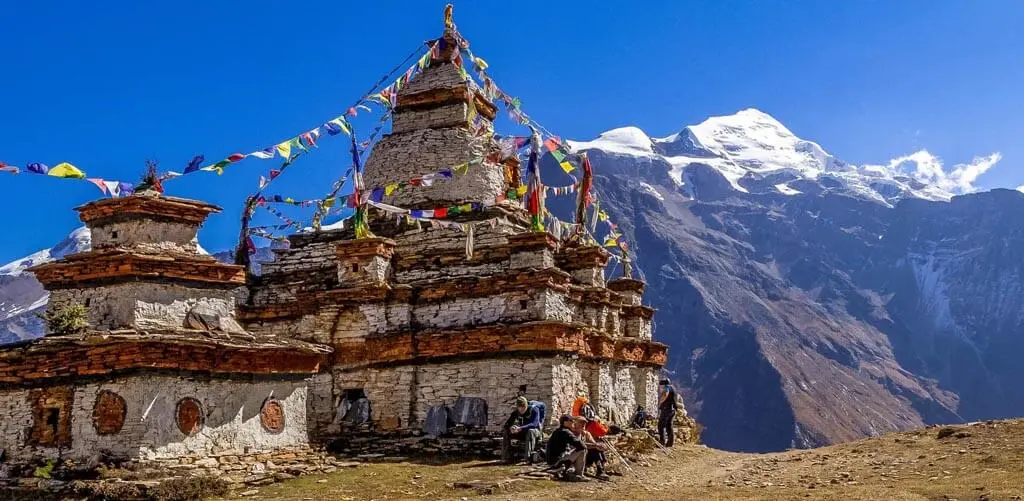
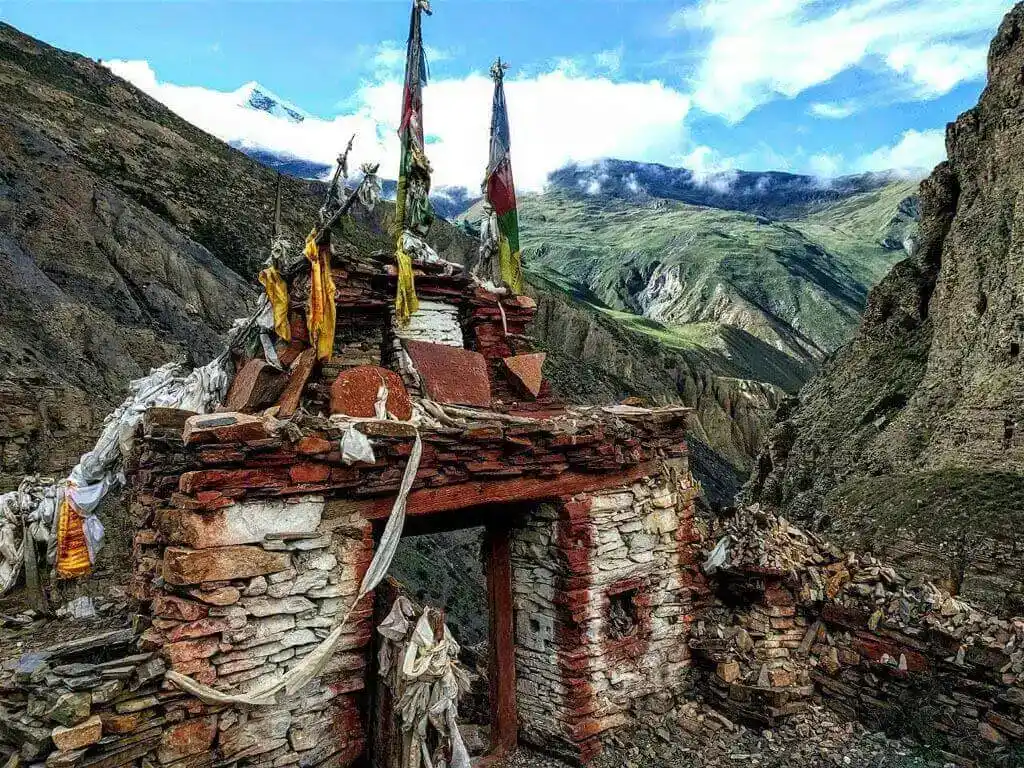
The trek to Nar Phu Valley exposes you to old established Tibetan villages rich in history and Buddhism. The predominantly Mongolian people with their genuinely warm and welcoming smiles will touch your soul as you stop at the tea houses and lodges along the trail. The green pastures where yaks graze is in bleak contrast to the surrounding landscape and towering mountains. As it is a Buddhist region you will see many chortens (Buddhist shrine/monument), gompas (monastery or temple), Mani walls (stone walls that form a 6 symbol prayer) and the Tashi Lhakhang Buddhist monastery in Marpha Village.
The Nar Phu Valley trek can be physically challenging at times due to some steep trails, high altitudes and narrow rocky trails in a rugged terrain. The trail heads through some lush forests and arid landscapes, surrounded by superb peaks appearing right before your eyes. The natural beauty and Tibetan Buddhist villages in this far-flung out-of-the-way place make this trek an adventure of a lifetime.
Sherpa Teams will arrange for permits, accommodation and meals on the trek.
Altitude Chart
Itinerary
A representative from Sherpa Teams will be at the airport to greet you and will take you to your hotel in Thamel, the tourist hub of Kathmandu.
After an early breakfast at your hotel we will leave Kathmandu by bus to Besisahar through a lush green countryside and via numerous villages and farms. Our first destination is Besisahar Village and then we continue until we reach Jagat where we stay the night.
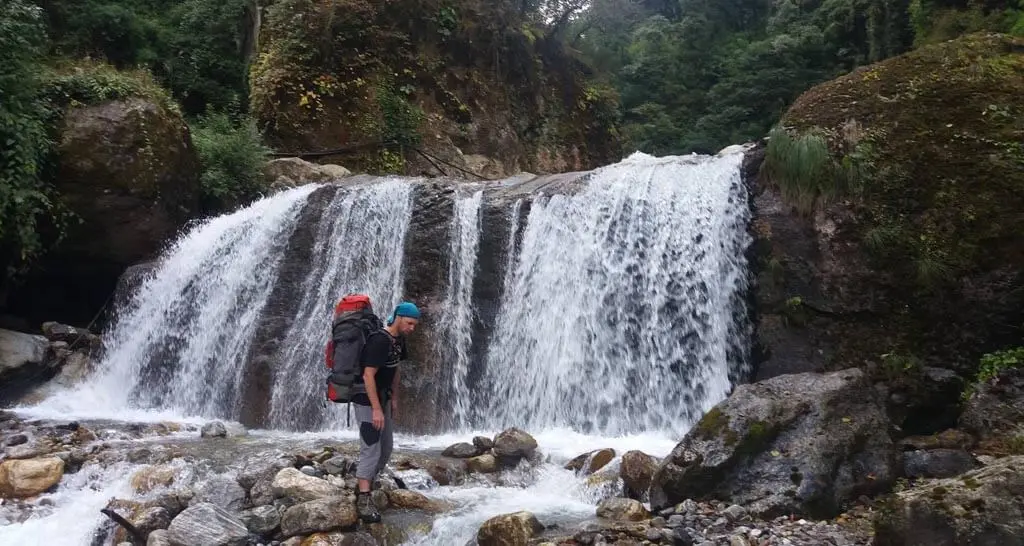
Today we follow the trail heading downhill from Jagat until we reach the river and continue through farmland where locals grow corn, barley, rice and potatoes. On the trail we pass through bamboo and rhododendron forests before climbing up to a ridge where we have stunning views down into the valley and of waterfalls plummeting into the river, and views of the splendid Annapurna Mountains. We follow a rocky trail before descending to the river that will take us to Tal Village and a little further on Dharapani where we stay overnight.
This morning we begin our trek to Bagarchhap, about a 1.5 hour trek through pine and fir forests until we arrive at the village where there is well-known white monastery. We then follow the steep trail, with signs of previous landsides, for another hour before we arrive at Danaque. Looking skyward we have some amazing views of Lamjung Himal, Annapurna II, and Annapurna IV (7,525m). After another 1.5 hours we reach Latamarang Village (2400m) where we stop for lunch. After lunch we follow the trail and get a glimpse of the massive Annapurna II peak (7937m). We then arrive at Koto Village where we will stay overnight.
This morning we have to register for our restricted area permit and then continue along the riverbank until we reach Soti Khola Village located on the banks of the river. The trail then passes through pine forests and next to rivers before we cross a suspension bridge from where we ascend to Meta Village situated on a wide-open plain on the Tibetan Plateau. From here we have exciting views of Annapurna II and Lamjung Himal.
Today we trek along an undulating trail that takes us over several suspension bridges. After 4 hours we reach Kyang Village and its ancient ruins of forts of the Tibetan Khampa people who once fought with Nepal and later settled. We pass Phu Khola and after 3 to 4 hours reach the Phu village of Phu Gaon where we stay overnight.
Today is a rest day and is important in that we have to acclimatize before heading to higher elevations. There will be opportunities to explore the villages and mix with the various ethnic groups in this town, such as Lama, Gurung (also called Tamu), and Ghale (known as Lila). It is fascinating to see how they survive in this region and farm in this harsh land. The views of Himlung Himal and other snow-covered peaks are in contrast to the mostly bare surroundings. Tonight we stay in Phu Gaon.
Today the trail is downhill and passes many streams as we cross numerous suspension bridges until we reach Nar Village that has several Buddhist monasteries and some breathtaking views of Pisang Peak (6092m) and other snow-covered mountains. Tonight we stay at Nar with its many stupas (dome-shaped Buddhist shrines) and stone buildings.
This is the second day set aside to acclimatize on this trek. We spend the day climbing up some nearby hills and wandering around the village observing their culture. We will also prepare for our trek across the pass tomorrow.
We have an early start today and a long uphill trek to Kang La Pass. The view from here of the enormous Annapurna Massif is breathtaking. After heading through the pass we head down to Ngwal Village where we stay the night.
Today we follow the trail from Nawal for Manang and pass through the village of Paugh that sits perched on the side of a mountain with the usual stone buildings. The massive Annapurna Mountain views in the background of Paugh appear in the distance. At the small village of Mungli we connect with the main Annapurna trail and then head to Manang where we will stay the night.
Today we have a 10.4 km uphill trek of around 3 to 4 hours on our way to Yak Kharka passing through juniper forests. We will most likely see yak grazing in the pastures along the way. On the route, we pass the only teahouse at Thorong Khola. The vegetation at this higher elevation is predominantly juniper trees. Depending on the weather conditions and how we feel we may decide to go a little further and stay the night at Letdar.
Climbing higher we gradually get used to the higher altitude. We follow the trail along the east bank of the Jarang Khola and on the trail view steep bluffs before arriving at Thorong Phedi (meaning foot hills). If we are fortunate we may see the famous blue sheep and even a snow leopard! This is also home to the Lammergeyer (bearded vulture). There is also a belief that the mythical griffons are in this region (half-bird/half-lion)!
the degree of difficulty, and there are also strong winds in these upper regions that add to the difficulty. Along the trail we may pass sheep, yaks and merchants transporting their goods. At Thorong La Pass we will be rewarded with breath-taking views of Annapurna, Gangapurna and the noticeable peak of Khatungkang (6484m). From the pass we descend around 1600 metres. Mt. Dhaulagiri (Dhavali giri, meaning “White Mountain”) is the highest mountain that is entirely in Nepal and is visible. The trail gets much easier as we head to Muktinath where we stay the night.
Leaving Muktinath we pass through lush meadows, fruit trees and streams passing and through Kagbeni before we come to Jomson in the Kali Gandaki valley. Kagbeni has a well-earned reputation for its horticulture industry. Tonight we stay at Jomson and may wish to sample some of its apple cider!
This morning we take a scenic flight to Pokhara flying between the enormous mountain ranges of Annapurna and Dhaulagiri. At Pokhara, we will head to our ‘lakeside’ hotel and can later explore Phewa Tal (lake) and admire Mt Machapuchare (Fish Tail) in the distance. We can also choose to take a boat ride on Phew Tal – Nepal’s second-largest lake, or amble along Lakeside and do some shopping.
Today we head back on a road trip to Kathmandu with many warm memories of Nepal and its unique culture and geography. These memories will be with you for a long time after you leave Nepal.
Today your adventure to Nepal ends. A representative from Sherpa Teams will take you to the airport around 3 hours before your departure. On your journey home you may already be thinking about another great adventure into the Himalayan Mountains. We will be here to answer your questions.
Services
Cost Included In Your Package
- Free airport transfer on arrival and departures by private vehicles
- Three meals a day (Breakfast, Lunch, and Dinner/ the main course) during the trek in the mountain.
- Sherpa Teams’s experienced, government-licensed, English-speaking trekking guide.
- Strong, helpful Sherpa porters with proper safety equipment and walking equipment, his salary, food, accommodation, and insurance (one porter for two people).
- All salary, food, drinks, accommodation, transport, and insurance for the guide.
- All necessary papers including Annapurna conservation permit and TIMS card (Trekking Information Management System)
- Use of sleeping bag, down jacket, duffel bag and walking poles (if you don’t have your own, to be returned after trip completed).
- Trekking lodges (Tea House) throughout the trek
- Fly from Jomsom to Pokhara
- Nar Phu Valley special Permit
- Standard twin-sharing accommodation in a three-star hotel in Kathmandu (2 nights only) and Pokhara (1 night only) including breakfast
- Assistant guide for the group 8 or above
- Transportation from Kathmandu – Besishar- Jagat, and Pokhara - Kathmandu by local bus/ Tourist / Local Shared Jeep
- Appreciation of certificate after the successful trek.
- Sherpa Team’s complimentary free T-shirt
- Oximeter to measure your oxygen and Pulse level during the trek in the mountain, it’s very useful for all the trekkers to be aware of the high altitude sickness.
- Compressive first aid box (Guide will carry it throughout the trek).
- Emergency rescue operation assistance in arranging in case of complex health conditions (funded by your Travel Insurance)
- All government, Local taxes, and official Expenses
Cost Excludes
- Nepal entry visa fee (easy to obtain the visa on arrival at Tribhuvan International Airport – Kathmandu). $30 USD for 15-day, $50 USD for 30 Days, and $125 USD for 90 Days visa.
- Extra accommodations and meals before and after the Anapurna base camp trek
- International airfare
- Personal expenses such as shopping, hot shower, hot and cold drinks, tea, coffee, hot water, lcohols, snacks, water, Wi-Fi, battery re-charge, heater charge, fee
- Travel insurance - make sure to cover an emergency high-altitude rescue and evacuations from the high altitude up to 600 m
- Personal clothing or gears
- Lunch and Dinner In Kathmandu and Pokhara
- Additional cost, the itinerary modifications or delay caused by out of management control due to the weather condition, illness, change of government policies, strikes, and physical condition, etc.
- Gratitudes to the guides and staffs (Recommended by local culture )
- And any other expenses that are not mentioned in the Price "inclusive section" of this program
Map
Download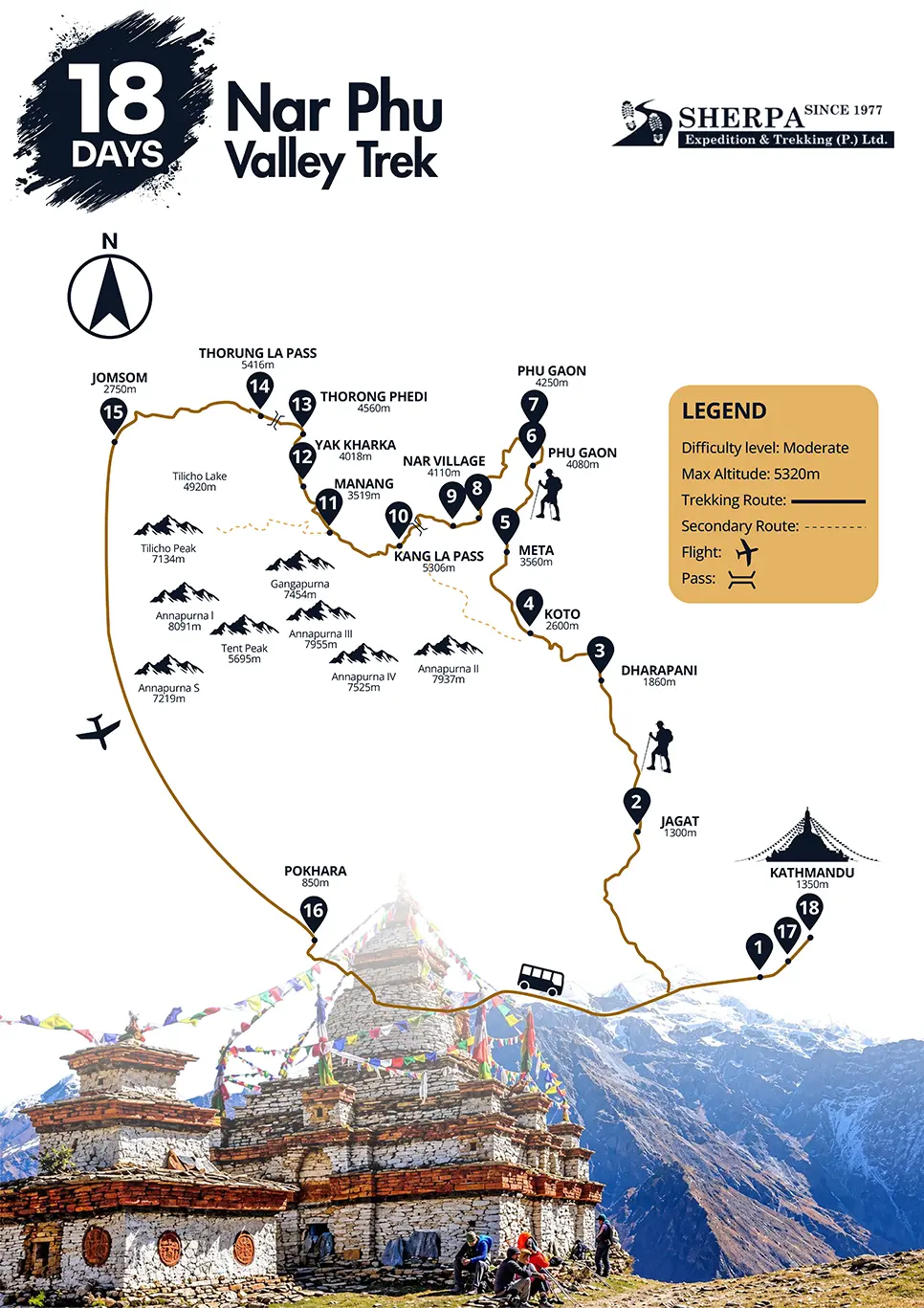
Equipments
The following information will give you some idea about what you need to bring for the trek. It is important you do not forget the essential items, as this will determine your comfort and safety on the trek. Equally important is that you do not burden yourself with unnecessary equipment on the trek.
- Sleeping Bag (Sherpa Teams will provide but need to return after completing the trip)
- Duffel Bag (Sherpa Teams will provide but need to return after completing the trip)
- Fleece jacket or pullover
- Waterproof windbreaker or windcheater
- Thermal underclothes
- Rain poncho
- Down jacket (Sherpa Teams will provide but need to return after completing the trip)
- Fleece or wool trousers
- Sun hat or scarf
- Trekking pants (two pairs)
- Mittens or woolen gloves
- Hiking socks (several pairs)
- Moisture-wicking shirts, including t-shirts
- Trekking shoes or boots with spare laces
- Flip-flops or sandals for relaxing in the evenings
- Underwear (several pairs)
- Swimsuit or swimming costume
- Sunglasses
- Headlamp or flashlight/torch
- Sleeping bag (Sherpa Teams can provide this for you)
- Trekking poles (if desired)
- Hiking backpack with a capacity of at least 40 liters
- Small lock for your backpack
- Reusable water bottles (at least two liters)
- Water purification tablets or filtration device
- Wash towel
- Basic first aid kit
Toiletries (tissues, toilet paper, moisturizer, lip balm, sunscreen, sanitary pads, hand sanitizer, nail clippers, a small mirror, toothbrush, toothpaste, glasses, contacts, etc.)
Good to Know
Accommodation
You will be accommodated in 3-star hotels in Kathmandu. During the trek, we will be staying at lodges/ teahouses. You may find comfortable and better quality teahouses - having attached bathroom at lower levels- until you reach higher elevations, where the accommodation is more basic with bare necessities.
Meals during the trek
In Kathmandu, your hotel includes breakfast, whereas all meals (breakfast, lunch, and dinner) will be provided during the trek. A staple food of the Manang & Mustang regions is potatoes, oats, buckwheat, Sherpa stew, and Tibetan bread. Sherpa’s’ started farming potatoes when the first seeds were introduced to the region in the early 90s. There is a limited choice of food at higher elevations and except many potato dishes. Potatoes are high in carbohydrates – an excellent source of energy needed at high altitudes.
Transportation
We use a private car for sightseeing and for the airport to hotel pick and drop off. We use public transportation or local buses during the trek.
Physical fitness
This can be a challenging trek where you often have to walk 6-7 hours a day. You need past experience of hiking or trekking but if you have done any kind of trekking activities then it is always a plus! We have met people from all walks of life, shapes, and sizes who have completed the trek. The only difficult part is when altitude sickness strikes and the effect that it can have on your body. Before leaving for Nepal it is good if you can prepare yourself physically by increasing your stamina and oxygen intake.
Remember – The better prepared – the more enjoyable your trek!
Gallery



Tour Dates
Every departure listed below is 100% Guaranteed — once you book, your trip will run as scheduled regardless of group size.
Loading departure dates…
Want your own personalized tour?
FAQS
Others
Nar Phu Valley is a remote and less explored trekking destination located in the Annapurna region of Nepal. It offers a unique cultural and wilderness experience, with stunning landscapes and traditional Tibetan-influenced villages.
The Nar Phu Valley trek is typically completed in 9-18 days, depending on your pace and itinerary. The total distance covered is around 75-80 kilometers.
The best time to do the Nar Phu Valley trek is during the spring (March to May) and autumn (September to November) seasons. These months offer clear skies, mild temperatures, and stable weather conditions.
Prior trekking experience is not mandatory for the Nar Phu Valley trek. However, it is recommended to have a reasonable level of fitness and some hiking experience, as the trek involves long days of walking and crossing high passes.
The Nar Phu Valley trek is considered a moderate to challenging trek. It involves steep ascents and descents, as well as crossing high passes. Good physical fitness and proper acclimatization are crucial for a successful trek.
Yes, permits are required for the Nar Phu Valley trek. You will need to obtain the Annapurna Conservation Area Permit (ACAP) and the Nar Phu Restricted Area Permit. These can be obtained in Kathmandu or Pokhara.
Teahouses and lodges are available along the Nar Phu Valley trek route, but they are limited compared to other popular treks in Nepal. Basic accommodation and meals are provided, but it is advisable to carry some cash as ATM facilities may not be available in remote areas.
Some essential items to pack for the Nar Phu Valley trek include sturdy trekking boots, warm clothing layers, a good quality sleeping bag, a waterproof jacket, a hat, sunglasses, sunscreen, a first aid kit, and a water bottle. It is also recommended to carry some snacks and energy bars.
Altitude sickness can be a concern on the Nar Phu Valley trek, as you will be crossing high passes and reaching elevations above 4,000 meters. Proper acclimatization, staying hydrated, and listening to your body are essential to prevent altitude-related issues.
Yes, there are optional side trips and extensions available on the Nar Phu Valley trek. One popular extension is the Kang La Pass, which offers panoramic views of the Annapurna and Manaslu mountain ranges. This can be added to the main Nar Phu Valley trek itinerary.
Yes, hiring a guide or porter for the Nar Phu Valley trek is possible and recommended, especially if you are new to trekking or prefer additional assistance. A guide can provide valuable information about the route, culture, and ensure your safety, while a porter can carry your heavy backpack.
Drinking water is easily available on the Nar Phu Valley trek. You can refill your water bottles at teahouses along the route, but it is recommended to use water purification tablets or a water filter to ensure the water is safe to drink.
Communication facilities, such as Wi-Fi and mobile network coverage, may be limited or unavailable in some parts of the Nar Phu Valley trek. It is advisable to inform your loved ones beforehand and carry a local SIM card for emergency communication.
Yes, you can do the Nar Phu Valley trek solo. However, it is always safer to have a trekking partner or join a group, especially if you are a first-time trekker. It is also recommended to inform the local authorities or your hotel about your trekking plans.
Reviews
Overview
This trek takes you to remote villages rich in Tibetan culture, soaring snow-capped peaks, deep valleys and high altitude passes. This area is well-preserved and its pristine wilderness will please the more daring trekker. The Nar Phu Valley is located between the Annapurna and Manaslu regions. The Nar Phu valley has some enthralling views of these colossal peaks: Gangapurna (7455m), Annapurna II (7937m), Himlung Himal (4900m), and Tilicho Peak (7134m).
The trek to Nar Phu Valley exposes you to old established Tibetan villages rich in history and Buddhism. The predominantly Mongolian people with their genuinely warm and welcoming smiles will touch your soul as you stop at the tea houses and lodges along the trail. The green pastures where yaks graze is in bleak contrast to the surrounding landscape and towering mountains. As it is a Buddhist region you will see many chortens (Buddhist shrine/monument), gompas (monastery or temple), Mani walls (stone walls that form a 6 symbol prayer) and the Tashi Lhakhang Buddhist monastery in Marpha Village.
The Nar Phu Valley trek can be physically challenging at times due to some steep trails, high altitudes and narrow rocky trails in a rugged terrain. The trail heads through some lush forests and arid landscapes, surrounded by superb peaks appearing right before your eyes. The natural beauty and Tibetan Buddhist villages in this far-flung out-of-the-way place make this trek an adventure of a lifetime.
Sherpa Expedition Trek will arrange for permits, accommodation and meals on the trek.
Altitude Chart
Itinerary
After an early breakfast, we leave Kathmandu heading toward Besisahar through a lush green landscape and via numerous villages and farms. We first reach Besisahar Village and then continue until we reach Jagat where we stay the night
Today our trek begins as we follow the descending trail from Jagat until we reach the river and then continue through farmland where locals grow corn, barley, rice, and potatoes. Along the trail, we pass through bamboo and rhododendron forests before having to ascend to a ridge where we have spectacular views down into the valley and of waterfalls cascading into the river, and views of the magnificent towering Annapurna Mountains. We follow a rock-strewn trail that requires some effort before descending to the river that leads to Tal Village and a little further on Dharapani where we stay the night.
This morning we start our trek to Bagarchhap, about 1.5 hours taking us through pine and fir forests until we reach the village where there is prominent monastery painted white. We follow the steep trail, with signs of landsides, for another hour before we reach Danaque. Looking skyward we are blessed with some amazing views of Lamjung Himal, Annapurna II, and Annapurna IV (7,525m). We continue for 1.5 hours until we reach Latamarang Village (2400m) where we stop for lunch. After lunch, we continue on and on occasion get a glimpse of the enormous Annapurna II peak (7937m). We eventually arrive at Koto Village where we will stay the night.
This morning we have to register for our restricted area permit and then continue along the trail along the riverbank until we reach of Soti Khola Village located on the banks of the river. The trail continues passing pine forests, rivers before crossing a suspension bridge before ascending to Meta Village situated on a vast open plain on the Tibetan Plateau from where you have fantastic views of Annapurna II and Lamjung Himal.
Today the undulating trail takes us over several suspension bridges and after 4 hours we reach Kyang Village and its ancient ruins where ruined forts of the Tibetan Khampa people who once fought with Nepal and later settled. We pass Phu Khola until finally, after 3 to 4 hours reach the Phu village of Phu Gaon where we stay the night.
Today the trail descends passing many streams and crossing numerous suspension bridges until we reach Nar Village that has several Buddhist monasteries and some awesome views of Pisang Peak (6092m) and other snow-clad mountains. Tonight we stay at Nar with its many stupas (dome-shaped Buddhist shrines) and incredible stone buildings.
Today it is necessary to acclimatize and prepare for the higher elevation at Nar. Health specialists recommend staying active while acclimatizing, so today we will wander around the village and check out its unique Tibetan cultural icons and meet the very friendly local people with their warm smiling faces. We can also trek from Nar to Tashi Lhakhang (monastery) and head up to Himlung Base Camp (4842m) and only a 3 to 4 km trek. Tonight we stay at Nar.
[An alternative to spending an extra day in Phu means you may have the option of climbing to Tilicho Lake from Manang, rather than head through Thorong La Pass and then on to Yak Kharka. This is something you can discuss with your guide]
An early start today begins with a long uphill trek to Kang La Pass through Jhombu Kharka Village (also referred to as Kang La Phedi) at the base of Kang La Pass. The view from here of the Annapurna Massif is breathtaking. Heading through the pass we continue on descending quite rapidly to Nawal Village where we stay the night.
Today we leave Nawal for Manang and on the trail pass through the mountainous village of Paugh perched on the side of a mountain with the usual stone buildings. The vast Annapurna Mountain views in the background of Paugh can be seen in the distance. At the small village of Mungi we connect with the main Annapurna trail and continue until we reach Manang where we will stay the night.
Today we head off on a 10.4 km uphill trek of around 3 to 4 hours and head to Yak Kharka passing through juniper forests and will see yak grazing in the pastures. On the route we pass the only teahouse at Thorong Khola. The vegetation at this elevation is mostly juniper trees. Depending on the conditions we may decide to go a little further and stay the night at Leader.
Climbing higher we gradually get used to the higher altitude. We follow the east bank of the Jarang Khola and along with the trail view steep bluffs before reaching Thorong Phedi (meaning foothills). If we are lucky we may see the famous blue sheep and even a snow leopard! This is also home to Lammergeyer (bearded vulture). There is also a belief the mythical griffons are in this region!
Today is most likely the toughest day of the trek, hiking for around 7-8 hours. The higher altitude contributes to the degree of difficulty and sometimes strong winds in these upper regions. Along the trail we may pass sheep, yaks and merchants transporting their goods. Once we reach Thorong La Pass we will be rewarded with breath-taking views of Annapurna, Gangapurna and the eye-catching peak of Khatungkang (6484m). Leaving the pass we descend around 1600 metres and the brilliant Dhaulagiri (Dhaula Giri, meaning “White Mountain”) is the highest mountain that is entirely in Nepal. The trail is more undulating and relatively easy before we reach Muktinath where we stay the night.
From Muktinath, we pass through lush meadows, fruit trees, and streams passing through Kagbeni before we reach Jomson in the Kali Gandaki valley. Kagbeni has a well-deserved reputation for its horticulture industry. Tonight we stay at Jomsom.
Today we leave Jomsom by local transport to Tatopani taking us through the deepest gorge in the world – the Kali Gandaki Gorge with the Kali Gandaki River that separates the major peaks of Dhaulagiri (8167m) on the west and Annapurna (8091m) on the east. As we head further down the gorge the vegetation changes from arid dry barren rock to more lush pastures and farmland. After arriving at Tatopani we can relax the tired muscles in the hot natural springs by the river.
This morning we drive to Pokhara. After arriving at Pokhara we will head to our Lakeside hotel and after check-in can explore Phewa Tal (lake) and admire Mt Machapuchare (Fish Tail) in the distance. Alternatively, we may wish to take a boat ride on Phew Tal – Nepal’s second-largest lake, or meander along Lakeside and do some shopping. Tonight we can visit some of the clubs and bars to celebrate our return to civilization.
Today we head back on a 6 to 7-hour drive to Kathmandu with many fond memories of Nepal and its unique culture and geography. These memories will last a lifetime!
Services
Cost Included In Your Package
- Drive from Kathmandu to Beshisahar or Jagat and from Jomsom to Tatopani to Pokhara by Local bus.
- Pokhara to Kathmandu by Tourist Bus.
- One night accommodation in a selected hotel in Pokhara with Breakfast.
- Tea House/ Lodge, camping accommodation during the trek.
- Three meals a day (Breakfast, lunch, and dinner) during the trek.
- Government License holder Sherpa Expedition and Trekking experienced and qualified trek leader (guide), assistant trekking guide, (12 or above trekkers: 1 assistant guide)
- Strong, helpful Sherpa porters with proper safety equipment and walking equipment, his salary, food, accommodation, and insurance (one porter for two people).
- Coverage of guides and porters meals, insurance, salary, lodging, transportation, and other necessary equipment.
- Annapurna Conservation Area Permit (ACAP) Fee.
- Trekkers Information Management System (TIMS) card fee.
- Use of sleeping bag, down jacket, duffel bag and walking poles (if you don’t have your own, to be returned after trip completed).
- Nar Phu valley restricted area permit.
- All Government and Local Taxes.
- Assistance in arranging rescue operations in case of complicated health conditions (funded by travel insurance).
- Sherpa Expedition and Trekking appreciation of certificate after over the successful trek.
- Oxygen meter to check your pulse and oxygen saturation and heart rate twice daily (Very useful to check Altitude Mountain Sickness(AMS) symptoms) which will ensure your health during the trek.
Costs Exclude
- Meals whilst you are in Kathmandu & Pokhara - lunch, and dinner.
- Nepal entry visa fee (easy to obtain the visa on arrival at Tribhuvan International Airport – Kathmandu). $30 USD for 15-day, $50 USD for 30 Days, and $125 USD for 90 Days visa.
- Personal travel and medical insurance.
- International airfare.
- Your personal expenses.
- All the alcoholic and nonalcoholic, soup, tea, coffee, hot chocolate, cocoa, mineral water, extra food, cold and hot drinks on trek ( i.e. those you choose to purchase along the way and during evenings in the tea houses)
- All desserts & sweet things like chocolate, cake, pie, pudding.
- Hot shower and battery charging at the tea houses.
- Tips for the guide, porter, and driver (tipping is expected)
- NOTE: If you return earlier from the trek due to sickness or any problem, the money you paid for the flight, hotel, mountain room, food, etc. is nonrefundable, and you will need to bear the expenses for the hotel, food, etc. in Kathmandu yourself.
Tour Dates
Every departure listed below is 100% Guaranteed — once you book, your trip will run as scheduled regardless of group size.
Loading departure dates…
Want your own personalized tour?