How Much Does the Everest Base Camp Trek Cost?
Everest Base Camp Trek costs $1,200 to $1,800 per person. In contrast, independent or self-arranged trips would, on average, cost $900 to $1,300, and the price will significantly increase with luxury or helicopter-assisted trips or itineraries reaching $3,000 to $5,000+. Such a large variation in price would be due to different trekking styles chosen by travelers and the method of booking the trip, as there is a double price for booking the tour directly with local providers versus booking it via international agencies, along with additional modes of transport for trekking.
Duration | Price From (Per Person) | Trip Type | Note |
| 5 Days | $1,790 | Helicopter-assisted | Flies over the lower Khumbu approach, getting to the Base Camp area in days as opposed to the weekly period of hiking. |
| 6 Days | $1,850 | Helicopter-assisted | No additional acclimatization stop is included, but the use of helicopter transfer remains in place. |
| 7 Days | $2,350 | Helicopter-assisted, return by heli | Most compact detailed itinerary, fly to and from Base Camp instead of following the trail exhaustingly. |
| 9 Days | $950 | Standard trek, minimal buffer | Strict schedule with little margin for weather disturbances; this itinerary should only be used by tourists experienced with fast turnaround in Lukla |
| 10 Days | $1,090 | Standard trek | Offers a little more buffer time, yet still intense |
| 11 Days | $1,150 | Standard trek | Gentle enough for a proper break and acclimation at Namche bazaar |
| 12 Days | $1,190 | Standard trek | Second-most booked itinerary with two acclimization days |
| 13 Days | $1,250 | Standard trek | More buffer and flexibility around potential Lulka flight day changes |
| 15 Days | $1,290 | Standard trek, most-booked | The pace we guide most first-time Everest visitors to; extra days will be spent properly at Namche and Dingboche rather than Cramped Schedule |
Our 15-day itinerary at $1,290 is the most booked, and most Everest first-timers are directed to that program rather than our cheaper 9-day itinerary, because the extra days pay for real acclimatisation in Namche and Dingboche rather than the shorter schedule. The 5- to 7 day packages are for a different reason: a shortened vacation, and rely on helicopter transfers to and from the lower valley, which explains the premium on a per day basis for a shorter expedition.
Note: Those figures include guide, porter, permits, teahouse accommodation, and food for the days indicated. International airfare, Nepal visa, travel insurance including evacuation, tips, and personal trekking equipment are not included, and we list what's in and out at the time of booking rather than have clients find out when in need on the trail.
Everest Base Camp Trek Cost Overview
Everest Base Camp trek costs range from USD 950 for our fastest 9-day itinerary to USD 2,350 for a 7-day helicopter-assisted package, with our standard 11 to 15 day guided treks running USD 1,150 to USD 1,290 per person.
Trek Style | Our Price Per Person | Typical Duration | Usually Includes |
| Standard Guided (Fast Pace) | $950-$1,090 | 9-10 days | Lukla flights, permits, teahouse accommodation, meals, guide and porter, minimal weather buffer |
| Standard Guided (Recommended) | $1,150-$1,290 | 11-15 days | Lukla flights, permits, teahouse accommodation, meals, guide and porter, proper acclimatization days at Namche and Dingboche |
| Helicopter-Assisted | $1,790-$2,350 | 5-7 days | Compressed schedule, heli transfer for the lower valley approach, guide, permits, accommodation and meals |
Price is quoted per person and changes with group size; our guide, porter, and jeep transfer costs are split further across a larger group; therefore, it is more expensive per head when booking solo than a group of 6.
We recommend most first-time Everest trekkers stay in the 11-15 day range rather than the cheaper 9-day option for a specific reason, and that's that the extra days are actually for acclimatization at Namche and Dingboche, not filler. We never skip these two rest days regardless of how strong a client is after years of guiding groups on this route, we have seen exactly what rushing the altitude does for people further up the trail.
Note: Regarding our prices stated in the quotation, we included a guide, porter, permits, accommodation at teahouses, as well as meals provided during the trek within the stated period. What is not included is airfare to and from Nepal, visa fees for entering Nepal, insurance, which includes helicopter rescuing, tipping, personal hiking equipment, etc. Helicopter tours over a shorter period cost more than trekking because of the replacement of several days of trekking by helicopter flight, rather than because of the uniqueness of the routes.


Everest Base Camp Trek Cost by Package Type
Everest Base Camp trek packages fall into three main categories: budget, guided standard, and luxury. However, the most significant cost driver when considering the complete trip is often the style of the trek.
Package Type | Our Price | Best Suited For | Typical Features |
| Budget / Self-Arranged | $900-$1,300 | Experienced trekkers comfortable handling their own logistics | Basic teahouses, simple meals, permits and flights arranged independently; guide or porter optional |
| Standard Guided (Ours) | $1,200-$1,800 | Most first-time EBC trekkers | Flights, permits, teahouse accommodation, three daily meals, licensed guide, porter support |
| Luxury | $3,000-$5,000+ | Trekkers prioritizing comfort over cost | Upgraded lodges, smaller groups, senior guides, private transfers, possible helicopter return |
Trek style dictates your price more than operator, season, or group size, which is why we always work our clients through these three tiers to quote a specific number, not the other way around.
A budget trek only makes sense for someone comfortable managing their own permits, lodge bookings, and route without a guide showing them the way. Ram Barakoti has talked down more novice trekkers out of this option than we can count, especially when they've never done a high-altitude trek before. Still, the right choice for an experienced solo traveler is to save their cash for something else; it's not the cheapest option for your first Himalayan adventure.
Our standard guided package is where most of our clients find themselves. For good reason: the burden of permits, the flight, accommodations, meals, and guide support is lifted as and not as individual pieces you have to piece together while on the trek.
Luxury layers are for those who decide that comfort is worth paying a premium for, not because it's a noticeably different trek; it's the same trail, same altitude, same acclimatization regime but with better beds and smaller groups partway through.
Note: Don't judge a package by its perceived starting price alone. We have seen packages listed elsewhere at about $900 that turn out to be more like $1300 or $1450 when the guide, porters, and basic support are added back in as "optional" extras. At that point, you're paying a standard-tier price for a budget-tier planning effort. Request the bottom-line price (all-inclusive) in advance, instead of the starting numbers.
Everest Base Camp Trek Cost With a Local vs. International Operator
Everest Base Camp trekking booking through a Nepal-based operator is usually much less expensive than booking through a foreign trekking company. And Less expensive for a couple of reasons. Firstly, we are based here in Nepal, so when Ram (our operations manager) manages porters and guides from Kathmandu, he is dealing directly with the local guides and porters, not a foreign sales department.
Operator Type | Typical Price Range | Main Advantages | Possible Trade-Off |
| Sherpa Expedition Teams (Local) | $1,200-$1,800 | Book directly with our own guides, Galden Sherpa Pemba Thile Sherpa and local operations in the Khumbu- no broker markup, money goes directly to local wages and local infrastructure | Support runs through our Kathmandu office and WhatsApp line, not a home-country call center |
| International Operator | $1,400-$5,000+ | Home-country point of contact, branded tour leadership, pre-departure account management | Often subcontracts the actual trek to a Nepali ground operator like us anyway, meaning the client pays twice for the same guide team |
Our price is in line with what you’d pay for a comparable international operator offering the same itinerary, usually between $1,500-$5,000+ and sometimes more (our prices are mid-range). We’ve tracked their costs as well, and can tell you much of the money they spend isn’t spent on your actual trip.
International companies offering similar trekking experiences can charge up to $1,400 to $5,000 or even more for the same tour. Based on what we have seen, the significant increase in price does not necessarily mean that you will get a different or better trekking experience. Mostly, the extra money goes into the international company’s staff, sales, marketing, and customer care departments.
In addition, many international companies operate in liaison with local Nepalese trekking agencies on matters about permits, guides, porters, hotel arrangements, and other transport services. This implies that the guides you will meet on your trekking tour will be local guides from the Khumbu region, like the ones we employ at our company. The international companies do not provide their own trained guides on trekking tours. Moreover, the trekking tour experience and expertise are almost the same. The only difference is that international companies charge higher prices for the same services rendered by local agencies.
Note: The true comparison is inclusions, not the headline number. We have the inclusions of trail meals, permits, and porter support built into our packages. Several of the international options appear to be attractive and fair at first glance but actually exclude trail meals and only reveal this at the invoice stage when the client is comparing final numbers – not the published price tag. Book directly through Ram and you're paying us and our guides directly, not double-paying a second company for markups on local guides.
What's Included and Excluded in an Everest Base Camp Trek Package
A standard package for an Everest Base Camp trek includes the major trek logistics, but the inclusions can vary greatly between operators. We share all our EBC trek inclusions with every client before any payment is made, not after, as Ram Barakoti has fielded too many calls from trekkers in the middle of their journey who found out that a competing operator did not include meals or porter support in their package.
Included in Our Package | Sometimes Offered Elsewhere as an Add-On | Never Included, By Anyone |
| Round-trip Lukla flights | Kathmandu hotel nights | International airfare |
| Sagarmatha National Park permit | Airport transfers | Nepal visa fee |
| Khumbu local permit | Pre-trek briefing | Travel insurance |
| Teahouse accommodation | Selected equipment rental | Wi-Fi and device charging |
| Three daily meals on the trail | Extra Kathmandu day services | Personal trekking gear |
| Licensed guide, Galden Sherpa, Pemba Thile Sherpa, or one of our wider crew | Snacks and drinks beyond set meals | Guide and porter tips |
| Porter support | Provided one for two trekkers | Uninsured emergency evacuation |
The line that counts most on this list is meals. We've compared invoices between agencies quoting $200 to $300 less on the same 14-day itinerary, with the gap disappearing entirely once trail meals get added back in at teahouse prices, sometimes $15 to $25 a day once you're past Namche. A more expensive-sounding package is often the cheaper option at Lukla once you start factoring in what the other operator left out.
Our most honest advice, to whoever books with whomever: don't compare numbers on a per-line basis. Set the two inclusion lists side by side, item by item, and price out the difference at trail rates before choosing the itinerary that best reflects what you expect to pay at Base Camp.
Kathmandu to Lukla Flight Cost

For our clients, we book round-trip Lukla flights for $410 to $500 and one-way flights for $210 to $250, ahead of time, rather than letting the times for the week-of scramble go to the independent trekkers who wait until the last minute. Baggage in general costs $10 to $15 per 10 - 15 kg, with 5kg hand luggage, and for every client we weigh their duffel at our Kathmandu office the night before we leave, as the surcharge is by the kilo at the counter, and we prefer not to have someone repacking at 5 am at the airport.
Flight | Approximate Fare |
| Kathmandu-Lukla One Way | $210-$250 |
| Kathmandu-Lukla Round Trip | $410-$500 |
| Excess Baggage | Charged per kg at check-in |
Weather, not the airline, is what actually causes problems here. If your flight gets cancelled, that means an unbudgeted night either in Lukla or Kathmandu, plus food and occasionally a rebooking fee if the airline that initially handles your flight doesn't have room on flexible seats. We advise all our clients, before they book their international return, to have at least one buffer day between their Everest region flight and their international connection; we've had clients miss international flights due to a single unlucky weather day in Lukla, and not even good planning can fix an airport with a closed runway.
Note: Ram Barakoti guarantees all of each client's booked in seat reservations in Lukla with a specific seat, rather than a waitlist, and advises clients new to treks to ask that question of any agency, not just the amount. After several days of bad weather, airlines fly those with confirmed named seat reservations before folks with waitlisted reservations, and identical fare paid by two passengers can sometimes mean a day between flights.
Ramechhap to Lukla Flight Cost During Peak Season
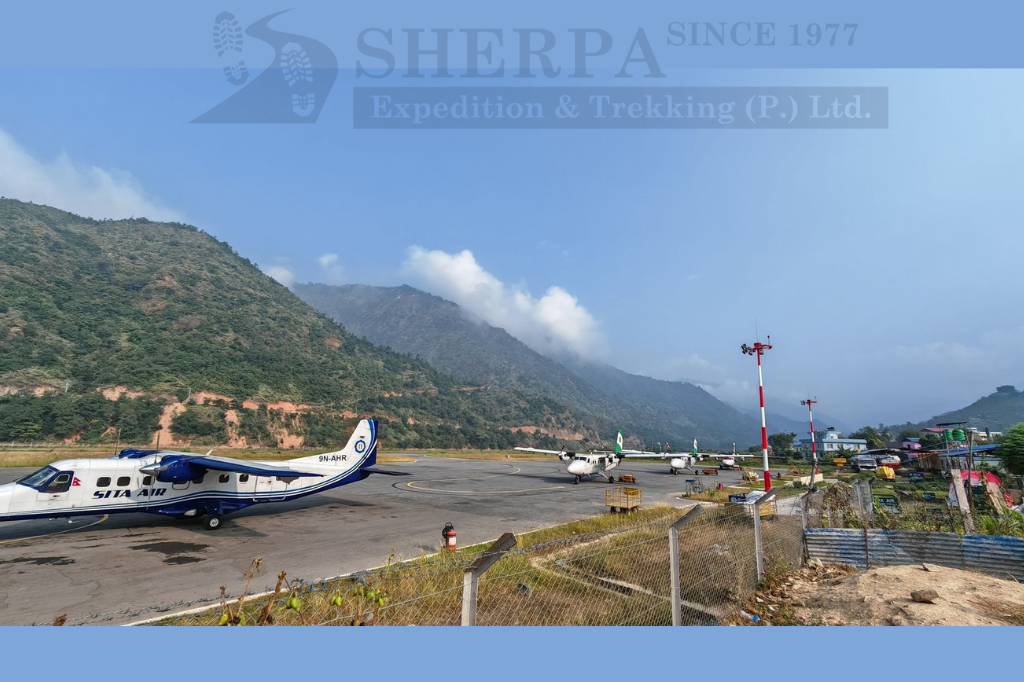
In popular trekking seasons, the Lukla flights depart from Ramechhap/Manthali Airport instead of Kathmandu because of congestion at Kathmandu's domestic airport. We operate in these seasons, from March to May and September to November, and thus are prepared for this change and don't consider it to be an exception.
Flights from Ramechhap are slightly less expensive than a flight from Kathmandu ( given that it requires 4-5 hours from Kathmandu to Ramechhap). We arrange this road transfer in a private vehicle. This is about $150 for a solo traveler or $25 per person each if 6 or 7 of you travel in one vehicle. We tend to confirm your arrival at the airport 1 or 2 days before you are due to fly, as airlines change the arrival airport at the last moment.
Note: Ram Barakoti advises all of his customers who are going on a trip in peak season to keep their arrival date flexible. The flight to Ramechhap requires travelling from 1 am to 2 am, and people with a prepaid reservation will lose their hotel booking unexpectedly because they didn’t anticipate the transfer schedule when they arranged their flights.
Permit Cost for the Everest Base Camp Trek
Two permits costing a total of $40-$60 are required, and we process both directly through our Kathmandu office before any client sets foot in Lukla.
Permit | Approximate Cost |
| Sagarmatha National Park Entry Permit | NPR 3,000, roughly $22-$30 |
| Khumbu Pasang Lhamu Rural Municipality Permit | NPR 2,000-3,000 |
| Combined Estimate | About $40-$60 |
The Sagarmatha National Park Entry Permit helps fund Sagarmatha National Park's conservation status; the Khumbu Pasang Lhamu Rural Municipality Entry Permit is a separate local-government fee collected solely inside the Khumbu – not the park. Guided clients never have to pay this paperwork – we include it in our packages. Independent clients need to be mindful of these entry fees as it's their own responsibility.
```Note: TIMS and other regulations surrounding independent treks have changed multiple times over the past couple of years, and are inconsistently documented in many of our older blog posts. Please check with either the Nepal Tourism Board or a licensed operator before embarking on an independent trek, rather than relying on what’s been written online.```
Guide Cost for the Everest Base Camp Trek
A licensed trekking guide for Everest Base Camp costs approximately $25-$40 per day, while the more experienced, senior guides can charge up to $50+ per day.
A guide on this route does a lot more than show you the way, and every guide we hire for you, including Galden Sherpa and Pemba Thile Sherpa, is trained to do the following:
- Check each guest for signs of altitude sickness every day, not just when they feel sick.
- Handle your permits, bookings at the lodges, and check-ins
- Communicate with teahouse owners about availability and meals
- Act as your interpreter at checkpoints and any other official lodges
- Plan the trip around weather, fatigue, or altitude
- CHandle any emergencies, including evacuation if necessary
Note: If you are hiring a guide outside of an agency, this is not a formality. Look at their license and papers firsthand. An unlicensed guide on a restricted or regulated trail might make permit enforcement more difficult and, more to the point, they may not have the training that checking your altitude every day on this trail actually requires.
Want Expert Guidance? Send Us Message on Whats App
Porter Cost for the Everest Base Camp Trek
A porter costs anything between 18-30 USD per day and can carry between 15- 20 kg. By having one porter for every 2 trekkers, porter’s fees are actually split. Our assigned guide weighs everything in Kathmandu before loading it. Not because he is suspicious of his porters, but because he knows what happens when uneven loads are loaded. Bringing a porter will ease your burden greatly – especially as the route gets higher and higher above Namche Bazaar, and as the body begins to feel the effects of altitude.
Important to note: The reason for low advertised porter rates on some budget itineraries stems from cutting porter insurance and is not a case of true efficiency. Sak Kumar Tamang, a long-standing guide for our company, has reported examples of porters being used by other trekking companies who do not have adequate cold-weather clothing when working above Namche, although their clients are well clothed. Be sure to ask whether the porter fee quoted includes porter insurance and cold-weather clothing or not. At our company, porter welfare are a part of our package, and this is one of the few parts of our service.
Accommodation Cost During the Everest Base Camp Trek
Basic teahouse lodging ranges from approximately $3-$15/night in lower altitude sites, $10-$25 in higher altitude villages, with luxury lodges priced at $40-$100+ per night.
Area | Typical Room Cost |
| Lukla / Phakding | $3-$15 |
| Namche Bazaar | $5-$20+ |
| Dingboche | $10-$25 |
| Lobuche / Gorak Shep | $10-$25+ |
| Luxury Lodges | $40-$100+ |
Traditional teahouse pricing makes independent trekkers unhappy more than any other expense on this trek, because a suspiciously low $3 room usually entails an uncommunicated requirement to have dinner and breakfast at that same lodge's restaurant, which has been priced to make up for the money wasted on offering that room. We tell clients outright: do not look for the cheapest room, price the room and the two meals as one number, and then that's your real nightly cost, not the advertised room at the door.
Accommodations are included in our guided packages; independent trekkers pay on a lodge-to-lodge basis and should expect to spend anywhere from $10-20 more for the attached-bathroom or single-room upgrades that will be truly worthwhile after three days above Namche sharing the bathroom at – 10 Celsius.
Food Cost on the Everest Base Camp Trek

Food costs about $25-$40 a day for an independent trekker on the Everest Base Camp Trek, and dal bhat costs about $5-$12 depending on altitude.
Expense | Approximate Cost |
| Daily Food Budget (independent) | $25-$40 |
| Dal Bhat | $5-$12 |
| Western Meals | Usually higher than local dishes |
| Hot Drinks | Additional, depending on lodge and altitude |
Dal bhat is the meal that our own guides eat every evening on the trail, not entirely because it's the cheapest option on the menu, but because unlimited refills really do provide much more energy for a full day's trekking than a reheated plate of pasta could manage at 4,000m. The pizza and pasta above Dingboche are generally made with powdered cheese and ingredients that have been long-life and carried up by porter for weeks; it's not bad food, but it's also not the picture on the menu either, and it costs almost twice dal bhat.
Our guided packages include three daily meals; independent trekkers will have to pay for each meal and should expect to pay more and more above Namche, as eventually everything will have to be carried by porter, mule, or yak rather than just on the road.
Important details: Galden Sherpa, who has been guiding this route for many years, has a simple test to assess the value of pizza for novices: if the lodges price their pizza and dal bhat similarly, the establishment is truly capable of making pizza of the right quality. If the price of pizza is at least double that of dal bhat, as is the norm after Dingboche, it is simply a reflection of the distance traveled by the ingredients, so eaters may as well have a serving of dal bhat instead, as it is much cheaper and comes with unlimited servings as well.
Drinking Water Cost on the Everest Base Camp Trek
Bottled water can cost between $1 and $4 per litre, increasing toward the high end near Gorak Shep. We suggest our clients not to purchase bottled water beyond Namche, as doing so is both expensive and contributes to the mountain of plastic waste we create in an area without infrastructure for its removal. At the teahouse, boiled or purified water is available, and we provide free purification tablets to every client at our Kathmandu office, so if you plan on setting out on your own, remember to buy at Kathmandu during your gear check. A 3 to 4 litres water intake is recommended per day, bottled water can add between $150-$200 to a 14-day independent trek in budget.
Note: Pemba Thile Sherpa, our guide, says one thing every season: "Ask for the tablets, not the drops." You have to wait for nearly 30 mins for the drops to work. When you go down to roughly 4,500 m water temperature is lower, so it takes even more time for the reaction. Thus, it is difficult when you are exhausted at the end of a walking day. Tablets are easier, which is why we give out tablets at the gear check.
Travel Insurance Cost for the Everest Base Camp Trek
Insurance costs range from $100-$250, depending on age, nationality, and coverage, and it's the one thing Ram absolutely refuses to see downgraded or omitted by any client in order to cut costs. Standard travel insurance policies will often exclude anything above certain lower altitudes, which in many cases aren't high enough to cover the high altitude at Everest Base Camp (5,364m) and Kala Patthar (5,545). Therefore, an online policy purchased without scrutiny of the altitude clause may be as worthless as the page it's printed on in our moment of need. We require some evidence of a policy that explicitly covers trekking above 6,000m and helicopter evacuation for medical reasons before we make any booking, not just as a courtesy, but because we've arranged both evacuations above 5,000m in the past when insurers refused to pay.
Caution: Don't rely on the altitude limit alone. Some policies specify "trekking" and "mountaineering" as separate activities with different altitude limits. You might find that climbing to 6,000m is insured, but being evacuated by helicopter isn't insured at all. Ring your insurer's helpline and request that they confirm in writing that Everest Base Camp at 5,364m and Kala Patthar at 5,545 gained on foot is specifically covered.
Everest Base Camp Trek Equipment and Gear Cost
Trekking Gear for Everest Base Camp Trek will be around 200-500 US$ for a first time trekker to buy the necessary equipment.
Gear Category | Buy or Rent? | Examples |
| Must Buy | Buy | Worn-in trekking boots, base layers, personal clothing |
| Can Rent | Rent or Buy | Sleeping bag, down jacket, trekking poles |
| Optional | Depends on preference | Additional accessories and comfort items |
Starting from scratch, most first-time trekkers can expect to drop $200-$500 on gear rentals, and most rental shops in Thamel won't tell you-is to triple-check your rentals before you leave the shop. Flimsy "branded" gear is everywhere in Thamel, and many clients have been shocked to discover their "20°C" sleeping bags actually maxed out at -5°C during our trips; Buy your boots and base layers, you'll need to break in new ones properly, and don't rent at all.
Note: A quick way to check a rental sleeping bag's real warmth before you commit, feel the loft, how thick and full it puffs up when unpacked, not just the tag. A genuinely -15°C to -20°C bag holds a noticeable loft on its own; a bag that stays flat and thin regardless of the number stitched on the label almost always underperforms its rating on the trail.
Hidden and Extra Costs on the Everest Base Camp Trek
On the basis of our clients’ feedback after the trip, we can advise budgeting either 15 or 20 dollars per day without the need to keep track of various expenses.
- Wi-Fi: $2-$10 per day or data package
- Device charging: $1-$6 per device
- Hot showers: $2-$8
- Snacks and drinks: variable daily spend
- Personal purchases: variable
- Tips: budgeted separately, typically 10% of total trip cost, split 60/40 between guide and porter on our trips
Individually small, these add up to $200-$400 across a full itinerary.
Our real recommendations, after years of asking clients what they did and didn't do afterward: Put aside one easy, round number, such as $15 or $20, daily for miscellaneous costs, instead of allocating for individual expenses; Clients who did this will tell you that they stress over the expenses more than clients who simply put one figure in a jar and forgot about it.
Everest Base Camp Trek Cost by Duration: 12 vs. 14 vs. 16 Days
The longer Everest Base Camp schedule costs more since every extra trekking day incurs expenses for rooms, a guide, and sometimes even porters.
Duration | General Approach | Cost Effect |
| 12 Days | Shorter practical round trip | Lowest total, less logistical buffer |
| 14 Days | Most common itinerary | Balanced duration and acclimatization |
| 16 Days | Additional buffer/acclimatization | Higher cost, greater flexibility |
Extra days cost approximately $20-50 for food and accommodation, before including the guide and porter fees; these costs don't count acclimatization days as ways to cut corners. Ram has simply ignored requests from clients who want a shorter trek of 10 days but are unfit. It is better to compare costs in terms of daily costs of trekking and the acclimatization schedule, instead of focusing on headline cost; a lower total cost doesn't mean more saving if the cheaper 12-day trip omits one acclimatization day.
Note: If the difference between two quotes is only a few hundred dollars, make sure to check which of the quotes has removed the second Namche or Dingboche rest day. The savings are most likely derived from the missing rest day and not the decreased rate of either the guide or accommodation.
Helicopter Return Cost for the Everest Base Camp Trek
A helicopter return from Everest Base Camp will set you back around $3800-$4200 for a private aircraft charter, or about $400-$500 per person for a shared seat. A complete helicopter-assisted trekking package can go for around $4000-$6500+ for helicopter sole use.
Helicopter Option | Approximate Cost |
| Shared Seat | $1,250-$1,300 per person |
| Private Charter | $3,800-$4,200 per aircraft |
| Helicopter-Assisted Trek Package | $4,000-$6,500+ |
Helicopter pricing is usually quite dynamic when the price is considered, because factors such as the weather, passenger load, and route used affect the final price of a single flight. As a general rule, we advise our clients not to treat the published price as the final one until the time of the flight. Besides the luxury use case, helicopters on this route have yet another function that very few people talk about: using helicopters as a kind of backup service during serious issues with Lukla flights. For example, we arranged helicopter trips for our clients who missed their international connections due to the lack of Lukla flights for several days.
Warning: If you're weighing a private charter against sharing a seat, do the math on group size first, a private aircraft typically carries up to five passengers depending on weight, so a full group can end up paying close to what four or five shared seats would cost individually, while also controlling departure timing rather than waiting to be slotted into another operator's shared manifest.
Factors That Affect Everest Base Camp Trek Cost
Everest Base Camp Trek cost mainly depends on trek style, operator type, group size, season, itinerary duration, and route choice.
It is common for us to be asked why two customers who book the same trekking trail pay very different prices for their services. Having analyzed the pricing of the said route over the years, we have found out that the difference in pricing does not arise from one element but from many contributing factors.
Trek Style Moves the Number Most
Ram Barakoti defines our pricing system on basically this exact split: budget, standard, and luxury, since this factor is one we have found to have the most significant impact. A budget client and a luxury client can pay at least $2000 different for their trek even if they are on the same trail, because they have made different choices.
Operator Type Changes What You're Actually Paying For
Most local Nepali companies like us typically offer a lower price than big foreign companies are offering on the same route. We've told this to enough people already, so often we don't have to hesitate before adding: the guide on the trail is most commonly the same Sherpa; just the international company's price difference is in marketing and home base costs.
Group Size Splits the Fixed Costs
The guide, porter, and vehicle costs are spread out between a group, which is why individual trekkers pay a significantly higher rate per person than a group of six. The permit fees, however, are a fixed cost per person regardless of group size, something that regularly catches clients off guard when calculating potential savings from adding an extra person to their booking.
Season Determines How Much Flexibility Costs
The spring and autumn seasons offer enough group departures for costs to be predictable, but booking out of season usually defaults to a private arrangement as there simply aren't enough other trekkers on the trail wanting a shared group.
Duration, Route, and Accommodation Stack on Top
A 16-day itinerary will almost always incur a higher price tag than its 12-day counterpart due to the additional food and lodging required. The extension of a route, Gokyo Lakes or the Three Passes, adds to the duration of the trek and guides' requirements. Accommodation level runs from basic teahouses to luxury lodges, charging $40 to $100+ a night. Additional services, private transfers, helicopter returns, sit above all of it and can increase the total more than any other single line.
Note: Trek style is a good starting point for comparing quotes, but be sure to take it beyond that: question what operator type, group size, and season assumptions are baked into any number you get, since two "standard" quotes based on different assumptions in those other categories can be thousands apart.

How Much Cash Should You Carry on the Everest Base Camp Trek?
Whatever figure you may have come up with for your own personal spending, add 10 to 20% in cash beyond that figure. Not because prices are not predictable – they’re fairly standard from lodge to lodge – but because there’s no way you can walk down to an ATM if you’ve miscalculated.
What Your Money Will Be Used For
- Wi-Fi
- Charging of devices
- Hot showers
- Snacks
- Drinks
- Smaller purchases
- Tips to guides and porters
- Other costs along the way: a delay in the plane, an unexpected extra night
Namche Is the Last Reliable Point, Not a Safety Net
Namche Bazaar may have the region’s better-developed financial system, some card facilities, and even ATMs. Still, we always make sure that our clients do not see Namche as their safety net. One thing that we emphasize in our advice notes given to all of our clients, which are not covered in the standard tour programs, is the fact that ATMs in Namche tend to go empty very often and for long periods during the months when trekkers are active, as replenishing these machines requires airlifting cash from Nepal by helicopters or mules.
Withdraw or exchange as much of your money as you can in Kathmandu before flying to Lukla. Beyond Namche, card facilities become nonexistent, and everything else becomes cash-only.
Tipping Is a Different Category, Not Pocket Change
Tips are usually paid out of pocket in cash at the end of the trip. Our recommendation to plan tips separately from the money you spend during the tour is to be sure, since it's quite possible to lack cash for giving tips when this money is included in your snacks and internet money for two whole weeks of the trek. Take care of it before your flight to Lukla from Kathmandu, not on the last night there.
Note: One Thing to Do Before You Leave Kathmandu
Exchange your money into smaller bills before flying to Lukla. NPR 1,000 notes are hard to break at the higher altitude teahouses; after Namche, lodge owners do not always have enough change to give you back from a large bill for a small purchase. There were cases when our clients were standing in front of the lodge trying to haggle even about $2 worth of tea just because it was impossible to make change from a large note. So exchange part of your money into smaller notes before going to Lukla.
Is the Everest Base Camp Trek Worth the Cost?
Yes, and we say this as we've priced this trek for years at every level of service. It's not just any one of these elements that adds up to value; it's the fact that you have Himalayan scenery that changes character every two days of walking, yet still includes traditional Sherpa village and monastery communities. You get to experience protected Sagarmatha National Park, and stand close enough to the highest peak in the world to truly grasp its enormity. And finally, there's the immeasurable value of having just finished a challenging high-altitude trek, which most of our clients 9 out of 10 tell us they experienced more of a thrill from than seeing any one of the sights along the way.
Where value goes wrong is prioritizing tiers on the basis of prices over what those tiers include. Well-run standard guided treks usually give the best value for money overall, in terms of low cost, good safety, and local support. Independent treks can reduce cost for experienced high-altitude trekkers who know what they're doing. Luxury and helicopter-assisted treks exist for another priority level entirely: convenience and comfort, over costs saved, and are worth considering for people who want that trade.
The other value to be careful about is very cheap packages. A package significantly below the standard price range always has corners cut, in one form or another. This can include loose insurance requirements, porters' bags being overloaded, meals not included and extra-charged on the trail, staff not being fairly paid or equipped. The value discrepancy is rarely listed; it's most often found two weeks later on a mountain pass.
A realistic budget and a trek that fits both your fitness level and time constraints, and a good license from an operator, determine if this trek is worth its price more than which tier level is listed.
Everest Base Camp Trek Cost by Traveler Type and Support Team
Besides the cost structure listed above, some of the Everest Base Camp Trek costs may be different depending on the nationality of the travelers and the kind of separate services that are required. The prices for flights from Lukla and permit costs may be different depending on nationality, whereas guides, porters, and water costs require extra consideration.
How Much Does the Everest Base Camp Trek Cost for Indian Trekkers?
Indian trekkers get discounts between $250-$350 more compared to other foreigners traveling along the same route. This is a direct comparison that we have been monitoring: the Indian family of four trekkers whom we led last October paid about $300 each, compared to a British family that followed them through the same 14-day trek, using the same lodges, same guide, and same meals two weeks later. This is attributed to SAARC discounting, low flight charges from Lukla, and special permit exemptions from the Nepal government. This is important for us to mention directly now because our Indian clients always tend to think that the discounted amount means fewer services offered.
How Much Does the Everest Base Camp Trek Cost for Nepali Trekkers?
Nepali citizens have to pay substantially lower permit and flight fees than foreign trekkers. These are the government-regulated domestic rates for trekking permits and domestic flights.
There is a considerable difference in prices for permits and flights for foreign and domestic trekkers. For instance, one of our clients, a Nepali citizen, who had gone trekking with his three companions this spring, paid considerably lower permit and flight fees than our foreign clients for a group of four persons. This difference is explained by the special rates for domestic trekkers established by the government. It makes Everest trekking more affordable for local people.
How Much Does the Everest Base Camp Trek Cost for Foreign Trekkers?
Foreign trekkers falling under neither the Indian nor Nepali classifications are charged the regular $900 to $5,000+, depending on the exact nature of their trip, whatever their non-SAARC passport may be. This is a frequent request from our EU customers in particular, who would like to enjoy some kind of discounted rate similar to what SAARC nationals do, but the fact is there are no such discounts and an American, a German, and an Australian client all pay identically here.
How Much Do Guide and Porter Services Cost on the Everest Base Camp Trek?
Guide and porter together cost $45 to $70 per day combined, $540 to $840 across a 12-day trek before tips, and we quote it this way deliberately because we've seen independent trekkers budget the guide line correctly, then get surprised when the porter cost is presented as a second, optional line, which of course it isn't; it's the other half of the same daily amount.
How Much Does Bottled Water Cost on the Everest Base Camp Trek?
Bottled water costs $1 to $4 per liter, with the highest prices around Gorak Shep, where every bottle had been hauled up the mountain by yak for most of the week. A client last season who kept track of every single expenditure spent almost $140 on bottled water over the course of 13 days more than his permit cost before switching to purification tablets on the sixth day and telling us afterward that he wishes someone had pushed harder on that front before he arrived in Kathmandu. We do now; every client leaves our office with free tablets in hand thanks to that conversation.
Frequently Asked Questions
How much does the Everest Base Camp trek cost per person?
It costs $1,200-$1,800 for our guided 14-day package. Single trekkers pay more than group trekkers, as we quoted a group of six at around $200 less per person than a single trekker on the same March trip, owing to the costs being shared among more people.
How much does the Everest Base Camp trek cost from Kathmandu?
The flight to Lukla costs $350-$510 round trip (Kathmandu to Lukla to Kathmandu), included in our total package. We make the booking 6-8 weeks prior to your trip, as you will see fares rise the later you book.
Is a TIMS card required for the Everest Base Camp trek?
Yes. This particular route now requires a licensed guide as well, effective March 31, 2023, along with your TIMS card issued by agencies: NPR 2,000 foreign, NPR 1,000 for SAARC. Your documents are handled directly by us; clients don't need to do anything themselves.
Are ATMs available during the Everest Base Camp trek?
There are ATMs in Namche, but that is the last place we tell clients not to rely on them as a safety net - ATMs run out of cash during high season far more frequently than most of our itineraries suggest. Beyond Namche, cash is all you've got to make your plans work, so we recommend getting it in Kathmandu or before your flight to Lukla.
Can I use credit cards on the Everest Base Camp trail?
No, not beyond Namche Bazaar. The majority of lodges and shops that operate at higher altitudes prefer travelers to make all their payments in cash in Nepalese rupees, and people who expect card payment options at later stages of the trek often come across their unavailability.
Should I pay guide and porter tips in USD or Nepali rupees?
Nepali rupees. Because our local guides and porters have a genuine inconvenience in exchanging foreign currency locally, a tip in rupees is actually much more helpful to them than the same amount in dollars.
How much does the Everest Base Camp trek cost without a guide?
Subtract our guide fee of usually NPR 2,500 to 4,000 a day, and the total is less, but permits, flights, lodging, food, and insurance still all require self-funding. Good to consider before you plan about EBC trek: you need a licensed guide according to the present rules, so check the exact guidelines instead of taking it for granted that independent trekking is still allowable.
What do real travelers say about Everest Base Camp trek costs?
Independent traveler discussion tends to reflect our own experience running this trek for years: that unusually cheap offers tend to be associated with more problems on the ground, cut meals, unclear porter arrangements, and less support if something goes wrong. Compare your full inclusions to any quote, not just the headline number.
About the Author
